Read all sorts of commentaries and tips across a range of racing disciplines on the most popular horse racing blog in Britain, from staff and guest writers.
Now we know why Kevin Buckley was dispatched to Doncaster, writes Tony Stafford. Few trainers or owners would miss the chance of a ninth St Leger, a third in a row, and a possible 1-2-3 to boot, probably enough to wrap up another UK trainers’ title.
No, while the boys’ UK representative was on the Town Moor to watch another routine Classic win, the big guns were at Leopardstown where Derby flop Delacroix wound up a fine career at 10 furlongs by adding the Irish Champion Stakes to his victory in the Coral-Eclipse at Sandown in July.
Meanwhile, earlier in the afternoon, Lambourn, who had benefited from Delacroix’s discomfort at Epsom, vied for the lead back at Doncaster, but again wilted in the closing stages as had been the case in the Great Voltigeur at York. His eventual fourth place, behind determined outsider Rahiebb and his second stablemate Stay True, was an honest enough performance, without perhaps the authority expected of a dual Derby winner.
That perhaps was the intended route for Delacroix when he lined up under Ryan Moore at Epsom. In retrospect, though, for his future stallion pretentions two top Group 1 wins at ten furlongs are immeasurably better box office for would-be owners of elite mares than the sort of mishmash race that Epsom provided on that first Saturday in June.
Lambourn’s future might be over further. Alternatively, as was the case for his predecessor, surprise winner of the Covid Derby, Serpentine, a change of location to Australia and a future pop at the Melbourne Cup might be on the cards.
No confusion though for Delacroix, who it seems we have seen for the final time. As Aidan O’Brien said after his defeat of the two classy UK-trained seven-year-olds Anmaat and Royal Champion, he’s booked for a place at Coolmore stud. “We’ve been waiting a long time for a Dubawi.” No wonder, with all those Galileo mares waiting for an appropriate suitor back in the velvet paddocks of Tipperary.
Having probably been disappointed by his initial few rides as the Ryan Moore replacement without a win, Christophe Soumillon at last got the financial reward his “have saddle will travel” initiative would have expected.
First prize in the Irish Champion Stakes was €712k to which the Belgian will also collect the rider’s proportion of the combined €147k for winning the two stakes races for juveniles on the Leopardstown card. Diamond Necklace looked a smart filly in the Listed event while in the Group 2, five-length winner Benvenuto Cellini sent out an early signal for next year’s Derby.
It must be something of a warning for Irish racing that the one-mile race could only muster three opponents for the 2/1 on chance from Aidan, especially as all three were trained by Aidan’s sons Joseph and Donnacha, whose connections picked up a far from negligible €47k for their pains.
I would have been at Doncaster in the normal way of things and it was hard not to admire the battling qualities of the Tom Marquand-ridden Scandinavia in the final Classic of the UK season, but it should also have been no surprise after his defeat of older stayers in the Goodwood Cup.
The collective £510k earned by the St Leger trio surely puts the championship beyond Andrew Balding although the master of Kingsclere continued picking up nice prizes all week, again benefiting from Oisin Murphy’s skills.
Scandinavia had comfortably beaten the Gosden-trained Sweet William in the Goodwood Cup and that older horse’s easy win in Friday’s Doncaster Cup, named for my old Daily Telegraph deputy Howard Wright, should have been enough to cement the favourite’s credentials.
Howard, who died earlier this year, had never missed a St Leger day since he was taken to the track as a toddler by his parents 80 years ago. Now, with sponsors Betfred attaching his name to the longest race of the meeting, there’s no reason why he shouldn’t be with us there for many years to come.
At close of play on Saturday, the margin in favour of Ballydoyle over Balding had stretched to an almost unassailable £750k and Andrew will need to win at least three of the races on Champions Day at Ascot next month as well as some nice handicaps in the meantime to overcome that deficit. Not that Aidan won’t be interfering!
On the same day, one of my favourite horses was running in one of my favourite handicaps. The Portland Handicap over 5f140y is something of a specialist’s trip and there’s no question that Jim Goldie’s horses know how to win it.
On Saturday, Jim’s Eternal Sunshine stuck out his neck to make it three wins in the last four runnings of the race (one of them via appeal). In doing so he denied another big sprint handicap win for the Peter Charalambous legend Apollo One. A regular big player in many valuable sprints over the past three seasons, he seems back at his best and nothing would please me more than if he could knock off another one by the end of the season.
Handicap comparisons: last run to current run (Part 1)
As the title suggests, in this first article of two I will look at some handicap data and compare horses in terms of their most recent run and their current one, writes Dave Renham. I will be looking at changes in a variety of criteria including distance, class, weight carried and official rating to name but four.
I have analysed UK flat handicap races between 2019 and 2024 on both turf and all-weather (AW), with a few caveats as follows.
Firstly, horses must have been at least three years old. Second, they must have had at least six career starts. Thirdly, they must have run in a flat handicap last time out; and finally their price must be 12.0 BSP or lower.
Sticking with horses aged three or more seemed logical as far as handicap races go, and with horses needing at least six career starts to qualify, it means that most of them would have found their niche as it were in terms of distance, class, etc. Using last time time out (LTO) flat handicaps means we can get a proper comparison in terms of changes in distances, official rating, weight, etc., while the price limit avoids bottom lines being skewed by the odd big odds runner hitting the winner’s enclosure. Profit and loss has been calculated to Betfair Starting Price (BSP) less 2% commission on winning bets.
Change in Distance
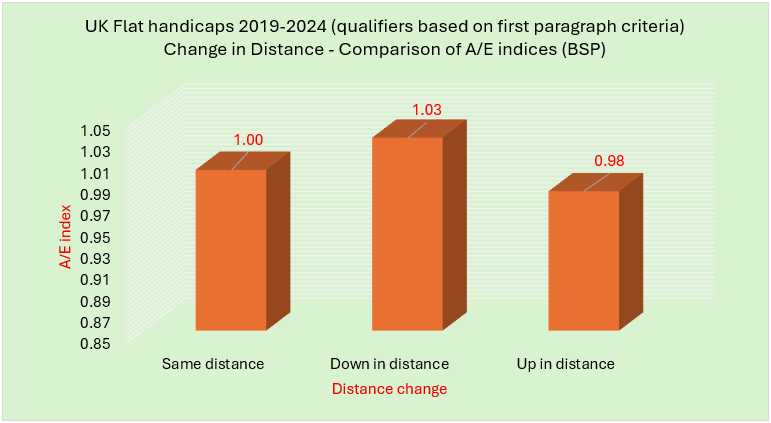
Let me start by comparing the stats for changes in distance. With nearly 90,000 qualifiers the sample size is significant, and below are the figures for each in terms of BSP A/E indices:
As we can see, horses dropping down in distance have offered the best value and when we look at the profit/loss figures we see the same thing:
Horses dropping in trip have nudged into profit, while those upped in distance have lost the most, showing the worst returns. It should also be noted that horses upped in distance that ran over five or six furlongs LTO have the poorest record. These runners have won 798 races from 5314 qualifiers (SR 15%) for a loss to BSP of £329.20 (ROI -6.2%); BSP A/E 0.96.
Conversely, horses that have dropped in distance and are running this time over five or six furlongs have provided the following positive results – 1238 winners from 6952 (SR 17.8%) for a profit of £189.89 (ROI +2.7%); BSP A/E 1.05.
Finally for distance move, horses dropping in distance more than two furlongs have produced the following stats – 349 wins from 2034 runners (SR 17.2%) for a profit of £90.85 (ROI +4.5%); BSP A/E 1.05. These are solid looking figures so don’t be put off by horses dropping in trip by over 2f.
Change in Race Class
On to change in class next from their most recent run. Here are the splits:
We have very similar strike rates, A/E indices and ROIs. Horses upped in class lost a little more than the other two, and perhaps the most interesting stats come from that ‘upped in class’ group when looking specifically at Class 2 contests.
Class 2 handicaps are the highest level of handicap in the UK and let me first share the record of horses switching up from Class 3 handicaps to Class 2 handicaps: they scored just 14.2% of the time (233 wins from 1643) for hefty losses of £239.49 (ROI -14.6%); BSP A/E 0.88.
However, horses making a bigger leap in class, hence those racing at Class 2 level having raced at Class 4 level or lower LTO, produced a profit of £71.68 (ROI +8.1%) thanks to 156 winners from 886 runners (SR 17.6%). The BSP A/E index stands at a very healthy 1.13. For the record, younger handicappers within this cohort, aged three to five, returned an even healthier 14 pence in the £.
It is interesting to try and decipher why this cohort of runners performed so well. I guess, and it is just a guess, that trainers who are prepared to make such a class leap with their horses must have enough confidence that the horses have sufficient potential to bridge the class gap.
Change in Official Rating (OR)
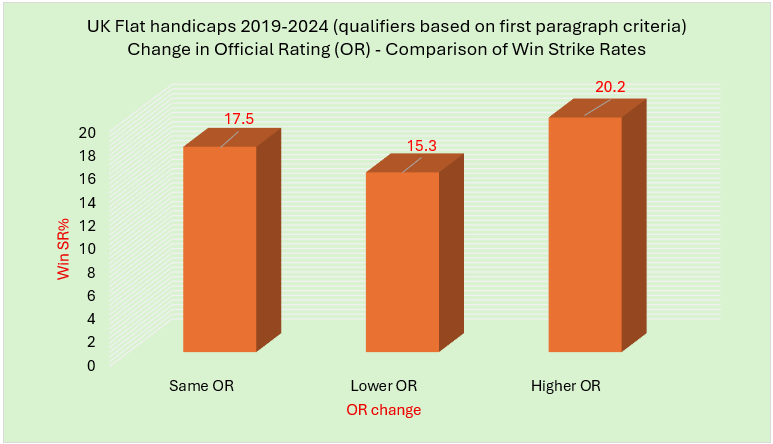
I would like to look at Official Rating changes next. I will start by sharing the win percentages (win strike rates) for each group shown by the graph below:
Horses which had a higher OR compared to their last run won around once in every five and were roughly 5% ahead of those whose OR was lower compared to LTO. However, when we compare the returns there is little in it:
Horses that have a higher OR almost certainly performed well last time out and those with a lower one probably performed moderately or indeed poorly. LTO performance has a clear influence on next time out strike rates and that is what I’m sure we are seeing here.
I do have another strong positive stat to share which is connected to horses whose OR was at least 7lbs higher than LTO. This cohort of runners have produced excellent figures with 401 winners from 1683 qualifiers (SR 23.8%) for a very healthy profit of £223.15 (ROI +13.3%); BSP A/E 1.08.
In terms of horses having lower ORs, those runners dropping just 1lb actually snuck into a very small profit returning exactly 1p in the £; those dropping 3lb or more would have lost 6p in the £.
Change in Weight carried
I wanted to look into this area but did not expect to find much. Essentially, I didn’t want to miss anything, and if we don’t test we won’t know! I had assumed the ‘same’ weight group would be a small one relative to the others and so it was:
The group carrying exactly the same weight as last time had the best record overall and with nearly 7000 qualifiers it is a decent enough sample. I cannot easily explain why they proved profitable. I am assuming it was down to variance but that is just another guess. What is interesting is when we split these ‘same weight’ results up by class.
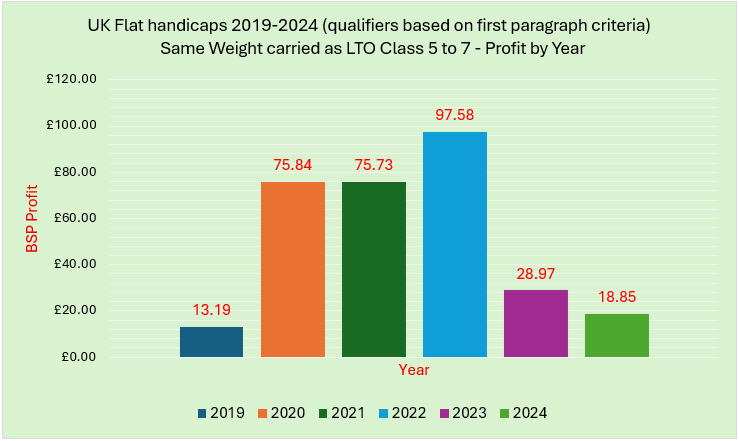
The lower classes of race (5-7) proved to be very profitable and, remarkably, this cohort would have turned a profit in every single year as the graph below shows:
The majority of the profits came from 2020 to 2022, but even so these figures are surprisingly consistent.
Change in Average Race OR
In a recent article for geegeez.co.uk, which you can read here, I discussed the average OR for different types of handicap races. I'm pleased to report that 'average OR' will soon be published on the geegeez racecards. Here I am comparing the change in that average to see if we can see any clear pattern:
Amazingly we see strike rates within 0.12% of each other. There are slight differences in ROI%s, but the A/E indices are virtually the same, so I have been unable to find an edge either positive or negative here.
Change in Odds
I want to examine odds data now. These are based on Industry SP rather than BSP:
Horses that were shorter in price than last time had the best strike rate as we would expect. However, they did not manage to produce a profit. The smallest subset is the group of horses that were sent off at the same price as LTO. They turned a profit but, as with the earlier weight stats, I have no real explanation why.
Change in Course
How about change in course from LTO? The majority of horses race at a different track from the one they competed on the previous day; but in the winter especially we see more horses racing at the same all-weather track. Here are the overall splits:
Horses that ran at the same course as LTO had a slightly better record overall than those that switched venues. Also, horses that raced at the same AW course LTO as this time just edged into profit as the table below shows:
Below is a breakdown of the six AW courses:
Return runners at four of the six all-weather circuits were in profit, while Chelmsford is the only course where having a LTO run at the same track could be considered to be a strong negative. The Kempton figures meanwhile have been particularly strong.
Change in Trainer
The final change I want to examine in this piece is connected with trainers. Naturally, the vast majority of horses in this sample raced for the same trainer last time as in the current race. However, are trainer switches preferable? Let’s see:
Horses that switched stables made a solid profit overall, with returns close to 10p in the £, and there were three trainers that stood out and they are shown below:
Mick Appleby seems to be the ‘go to’ stable when it comes to switching stables, especially when talking about handicappers. His record is very good from a decent number of runners. Tony Carroll and James Owen had smaller sample sizes but both of them produced exceptional figures, and all three are definitely worth keeping an eye on in the future when saddling a new recruit under these specific parameters. One trainer who has been less successful is Stuart Williams, whose record reads 0 wins from 21 in the study period.
Summary
In this piece, I have looked at a variety of changes between two handicap runs. When looking at these types of areas, especially with huge sample sizes, it is important to understand that it is rare to find strong positive angles. However, although not all areas offered us an edge, there have been some useful findings. Here is a recap of the most interesting:
Horses dropping in distance outperformed those running over the same trip or those upped in trip.
Horses upped in distance that ran over five or six furlongs LTO had a poorish record.
Horses dropping in distance to run over five or six furlongs this time proved profitable.
Horses dropping in distance more than two furlongs made a small profit.
Horses racing in Class 2 handicaps having raced in Class 3 handicaps LTO had a poor record.
Horses racing in Class 2 handicaps having raced in Class 4 to 7 handicaps LTO had a good record, especially those aged three to five.
Horses whose OR was at least 7lbs higher than LTO made very solid profits.
Horses carrying the same weight as LTO proved profitable. The stats were much stronger in class 5 or lower handicaps.
Horses running at the same AW course as LTO performed better than horses that raced at the same turf course as LTO. Both groups outperformed horses that switched courses.
Horses that changed stables since the last run made an overall profit. Three trainers who had very positive stats in this scenario were Mick Appleby, Tony Carroll and James Owen.
In the second part of this article I will look at combining different areas together as well as digging further in terms of trainer performance within specific areas. Look out for that one next Wednesday.
- DR
https://www.geegeez.co.uk/wp-content/uploads/2020/02/AgentofFortune.jpg319830Dave Renhamhttps://www.geegeez.co.uk/wp-content/uploads/2022/10/geegeez_banner_new_170x78.pngDave Renham2025-09-09 17:01:262025-09-09 17:02:16Handicaps: Today vs Last Run (Part 1)
Placed as it is in the calendar just as the seasons seem to have turned abruptly from debilitating summer heat to breezy early autumn, Kempton’s September Stakes retains its status as a Group 3 race despite being run on Polytrack, writes Tony Stafford.
Its recent distinguished roll of honour is overshadowed by the two pre-Longchamp wins of the peerless Enable and it was no doubt with that John Gosden trainee’s exploits in mind that Andrew Balding plotted a repeat success for his Kalpana on Saturday.
Following that one’s three Group 1 places this year behind Los Angeles, Whirl and, finally, Calandagan in the King George at Ascot, but no wins, the Juddmonte filly had been promoted to favouritism for the Prix de l’Arc de Triomphe in a month’s time.
It seemed odd that she should have been at such a short price, but no doubt last year’s late season exploits, following the September Stakes with victory in the Fillies and Mares Stakes on Champions Day at Ascot, gave the suggestion she would again be at her best in the autumn this time around.
The reruns of Saturday’s contest and that of a year ago when, under P J McDonald, she challenged on the outside two furlongs from home and drew clear for a four-plus lengths win over Lion’s Pride, had little in common as this time she couldn’t get past Marco Botti’s six-year-old Giavellotto in the closing stages.
Colin Keane challenged at almost precisely the same moment as McDonald had, on the outside, but whereas previously she accelerated then stayed on stoutly, she found very little this time. Commentator Mark Johnson called her “breezing up”, but it wasn’t long before he inserted a note of well-founded caution.
Now she has been pushed out abruptly in the Arc market, one that was further amended after events at Longchamp yesterday, to which I will return later. The consensus is that she might miss the big race in Paris – there’s always Ascot as a backup against the girls.
Giavellotto has been a terrific servant to his trainer, the six-year-old now a winner of eight races topped off by last December’s Longines Hong Kong Vase where he had the globe-trotting Dubai Honour as his nearest pursuer. Oisin Murphy took over the riding of Giavellotto when Andrea Atzeni decamped to Hong Kong at the end of the 2023 season, a move replicated this week by the ultra-professional David Probert, who looks sure to make the best of his opportunity.
The seven-year-old Dubai Honour had been off since May but made a splash with his comeback run yesterday in the Group 1 Grosser Preis von Baden; he’s no doubt building up for another tilt at the massive prizes on offer at the end of the year around the world. His career earnings, mainly from overseas, are just north of the £5 million mark. That exceeds by £2 million the money earned by Haggas’s 118 wins and 119 places from the 142 individual runners he has sent out in the UK in 2025.
The trainer’s latest win came in yesterday’s Garrowby Stakes at York where Elmonjed, the stable second string, prevailed in a tight finish. The race though was marred by the fall a couple of furlongs from home after severe crowding of the Haggas and Shadwell number one Almeraq. His rider, Jim Crowley, and Trevor Whelan, also involved in the melee and a faller from Tiger Bay, both reportedly suffered broken legs.
Haggas remains a long way behind the big three in the trainers’ title race. I suggested the other week that Andrew Balding was coming up on the rails and now he has crept above the Gosdens into second place, by dint of nine wins from 53 runners over the past fortnight. Even Aidan O’Brien might not be in reach unless Ballydoyle wins the St Leger and has a beanfeast at Ascot’s Champions Day next month.
Aidan has secured the services of Christophe Soumillon to replace the injured Ryan Moore, and no doubt the Belgian will be at the Irish Champions fixture next weekend. Presumably then, a domestic jockey will be needed for the St Leger with Wayne Lordan also ruled out, in his case by suspension.
Haggas reckons it’s been a moderate season for him as he hasn’t been a factor in many of the top races, but his skill in handicaps has never been in doubt. He added four more on Saturday, with three of his charges starting favourite. In the case of Crown Of Oaks, overwhelmingly so as he siphoned up a contest at Ascot for horses that had not won more than one race, in laughably easy fashion.
Kneejerk reaction from the bookmakers was to promote the three-year-old to 4/1 favouritism for this month’s Cambridgeshire at Newmarket, neglecting to factor in his extreme unlikeliness to make the cut.
From his mark of 85, he gets the 4lb penalty which brings him equally with nine others at a highest possible position of 79, therefore worst case of 88. Thirty-five can run, so it will be a gamble if Haggas waits to find out if the six and half-length cantering winner gets in. He faces at least a 10lb rise, but cynical fellow trainers waiting for tomorrow morning’s new ratings might be thinking the son of Wootton Bassett could get away with a single figure uplift.
Haggas wasn’t the only four-time scorer on the day. It was Oisin Murphy’s 30th birthday on Saturday and he celebrated it by adding three further wins to Giavellotto’s. For the second time last week I marvelled at his instinctive understanding of what would suit his mount as he waited until two furlongs from home even to put Hughie Morrison’s handicapper Caprelo into contention in his two-mile handicap.
Always going comfortably, Caprelo could be seen enjoying every moment and, making use of the cutaway in the straight, he brought the improving four-year-old with a smooth run. The winning margin of three lengths could have been extended. Now Hughie will be wondering whether Caprelo’s uplift matches or even exceeds that of Crown Of Oaks!
Earlier in the week, I was at Windsor where Oisin gave hitherto disappointing Glitter Code an instinctively perfect ride which, though no fault of the rider’s, ended in third rather than first place. Oisin said that William Knight’s gelding pulled himself up when hitting the front, otherwise it might have been success at the 16th attempt.
Oisin’s skill confirmed his owner’s view that he would stay 1m4f and especially as he did so on heavy going. The snag is that Oisin will be elsewhere when Glitter Code reappears at Epsom on Thursday. He’ll be a hard act to follow.
It didn’t take the runaway championship leader long to continue the run of success over at Longchamp yesterday. Teaming up with the Japanese Byzantine Dream, he found a strong finish to edge out the Andre Fabre-trained Sosie by half a length in the Prix Foy, the trial race restricted to four-year-olds and upwards.
Murphy, who has been a regular ally of Japanese runners in Europe and the United States, reckons that, having not raced since May, Byzantine Dream would improve a little for the run and be at his peak back at the track next month.
If Soumillon had expected an instant dividend on his recently announced stand-in job for O’Brien, he would have been disappointed. First, on the strongly supported Henri Matisse in the one-mile Prix du Moulin de Longchamp, he could finish only a fading fifth to Sahlan who had just enough in hand to resist the last-gasp finish of the frustratingly unlucky Rosallion.
One bright spot here was the back-to-form close third for Ballydoyle of The Lion In Winter, belatedly finding some 2025 promise and only a neck adrift of Rosallion. The Breeders’ Cup might now be on his agenda.
Then Whirl, taken wide early in the Group 1 Prix Vermeille for fillies and mares, faded into last place having led in the straight. This race featured the most likely Arc winning performance, as Aventure drew nicely clear of her field.
Last year’s second, both in this race and then the Arc behind Ralph Beckett’s Bluestocking, she had the traditional French preparation with no run in July or August and will be at her peak as she tries to fend off Whirl’s stablemate Minnie Hawk and the rest next month. I reckon she is the one to fear.
- TS
https://www.geegeez.co.uk/wp-content/uploads/2025/09/Giavellotto_Kalpana_SeptemberStakes_Kempton_2025.png319830Tony Staffordhttps://www.geegeez.co.uk/wp-content/uploads/2022/10/geegeez_banner_new_170x78.pngTony Stafford2025-09-08 05:46:502025-09-08 05:48:35Monday Musings: Raising the Stakes in September
Using Official Ratings to measure trainers' ability
Trying to predict whether horses are improving, have reached their ceiling, or are on the downgrade is a part of the racing puzzle that punters have get a handle on, writes Dave Renham. Whether it equates to long term profits is still determined by how much value we are getting, especially on winning selections. If we spot an improver but everyone else does too, it is unlikely to offer value because the price will be driven down by popular opinion. However, if we can spot an improver that most of the crowd do not, then that is a different matter.
Introduction
In this article I will look at fifty trainers with the aim of trying to gauge whether their horses improve, or not, within specific time frames. To do this, I compared their horses in terms of movement in Official Ratings (OR). Specifically, I compared their ORs after three, seven, ten and fifteen career starts.
For each trainer I will first compare horses' OR figure between three and seven starts, then seven and ten starts, and finally ten and fifteen. I have taken data from 2017 to 2024 and, when quoting any profit/loss figures, I have calculated to Betfair Starting Price (BSP) less 2% commission.
It's important to note that only UK and Irish runs are included, so those horses that have raced overseas may have had more than the stated number of runs. Overall, this difference should be negligible but feel free to consider some of the stats approximations and use the intel accordingly.
Three career runs vs. seven career runs
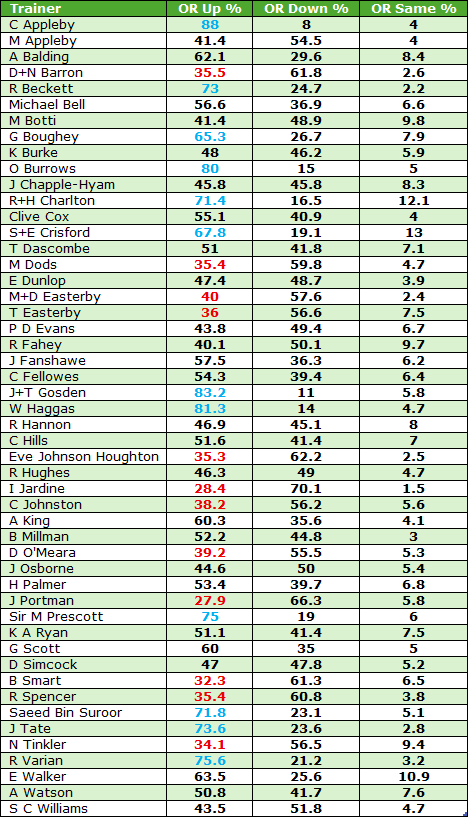
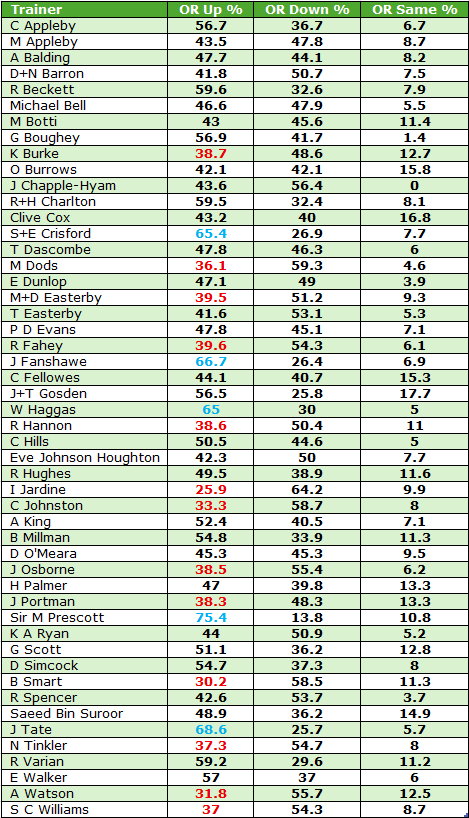
This first group is dominated by younger horses: around 22% of them were aged two and roughly 64% were aged three. I have calculated the percentage of horses within each stable that saw an improved Official Rating between their third and seventh career runs, those with a decreased rating, and those that stayed the same. The trainers are listed in alphabetical order, with any positives and negatives highlighted in the ‘OR Up %’ column. Positive percentages in blue (65% and above); negative percentages in red (40% and below).
It should come as no surprise to see Charlie Appleby, William Haggas, Sir Mark Prescott, Roger Varian, and the Gosden and Charlton stables with a high percentage of horses who have improved their ORs within this early time frame. Many of the lower scoring trainers are more renowned for handicappers and hence it will be interesting to see whether their figures start to improve as the number of runs increases.
Charlie Appleby’s figures are quite stunning with 88% of his horses increasing their OR figure between career runs three and seven. Digging deeper, backing all Appleby runners that had previously run between three and seven times would have seen the following impressive figures: 245 wins from 956 runners (SR 25.6%) for a profit of £189.87 (ROI +19.9%); A/E 1.08.
Here are some further Appleby stats to keep an eye out for this coming autumn. His horses that had run exactly three times and were racing for the fourth time in either September or October produced 30 wins from 74 runners (SR 40.5%) for a profit of £42.67 (ROI +57.7%); A/E 1.34. Add one run to that - those horses who had four career starts and were having their fifth in September/October - and their record reads 13 wins from 41 (SR 31.7%); A/E 1.26 for a profit of £18.40 (ROI +44.9%); A/E 1.26.
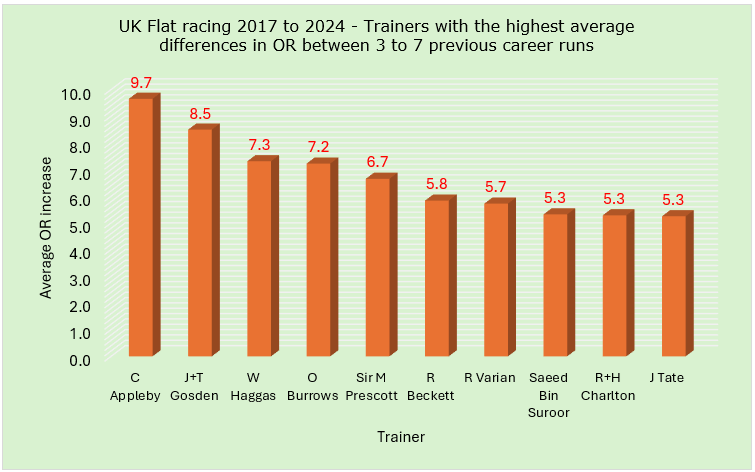
Next, I have calculated the average OR improvement per horse that the ‘better’ trainers achieved within these past runs grouping. [By ‘better’, I mean those with the top ten percentage improvement figures].
Charlie Appleby again tops the list. On average his horses improved 9.7lbs between those four runs from third to seventh career start, a very decent figure. All trainers in this top ten have performed well above the norm.
Seven career runs vs. ten career runs
Onto the second grouping. Logic dictates that the improvement achieved later in horses' careers will be less in OR terms overall than with the previous group of runners. This is indeed the case and hence I have moved the positive percentage figure to 60%+ (in blue); the negative figure remains at 40% or lower:
Sir Mark Prescott heads the figures here, with 75% of his runners improving their ORs between their seventh and tenth career start. Backing all Sir Mark's runners that had raced between seven and ten times previously across these eight years was worth 100 wins from 388 (SR 25.8%) for a profit of £44.73 (ROI +11.5%).
Next in the list are James Tate (68.6%), James Fanshawe (66.7%), Simon & Ed Crisford (65.4%) and William Haggas (65.0%). Prescott, Tate, Crisford and Haggas all had positive ‘blue’ figures in the first table as well.
At the other end of the scale, there are some surprisingly low improvement percentages for Charlie Johnston (33.3%) and Archie Watson (31.8%).
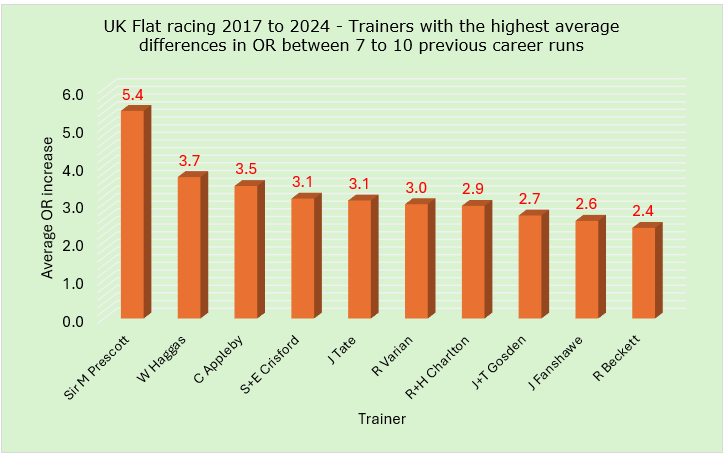
Let me once again calculate the average OR improvement per horse that the top ten trainers achieved within the 7-10 grouping:
Sir Mark Prescott is comfortably ahead, averaging an improvement per horse of 5.4lb. For the record, 38 of the 50 trainers managed a positive percentage improvement across their total runner cohorts. The numbers for these top ten are lower overall than we saw for the first grouping, but as horses get more exposed it is harder for them to improve their OR figure.
The horse that showed the biggest improvement was Love So Deep trained by Jane Chapple-Hyam. Her rating went up 27lbs from 74 to 101.
Ten career runs vs. fifteen career runs
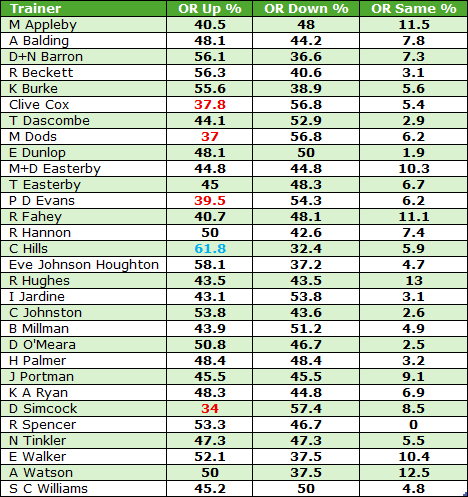
Finally, a look at this most exposed of the three groupings. This time there are several trainers who have not saddled enough runners to make the figures meaningful. I have included trainers who had at least 30 qualifiers - 20 of the original list missed out on that basis. Here are the splits for the remaining 30 trainers with the same colour coding as for the previous group:
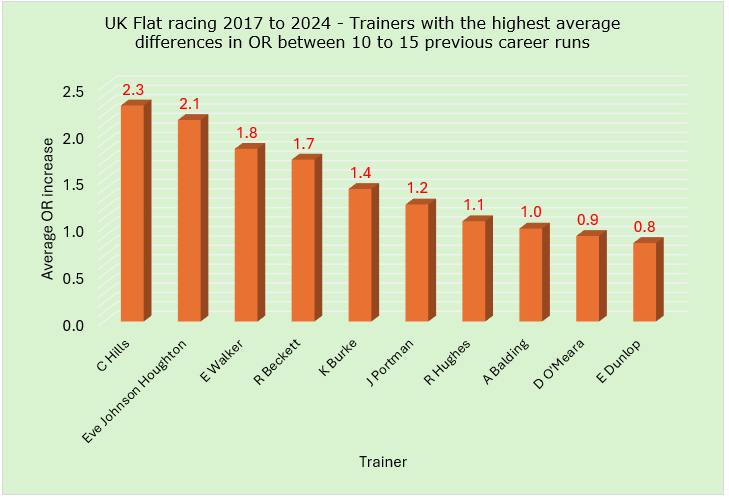
Charlie Hills is the only trainer to have improved more than 60% of his horses in terms of their OR figure between their tenth and 15th starts. Meanwhile, Messrs. Cox, Dods, Evans and Simcock all ended up below the 40% mark in terms of improvement. These are four trainers that I had expected to have much better figures.
Of the trainers that didn’t make the list due to limited qualifiers, I should mention that the Charlton stable saw improved ORs for 13 of their 15 qualifiers (86.7%). Also, George Boughey saw 20 of his 26 (76.9%) achieve improved ORs.
The final graph shows the average OR improvement per horse that the top ten trainers in this group achieved within the 10-15 career run bracket. Naturally, these are much lower than we have seen previously:
The horse that improved the most within this whole grouping was Lion Hearted, trained by Mick Appleby. He improved 28lbs from a rating of 58 after 10 starts to a rating of 86 after 15 starts.
*
As horses mature there is usually less improvement to be had before they settle at their ability level; however, as we've seen, some trainers find that level quicker than others, and knowing which to follow now and which to be patient with is a big advantage on Joe Punter.
Good luck
- DR
https://www.geegeez.co.uk/wp-content/uploads/2018/06/Appleby-and-Buick.jpg320630Dave Renhamhttps://www.geegeez.co.uk/wp-content/uploads/2022/10/geegeez_banner_new_170x78.pngDave Renham2025-09-01 16:04:352025-09-01 16:04:35Using Official Ratings to Measure Trainers’ Ability
One of the enduring funniest moments in all of racing to my mind was the time when jockey Adam Beschizza was called into a stewards’ inquiry at Newmarket, writes Tony Stafford. Not one of the “faces” among the jockeys at the time, the lead in the stewarding panel asked him his name. “Beschizza”, he replied, omitting to add the requisite, “sir” after the name. The steward continued, “Well, Mr Biscuit.”
I doubt he has had a similar episode in the now eight years he has been riding in the United States. He left in 2017 when he rode 39 winners – his joint-best tally – all his mounts earning £266,382.
On Saturday evening at Kentucky Downs, riding the two-year-old newcomer Ground Support in a maiden special weight race, he came home in front. As the horses passed the post, 40/1 jumped up on the Sky Sports Racing screen. The starting price in the Racing Post on Sunday morning was 101/1.
Normally you might expect a lesser disparity, and more often the other way around. It ended a notable day for Adam’s family. His aunt and cousin, Julia and Shelley Birkett - Julia formerly trained as Feilden, her maiden name, until joining forces with her daughter earlier this year – had a great evening themselves nearer home at Chelmsford.
From three runners, Sam’s Express (16/5) and Rusheen Boy (9/2) both won, while their middle runner Mrs Meader, a soft-ground specialist forced to run on AW but declared overpriced by her trainers, was second at 40/1. If she had come in first, the 1,025/1 hat-trick would truly have taken the biscuit.
Enough of contrived intros and now we must mention the shock news that Ryan Moore, said by Aidan O’Brien to have been riding with a broken leg for the last two months, is likely to miss the rest of the season.
Additionally, Ballydoyle and its Coolmore paymasters will also have to accept the absence of their highly effective number two Wayne Lordan for a while. He collected a ten-day riding ban at Goodwood last Sunday, a sanction which he is aiming to overturn. If he fails, the big Irish Champions weekend will have to go on without him, as will the St Leger, a race the stable has won eight times including the last twice.
Aidan O’Brien’s span has been from 2001, the first of them being Milan. That was the year when Michael Tabor, Jeremy Noseda and I watched on for hours in the lunchroom of our hotel in Lexington, Kentucky as the scenes from the bombing of the twin towers in New York earlier that day made such an impact on the world.
We were all there for Keeneland sales, the first day of which had to be postponed for 24 hours. With travel plans disrupted, Tabor’s plane home was very much in demand from UK trainers and others, and I just missed the cut on the Friday, I think, so missed getting back in time for the big race. John Magnier, of course, got out a day earlier!
Aidan’s speed of acquisition of England’s oldest Classic is impressive, but he needs to up the ante in both numerical and time terms as 19th Century trainer John Scott won the races 16 times in a 35-year span from 1827-1862, a record they said at the time, “would never be beaten!” You never know with the master of Ballydoyle.
No doubt jockey agents will be on the lookout for possible rides for their employers, with the top squadron like Oisin Murphy, William Buick and Tom Marquand offering obvious attraction. At home Aidan has been giving plenty of rides to the 5lb claimer Jack Cleary.
He had a mount yesterday at Tipperary but Lordan, whose ban is yet to kick in, was in the saddle for the stable’s three remaining runners, in a maiden, a Group 3 and a Listed contest.
Such a blow for Ryan Moore comes at a most inconvenient time of the year when so many massive prizes are available around the world, and the O’Brien stable is often represented in them. Fortunately, the 41-year-old has built up a nice cushion over the years as he has deservedly earnt the accolade as the best jockey in the world, and not just from professionals in the UK and Ireland either.
If losing their main jockey for a lengthy spell was a blow for Coolmore, their long-term major rivals Godolphin suffered an even more devastating setback last week. Ruling Court, the winner of the 2,000 Guineas this spring, has had to be put down due to laminitis, a serious and often incurable foot condition.
A son of Justify, the US Triple Crown winner and already a prolific sire on both sides of the Atlantic, Ruling Court held off Field Of Gold in the Newmarket Classic, a race that cost Kieran Shoemark, the runner-up’s rider, his job with the Gosden stable.
Third on his next run behind Field Of Gold in the St James’s Palace Stakes at the Royal meeting, he ran what was to be his swansong with another solid third place behind Delacroix and Ombudsman in the Coral-Eclipse Stakes at Sandown in early July.
He would have been an obvious potential successor to the ageing but still firing Dubawi at Darley Stud where he would have commanded a substantial fee for his first season as a stallion in 2026.
Many of Godolphin’s finest days were achieved with Frankie Dettori in the saddle and the former champion, now residing with much material and emotional satisfaction in the US, teamed up with three UK-based trainers to collect some of the even more substantial prizemoney at Kentucky Downs, scene of Adam Beschizza’s earlier score. Adam’s race was worth $101,000 to the winner, so would have been equivalent to three months’ activity for him back here in 2017 for just over a minute’s work!
Dettori was operating at a far higher end of the scale, teaming up with James Owen on the Gredley family’s Wimbledon Hawkeye, whose form this year ties in with Ruling Court, to whom he was fifth in the 2,000 Guineas. He has been toiling all season, usually getting close to the better three-year-old milers and middle-distance horses.
Last time out before Saturday, Wimbledon Hawkeye was nosed out by the rapidly improving William Haggas horse Merchant in the Gordon Stakes over a mile and a half at Goodwood. That run alone was enough to send him off the favourite for a 10.5-furlong Grade 3 race that carried only around 20 grand less than the Derby to the winner and was called the DK Horse Nashville Derby Invitation Stakes.
Dettori’s day was sublime with a third place for Charlie Hills in a Grade 2 and fourth for Hugo Palmer in a second Grade 3. Kentucky Downs has been a track that from modest beginnings has rapidly become an entity with high prizemoney. James Owen mused that more UK trainers should be targeting the races there as the course is all grass with no US dirt to be seen. Why this emerging training talent in which Bill, son Tim and the rest of the family operation have put so much faith, should want to advertise the track’s splendours, I can only shake my head in wonder.
Next year though, for this fixture, the top stables will be chartering the planes and no doubt the evergreen Mr Dettori will be happy to offer his skills. Tim Gredley goes back a long way with Dettori and says at one time they lived next door to each other. They have both had exciting lives to say the least since then, with Tim enjoying great success as a show jumper and point-to-point rider until taking charge of his nonagenarian father’s racing interests.
And of Frankie, what more is there to say? Well, how about that he rode a 2391/1 four-timer at the same track last night!
- TS
https://www.geegeez.co.uk/wp-content/uploads/2025/09/GroundSupport_AdamBeschizza_KentuckyDowns.png295687Tony Staffordhttps://www.geegeez.co.uk/wp-content/uploads/2022/10/geegeez_banner_new_170x78.pngTony Stafford2025-09-01 06:22:122025-09-01 14:02:19Monday Musings: The Ups and (Kentucky) Downs of Racing
Ah, York, and more particularly Ebor week, writes David Massey. It’s well known I’m more a jumps man than the Flat but it’s a week that even I look forward to. Royal Ascot, with its regimented fun, and Glorious Goodwood, a more relaxing week but still a day too long, have their charms but Ebor week has that right balance of quality racing (just the Super Seven every day, no need for eight races and no requirement to be finishing at a stupid time - this is the North after all, teatime is half five), tremendous atmosphere, great nightlife (if that’s your thing) and the whole thing doesn’t require you to sell a kidney to pay for it all.
As ever these days, I’m working alongside Vicki for the week, the pair of us delivering our Trackside paddock reporting service, but I’ve plenty of tipping pieces that need writing up as well. Thankfully, the weather is set fair as there’s nothing worse than a changeable or uncertain forecast when you’re trying to get ahead of the game. “Well, we might get 5mm of rain, but we might get 30 if we’re unlucky.” At that point there’s nothing you can do except wait. So my week actually starts Monday morning once we get the Wednesday declarations through.
I’ve decided to stay in York all week. It’s right on the periphery of how far I’m willing to travel there and back in a day, but with two sets of roadworks on the A1 (still) adding 20 minutes to the journey both ways, it’s a case of finding a decent Airbnb, which I do, no more than ten minutes from the track.
The Placepot isn’t a bet I have much time for, if I’m honest; too many five-out-of-sixes, too many out-first-legs, I find it utterly frustrating, but I do partake during this particular week, mainly as my good friend James is at the track every day, and he loves it. As such, I just throw a score away each afternoon in his direction. We’ll forward ahead at this point to say we didn’t get any of the placepots up; a short-head away from landing it on one occasion, and a five-out-of-six where we doubled up on two legs on another. I repeat, I do not like the Placepot much, and it doesn’t like me back.
I’m currently dieting (1st 3lb so far, although by the end of the week, perhaps unsurprisingly 4lb will have gone back on) so it’s Shredded Wheat for breakfast and salad at lunch, but I eat like a king each night whilst I’m away, it has to be said. Wednesday night I’m out with James, having steaks. The food is superb and better still, my half of the bill has been taken care of by a friend of James who backed a winner I’d put up (I do that occasionally, you know) so it’s a free night. James enjoys a glass of wine or three, but as a marathon runner in training for his next, he assures me he’ll still be up for a jog at eight o’clock the next morning. I tell him I’d like a photo as proof of this, as I think he’s about a million to one to make it as we go our separate ways at the end of the night. Reader, no photo was forthcoming. I see him later on Thursday to pay for the next losing Placepot we’ll have. “It just wasn’t going to happen”, he admits.
Ombudsman bounces back to form to take the International, but not before Birr Castle scares the living daylights out of us all. Hasn’t it been a strange Flat season, this? Talented handicappers winning Group 1 sprints, pacemakers causing mayhem, 2yo form all seemingly up in the air? Makes you long for a 0-100 at Warwick (please re-read the opening paragraph if you think I’ve lost my mind.)
Thursday is very much a day for the favourite-backers, with five of the seven going in and bookmakers looking like the stretchers will be required to carry them out. My step count for the day is through the roof - just shy of 12,000 - which means, in calorie terms, I can “afford” a pudding tonight. And what a night it is too, with 16 of us booked into Delrio’s Italian restaurant in the city. There are three tables in the room we’re booked into; on the table to my right is Kia Joorabchian, along with a few owners, trainers and jockeys; to my left Charlie Swan, Ruby Walsh and many of the Irish lads. Quite surreal, let me tell you. I do my quiz that I’d prepared for everyone and that goes down well, too. Plans are already afoot for another one. Next morning, I do my round on “racecourse geography” with Richard Hoiles and Stuart Machin and I really wish it had been recorded as it would have been social media gold. To see two of our finest commentators scratching their heads as I read out a series of roads and ask them which racecourse they would end up at was a joy to watch. I was surprised how tricky they found some of them, given their vast knowledge, and a 7 out of 10 for Richard earned him a “see me” on his report card. Must do better next time…
Friday kicks off in the best possible fashion with Asgard’s Captain, who I was very strong on, and better still, was one of the paddock picks too. I pressed up again and gave him a roar as he came to claim the prize. Our new customers would have been delighted. Even more so when we find Lifeplan, Cape Flora and Frescobaldi as the afternoon progresses and it really is something of a red letter day for Trackside.
There are days as both an analyst and a paddock watcher when you can’t find your own arse with both hands and you can have a crisis of confidence in this game more times than is good for you, believe me; but on days like today, when everything just flows, and the winners jump out at you, it’s the greatest game in the world. Find me a better one and I’ll switch. But until then, this will always be king.
Friday night and we’re eating at eight o’clock. At a place called Ate O’Clock. You can imagine the anger earlier as I tried to get the relevant information out of the idiot that booked it. “What time are we eating?” “And where are we eating?” “No, you’ve already told me when, where?” “STOP TELLING ME WHAT TIME WE’RE EATING” and so on. He did it on purpose, obviously, as he knew full well he’d get a rise out of me, and he did.
The sooner he gets his HWPA Lifetime Achievement award and leaves the press room, the better. I won’t give him the satisfaction of naming him, he’ll only think he’s even cleverer. Anyway, Ate O’Clock (at 8.15, it turns out, ha!) do good food and I get to chat to some new people, which is always great. We end up going round a few pubs and bars and meet up with one of the Sporting Life lads, who tells me an utterly unrepeatable story from Delrio’s the night before. I’d have been better not knowing, I think. It’s 1.30am before I crawl back into bed, and whilst by no means pi$$ed, I know I’m going to suffer a little in the morning. Indeed, the Shredded Wheat next morning isn’t cutting it, and I weaken enough to have a bacon sandwich, a sure sign I probably had plenty the night before. God, I’d forgotten how good bacon is.
And so… we reach Saturday. Most of the work for the week is done and, bored, six of us in the press room have a round of Greyhound Roulette. I’ve explained the rules before, but essentially a dice decides your trap number for the first ten races on the card that morning, 3pts for a winner, 1pt for second. (Yes, it’s a game for degenerates. Don’t judge.) Anyway, all you need to know is we throw a tenner in each, winner takes all, and the winner was… me! A nifty in front before lunch. Could be a good day, this.
We’ve already had one visit from the Queen this week and today we’re getting another. I come barrelling out of the press room around lunchtime, head down, not really looking where I’m going, to be grabbed by a member of security as I walk into what appears to be a vacated area. “Sorry sir, sterile area.” I’ve never been so insulted. I’m on the verge of telling him I have two happy and healthy children when I twig he means Her Maj is on the way through. But what’s really strange is, once she’s gone past, I’m able to walk, quite literally, five paces behind her with nobody seemingly stopping me. I’ve never been part of a Royal Entourage before and although I’m not supposed to be part of this one, it’s yet another quite surreal event in a week of them.
It proves tougher to find a winner today, although the good news is that James has gone home, so I immediately feel I’m twenty quid better off, and I do locate both Never So Brave (another Group 1 winner that was in handicaps not so long ago) and Revival Power on the card. We at Trackside are big Revival Power fans; she’s going to be some horse at three. Mark this, and come back to it. (Only if we’re right though, obviously.)
Death, taxes and the Irish winning the Ebor. Seemingly, three certainties in life. Actually, add a fourth. Roadworks on the A1. They might be gone by this time next year. Then again, probably not. See you at Doncaster, and then at Newmarket. AND THEN, AT CHEPSTOW!! Hurrah!
- DM
https://www.geegeez.co.uk/wp-content/uploads/2023/05/SoulSister_Musidora_FrankieDettori_York.png319830David Masseyhttps://www.geegeez.co.uk/wp-content/uploads/2022/10/geegeez_banner_new_170x78.pngDavid Massey2025-08-28 15:07:052025-08-28 15:07:05A York Roving Report
Horses racing in the same race that they contested last year
Back on January 2nd 2025, Geegeez incorporated an excellent addition to the racecard namely the TRENDS tab, writes Dave Renham.
Geegeez Trends
Before discussing my plan for this article, let;s take a look at the TRENDS tab in a little more detail. Clicking the TRENDS tab will take us to a screen like the one shown below:
These were the trends for a handicap race at York which occurred fairly recently, on the 25th July 2025. The left-hand half of the screen is focused on standard information, like winning horse, trainer, jockey and going. The middle to right-hand of the screen has further info including the weight the winner carried, the age it was, its SP, official rating, and so on.
Note the red font. Any jockey in red means they are riding in the race again this year. Hence past winning jockeys in this race Oisin Orr and Rowan Scott had rides again in this 2025 renewal. Likewise for trainers, Bailey, Fahey, Nicholls and Ellison had runners this year too. There was one horse highlighted in red namely Dicko The Legend, and this horse was trying to repeat its win in 2024. (As it turned out Dicko The Legend did win the race for the second year running).
When we click on the TRENDS tab for a particular race, if we click on any race date this takes us to the result of that race for the selected/clicked year.
In addition, all of the columns within the TRENDS tab are sortable, making it easy to see if a specific profile is emerging around any of the variables. Hence, some races can offer up some useful past trends that we might be able to use to our advantage. The point of past race trends is not really to pinpoint winners - after all, looking only at win trends is a narrow field of vision for such a thing - but, rather, to highlight potential positives and negatives for horses that you are considering in the round of their overall form profile. Geegeez also has regular articles written by Andy Newton which highlight key trends in certain big races.
As far this article is concerned, I want to examine the performance of horses that ran in the same race the previous year. How often do winners manage to double up? And what about horses that ran in the race last year but did not win? Well, let’s see...
I have looked at UK flat racing (turf & AW) between 1st Jan 2017 and 31st Dec 2024. Any profits and losses have been calculated to Betfair Starting Price (BSP) less 2% commission.
All Runners Returning to the Same Race A Year On
The first thing to say is that not all races can have repeat winners or indeed runners from previous years, such as those restricted to horses of a certain specific age group. However, there have been plenty that contested the same race as in the previous year so what do the stats show us?
The table below shows us ALL runners that came back a year later to contest the same race but split into those that won the race last year versus those that did not:
As we can see the previous year’s winners have won more often, but in terms of returns they would have lost us a bigger percentage of our bankroll. In fact, both ROI figures are disappointing in truth. I had hoped for and expected better.
Perhaps not the start we were hoping for then, but there is an early positive to share when looking at horses that finished runners up the previous year – they have turned a small profit:
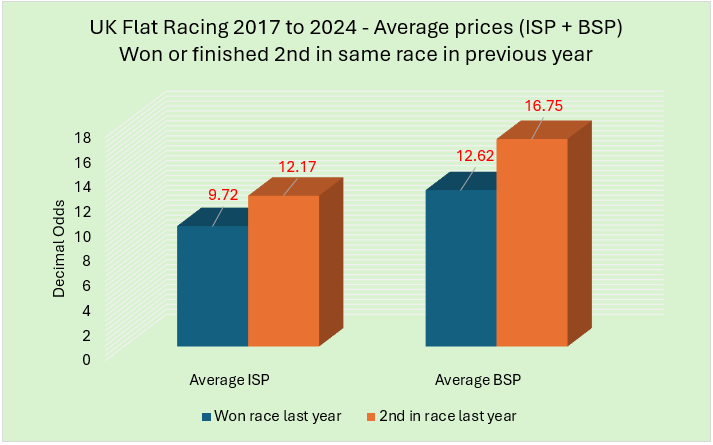
The win rates for last year winners compared to runners up are similar, but have those past winners been overbet driving their average price down? If we compare the average prices for previous year winners compared to previous year runners up, we might get some pointers:
Both the average decimal odds for the Industry SP and Betfair SP show a lower figure for the horses that won the race the previous year. I tlooks like horses trying to repeat their win a year later have been overbet by the punting fraternity after all. I’ll come back to this later.
Horses that Won the race last year
Handicaps vs Non-Handicaps
Despite the overall results for horses that won the same race the previous year not being that positive, let me dig a bit further to see if any positives can be found. Or indeed any strong negatives. I’ll start with non-handicaps versus handicaps:
As might have been expected there are far more horses trying to repeat a win in the same handicap race than in non-handicap races. There is a higher strike rate in non-handicaps which is also to be expected, but returns have actually been worse.
Race Class
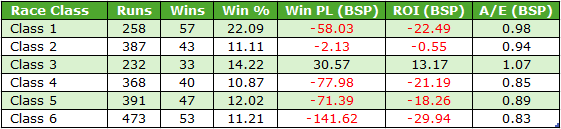
What about splitting the results up by class of race? I have not included Class 7 races as there were only five qualifiers (who all got beaten).
The strike rate in Class 1 events is decent but this is partly because all races were non-handicaps. If we exclude Class 1 races, there does seem a trend where the lower classes of race have offered last year’s winner less value.
When lumping together the results for horses that tried to repeat their win in Class 4, 5 and 6 races, losses amount to nearly 24 pence in the £, with a poor BSP A/E index of only 0.85. I would be steering clear of these runners unless I had a gilt-edged reason to convince me otherwise.
Class 2 and 3 races have produced the best returns, and an interesting stat is when we look at the results in 3yo+ handicaps across these two classes: winners of the same race the previous year have gone on to repeat their success 53 times from 395 runners (SR 13.4%) for a profit of £89.76 (ROI +22.7%). Also, if we restrict further to the most fancied runners, those priced BSP 4.5 or less, this cohort would have produced 18 winners from just 38 qualifiers (SR 47.4%) for a profit to Betfair SP of £23.22 (ROI +61.1%).
Turf vs All-Weather
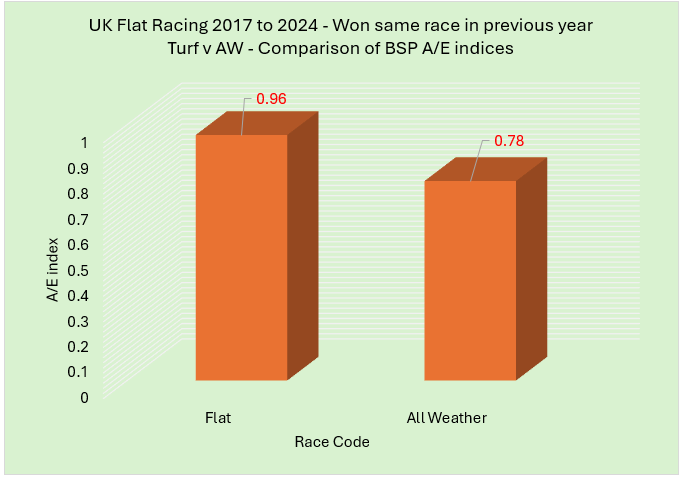
I next wanted to compare turf races with all-weather (AW) ones. Would there be similar results? The answer is an emphatic no as the graph below comparing A/E indices shows:
Horses that won the same race last year have proved far better value in turf races than AW ones as the numbers clearly show. Indeed, the other metrics back these A/E indices up:
There was a better win strike rate for turf performers and a very clear ‘win’ in terms of their respective returns. OK, turf runners have not proved to be profitable, but they have returned close to 30p more in the £ compared to AW runners.
Sticking with the AW for a minute, the worst time in the calendar for last year’s race to have been run has been during the winter AW season. From November to March the record reads a dismal 37 winners from 337 (SR 11%) for a loss to BSP of £154.55 (ROI -45.9%).
Courses
With turf racing producing the better stats, what about different courses? Has it been easier to repeat wins on certain courses compared to others? One slight issue is limited data for some courses, so let me start by grouping together the results on the ‘best’ tracks - those tracks that are considered Grade 1 tracks. These are Ascot, Doncaster, Epsom, Goodwood, Newbury, Newmarket, Sandown and York:
These have combined to edge us into blind profit which is pleasing to see. Splitting the results by individual track see the following four hit a profit:
There is one other course I would like to mention and that is Chester. The figures for horses trying to repeat their win the previous year is decent – 11 wins from 57 (SR 19.3%) for a profit of £23.41 (ROI +41.1%); A/E 1.35.
Trainers
A quick look at trainer performance next. Data again is limited and only a handful of trainers have had more than 30 qualifying runners. They are shown in the table below:
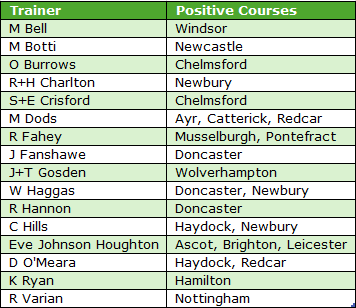
There are two trainers that stand out, namely Richard Fahey and David O’Meara. Both have strike rates above 20% and have returned good profits with excellent A/E indices. These two trainers are worth noting in the future with the previous year’s winner attempting a repeat.
Overall, it has been hard to find many positives for horses trying to repeat their last year’s win but I have uncovered a small handful.
For the second part of this piece I'll look at runners up from the race the previous year as they gave us a better starting baseline as we saw earlier.
Horses that were 2nd in the race last year
Handicaps vs Non-handicaps
I’ll start as before with non-handicap results versus handicaps:
We see the same type of difference in win percentage but this time non-handicaps have provided far better returns. Having said that, handicappers have still gone close to breaking even.
Race Class
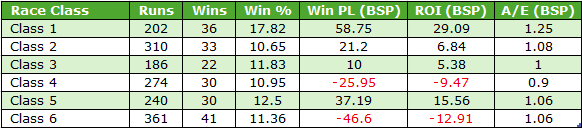
Race class now and it will be interesting to see if the performance in the lower classes of 4 to 6 is poor as it was for the last year’s winners:
Class 4 and 6 have incurred losses once more although Class 5 results buck the earlier trend. Once again Class 6 results have proved to be the worst from a profit/loss/returns perspective. It is interesting to see the positive performance in Class 1 events with this cohort of runners. Their strike rate is 4.27% below that of the last year winners’ group shared earlier, but they have turned a 22p in the £ loss to a 29p in the £ profit. The reason for this is the same one discussed earlier when looking at each groups’ results as a whole; it comes down to the prices that have been on offer for each group and the averages prices in Class 1 races have been as follows:
Once again, we see that the average decimal odds for the Industry SP and Betfair SP are showing lower figures for the horses that won the race the previous year. The difference between the average prices for each group is much bigger than we saw for ALL runners. In these better class races it looks like race winners from the prior year are significantly overbet, while the runners up from a year ago were significantly under bet.
Turf vs All-Weather
Turf versus all-weather next. Will we see the same pattern as earlier with turf results outperforming AW ones by some margin?
Overall, the metrics as a whole are much closer, but the profit/loss and returns still show turf races to be comfortably the better option.
Courses
Onto courses now and a look at the performance of the Grade 1 tracks. They produced solid results earlier, how about now?
These are even better than we saw for the combined results of last year winners. Doncaster’s figures were strong once again, producing returns in excess of 90p in the £ thanks to a 20.8% strike rate (11 wins from 53).
Trainers
Trainers will be my final port of call, and as before data is limited. Only four trainers had over 30 qualifying runners:
Four familiar faces from before. Again, O’Meara’s stats are excellent, while Fahey’s are not as good as we saw earlier. Meanwhile, Tim Easterby has a poor record with these runners.
Conclusions
I have always been a fan of past race trends over a time frame of 10 or 15 years. This is especially true at the big meetings such as the Cheltenham Festival, Royal Ascot, Glorious Goodwood, etc. I feel better quality races tend to produce stronger profile patterns. We have seen in this piece, although we have only focused on horses that came first or second in a specific race a year prior, that better class races tend to produce the most positive results; likewise the higher profile courses do the same.
Other Key findings
Horses looking to repeat a win in the same race the following year are generally over bet, while runners-up from last year’s race are generally under bet.
Turf results have been far stronger than AW results for both winners / runners-up from last year’s race.
David O’Meara has an excellent record with horses that were first or second last year and returning to run in the same race.
Avoid Class 6 races in terms of both last year’s winner / runner-up.
That's all for this week. More racing data crunching next Wednesday. Until then...
- DR
https://www.geegeez.co.uk/wp-content/uploads/2019/09/CallumRodriguez830x320.jpg320830Dave Renhamhttps://www.geegeez.co.uk/wp-content/uploads/2022/10/geegeez_banner_new_170x78.pngDave Renham2025-08-26 14:15:472025-08-26 14:15:47When Horses Return to the Same Race
This is the time of year when we like to see Derby form franked as we move into the lucrative end-of-season international racing action around the world, writes Tony Stafford. Initially, we didn’t and then gloriously at Saratoga on Saturday night, we did.
There were suggestions that Lambourn’s Derby win had been in some ways fortunate. He was very much the second pick for Aidan O’Brien, Ryan Moore favouring Delacroix, who found himself well behind the all-the-way winner. Then the latter’s subsequent electric finish to catch Ombudsman in the Coral-Eclipse at Sandown muddied the waters a little further.
Both colts went to York last week, Lambourn on the back of a second Derby triumph, in the Irish version at the Curragh which was a little underwhelming – but he won, and he was the chosen one in York’s Great Voltigeur Stakes.
Delacroix was pitched in against Ombudsman once more in the Juddmonte International and in a race that took a lot of watching with his pacemaker Birr Castle at one time seemingly in an unassailable lead under Rab Havlin, before he ran partly out of steam.
You have to say “partly” as he was still good enough to be third at a price of 150/1 – thank you M Fabre, say Godolphin and the Gosdens. The winner earned £748k; the second £283k and Birr Castle swelled the Godolphin coffers by a further 141 grand. I bet Havlin has never earned so much for finishing as far back as third on a 150/1 shot.
Once you get into a stream of consciousness, such as events on that first of four days at York, you (well anyway, I) go into sidetrack mood.
Godolphin must be happy with the progress of Ombudsman, but the international operation must be even happier in the knowledge that almost certainly they own the best dirt horse in the world.
For much of the year their Sovereignty, trained by the vastly experienced Bill Mott, and the Michael McCarthy-handled Journalism have dominated affairs among the classic generation. They finished one-two in Sovereignty’s favour in both the Kentucky Derby at Churchill Downs in May and again in the same order in the Belmont Stakes, third leg of the Triple Crown run over the shorter than usual 1m2f at Saratoga. The track’s tighter configuration doesn’t allow for the 1m4f at Belmont Park which has been under reconstruction.
The margin between them doubled from one and a half to three lengths, while Journalism stepped in for leg two, the Preakness run at Pimlico, Maryland in between, winning that race comfortably. Additionally, he can also lay claim – horses do, you know! – this year to the San Felipe and Santa Anita Derby in California and since the Triple Crown races, picked up the prestigious Haskell at Monmouth Park in July, where he pulled victory from defeat with a flying late run.
So over to you, Sovereignty. Mott departed from the sequence of Grade 1 or Classic races by picking up the Grade 2 Jim Dandy early in the Saratoga meet, but then upped him in grade for the Travers, known as the midsummer 3yo championship for the colts.
Only a quartet took on the 30/100 favourite, but one of them, Magnitude, next best at 18/5, came into the race with interesting credentials. He had won the well-regarded Risen Star at the Fair Grounds in February collecting a $240k prize for trainer Steve Asmussen and one-time North of England jockey Ben Curtis.
The team were reunited when Magnitude went on to win a turf race at Prairie Meadows racecourse back from a lengthy break in July and here was running for $660k in the Travers Stakes.
Curtis set the pace and, coming to the far turn, he was still challenging at the front with eventual runner-up Bracket Buster (Luis Saez), who had been fourth to Journalism in the Haskell.
On their outside around the far turn, Junior Alvarado brought the favourite alongside and for a half-furlong or so, Victoria Oliver’s colt looked to be holding his own. Then the turbo kicked in, Sovereignty quickly drawing clear, and in the last furlong he put ten lengths’ daylight to his closest pursuer even as his jockey eased up in the final strides.
What of Magnitude, winner by nine lengths in each of his two previous races? He was another eleven lengths further back, his bubble well and truly pricked. Ben wouldn’t have been too fussed, the cumulative third prize being a handy $120k.
In his last full season in the UK two years ago, Ben Curtis rode a level 100 winners from 677 rides. The aggregate stakes earnings for his mounts’ efforts were £1,339,549.
The last three runs from Magnitude alone have worked out at not far short of half a million dollars, so without being too pedantic about exchange rates, that’s around a quarter of what his efforts on those 677 rides brought. Indeed, Equibase informs us that Curtis has 2025 earnings to date of $6,568,478 from his rides! And that’s before factoring in all the travel up and down the country and early mornings on the gallops here in Blighty.
Working in the US seems to be just the job for Frankie Dettori (a ‘meagre’ $3,552,180 this year from his roughly half as many mounts) and in a much quieter way, it’s proven ideal for the very capable Ben who at 35 is two decades younger than the former multiple UK champion and is going to make plenty of bank for the rest of his career.
Sovereignty’s superiority on Saturday was overwhelming and he now goes to the Breeders‘ Cup Classic on November 1 as the guaranteed favourite. With prize money as lucrative as it is, there’s no reason why Journalism shouldn’t be there in the vain hope Sovereignty has an off day, and there’s still terrific purses for the places. Last year’s one-two, Sierra Leone and Fierceness, have stayed in training, their connections energised by the thought of £2,866,000 to the winner.
My belief is that the younger pair will take centre stage with Sovereignty looking the best we’ve seen since the 2022 winner Flightline.
After the Wednesday Knavesmire reversals, the Coolmore/Aidan O’Brien week did get much better when the Epsom and Irish Oaks heroine Minnie Hauk comfortably won the Yorkshire version by three and a half lengths from her main market rival, the four-year-old Estrange; her season is putting her potentially in Enable territory.
With big race wins for the Gosden father and son team, the prizemoney margin between their stable and O’Brien has shrunk to not much more than £500k. Creeping up on the inside is Andrew Balding, whose 142 wins this year in the UK is almost double the Gosdens’ number.
Balding’s £5,244,464 tally includes victory in the initial Group 1 running of the Sky Bet Stakes at York on Saturday with Never So Brave, and Jonquil kept up the pressure with success in yesterday’s Group 2 feature at Goodwood.
All three stables have more than 200 horses, but Balding is definitely on the march and I wouldn’t be surprised if he came through to take the pot. I reckon the other contenders will need to have a great Champions Day in October to stave him off.
TS
https://www.geegeez.co.uk/wp-content/uploads/2025/08/Sovereignty_TraversStakes_2025.png319830Tony Staffordhttps://www.geegeez.co.uk/wp-content/uploads/2022/10/geegeez_banner_new_170x78.pngTony Stafford2025-08-25 05:58:562025-08-24 19:03:11Monday Musings: Sovereignty Looks The Real Deal
I think most of us have favourite trainers or at least ones we prefer, but there is a good proportion of punters who use trainer form, be it long term or recent, as a significant part of their betting selection process, writes Dave Renham.
Introduction
Some people follow trainers at certain courses, others certain jockey/trainer combos, some look for first time runners in handicaps, etc. In this article I am going to try, and please note the word ‘try’, to find a way to determine how consistent an individual trainer has been over the past decade or so.
To do this I have taken data from the last ten full years of flat racing in the UK (turf and AW) and split it into two blocks of five years – 2015 to 2019 and 2020 and 2024. The idea is that I will compare the earlier data set against the more recent one. I have chosen an elite band of trainers to make the research more manageable.
Personally, the more consistent the trainer, the easier it is to assess the chance of any of their runners. And, when I am looking at a potential bet, I prefer the trainer to be consistently good rather than consistently bad!
Methodology
The question I had before I started was, what is the best way to undertake such a comparison of different trainers? What do I use? Win strike rates? Placed strike rates? A/E indices? PRBs? Or a combination of all of those?
The logical starting point for me seemed to be win strike rates. However, I hit a snag immediately. My initial idea felt really logical: compare the win strike rates of different trainers over the two different time frames across different parameters. Then divide the highest winning 5-year percentage by the lowest to give a Comparison Strike Rate (CSR) for each trainer.
I have used this type of CSR method before when comparing win strike rates but that was when I was looking at individual trainers or individual sires and comparing them with their own strike rates across various parameters. That ratio approach generally works well as a metric and it was plan for the second part of the article.
The problem with comparing one trainer’s CSR with other trainers is when the strike rates for each trainer vary significantly. It will probably be easier to give you an example to explain what I mean.
Imagine a 100-race scenario where a trainer had five winners, equating to a 5% win strike rate. Let us then imagine that in the next set of 100 races we saw nine winners (+4 winners). This is a highly plausible scenario, but suddenly the win strike has almost doubled to 9%. This would give us a CSR figure of 1.80. Imagine the same idea with a trainer that hit 25 winners in the first 100 races and then 33 winners in the second 100. Eight more winners is a decent improvement, twice the difference in winners compared with the first trainer, but their CSR figure is much lower at 1.32. To hit a comparable CSR figure of 1.80, 45 winners would have been needed in the second group of 100 races, equating to 20 extra wins.
So, I decided to put the strike rate CSR method on the back burner for the first half of the article, opting instead to use a value metric, A/E index, instead. This seemed a better plan for trainer to trainer comparisons as long as the sample sizes were not too small.
Small sample sizes can make A/E indices look far better or worse than they are in reality. That is the same for most metrics, of course, and is one of the perils of working with racing data. However, for decent sample sizes, A/E indices tend to be a good metric when it comes to comparing different trainers (and horses and jockeys and sires and courses, and so on).
For this article I will be using a minimum of 30 runs within each area to qualify and, as I mentioned earlier, will be using A/E indices to make comparisons for this first half of the piece. The indices are based on Betfair Starting Prices.
Trainer Consistency: 2yo runners
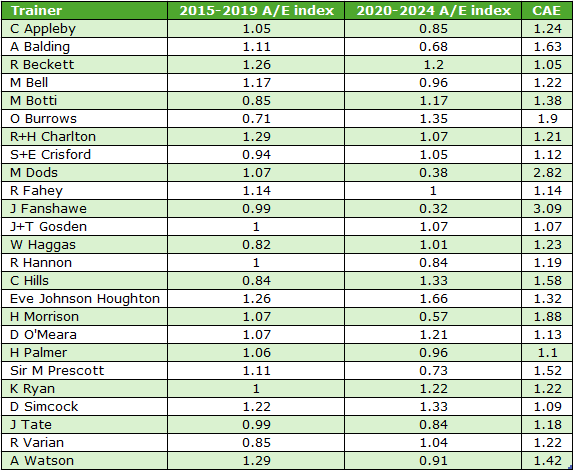
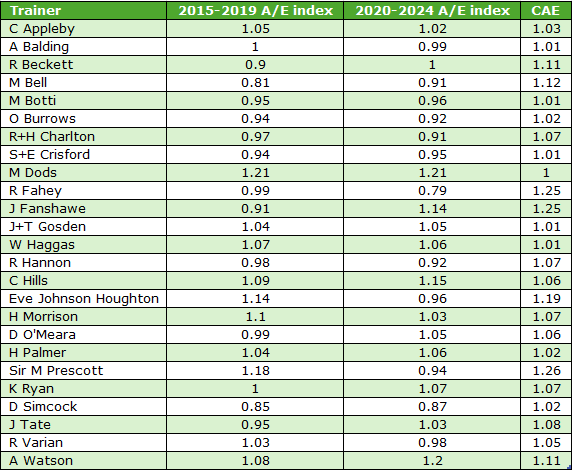
Let me look at some two-year-old (2yo) data first, starting with the individual trainer A/E indices for horses making their debuts. I will divide the bigger A/E index by the smaller one to create a comparison A/E figure using a similar idea to the one mentioned earlier with the Comparison Strike Rate (CSR). I will call it the CAE figure:
The closer the CAE figure is to 1.00, the more consistent the trainer has been in relation to comparing their A/E indices over the two-time frames. Based on this method, as far as 2yo debutants go, the trainers that have shown the most consistency are Ralph Beckett (1.05), J & T Gosden (1.07), David Simcock (1.09), Hugo Palmer (1.10), Simon & Ed Crisford (1.12) and David O’Meara (1.13).
Owen Burrows has shown a real uptick in performance from 2015 to 2019 compared with 2020 and 2024. His CAE figure of 1.90 underscores this. In fact, when we drill into his performance with 2yos on debut we see that in the past two full years (2023 and 2024) these runners won nine races from just 30 starts (SR 30%) for a BSP profit of £32.79 (ROI +109.3%).
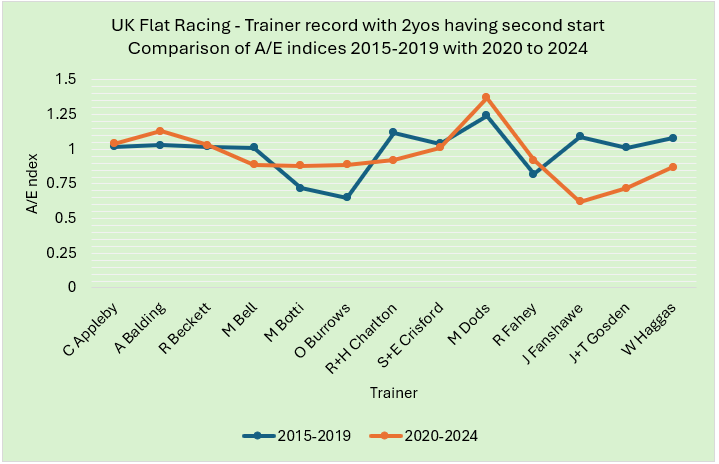
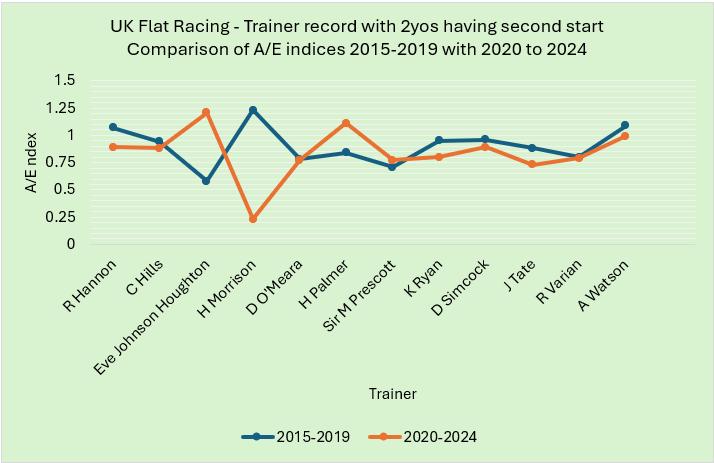
Moving onto 2yos on their second career start, here is a graphical comparison of the trainers’ A/E indices across the two-time frames. I have split the trainers into two groups in order to fit in each graph:
The closer the orange and blue dots are to each other, the more consistent the trainer’s A/E indices have been across the two periods.
Converting these into CAE figures we see the most consistent trainers from this group with second time starters aged two have been Ralph Beckett (1.01), Charlie Appleby (1.02), Simon & Ed Crisford (1.03), Andrew Balding (1.10), Michael Dods (1.10), Richard Fahey (1.12) and Michael Bell (1.13). Interestingly, when we look at the two win strike rates for these seven trainers, their strike rates have been very similar, which adds further confidence in the findings.
Onto the second batch of trainers now:
In this group the trainers with the closest CAE figures to 1.00 are Roger Varian (1.01), David O’Meara (1.01), Charles Hills (1.07), David Simcock (1.08), Sir Mark Prescott (1.08) and Archie Watson (1.10). These trainers have produced some consistent performances across the board with their 2yo second starters.
Trainer Consistency: 3yo runners
I want to move on to three-year-old (3yo) races next and am going to look at a much bigger data set, namely all 3yo non-handicaps. In theory, we should see the CAE figures much closer to 1.00 than before due to the sample size.
With 18 of the 25 trainers having a CAE figure of less than 1.10, this is an indication that most of these top trainers do perform to a similar level year in year out with specific horses in specific races – in this case 3yos in 3yo non-handicaps. Larger samples of data are less affected by those occasional unusual results which can impact on smaller data sets.
However, it should be noted that Richard Fahey and Sir Mark Prescott have both seen a dip in performance in 3yo non-handicaps over the past five years. Fahey’s record across both time frames has been particularly contrasting as the table below shows:
The strike rate has almost halved, and the returns have gone from a strong positive figure to a poor negative one. Conversely, James Fanshawe has seen an uptick in performance over the past five years, turning an 8% loss at BSP from 2015 to 2019 into a 22% profit from 2020 to 2024.
It’s now time to switch methods for the second half of the article where I aim to examine some trainer course data.
Trainer Consistency: Racecourse Angles
For the trainer course data, I plan to look at a selection of individual trainers comparing their course records and so, as I stated earlier, I will revert to the CSR (comparison strike rate) concept. Again, to help make comparisons easier when I divide the strike rates, I will divide the bigger by the smaller to give figures of 1.00 or higher.
Charlie Appleby
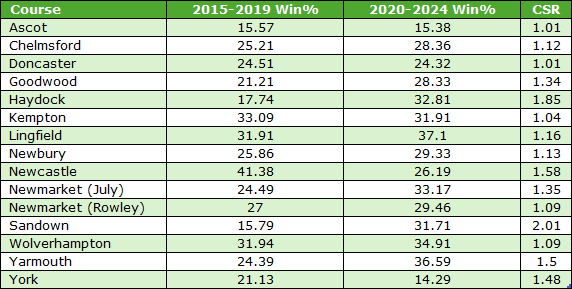
A look at the Godolphin trainer Charlie Appleby first. Here are the courses where he has had at least 30 runners in both timeframes:
I think this table shows why as punters need to be a little careful when it comes to some trainer course stats. Yes, certain trainers do target certain courses, and some are able to consistently repeat successes year on year. However, even for someone like Appleby, who has a yard chock full of top-quality horses, not all courses have delivered similar strike rates in the two five-year batches. At Sandown his win record has been excellent in the past five years but was relatively modest in the earlier five, giving a CSR figure of 2.01. The same applies for Haydock and the splits for Appleby at the Warrington track are as follows:
In terms of returns, we can see that Appleby’s figures have improved by around 40p in the £, although despite this he did not manage to get into overall profit.
Looking at which courses it might be worthwhile considering backing his runners in the future, I would say the following: Doncaster, Lingfield, Newbury and the Rowley course at Newmarket. My thinking is that these five have not only seen consistent performances (CSR figures all between 1.00 and 1.16) but have produced blind profits to BSP in both of the two five-year time frames. Ascot also falls into that category but his figures there are skewed by a BSP winner priced 36.0 in 2017 and a BSP 75.0 winner in 2022.
Before moving on, Appleby’s record at the Newmarket Rowley course is worth sharing in more detail; from 2015 to 2019 he had 54 winners from 200 (SR 27%) for a profit of £58.62 (ROI +29.3%). From 2020 to 2024 his record read 104 winners from 353 runners (SR 29.5%) for a profit of £105.76 (ROI +30%). Eight of the ten years saw the Godolphin trainer produce a blind profit on all his runners.
Andrew Balding
There are three courses where Balding has turned a profit in both five-year time frames and hit a low, i.e. consistent, CSR figure. These are Chester, Doncaster and Newbury. Of the three, Chester has the most consistent feel to the stats. He has a good record there with shorter priced runners (BSP 10.0 or lower) hitting a strike rate of 26.2% (71 wins from 271) for a profit to BSP of £60.34 (ROI +22.3%).
With bigger priced runners (above 10.0) at the track, he has made a profit of £73.52 (ROI +61.3%) thanks to 10 winners from 120. Overall, taking all prices into account, he has made a blind profit there in seven of the ten years.
Ralph Beckett
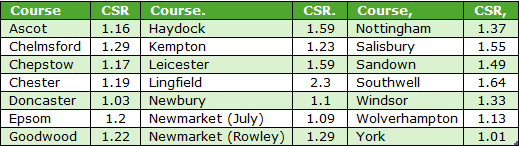
For Beckett I have produced a table of his CSR figures for different courses and these are shown below:
Doncaster, Wolverhampton and York have seen consistent CSR figures of 1.03, 1.13 and 1.01 respectively, with all three of them proving profitable across both time periods.
Chelmsford has a slightly higher CSR at 1.29 but this is a fourth course I would look out for Beckett runners as these splits are decent:
In contrast, his record at Lingfield (turf and AW courses combined) has been all over the place. The 2.30 CSR screams this and, if we look at the yearly win strike rates, coupled with the win & placed (EW) ones, we see the following:
We can see the huge discrepancies comparing 2016 and 2024, where the win rates were over 30%, with 2019 and 2021, where the win rates were 6.3% and 8.8% respectively. These results are based on fairly decent yearly sample sizes, too, with eight of the ten years having 30+ runners at the course.
I have said it many times before in articles that some stats can be misleading, and the more digging we can do behind the numbers the better.
Other Profitable Trainer Consistency Angles
Time precludes further trawling of the full list of trainers in such detail but I will share the remaining positive trainer/course stats, based on the combination of low CSR figures combined and two profitable five-year time frames. Trainers not shown failed to complete that double qualification for any course:
Outro
As I stated at the outset, this was a piece of research where I wanted to try to establish when trainers show consistency within certain parameters. Hopefully all the hours of research combined with my approach has at least offered some tasty food for thought. I am sure the ideas are not foolproof, but I believe they have merit and utility.
Comments are always welcome and if there are any tweaks to the methods that you’d like to discuss, please let me know in the space below.
We’ve all read them, writes Tony Stafford. Streams of platitudes when somebody gets a new appointment. But last year, when Sam Sangster became one of three new youthful directors at the National Stud, his words were to prove so prophetic.
“I hope to bring added value to an already well-established team… I am excited to be part of the path they are heading towards – it promises to be a very exciting journey.”, he said.
With four solid stallions, heroic multiple Group 1-winning staying champion Stradivarius and ace sprinter Bradsell (from this year) among them, they were sure to keep the tills of the Jockey Club, which owns the National Stud, ticking over.
Then twice within a few days, Sam outdid what anyone could have thought possible for an operation which, by its own admission, is nowhere near the top table as far as owners of mares are concerned.
First, last week, there came the announcement that in a deal brokered by Sangster and put together with “several investors”, Diego Velazquez had been purchased out of the Aidan O’Brien stable. He will stand at the National Stud next year and, while remaining with O’Brien, will carry the famed colours of his late father Robert for the rest of the season.
To show just what a shrewd acquisition this is, look at the breeding. Diego Velazquez is by the unbeaten Frankel (by Galileo) out of a mare that bred Group 1 winner Broome and dual Group 2 victor Point Lonsdale. He cost just the 2.4 million gns as a yearling.
As a racehorse he had compiled a record of five wins, three at Group level, in a career of only ten races. Two wins at age two are always manna from heaven for a stallion owner and that overall record could have been even better had the realisation that he had speed in excess of stamina kicked in earlier. He was unplaced over 1m4f at Royal Ascot last year.
This season only started at the Royal meeting, when he was 8th to surprise winner Docklands in the Queen Anne Stakes. He dropped back another furlong for a Group 2 at the Irish Derby fixture, winning very easily, and Sam’s deal was brokered just in time to run in his colours in yesterday’s Prix Jacques Le Marois.
With Ryan Moore otherwise engaged on the disappointing favourite, Lion In Winter for the Coolmore owners, Christophe Soumillon stepped in for the ride. Always in the first three close to the outside, Diego’s big white blaze and four white legs were always easily visible in the first three.
Having taken over inside the last furlong from Roger Teal’s back-to-form Dancing Gemini, he had enough in hand to stay ahead of the fast-finishing Notable Speech, the 2024 2000 Guineas winner, in his case also showing he’s back to his best. The winner handsomely turned around the Ascot form with Docklands who finished fourth just behind Dancing Gemini.
What a difference those few centimetres have made. Diego Velazquez is now a Group 1 winner, and not a Mickey Mouse one either – this race is the acknowledged midsummer mile championship in France.
As such, it carried a first prize of £472,231, the head verdict making more than £280k difference to the detriment of the Charlie Appleby, William Buick and Godolphin-connected colt.
So now, having probably been aiming at a nice first-season figure for their colt, Sam and whoever else will be making the decisions from this point on, will no doubt have a higher figure in mind than they originally did. Then again, there is sure to be a flurry in interest in him, and a sensible initial amount would pull the numbers in. He will assuredly, whatever happens in the pricing of his services, give the staff at the National Stud a massive boost.
Through much of the late 20th Century the names of O’Brien and Sangster were irrevocably bound at the same Ballydoyle complex that houses the present Aidan O’Brien team. But it was Robert Sangster, Sam’s father, and Vincent (I must stress once more, no relation) O’Brien, as with his successor, the pre-eminent trainer of his generation on this side of the Atlantic. The present-day link of course is John Magnier, Vincent’s son-in-law and foremost among the Coolmore partners.
It’s been a while since a horse ran in the famed green, blue sleeves, white cap from Ballydoyle and I did suggest to Sam (tongue in cheek, of course) when the news of the deal broke that maybe he would need to take a set of silks with him to Deauville.
“We already have them there,” he said, referring to the fact that several of the Brian Meehan stable challengers had been involved running under Sam’s Manton Thoroughbreds banner over the past few days. Those syndicates have helped sustain the highly talented Meehan going through some testing times, and while they kept hitting the crossbar, more than 120k in placed earnings made this a lucrative venture.
Even when the numbers have been more limited, Meehan always has some nice two-year-olds; while the successes last week of the unexposed three-year-olds, the filly Lodge at Chepstow and the gelding Release The Storm, making it two from two at Doncaster on Saturday, promise an exciting finish to the season.
Release The Storm has a fast-ground action and had no trouble making all under his penalty in a novice race up the testing Doncaster 7f. There certainly ought to be overseas buyer interest in this gelding who carries the trainer’s colours.
One facet of his training this year has been that none of the ten individual two-year-old runners (five winners) he has sent out from his Manton base has raced on all-weather, from 30 collective starts. I’m not sure whether that’s just a coincidence, as I know he uses Lingfield’s Polytrack when he sends unraced horses for barrier trials.
The best part of the Meehan-Sangster partnership has been their two-way loyalty. Sam has had a horse or two most years lately with Nicolas Clement in France. He also had a winning filly with Tom Ward a couple of years ago but, as they choose all the young horses together, it’s great that they sink or swim together also.
You might have thought that, seeing as they were both in situ all over the weekend, Sam Sangster Bloodstock might have been among the purchasers over the first two days of the Arqana August Yearling sale which began on Saturday. Unless he is operating through proxies, which I doubt, he simply hasn’t bought any. He never overpays for the yearlings he buys and as a result leaves the first stages here, and mostly of Newmarket Book 1 and Goffs’ top sale, to the people with bulging chequebooks.
Whatever else happens to this highly personable (as with all the family) young man, now he will always go down as the man who single-handedly (with Aidan O’Brien and the Coolmore partners’ help of course) brought the National Stud of Great Britain right back into the horse breeding limelight.
From Deauville, all the big players will be sorting the private jets for four days at York. I’ll be going there much more prosaically, but Jim and Mary Cannon do have one comfortable room free, so that’s going to be my holiday for 2025. The weather apparently is taking mercy on those of us who don’t relish too much heat, so all we need is a winner or two. Got anything running, Brian? Doesn’t have to be there!
Most male horses begin their life on the flat as an entire, writes Dave Renham. At some point sooner or later - usually sooner - most horses disappoint their connections with racecourse performance and thus, in search of improvement, are gelded.
Introduction
The term "gelded" refers to the process of castrating a male horse, and this procedure is common within the horse racing industry especially with horses that race on the flat. The main reason for gelding a horse are to improve temperament and focus which it is hoped will improve performance on the track. Further, gelding a horse can improve a horse's compatibility with other horses, reducing tensions and possible distractions during races and on the gallops.
First Time Gelding
Overall
In this article I will primarily focus on data concerned with a first run after being gelded. The data has been taken from six full years of UK flat racing (2019 to 2024) and any profit / losses have been calculated to Betfair Starting Price (BSP) less 2% commission. The A/E indices have also been calculated to BSP.
Let me start by looking at the results for ALL horses that were having their first run since being gelded. The stats read as follows:
As we can see these horses win close to one time in every eight starts, and a small profit would have been made from backing them all. Of course, the chances are that we have had a few big prices which have skewed the returns a little. Below then are the results by different BSP price bands:
The best value has been with those horses priced BSP 7.01 to 19.00. In terms of the huge prices, there were five horses that won at three figure odds (BSP 100.0 +) with the biggest winning price being a whopping BSP 612.25.
It makes sense for the remainder of the article to have a BSP price ceiling in place to avoid skewing.
For the rest of the article therefore I will impose a BSP price limit of 19.00. This still gives us over 4000 horses to examine.
Age of horse
My first port of call with this price limitation is to look at different ages of horses to see if that had made any difference. The graph below looks at the BSP returns (ROI%) across different age groups:
Three-year-olds have by far the worst record (they also have the lowest win strike rate of all the age groups). The Classic generation have struggled particularly in Class 6 events. Their overall strike rate stands at 17% but in Class 6 races this drops to 13.8% as a result of just 70 winners from 506 runners. Backing all qualifiers would have seen significant losses of £117.03 (ROI -23.1%).
Juveniles (two-year-olds) having their first run after being gelded have done particularly well when contesting Novice races. Of the 123 runners, 33 have won (SR 26.8%) for a healthy BSP profit of £53.84 (ROI +43.8%).
Four-year-olds on their first run after the op have performed best in handicaps with 133 winners from 692 runners (SR 19.2%) for a decent profit of £178.61 (ROI +25.8%).
Career starts
One interesting finding relates to career starts. Horses that have raced three times in their careers previously and then were gelded have a good record. This is especially true when they race in handicap races as virtually all of them were making their handicap debut having qualified to run in handicaps for the first time. This cohort of runners have run 1044 times with 191 winning (SR 18.3%). Backing these runners blind would have produced a healthy profit of £188.03 (ROI +18%). This is especially impressive considering the BSP price limit that I imposed earlier.
Position LTO
Onto last time out performance now, specifically position last time out. Here are the splits:
It is interesting to note that 335 horses that won last time out were still subsequently gelded; that is a bigger number than I had expected. Having said that, they performed well on their next starts, making a solid profit – returns are just over 9p in the £. When we look at the strike rates across different finishing positions, there is not the drop off I had expected. Horses that finished sixth or worse have still won over 15% of the time which is a decent effort.
Days since last run
Horses that are gelded are rarely rushed back to the racecourse for obvious reasons. Only 3.5% of all horses that have been gelded return to the track within four weeks. The rest tend to be given much longer to recover. Indeed, 55% of all gelded horses are given at least five months until they are asked to race again, the surgery often coinciding with a horse's scheduled winter break.
In reality, the longer the break the better in terms of offering punters value, as the graph below displaying the A/E indices for different ‘days off track’ groupings shows:
Once we get to 85 days plus (more than 12 weeks), we can see an improvement in the A/E indices. Those off the track for five months or more (151+ days) provided good value. This cohort of runners had an excellent A/E index of 1.09 (as seen above), and their overall figures read an impressive 431 wins from 2294 runners (SR 18.8%) for a level stakes profit of £258.69 (ROI +11.3%).
Sires
I thought it would be interesting to see if any sires showed a pattern in terms of when their offspring were gelded. It is generally agreed that sires can influence their progeny from the perspective of distance requirements, ideal ground conditions, etc. I wondered if that also applied to behaviour, attitude, temperament etc? Below is a list of sires who have had at least 50 of their offspring running for the first time after being gelded coupled with the 19.0 BSP or lower price restriction:
Eight sires have turned a profit but two stand out, namely Iffraaj and Invincible Spirit. Both have seen strike rates of more than 30% (with Invincible Spirit nigh on 40%), and both have made excellent profits. Progeny of New Approach, however, have really struggled on their first run after being gelded.
I did take a quick look at sire performance when having their second, third or fourth runs after being gelded. Iffraaj and Invincible Spirit’s strike rates both dipped back to around 20%, but both still turned a profit. New Approach on the other hand saw a huge improvement in strike rate (22%), although backing all qualifiers would still have made a small loss.
Trainers
1st run after gelding
All trainers will have a slightly different approach to what happens after one of their horses has been gelded from the viewpoint of methods of recovery and rehabilitation. They will also plan out horses' return to the track slightly differently from each other. Below is a list of trainers who have saddled at least 50 qualifiers (1st run after being gelded / BSP 19.00 or less). The list is order alphabetically:
The first thing that stands out to me is the difference in the figures for the Godolphin trainers Charlie Appleby and Saeed bin Suroor. Appleby’s figures, by his high standards, are poor, while bin Suroor’s are excellent.
There do seem a be a handful of trainers to avoid; namely David Simcock (whose record is dreadful), Karl Burke, Richard Fahey, Charlie Johnston and David O’Meara.
1st vs 2nd run after gelding
Before winding this piece up, I would like to compare win strike rates for individual trainers comparing the first run after being gelded with the second run. I have split the data up into three graphs – the first one contains the eight trainers with the highest strike rates from the first run data shown earlier. The second graph shows the next eight trainers, and the final graph shows the nine that had the lowest strike rates. Presenting in this way makes each graph comparison easier to see:
As we can see William Haggas, Ralph Beckett and the Gosden yard have very similar strike rates. However, there is a marked difference with some of the others. Most have seen a significant drop, such as Marco Botti 22% down to 10.29%, Saeed bin Suroor down from 29.41% to 20.83%, and Archie Watson down from 27.66% to just 15.6%.
Roger Varian is the only trainer to really buck the trend with a big jump in the opposite direction from 21.74% to 33.09%. I will share the full figures of all the trainers including profit/losses/returns after the third graph.
Onto the second group of trainers now:
In this group we have five trainers with very similar strike rates, while Richard Hughes and Charlie Appleby have seen significant improvements in terms of win success. Michael Bell’s figures look more akin to the first group of trainers with a drop from just under 21% to 13.7%.
And finally to the third group:
This third group were the trainers with the lowest strike rates with horses having their first run after being gelded. As we can see, every single trainer improved their strike rate when the horses were having their second run. Charlie Johnston (9.84% to 23.21%), David Simcock (3.77% to 18.99%) and Clive Cox (15.38% to 26.92%) all showing significant improvements.
As promised, here are the full facts and figures for these trainers with their runners that are having their second run after being gelded:
There is a stark difference between some individual trainer performances when comparing first run versus second run.
To make it easier to digest, in the table below I have listed those trainers that have either a positive record or a negative one across both first and second runs after being gelded:
This article has thrown up a fair few positive angles – more than I had expected.
I hope it has been an interesting read, and it is time for me to start thinking about my next piece. Until then...
Amid all the excitement of the longer-distance Group 1 races set to be staged at next week’s Ebor Festival at York, one that normally commands less attention is the Nunthorpe Stakes, an all-aged 5f sprint, writes Tony Stafford.
In this case, all truly does mean all, as we’ve 27 horses still entered for Friday week’s Coolmore Wootton Bassett Nunthorpe Stakes, the title paying homage to the stud’s closest acknowledged successor to Galileo and the race’s being worth a tasty £340k to its winner.
Ages are represented from seven all the way down to a couple of two-year-olds. True Love, the Queen Mary winner at Royal Ascot and then successful back home in the 6f Railway Stakes, is in the list but she was humbled in the Keeneland Phoenix Stakes at the Curragh on Saturday.
Whether Aidan O’Brien will be tempted to try to win back some of his employers’ money is an intriguing question. The other juvenile in the original cast was Zelaina, a 650k breeze-up buy for Wathnan Racing who won first time for Karl Burke at Nottingham but flopped at Ascot and again when favourite at Goodwood.
But, and in a season of exceptional achievements from the first crop of Starman, there might just be a left field contender. It comes in the shape of Ger Lyons’ Lady Iman, the first scorer for her fledgling sire at Dundalk as early as March 28, and successful another three times, including impressively in the Molecomb Stakes at Goodwood.
Starman, trained for his breeder David Ward by Ed Walker, didn’t make it to the track at two, but the son of Dutch Art made up for it with five wins from eight starts at three and four, including an impressive win from 18 others in the July Cup at Newmarket.
Lady Iman’s story, as ever in racing, is one of one man’s (or family’s) luck meaning another’s misfortune. She was bred by the Tony O’Callaghan family at their Tally-Ho stud which stands Starman. She was sold for £185,000 but returned by the buyer, leaving her to run in wife Anne O’Callaghan’s colours.
By Goodwood, she comfortably won against the colts despite carrying a 3lb Group 3 penalty. She had lost her unbeaten record the time before over 6f at the Curragh when a Wootton Bassett filly from the Ballydoyle yard outstayed her after she had looked the assured winner.
Now Lyons, not entirely of his own volition it seems, has been persuaded by the O’Callaghans to supplement her for the Nunthorpe, where she will aim to be only the third winner of the race of her age since 1992.
That was the year when Richard Hannon senior’s filly Lyric Fantasy started at odds-on under Michael Roberts, now a top trainer in his native South Africa. He did 1lb overweight at 7st8lb. In 2007, the John Best colt Kingsgate Native was a 12/1 shot under Jimmy Quinn and ran home a comfortable winner, belatedly opening his account at the same time.
The Starman success story began with a rush and has continued unabated with I think 16 individual winners, several of them emulating Lady Iman by clocking up multiple wins.
Foremost among them – for now – must be Venetian Sun who completed her unbeaten hat-trick in the Duchess of Cambridge Stakes at Newmarket last month. Green Sense, who had been a close second earlier on home soil to Lady Iman, went across to France and won the Prix Robert Papin, a noted Group 2 summer juvenile feature there.
Starman’s owner-breeder David Ward was on hand to see The Prettiest Star, his homebred daughter of the sire, romp away to a wide-margin debut victory in a newcomers’ race at Newmarket on Friday evening. Simon Crisford expects her to be a star and is looking forward to formulating an appropriate programme for her. Ward coyly admits to having “another nine or ten” of that minted first crop “waiting in the wings”, as you do.
Having counted to 16 from the list of Starman winners, I came to a borderline similar result when having a first look through the initial test of potential two-year-old marketability, Goff’s Premier Yearling Sales, staged at Doncaster immediately after York, on the 27th and 28th of August.
Around 400 yearlings will be offered, 17 by my count with Starman as their obvious attraction and five of those coming from Tally-Ho. Should the filly win on the previous Friday, the O’Callaghans will not have to wait long into the Doncaster sale to see how much that will affect prices. Lot 1 is their daughter of Starman out of the Dunaden mare Under Oath. Light blue touch paper and retire? Not quite!
Anne O’Callaghan will be a very much welcomed winner of the Nunthorpe if that should come to pass. She is the sister of John Magnier and there is no question that she, along with Tony and sons Roger and Henry, have not wasted any knowledge picked up from their illustrious relative.
Tally-Ho Stud has been a watchword for developing raw stallion talent into top progenitors, with Mehmas (now €70k from €7.5k in 2020) an obvious example. Kodiak, still going strong at age 24, has settled back down for this year at €25k after peaking at €65k for four seasons (2019-2022) from a starting point of just €5k.
Top sprinter Big Evs (€17.5k) and Champion Stakes winner and Derby runner-up King Of Steel (€20k) were this year’s new additions, but no doubt Roger O’Callaghan will be keeping his eyes open for further prospects for 2026, the new blood that the stud habitually finds under everyone else’s noses!
Joe Fanning, 54 years old but still riding to the top of his ability, has been booked to manage the light weight of 8st and the 27lb his mount receives from the older male sprinters is a compelling attraction.
There was a lovely “where are they now” piece in the Racing Post around the time of Royal Ascot this year where Chris Richardson, boss of Cheveley Park Stud, detailed the many phases of Kingsgate Native’s life.
After the big win at two, he continued to race in John Mayne’s colours at three, although bought by the stud for a projected stallion career, and he added the Golden Jubilee Stakes at three at the Royal meeting.
A first try at stud didn’t work out so he returned to racing, though not with Best, starting with Sir Michael Stoute and continuing until age 11. After that he spent time at the British Racing School. As Chris related, “Anyone who could stay on him had achieved something as he enjoyed throwing the riders off!”
A later phase was his time at the Newmarket Horseracing Museum where he was a celebrity that the regular visitors always sought out. He left there four years ago to spend his time in Cheveley Park’s paddocks but last August he was paraded at York prior to the Nunthorpe. “He spent a couple of weeks at David O’Meara’s before that and he was great,” says Richardson. “We’ve no plans for him now,” he said, adding, “He’s just living a wonderful life”. Just the job for a 20-year-old!
On the basis of even-handedness, what of John Best, who left the training ranks a couple of years ago? I called him over the weekend and he told me he has joined forces with his girlfriend Raeane Turner, who owns the Rhoden Rehabilitation Centre near Tonbridge in Kent, close to where John trained for the whole of his successful career.
“It has been running since 2020. Not the best time to open! We have an equine water treadmill which is used in the rehabilitation after injury but just as much for strength and conditioning. I’m also a great believer in injury prevention. This gets the horses working using all four limbs equally and therefore helps to stop compensatory injuries before they occur. It’s an unbelievable bit of kit.
“We also have a combi floor which is a magnetic vibrating plate that increases blood circulation and provides a full body massage. This is helpful for many types of injury and afterwards for exercise to loosen them up. Finally, in the centre we have a cryotherapy machine which we use to reduce heat and swelling and increase blood supply.
“My principal job though is running the salt and oxygen system. We have it mobile in the back of a 3.5 ton horsebox and go to yards to treat horses with breathing and skin issues. Also, it’s used post-surgery to speed up healing. The horses go in the back of the box and the whole of the back fills with a very fine mist of Dead Sea Salt. They breathe it in and it lands on their skin. I’ve been amazed by the results.
“Horses with allergies or asthma respond really well. We have had horses that the vets cannot stop coughing but we seem to be able to sort it out. We are getting more referrals from vets all the time as our system allows horses to be treated drug-free. Quite often it’s horses they just can’t seem to fix,” he said.
John’s 25-year career had many other highlights apart from the two Group 1 wins from Kingsgate Native. A regular at St Moritz over the winters, he had multiple wins there most years, recognising the right horses to send to race on that frozen lake. Also, in 2008, the year of Kingsgate Native’s Golden Jubilee success, he sent three horses to run in the Lane’s End Breeders’ Futurity on the Polytrack at Keeneland in Kentucky and won with Square Eddie. His other two runners finished fourth and eighth.
A very nice and knowledgeable guy. I wish him well.
I would like to start this piece with a question, writes Dave Renham. “When analysing a handicap race, how many of us look at the class of the race and other class factors in detail?”
Clearly, I cannot speak for everyone, just for myself, but in terms of the pecking order of race factors I’ll look at, class considerations are at the lower end of my list of priorities. I would always look at run style/pace, the draw, Peter May’s ratings, last time out (LTO) factors (position, odds, course) first. Once I move on to class factors though, there are five main things I will look at:
which class of race each horse raced in last time and over its last few starts
which horses have won at this level before, or indeed at a higher class level
recent handicap marks or Official Ratings (ORs) over the past few races noting how well the horses ran on each occasion
highest winning handicap marks, as long as they are relatively recent (within 18 months or so)
past placed form and the relative handicap mark at the time
I must admit there are times when, especially if I am looking at a big field handicap, I’ll only do this for the main contenders, or at least the horses I believe are the main contenders! Also, in terms class factors, I know from past research that it is quite difficult to find an edge when taking on the Official handicapper, as the handicapping system in this country is extremely accurate. However, I still want to review what I think I know and compare it against recent evidence.
Data has been taken from UK racing, turf and AW, handicaps spanning the four full years from 2021 to 2024.
Before sharing my research let me discuss the different classes of handicaps. In 2021 and 2022 the European Free Handicap was the only remaining Class 1 handicap, but that race was discontinued thereafter, so the highest class of handicap is now Class 2 - and the lowest level is Class 6.
Within each class there are races open to slightly different ability levels as regards their Official Ratings. Every classification has at least two different rating bands within it, and there may be some variants of these which I've not listed, for example 56-72:
Class2 includes Heritage Handicaps. The rating bands for this class are 86-100, 91-105 and 96-110.
Class 3 The ratings band for this class are 76-90 and 81-95
Class 4 For horses rated 66-80 and 71-85
Class 5 For horses rated 56-70 and 61-75
Class 6 For horses rated 46-60 and 51-65
Class 2 Races Overview
Therefore, within each classification there are races where the quality or class level of the runners is slightly different.
Let me give two race examples of Class 2 handicaps run during the period of study. The first race, run on October 16th 2021 at Ascot, was the Class 2 Balmoral Handicap, a 20-runner race where all horses were rated between 101 and 110. The average OR for the race was 105. The second race, run on October 17th 2024 at Southwell, was the Class 2 Download the At the Races App Handicap, a 12-runner race where 11 of the 12 runners were rated 94 or less with the highest rated horse having an OR of 98. The average OR rating for the race was just 91, a difference therefore between the two race OR averages of 14 pounds.
Hence, we need to be aware that the level of competition within each class band can differ, and sometimes quite markedly. Of course, the handicapper, as I have already stated, does an excellent job when rating horses, so in theory the rating adjustments made should ensure races are equally as hard to win regardless of the average OR. Having said that, higher rated runners in Class 2 handicaps do win slightly more often than lower rated ones.
This can be seen when we look at the splits for horses rated 101 to 110 compared with those rated 90 and lower when racing in Class 2 handicaps. Let me look first at qualifiers with a BSP winning price set at a maximum of 20.0. This is to avoid the results potentially being skewed by a huge priced winner or two:
Horses with a higher rating have outperformed those with a lower one as mentioned above, albeit the difference in absolute win rate is only 1.7%. In relative terms, it is nearly 14% greater. The hugher rated runners recorded a small profit with a difference of just under 7p in the £ when comparing the two rating groups. The A/E index was also higher for the 101 to 110 group.
Just for the record here are the figures for qualifiers priced over 20.0 BSP for each rating band:
Hence, in this cohort of genuine outsiders, the higher rated Class 2 runners have comfortably outperformed the lower rated runners across strike rate, returns and A/E indices. It should be noted that the 101 to 110 group did not have any 100/1+ winners that would have completely skewed their profit figure. Indeed, it was the 90 or below group which had the biggest priced winner and comfortably so at BSP 146.4.
Class 3-6 Races Overview
We see a similar pattern in different class groupings when comparing the highest rated runners with the lowest, including a price cap of BSP 20.0. Across all class groups the higher rated runners won more often. Differences in win strike rates vary from 3% or higher to 4.5% or higher depending on the class level. In terms of A/E indices the higher rated runners have proved better value in Class 3, 4 and 5 contests. At Class 6 level the lower rated runners have had the edge value wise.
Comparing Average Race OR with LTO Average Race OR
Having given us some background, for the remainder of this article, I am going to dig a bit deeper into the whole question of class. I will set an odds range of BSP 20.0 or shorter once more to avoid very big prices skewing the findings. In addition, the horse data I am checking requires the horse to have run in a flat handicap (turf or AW) last time out as well.
I have discussed already that within each race class we can get a significant differential in terms of average race ORs of the runners. For the main body of this article, I want to examine the performance of horses racing in a handicap when comparing the average OR of their current race with the average OR of their last race. I have decided to split the OR race average differences up thus:
Just to clarify, a horse that raced in a handicap that had an average OR of 76 last time out and races in a handicap with an average OR of 82 this time would go in the '+6 to 9' group as the difference is six higher. A horse racing in a handicap where the average was the same would go into the '+1 to –1' group, and so on.
Let's examine and compare the win strike rates of each group first. I wasn’t sure what I would find but these results come from huge sample sizes so we can be very confident in the numbers:
As we can see the strike rates are very similar which again perhaps highlights how accurately calculated handicap ratings in this country are overall. The two highest percentages lie at the right of the graph with the '-6 to -9' group and the '-10 or lower' group. If we now compare the A/E indices (to BSP) we again see a very level playing field:
The figures vary by just 0.03 from the lowest, 0.99, to the highest, 1.02. For the second graph running the '-6 to -9' group and the '-10 or lower' group are marginally better performing than the rest. Both these groups also made a small profit to BSP with their cohort of runners that were BSP 20.0 or less.
There are so many different routes I could take at this point, but I elected to fully focus on the '-10 or lower' group for the remainder of this article, as based on these initially findings this could be the group where we find an edge.
Handicap Races where Average OR dropped by 10 pounds or more from previous race (also a handicap)
Race Class Change
The first area which I want to look at for this cohort is ‘Race Class Change’ in terms of official classifications (Class 2, 3, 4 etc). Clearly, with a drop in race average OR of 10 or more from LTO, there were always going to be very few qualifiers in terms of being upped in class next time – just 18 horses went up in class to be precise (for the record this small sample made an ROI% loss of 14.4%). Here are the splits for qualifiers racing in the same class or dropped in class:
According to these figures, the bigger the drop in race class the better. There is positive correlation across strike rates, returns and A/E indices.
What is really interesting is when we look at the race class last time out for any qualifying class dropper. For example, if a horse raced in Class 2 LTO, then raced in Class 3 or lower next time, their record when the average race OR drops by 10 or more is quite remarkable:
These runners have shown a BSP profit in each of the four years showing excellent consistency with A/E values for each year ranging from 1.08 to 1.21. I, for one, will keep a close eye on these runners in the future.
The Betting Market
Moving onto market factors, and horses that start in the top three of the betting, after seeing the race average OR drop by 10 or more produced a blind profit:
Returns equated to a smidge under 3p in the £ and, if we stuck to favourites only, returns were marginally better at 3.3p in the £.
When we look at BSP prices, those qualifiers priced between 15.0 and the price cap of 20.0 won just 5.2% of the time (48 wins from 932) for a hefty loss of £133.20 (ROI –14.3%).
Based on this evidence, it seems to make sense to be looking for horses nearer the top end of the betting market more often than not.
Position LTO
How about last time out finishing position? The past stats have favoured horses that finished either second or third last time out. These runners have combined to produce the following figures:
We see a strike rate close just better one win in every five, and positive returns of over 5p in the £. The A/E index of 1.04 is also very solid. Logic dictated to me that there would not be too many LTO winners that qualified considering the average race class OR drop, but actually there were 204 such winners of which 43 won (SR 21.8%). However, they are very well found in the market and have proved quite costly to follow, losing £28.56 (ROI –14.0%).
Trainers
Trainer data is always something punters are drawn to and for this area of research I think the findings may be more illuminating than usual. One skill that all trainers need is an ability to find the right race for their horses. However, in handicaps there will be times when this may not the case and a trainer will be quite happy to see a moderate or even poor run in the hope that the horse's handicap mark drops. But how many trainers have been adept at finding a much weaker race in an attempt to exploit it? Let’s see.
The table below shows those trainers who had at least 50 runners with a drop in race average OR of 10 or more compared with the average rating of the race they contested last time out. The table is ordered alphabetically:
We have quite a mixed bag here, but there is a good proportion of trainers who stand out positively including George Boughey, John Butler, David and Mick Easterby, Brian Ellison, David Evans, Richard Fahey, Paul Midgley, Gary and Josh Moore, Nigel Tinkler and Archie Watson.
What may be even more enlightening is to compare the record of the trainers in the above table against their overall record with all other runners under all other circumstances, (e.g. runners whose race average OR changed by -9 or more). Below are the trainers with the biggest differentials between the two in terms of win strike rate:
We could argue that these nine trainers have been very adept at placing horses in much weaker races compared with the handicap LTO over the past four years. Not only do the strike rates suggest that, the A/E indices for each group show that too:
There are some excellent A/E indices there in the blue columns. Overall, of the 33 trainers in the original table 24 had better records when their charges raced in handicaps with an average race OR of 10 or less compared to their most recent start.
Summary
As with a lot of areas I research, I have literally scratched the surface in terms of race class. However, it has been an interesting journey with several positives noted on the way. The second half of the article focused on just one specific group of runners - those who were contested a handicap where the average official rating was at least 10lb lower than their previous race - so there is scope to look in detail at other groupings in the future. For those who want more class articles (no pun intended) please suggest any ideas in the comments.
- DR
https://www.geegeez.co.uk/wp-content/uploads/2025/07/2.80713447-scaled.jpg12802560Dave Renhamhttps://www.geegeez.co.uk/wp-content/uploads/2022/10/geegeez_banner_new_170x78.pngDave Renham2025-08-04 14:44:512025-08-05 10:14:45A Preliminary Look at Race Class in Flat Handicaps
I'm back, with my annual kickball preview that is as deserving of being digital chip paper as anything penned on these virtual pages. I sort of know a bit about racing, though it may not radiate from every stanza scribbled or every suggestion sunk; my grasp of the football form book is more tenuous - that of a keen amateur at best. I'm keen enough, and also amateur enough...
If that hasn't had you clicking for the exit button then thank you for the blind optimism - we'll be in it together, at least - and let's get to business. Before this season, however, a rapid retrospectacle (copyright Thomas Dolby 1994) of last year's wager.
2024/25 Season Review
It was a promotion perm trixie as follows:
Championship: Leeds / Middlesbrough
League One: Bolton
League Two: Port Vale / MK Dons
Boro were the perfect 'data' team: xG through the roof, Hayden Hackney farming midfield metrics... and no end product. Having played like Vesuvius all season - dormant, with the promise of erupting at any moment - they finished by making a molehill out of that volcanic mountain. And that, friend, is possibly the worst metaphor you'll ever read.
Leeds fared better, beating Burnley to the divisional title by a goal difference short head, both clubs finishing as point centurions. They were the favourites, and plenty short enough at 11/10 for promotion, but they got it done.
Bolton did Bolton things in League 1: variously looking like promotion and relegation contenders, sometimes in the same match, before fizzling out tamely in the last quarter of the season.
League 2's double darter was MK Dons and Port Vale. The Dons were well fancied generally, as they seem often to be, but floundered miserably - so miserably in fact that at one point relegation out of the Football League was a genuine possibility. In the end they managed a secure but hopeless 19th. Good luck if you're following the money there again this season (cue facile victory, of course).
Happily, we also had Port Vale, a side reinvigorated and which only failed to win the league on the final afternoon, eventually finishing second in a ding-dong four-way go for much of the spring.
In the finish, then, we managed a double from our perm trixie, even money and 10/3 not covering the losses. 12 units were staked and 8.67 returned. Not disastrous, and a lot of fun had along the way, but let's face it, not great either.
I'm a week late and annoyed that a couple of major market movers have stolen a march - and the price - on teams I like, one in particular. To mitigate for skinnier prices, I'm taking a treacherous route involving two European League 'bankers'. Obviously, there's no such thing and it will be galling in the extreme to correctly predict the main business while flunking the bonus ball, so whether you want to follow along is entirely your call.
Caveats successfully applied to caveats, then, the first banker is Paris Saint-Germain to win Ligue 1. They are 1/8 and prevailed last season by 19 points. They also won the Champions League. It's hard to say that 1.125 decimal odds represent value but, realistically, the only issues I can see are financial penalties (none mooted, and they just got £100+ million from Club World Cup action - as well as Champions League winning wages) or the fact that they played a LOT of football last season and return off a very short layoff. But it should be remembered that the rest of Ligue 1 is potless, despite Marseilles almost certainly spending beyond their means, and there is a weird (and interesting, it might work!) situation where the TV rights have been brought in house by the league after the collapse of its previous commercial deal. PSG really ought to win, and represent 12.5% on top of the prevailing odds for our other teams.
More speculatively - I guess most things are more speculative than that unless you're of the bridge-jumping punting varietal - I offer 1/3 Bayern Munich. They actually lost the Bundesliga title two seasons ago (the curse of Harry, eh?) before resuming normal service with a 13 point romp last term - go Harry! I'm not crazy about their transfer business this summer - £70m for 28yo Luis Diaz looks punchy - but we don't care about resale value or longevity, only here and now performance. In that context, he's going to do well if he can stay off the injury list.
Of greater materiality, perhaps, is the weakening of one of their main rivals, Bayer Leverkusen. Lederhosen, sorry Leverkusen, bolted up in the Bundesliga two seasons ago and were closest to Munchen last term; but the losses of Florian Wirtz and Jeremie Frimpong to Liverpool and Jonathan Tah to Munich - and perhaps most crucially of manager Xabi Alonso to Real Madrid - are not fully mitigated by the arrival of Malik Tillman, plus Liverpool's Quansah and Brentford's cat, Flekken. It might not be as comfortable as PSG, but Vincent Kompany's prospects of a second successive Bundesliga title seem robust.
Feel free to include or exclude either or both of my 'casual bankers'.
Championship Promotion
There can be a danger in over-thinking the Championship promotion race. Given the untold riches of the Premier League, which extend to parachute payments for trapdoor-plummeting teams, the firm expectation is that the EPL's relegated sides typically stand the best chance of re-election to the top tier. Yes, there are failures; but for every Luton there's a Burnley. And, that, in a nutshell is the case for Ipswichat 11/10.
They have the best manager in the division in Kieran McKenna and have retained most of their Premier League side. Naturally, a couple have gone, notably Liam Delap to Chelsea and Omari Hutchinson linked to an array of Prem sides and missing a friendly at the weekend. But George Hirst looks primed for a big season in the main striker role and there is plenty of creativity via the likes of Jack Clarke and Leif Davis. McKenna has moved to add experience in the form of Ashley Young and David Button, as well as resilience with Azor Matusiwa (who I confess I know nothing about except that he's amassed almost 10,000 minutes in France's top division). Expect more incoming business to an already strong squad.
Sheffield United were comfortably the third best team in the Championship last year, their haul of 90 points fully 14 clear of play-off winners Sunderland. Losing in the play-offs is tough to take but this club's last five seasonal finishes were, oldest to most recent, 20th in Prem, 5th Champs, 2nd Champs, 20th Prem, 3rd Champs. They just always contend in this division. I feel they have to be a better proposition than that dreadful Southampton side which came down - and Saints have lost a number of their better performers. Of course, the window is open for a while longer and further incomings are expected - but that's true for all clubs. The Blades have added a couple from the Bulgarian League - no, me neither - and lost only one key player, Vini Souza, although they need to replace a number of loanees, some of whom were first team personnel last term. There are also some financial issues apparently, though the £13m they got from Wolfsburg for Souza should help. They're a top price 9/4 for promotion.
League 1 Promotion
This was bad last year and it might be again this time around, but I'm singling Stockport County. The price has just about halved from a week or so ago, not helped by an opening day home win over Bolton, but they were the wrong price and may still not be too skinny. County won the National League three seasons ago before finishing fourth and then first in League Two in the following two campaigns. Last term they had the misfortune to bump into Loadsamoney Birmingham and Hollywood Wrexham; nobody apart from those two relative goliaths finished ahead of them.
So that's form of 1413 coming into 2025/26. The squad has seen some upheaval - very common in the lower leagues - but it's mainly been on County's terms with few of their better players leaving. Meanwhile, they've acquired the services of winger Malik Mothersille, a debut scorer at the weekend. That was a good sign as they need to replace their 20 goal top scorer from last season, Tanto Olaofe, who moved on to L1 playoff winners Charlton.
This is a well-supported club with a settled core and proven form in the section. They're still around the 2/1 mark for promotion and that gets us something to cheer down to sixth place - though let's hope we don't need any playoff drama in their case.
National League Winner / Promotion
Even with the luxury of three automatic promotion spots, and playoffs down to 7th, I really don't love League 2. All the more so this season with my bogey, MK Dons, heading the lists. I can't be with them, and I can't really let them beat me either; so I'm swerving it for what looks a two horse race in the National League. Carlisle weren't terrible last season but they were bad enough to fall out of the pro leagues as the second-lowest points scorers in L2.
Amid a revolving door of transfers in and out, Regan Linney looks a strong addition after notching 25 goals last season, 23 of them in this division. Mark Hughes seemed to improve things when entering the dugout in February but he'll need to begin on the front foot this season, starting at Woking on Saturday. I'm siding with Carlislefor promotion at even money. They'll have the top five to get a playoff place, with only the divisional winner - as well as the playoff winner - going up.
At the same time, and this could end up frustrating, I'm backing York City to win the division. It's been a few years - ten - since they were in League Two, and much has happened in that decade including relegation to NL North and an FA Trophy Final win at Wembley. They were close to Barnet all season last time, eventually running up with 96 points. Third placed Forest Green were a further 13 points behind. They are another team to have shortened irritatingly in the past fortnight, but that's mainly because they have such a good chance in a section that is typically weakly contested at the top end. 7/4 is pretty tight but just about playable for a perceived three-horse race (York, Carlisle, the rest).
The Bet
If you're still with me, fair play. There is a lot of precariousness in the above, and the value lemon has already been at least half squeezed - hence the Euro banker gamble. In other words, this has even more of a 'fun bet vibe' than usual because we're two weeks too late to the party.
Candidly, I couldn't suggest value purists follow me in; but I do like some action through the footy season and I feel - I certainly hope - there are at least a couple of winners on these tickets. Caveats very much emptored.
My bet, spread across 365 and Hills as top prices on the Euro bankers (365) and Sheff U (Hills) respectively, are below. I've displayed one of the fivefolds with each bookie, rather than faff about with all twelve in detail.
[Click the image to enlarge it in a new window]
Matt's 2025/26 Footy Season Ante Post Perm Trixie
Twelve bets, so for 50p's it's £6, and hopefully a few of these teams take us through the season with some hope in our hearts and, erm, wagers.
Here's the breakdown of the bets:
A1 Ipswich A2 Sheff Utd B Stockport C1 York C2 Carlisle
When I was in my early days in Fleet Street, the term “dizzy blonde” used to be a regular description in the Red Top newspapers of young, outgoing females, the blondeness used to express silliness, whether deserved or not, writes Tony Stafford. I have never been blonde, if answering to “bald” nowadays, and now I know what “dizzy” feels like.
Last month, soon after spending three days in the extreme heat of the Newmarket July meeting, I was sitting as I am now in front of my computer screen and everything started rolling around. It lasted two days, innumerable bouts of vomiting which was just bile rather than anything solid and the world kept on spinning.
Vertigo was the obvious answer. Why, though, after all this time? Then Steve Gilbey, my good friend and Raymond Tooth’s long-term security and driver, called the first night when I was too sick to contemplate talking to anyone. He told my wife that two other people he knew had had a similar problem a couple of days earlier and, again, for the first time in their lengthy lives. The conclusion must be the effects of too many hours at such high temperatures.
It wasn’t just human old-timers that were affected. The previous week, before the attack on the players at the Test match by swarms of ladybirds, we had been afflicted in the same way with them all over every surface inside and out for several hours.
When I was young, I used to have awful bouts of migraine, once missing a whole week of school slumped in my bed listening to the radio. It’s coming back to me now, hearing “I Enjoy Being a Girl” by Pat Suzuki from Flower Drum Song – probably 67 years ago, when I was 12. Why that song I’ve no idea. Don’t worry, I’m not for changing!
For the next four decades at least, mention of the word “migraine” had me panicking, often getting another lesser episode. I would hate to think the work “vertigo” would send me toppling over in a similar fashion.
At that time, I even was brought to a teaching hospital in Central London, sitting next to a specialist in a large, tiered hall, in front of a sizeable group of medical students as he related my case to them. I’m not sure it helped, but I have been clear for half a century thankfully.
Two friends also have suffered from the condition. Quite a while ago, Harry Taylor informed me he was unable to come racing with me whatever day it was, as he had vertigo. He ended up in bed for a week and has had the occasional reminder on a milder scale since.
Ironically, when my first attack started, I had been going through and editing the manuscript of the book I’ve recently written with owner-trainer and 82-year-old work rider Victor Thompson and partner Gina Coulson. I’d just got past a chapter, ten minutes earlier, where Victor describes his experiences – you’d never believe it – with vertigo and his remedy for countering it.
He focuses on a spot in the distance, if he’s riding work; one on the ceiling if he’s unable to sleep, and another on the floor if he’s dealing with a horse’s feet. My vision didn’t stop long enough to focus anywhere for two days at least.
Still, the ECG when the medical team – I understand two attractive young women, but I never opened my eyes while they were here, so cannot confirm it - was clear while the blood pressure was very high. So, no biscuits, cakes or sugar of any kind. I’ve no idea what I can eat when I get back to my regular monthly lunches with Editor Matt Bisogno, or in the box at York later this month, which probably will be my full comeback to racing, all being well. Is my room still available, Mr Cannon?
Ten years after that 1958 migraine episode, a young trainer was making his first steps towards a terrific career. Paul Cole could hardly have come from better tutors, having been assistant to Richmond Sturdy and then George Todd, who owned Manton before Robert Sangster acquired it in the 1990s.
I admit my lying low prevented my noticing that Cole, after 57 years as a licensed trainer at the beautiful Whatcombe estate in Berkshire - the last six seasons in concert with middle son Oliver - had retired, at the ripe old age of 83.
There has been little or no discernible change in the success rate of the stable since the joint ownership of the licence, and while I realised that Paul had been around for the whole time I’ve been involved with the sport, it had never occurred to me that he must have been in his mid-80s.
To say he’d served his time was an understatement and always with, at his side, his wife Vanessa. Her death last year was an obvious blow to a man who always showed a stern outlook especially to outsiders.
His training career was little short of miraculous. He regarded 1990 Derby winner Generous as the best he trained. To show his class, he had the speed to win a five-furlong race at Ascot as a two-year-old, something few winners of the great race could have done to start their careers.
Generous went on to win that year’s Dewhurst and, at three, the Derby, Irish Derby and King George. Cole attributed those achievements to the sort of speed he exhibited first time out. Generous’ owner, Fahd Salman, was the main supporter around that time and I remember well the three Royal Ascot Prince Fahd juvenile winners in one week, all backed as though defeat was out of the question. It wasn’t.
If Paul Cole has been rather taciturn throughout his career, son Ollie and for that matter elder son Alex, racing manager to Jim and Fitri Hay, are anything but. I don’t remember meeting the third sibling, Mark.
Ollie has long looked forward to his eventual taking over as sole trainer at Whatcombe and, as he says, “We’d been talking about it for some time, but it was still a surprise when my father finally said a few weeks ago that he was ready to hand it over to me.
“All his life he had been used to getting up at 5 a.m. and in the yard at 5.30. It runs so deeply in his life. Stopping was a wrench for him, but it was finally time to stop. Since my mother’s death last year, it has been horrible for him to be on his own.”
Ollie related that his grandparents had two farms but were unable to provide anything towards the young Paul as he began his journey. “He had to do it all himself, from scratch. He was too tall to be a jockey – trainers wouldn’t employ him to ride their horses so he had to do it the hard way, and what a stellar career it was!
“All my life I’ve been watching and learning and now I’m in the happy position of having had lots of experience and can use all the knowledge I’ve picked up from him over so many years.
“Whatcombe is a wonderful place to train horses and many of our owners are as much friends as clients. Few trainers are as fortunate. My older brother Alex of course has been a big help as manager to the Hays and Anthony Ramsden of Valmont has become a very good friend and is the second-biggest owner in the yard.
"I’m looking forward to continuing Whatcombe’s success and have some ideas to let the potential owners around the sport know that we are a young, dynamic set-up that intends getting back to the top echelon in the sport - and quickly."
Ollie has always been very engaging and has been around the international scene, first as his father’s assistant and then joint trainer. He had big plans to reinvigorate the stable five years ago when he joined forces, but now he can express himself.
The Hays are very much involved as owners at Whatcombe as are Valmont, original owners of last year’s Irish Oaks winner You Got To Me, which Graham Smith Bernal’s syndicate bought into before her victory at the Curragh for the Ralph Beckett stable.
Oliver Cole was quickly off the mark with the three-year-old filly Bela Sonata, who had also won first time out this year for the joint handlers. She easily won a well-contested fillies’ handicap at Newbury last month in the style of an improving filly.
Cole’s placing of the filly in that race was either fortuitous or reflected a keen sense of timing. She is owned by Weatherbys Racing Club and no doubt racing’s administrators’ much-travelled senior director Nick Craven would have been on site to enjoy the post-race celebrations.
It came only three races after the Weatherbys Super Sprint, their biggest sponsorship of the season, won by race-specialist Rod Millman’s Anthelia. That was the principal reason for Nick’s attendance.
He’ll also be needed tomorrow when he and I have a go through Victor’s “80 Years In The Fast Lane” with the production team. Weatherbys will be publishing it later this year.
Nick was on duty at Goodwood last week when the star of the meeting was Beckett’s 150/1 shot Qirat, belying his pacemaker status in benefit of long odds-on Juddmonte-owned Field Of Gold in the Sussex Stakes.
Beckett had convinced the Juddmonte management team to allow him to supplement the four-year-old at the five-day stage for £70,000 that would have got back £57k if he had managed fourth behind the three apparent major players, Field Of Gold, Rosallion and Henri Matisse, the latter pair running second and third. Instead, it was Field Of Gold who got the consolation prize for fourth, John Gosden stating that he “just didn’t fire”.
Not far behind in terms of merit was Coolmore’s Whirl in the Nassau, Aidan O’Brien’s filly making all from an old-style barrier start under Ryan Moore. She coped admirably with the rain-drenched conditions and must be the top staying filly around.
The Coolmore boys would also have been happy at the half-length Haskell win of Journalism, into which they had bought an interest, at Saratoga on Saturday evening.
Apart from his two defeats by generational leader Sovereignty, Journalism comfortably heads the remainder in what looks a very solid team of Classic three-year-olds in the US.
geegeez.co.uk uses cookies to improve your experience. We assume that's OK, but you may opt-out from the settings. Cookie settingsACCEPT
Privacy & Cookies Policy
Privacy Overview
This website uses cookies to improve your experience while you navigate through the website. Out of these cookies, the cookies that are categorized as necessary are stored on your browser as they are essential for the working of basic functionalities of the website. We also use third-party cookies that help us analyze and understand how you use this website. These cookies will be stored in your browser only with your consent. You also have the option to opt-out of these cookies. But opting out of some of these cookies may have an effect on your browsing experience.
Necessary cookies are absolutely essential for the website to function properly. This category only includes cookies that ensures basic functionalities and security features of the website. These cookies do not store any personal information.
Any cookies that may not be particularly necessary for the website to function and is used specifically to collect user personal data via analytics, ads, other embedded contents are termed as non-necessary cookies. It is mandatory to procure user consent prior to running these cookies on your website.