Thursday's free feature, the Instant Expert racecard tab is one of Geegeez readers' most popular tools because it has the unique ability to condense the entire form profile of every runner in the race into a single, easily digestible, view covering the form in terms of wins (or places), runs, and win (or place) percentage for each of going, class, course, distance, and field size.
It also compares today’s official rating with the horse’s last winning official rating. The display is colour coded: green for a higher percentage rate, amber for a middling percentage, and red for a low percentage. Horses with no form under a certain condition have grey figures.
IMPORTANT NOTE: Where a horse has no UK/Irish form – i.e. it is having its first run in Britain or Ireland under Rules – it will not show up on Instant Expert at all.
We make this feature freely available to ALL readers EVERY Thursday for ALL races, including, naturally, our selection of 'free' races as follows...
4.30 Redcar
4.40 Ayr
5.45 Chelmsford
5.55 Tipperary
7.55 Tipperary
...which are fairly uninspiring featuring two Irish races and UK flat handicaps at Class 6 and Class 5 plus a UK Class 5 Novice A/W contest. That said, every race has a winner to be found and the best of the bunch looks like being the 4.40 Ayr, an 8-runner, Class 5, 4yo+ flat handicap over a left handed 7f on good to firm ground...
No LTO winners on display, but Classy Al was a runner-up and won two starts ago, Novak has been secind in each of his last two and Judgment Call, Lilikoi and Drakeholes do at least have a win on their five-race form line, whilst Rogue Force and Merricourt are each unplaced in their last seven outings.
Merricourt is also up in class here, which willmake life even harder, but both Classy Al and bottom weight Global Humor do at least have the respite of a drop in class. Classy Al is noted as a fast finisher and he's the only one without a run in the last seven weeks or so, as he returns from a seven month break.
Rogue Force will be hoping that a change of scenery inspires him into some form on his debut for Mike Smith and like all of his rivals, he has actually already won over a similar trip to this one. Half of the field (Judgment Call, Classy Al, Merricourt & Global Humor) are also course and distance winners.
Instant Expert doesn't add much meat to those bones above, but does point out that Merricourt, Novak and to some extent, Classy Al have toiled at Class 5, whilst Judgment Call has a poor win record here at Ayr. Elsewhere this trip hasn't tended to suit Novak, Merricourt or Global Humor, which is a shame for the latter, as he has reasonable stats across the board despite being an unreliable type...
Interestingly Global Humor is some 10lbs below his last win. Mind you, he has lost 19 in a row since scoring in September 2021, so he might not break that sequence here. As there's not much green above, let's have a look at who might be contenders for the frame via the place stats...
Again, Global Humor scores well, but his run of form is a real concern and it's Lilikoi who catches the eye here. He'll relish the quick ground and both class and trip are ideal for him. He's drawn low here in stall 2, with only the returning Classy Al inside him and the draw stats from past contests here say that whilst a high draw is preferable, your stall allocation shouldn't be the reason for a defeat...
And those two drawn lowest will probably just sit in and wait for a late run, if their last few outings are anything to go by...
...whilst it's highly likely that Novak will make a run for the line from the word go. A further look back at those races above for the draw stats says that leaders make the frame more often than any other running style but are prone to getting caught leading to a dismal win record...
Summary
It's not the best races I've ever looked at, it's not even the best race I've looked at this week and I've no real standout pick as my winner and as such won't be backing any to win.
I might however have a small E/W play on Lilikoi, if I can get a decent price about, but as of 2.50pm on Wednesday (early dart today, I've to get to a function!) there were no odds available; I'll update later tonight.
Friday's free feature, the Horses for Courses (H4C) report does exactly what it says on the tin ie it shows the full course history since 2009 of any horse running that has previously had a run at the track and is sorted by number of wins, but this can be changed to any column at your discretion.
As well as today’s race time, course, horse name, jockey and trainer name, there is a breakdown of runs, wins and places, and profit and loss calculations for both win and each way betting and as with all Geegeez reports, there is a ‘Today’ and a ‘Tomorrow’ (for the next day’s racing) view.
HINT: Layers might like to look towards the lower end of the report, for those with negative performance at the track, but as ever please refer to our User Guide for further information!
My own settings (you get to choose your own parameters) for the H4C report...
...are quite restrictive but have still produced three qualifiers...
And our daily feature is always supplemented by a number of 'free' racecards...
2.05 Newbury
2.50 Fontwell
3.08 Cork
4.30 Fontwell
4.50 Cork
6.35 Exeter
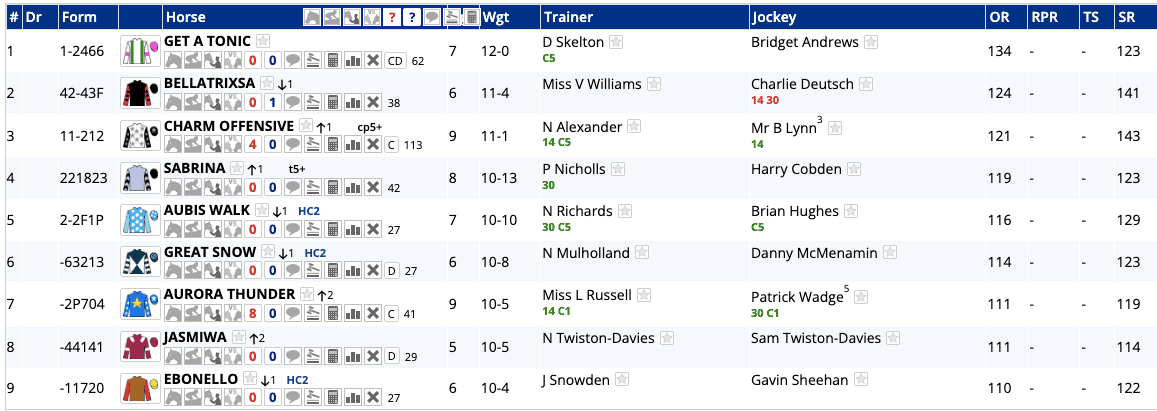
Both Ayr runners on my H4C report go in Class 2 contests, but it's the latter of the two races that interests me most, as E/W backers can get three places in the 3.35 Ayr, where the in-form Charm Offensive takes on eight other rivals in a Class 2, 4yo+ Mares Handicap Hurdle over a left handed 3m½f (after a +60 yards rail movement) on good to soft ground...
Only Jasmiwa won last time out, but that was a Class 4 contest and she's up two grades here. That said, she'll be in good heart, having won two of her last three. Featured horse Charm Offensive has three wins and two runner-up finishes from her last five outings and now steps up one class, whilst Great Snow makes a second handicap appearance after finishing third in a Newbury Grade 2 contest on handicap debut four weeks ago. Aubis was pulled up in that same race on her handicap bow and now also drops in class.
Bellatrixsa and Aurora Thunder are winless in five and eight NH races respectively and whilst the former drops in class here, it'll be tough for the latter stepping up from Class 4. Sabrina has made the frame in seven of her last eight outings, but also steps up in class here. Charm Offensive might well need a run here, after a 113-day absence but aside from last year's winner Get A Tonic coming back from two months off, the rest of this field have all raced since the start of March.
Winning this race last year makes Get A Tonic, the only course and distance winner in the field, as Charm Offensive's two wins here were at 2m4½f/2m5f and Aurora Thunder is the only other course winner, having also won over 2m4½f. Great Snow and Jasmiwa have won at this trip in the past, though and stamina may be the key here.
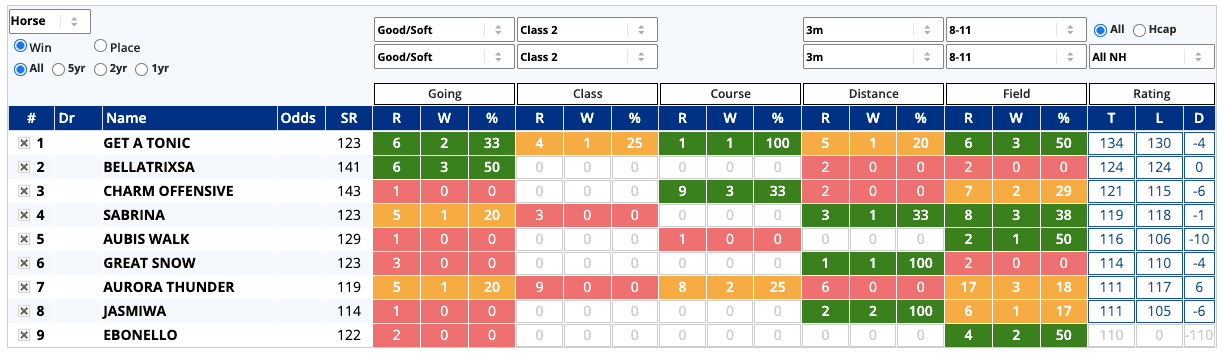
All the above data comes from your racecard above, but clicking the Instant Expert tab will also reveal four previous NH winners on good to soft ground and just the one previous Class 2 success...
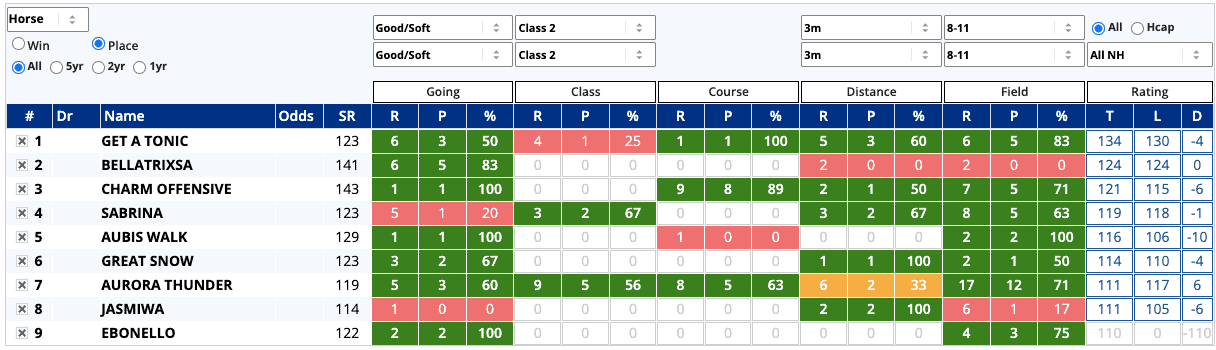
Get A Tonic is that sole Class 2 winner, courtesy of winning this race last year, but she has failed to place in the three defeats at this level. Sabrina has made the frame in two of three Class 2 runs and Aurora Thunder managed to place in five of her nine efforts, but a 0 from 9 win record is worrying, as is her 0 from 6 at the trip. If we looked a little closer at place form...
...we'd probably not fancy Sabrina on good to soft ground and we'd still have questions about Aurora Thunder staying the trip. Charm Offensive's record here is exceptional, but she has a career record of just one win from five at any trip beyond 2m5f, but she has made the frame in three of the four defeats.
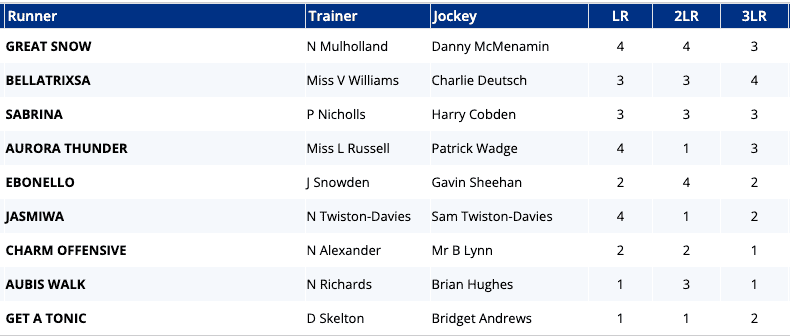
I suggested that stamina could well be the key here and there's quite a few way this field have approached their recent outigs and if we consider how they've raced in their last three contests...
...you'd expect class-dropper Great Snow to be setting the pace here, closely followed by Bellatrixsa and Sabrina, whilst last year's winner Get A Tonic looks like he has been waited with of late, despite that win here coming from a prominent racing position. Last year's tactics have proven to be more successful than a hold-up approach here...
...and she'd probably be best served by a switch in tactics here, if she's to succeed, as might well Charm Offensive.
Summary
For me, the one to beat is Great Snow. She ran really well to finish third of fifteen in a Grade 2 handicap four weeks ago and with her front-running tactics could be difficult to catch/beat. She's unexposed and has already won over three miles and the only surprise to me is that she's available at 9/2 with Bet365.
As for who might chase her home, Get A Tonic won this last year, Charm Offensive loves it here and both should go well, but wouldn't be E/W bets at just 6/1 and 9/2 respectively. I don't normally dip below 8/1 for an E/W pick and based on that Sabrina would be the likeliest. She'll be up with the pace, has gone well at class/trip before and if it dries out any, she could edge one of the others out for a place.
Saturday's free feature is the Trainer/Jockey Combo (TJC) report, which works by bringing together the form of trainers and jockeys into a single composite report that has produced excellent results for users. Basically, some trainers turn to specific riders when they have one ‘ready to win’ and this report quickly identifies the most profitable of those combinations. Clicking on any row will reveal the entries for that trainer/jockey pairing whilst clicking on the entry will open the race in a new tab.
HINT: Look for a good sample size – ideally five or more – combined with a decent win percentage (30%+), and a positive figure in the profit columnand as ever, please refer to our User Guide for further information.
My own settings for the TJC Report look like this...
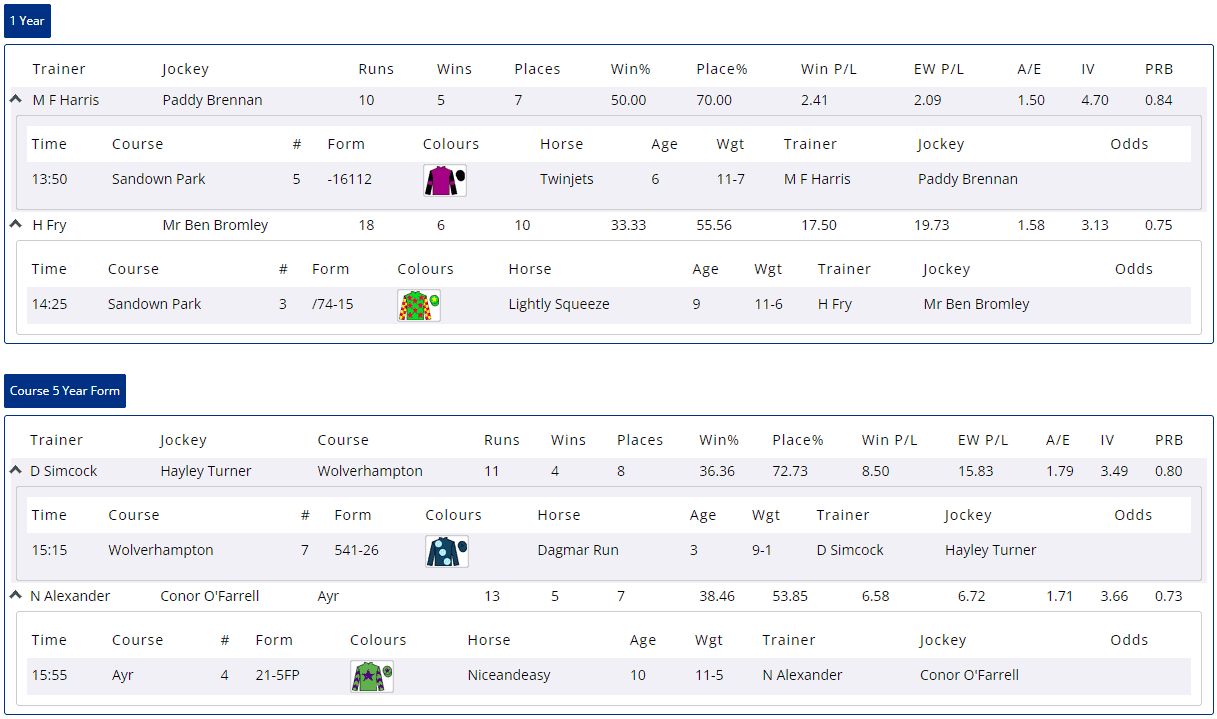
...and they have generated a pair of runners for both the 1-year form and course 5-year filters...
...for me to consider in addition to our selection of daily 'free' races...
1.50 Sandown
3.05 Hereford
3.55 Ayr
4.20 Gowran Park
4.25 Wolverhampton
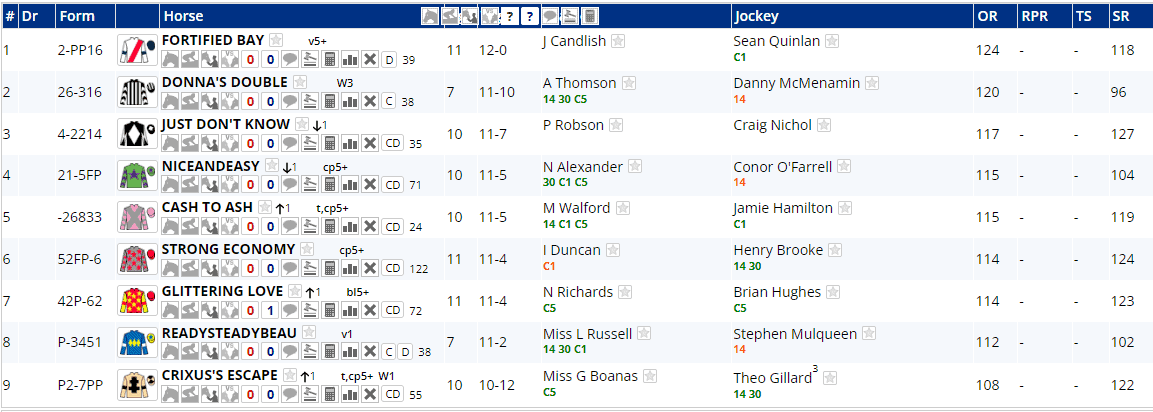
...and with a couple of my TJC Report qualifiers running in 'free' races it makes sense to focus on one of those. The Sandown race is clearly the better standard, but 17-runner novice handicaps aren't really my bag, so let's focus on the 3.55 Ayr, a 9-runner, Class 3, 5yo+ handicap chase over a left-handed three miles on good/good to soft ground...
Joint youngest (with Donna's Double) Readysteadybeau is the sole LTO winner in the field, but Glittering Love was a runner-up beaten by just a head. Cash To Ash, Strong Economy, Glittering Love and Crixus's Escape are all winless in five and the latter in one of a few with plenty of letter in their formline, as his last seven races contain 4 x pulled up and a last of seven. Perversely, he was a runner-up in the other two!
Plenty of Class movement here, as only top-weight Fortified Bay, Donna's Double, Strong Economy and Readysteadybeau ran at Class 3 LTO with Just Don't Know and Niceandeasy both dropping down a class and Cash To Ash, Glittering Love & Crixus's Escape all up from Class 4, which doesn't inspire confidence in latter who has failed to complete his last two at a lower grade.
LTO winner Readysteadybeau wears a visor for the first time here, whilst bottom weight Crixus's Escape returns from an eight break during which he had wind surgery, but he's not the one who has been away from the track the longest as Niceandeasy (71 days), Strong Economy (122d) and Glittering Love (72d) all come off 10+ weeks absences. The rest of the field have raced in the last 24-40 days and they might well have the edge being more "match-fit" to steal a footballing term.
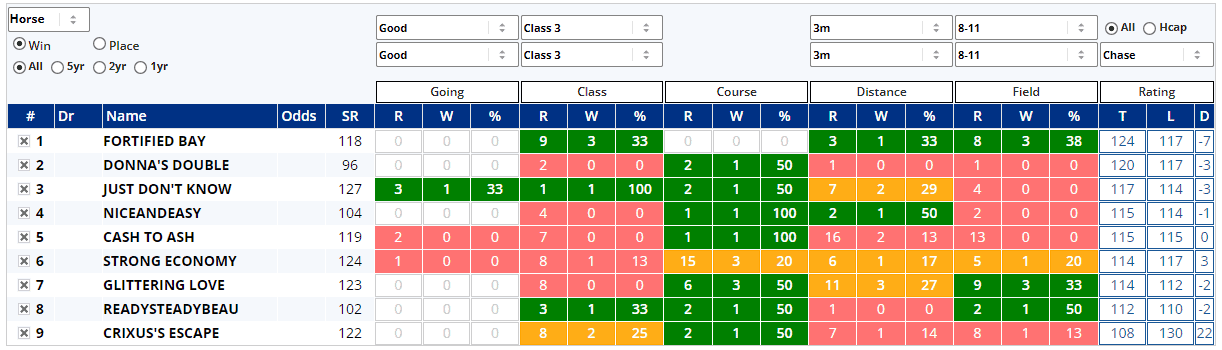
All of them have had some success at course, distance or both. Fortified Bay is the only one yet to win here, but has won at Newcastle over three miles. Of the remaining eight runners, all bar Donna's Double and Readysteadybeau are former course and distance winners, with Niceandeasy winning this race last year and Cash To Ash winning the year before! Donna's Double dis win a 2m4½f chase here whilst Readysteadybeau has won a 2m5½f chase here and a 3m½f hurdle at Haydock. As for their records over fences on similar ground conditions and class, we always have Instant Expert...
...which as well as highlighting lots of great course form does ask some questions about several of these. This race was a Class 4 contest when Niceandeasy and Cash To Ask won it recently and neither have won a Class 3 chase yet and are a combined 0 from 11, but that's not as bad as Strong Economy & Glittering Love's total of 1 win from 16. These numbers put all four at risk here and Cash To Ash's record over this trip is pretty poor too at 2 from 16, as is the 1 from 7 scored by Crixus's Escape, whose form has been so bad (11 without a win) that he's now some 22lbs lower than his last winning mark.
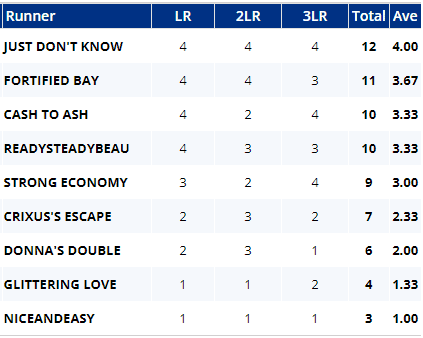
In terms of the ideal pace profile here, we're looking for a horse that likes to be up with the pace if this is anything to go by...
...with those running in mid-div or further back winning just 6 of 108, as opposed to 20 front-end winners from 105 winning almost 3.5 times as often and that's going to suit the likes of Just Don't Know, Fortified Bay, Cash To Ash and Readysteadybeau, based on recent outings...
Summary
The pace angle is going to be so important here and I think the top four on the pace chart is the place to start. My first job, of course, is to get rid of one of them for my top three shortlist and it's a pretty easy call to eject Fortified Bay from proceedings based on his inconsistency (3 x PU in his last 7)and the fact he's top weight.
So, we have three and whilst Cash to Ash is still in my mix, I don't see him repeating his 2021 success this time. He's only 2 from 23 over fences but has made the frame 11 times (47.8%) showing that he's essentially a near-miss type generally worth backing E/W or for a place, but not a winner. He's currently 7/1 here, which is borderline for my own E/W confort zone, but you can make your own call on the price.
All of which brings us to Just Don't Know and Readysteadybeau, who'll both be very prominent here and there's not much between them, but Just Don't Know runs off the same mark as LTO (Ready is up 2lbs), JDK scored slightly better on Instant Expert, drops in class and is a former course and distance winner and I think that his current (4.25pm) 5/1 price with both Bet365 & Hills represents better value than his rivals 5/2 & 3/1, so it'd be Just Don't Know for me here.
It's Valentine's Day on Tuesday and I'm just back off a long/heavy weekend, so I'm not exactly feeling the love. Hopefully the racing will provide a spark for me and The Shortlist is Tuesday's free Geegeez GOLD feature and it's a simple (usually brief) report highlighting those horses with a largely ‘green’ profile in the Instant Expert Report each day and it covers win or place stats for both the current and the next day's racing.
GREENis good (33% or better win rate) – worth 3 points AMBERis quite good (16-32% win rate) – worth 1 point REDis not so good (0-15% win rate) – worth -1 points GREY means there is no available data for that factor - worth 0 points
The final column, ‘Score’, is the sum of the previous five ‘colour’ columns, with 15 being an all green profile, and 9 being the lowest score appearing on this report.
HINT: The best bets are not necessarily the highest scores. Rather, they are often the biggest difference between a Shortlist horse and the ‘best of the rest’ in that race.
N.B. Shortlist selections are unlikely to make a profit, at SP at least, to blind backing. Our recommendation has always been that The Shortlist should be a starting point rather than an end in itself. That said, it continues to highlight horses whose chance is better than recent form and its odds might imply.
[Please refer to our User Guide for further information] and here is Tuesday's Shortlist...
...where Hoganville & Statu of Liberty are of obvious interest. As ever, the daily feature is complemented by a selection of fully functional racecards opened up to all readers and for Tuesday they cover...
3.00 Lingfield
3.55 Ayr
7.30 Newcastle
Both of the interesting Shortlist horses run in 'free' races, so let's quickly see if either are worth backing, starting with Hoganville in the 3.55 Ayr, an 11-runner, Class 4, 4yo+ handicap hurdle over a left handed 3m on good to soft ground...
HOGANVILLE arrived from Ireland last summer with a 0 from 9 record for Paul Nolan in Ireland, but he has since finished 1113 in his four starts for George Bewley with his second win coming over course and distance in late October. This run of form took his mark from 96 to 112 and he was beaten by 13 lengths in to third last time out under today's weight; a mark that might ask a little too much of him. He'd had a month's rest, though, so who knows?
Instant Expert suggests that he's one of the few who should relish the conditions...
...and those four at the top may well be where the winner comes from in a race that in the past has rewarded those getting on with it more than those who want to be waited with...
This field's recent races have looked like this...
...and of the four from Instant Expert, I'd have to omit hold-up horse Nicandeasy, leaving me with Apple Away, Hoganville & Leostar to consider in my summary later.
*
Race 2 sees top-weight Statu of Liberty make just a second handicap run in the 7.30 Newcastle, an 8-runner, Class 5, 3yo A/W handicap over a straight 5f on standard to slow polytrack...
STATU OF LIBERTY was a winner here in a 6f maiden three starts ago for Brian Meehan, but finally made her handicap debut at Southwell last time out almost four weeks ago. That was her seventh career run and first for new handler Michael Dods, but could only finish 6th of 7, beaten by almost 4.5 lengths.
She's down in trip and has been eased 3lbs by the assessor, but she'd still have room to improve if she wants to win here. That said, she's the main eye-catcher in another sea of red on Instant Expert...
...where Colors of Freedom also has some good numbers, especially over this trip. Based on recent outings...
I'd imagine the field will have chase to Statu of Liberty down to win, as she appears to be one most likely to set the tempo of the contest in a race that has favoured front runners in the past...
.
So far so good for Statu, then and the draw has her in stall 2 with only Tantalus inside her, but sadly the higher drawn runners have done much better here...
...but pace is more important than draw here over a straight 5f, as shown by the pace/draw heat map...
Summary
In race 1, we got it down to Apple Away, Hoganville & Leostar and they're priced at 5/2, 6/1 and 8/1 , from which only Leostar is worth backing E/W (keep an eye out for firms paying 4 places). All three are capable of making the frame, but if pushed for the winner, I'd fancy Apple Away to 'pip' (sorry!) the other two.
As for the evening contest at Newcastle, Statu of Liberty has plenty going for her, but I do fancy the top two in the market Sugar Hill Babe (5/2) and the 11/4 Colors of Freedom to beat her, but Statu currently trades at 9/1, so is of E/W interest.
Before I post the daily selection, just a quick reminder of how I operate the service. Normally, I'll identify and share the selection between 8.00am and 8.30am and I then add a more detailed write-up later within an hour or so of going "live".
Those happy to take the early price on trust can do so, whilst some might prefer to wait for my reasoning. As I fit the early service in around my family life, I can't give an exact timing on the posts, so I suggest you follow us on Twitter and/or Facebook for instant notifications of a published pick.
...in a 14-runner, Class 6, Flat Handicap for 3yo+over 7½f on Good ground worth £2,782 to the winner...
Why?...
Going to keep things nice and simple today, starting as usual with our self-explanatory racecard...
So, horse running pretty well, top of the Speed Ratings and representing an in-form yard. The elephant in the room from the racecard is trainer Iain Jardine's poor return over the last year at this venue denoted by the C1, of course. However that refers to all his runners here over the past 12 months, NH & Flat, handicap and non-hcp etc etc. It also only represents a small time frame and in certain circumstances, the Jardine runners are worth following here, as...
...since 2015 in Class 4-6 Flat handicaps over 6f to 1m5½f at odds of 7/4 to 13/2, the numbers are far more attractive at...
... an A/E of over 1.5, a near 1 in 3 win ratio and almost 65p in the pound profits at Betfair SP are all good to see and eliminate plenty of bets we'd not want to be making. And from those 48 runners above...
14/41 (34.2%) for 33.7pts (+82.2%) racing off a mark (OR) higher than 55
11/29 (37.9%) for 25.8pts (+88.9%) had raced in the previous 15 days
11/26 (42.3%) for 26.2pts (+100.8%) had made the frame LTO
and 6/12 (50%) for 17.1pts (+142.5%) had finished third LTO...
...whilst those racing off a mark higher than 55 within 15 days of a placed finish LTO are 7 from 14 (50% SR) for 17.2pts (+122.6% ROI), including 3 winners from 5 (60%) for 10pts (+200%) from those who were third LTO...
...and this simple approach points to... a 1pt win bet on Equidae @ 4/1 BOG(or bigger in places) as was available at 8.05am Monday, but as always please check your own BOG status (*some firms are not BOG until later in the morning). To see a small sample of odds offered on this race...
P.S. all P/L returns quoted in the stats above are to Betfair SP, as I NEVER bet to ISP and neither should you. I always use BOG bookies for SotD, wherever possible, but I use BFSP for the stats as it is the nearest approximation I can give, so I actually expect to beat the returns I use to support my picks. If that's unclear, please ask!
https://www.geegeez.co.uk/wp-content/uploads/2020/07/SotDimage.jpg320830Chris Worrallhttps://www.geegeez.co.uk/wp-content/uploads/2022/10/geegeez_banner_new_170x78.pngChris Worrall2020-08-24 07:11:142020-08-24 07:37:21Stat of the Day, 24th August 2020
The lockdown is easing and racing will resume in Scotland from this week. Time for a trip north, then, to analyse the draw and pace data from Ayr racecourse, writes Dave Renham. As with previous articles in this series I have used some of the tools available on the Geegeez website, specifically the Draw Analyser, the Pace Analyser and the Query Tool. The main period of study goes back to 2009 but, as before, I will examine a more recent data set in detail too (2015 to 2019) where appropriate. I will be focusing once again on 8+ runner handicap races.
Ayr is a left-handed course roughly 12 furlongs in circumference and is generally considered to be a track that suits galloping types. The 5f and 6f races take place on a straight track, with longer races using the round course. As can be seen from the course map below, there are a number of undulations in the back straight and a dip then a rise in the home straight. The five furlong course is largely uphill.
Let’s start with the sprint distances:
Ayr 5 Furlong Draw Bias (8+ runner handicaps)
Since 2009 there have been exactly a hundred qualifying races so no need for a calculator to work out the draw percentage splits! Here are the 11 year stats:
High draws have been at a disadvantage looking solely at the win percentages for each third. Looking at A/E values, these show an excellent correlation with the draw win percentages:
At the minimum trip of five furlongs, both sets of data point clearly to high draws struggling.
However, before moving on, it is important to realise that Ayr is one of the rare courses where they use three different positions for the starting stalls. Here is the breakdown for each stall position:
Ayr 5f Draw Bias when stalls are in the centre (37 races)
With the stalls in the centre the figures are quite similar to the overall ones, although higher draws seem to struggle even more.
Ayr 5f Draw Bias when stalls are stands' side (39 races)
The stalls when placed stands’ side mean that higher draws are drawn against the near rail. It seems that higher draws are more competitive in this scenario, but as a general rule the ground next to that rail looks likely to be slightly slower than the centre or far side, as such horses still struggle.
Ayr 5f Draw Bias when stalls are far side (24 races)
Low draws are drawn right next to the far rail when the stalls are placed in this position and although the data is limited, those drawn on the far side seem to enjoy a decent edge. It will be interesting to see whether the six furlong data supports this (more of that later).
Ayr 5f Draw Bias (by going and field size)
There is no clear-cut going bias, and the same is true when analysing field size data.
However, in bigger field races (16 or more runners) there have been several occasions when individual races have apparently shown a draw bias. The difficulty lies in the fact that the bias is not consistent and has no clear pattern. Having said that, of the 19 races with 16+ runners since 2009, I believe that at least twelve have shown a significant bias. I won’t go through all of that dozen, but here is a flavour:
15/9/11 – a 17 runner race where low draws seemed in charge with horses drawn 4 and 1 filling the first two places and draw 2 was back in 5th;
21/9/12 – a 16 runner race where there was an even split with eight horses going far side (low) and eight coming stands’ side (high); 5 of the first 6 home raced far side;
19/9/13 – in this 20 runner race 14 horses raced stands’ side (high) and 6 raced far side (low). 11 of the first 12 horses home raced stands’ side with the first three horses home drawn 17, 16 and 18;
20/9/13 – a 24 runner sprint where there was an even split with 12 runners coming stands’ side and 12 staying far side; 7 of the first 8 home came from the stands’ side group (high);
19/9/14 – a 20 runner race where taking non runners into account the first 8 horses home were drawn 13, 15, 4, 12, 18, 17, 11 and 20.
15/9/16 – the first 8 runners home were drawn 1, 3, 7, 2, 8, 12, 6 and 4 in a 19 runner race;
13/8/18 – 5 of the first 6 home exited from double figure draws (16 ran).
For those interested in exotic bets, if you had hedged your bets in terms of not being sure whether low or high draws would be favoured, and permed both very high draws and very low draws in straight forecasts, you would have seen a huge profit across these 19 races. Perming the four lowest draws and also the four highest draws would have produced 6 winning bets from the 19 races. Assuming an outlay of £24 per race (2 x £12 perms) the outlay on these forecasts would have been £456; but the dividends would have combined to return a whopping £1074 giving a profit of £618. As I have stated before past profits are no guarantee to future profits, but selective draw focussed forecasts have served some punters very well over the years (including me).
It is time now to break down the draw by individual stall number. I use the Geegeez Query Tool to give me the relevant data:
Profits for draws 3, 4 and 6 which given their grouping suggests again lower rather than higher draws are often the place to be.
Ayr 5f Draw Bias (2015-2019)
Homing in on a more recent data set, looking at the past five seasons (2015-2019), below are the draw splits for the 37 races that have occurred during this time frame.
As can be seen, high draws have struggled even more in recent years but, interestingly, middle draws have performed particularly well. 37 races is a relatively small sample but it does seem that middle draws currently hold sway.
The A/E values correlate with the draw segment percentages above:
Below are the five-year stats for individual stall numbers:
A blind win profit for just draws 1 and 6, those two stalls book-ending the section to be: that six-berth segment has secured 27 of the 37 races with an A/E of 1.07. Their overall strike rate is 12.2%, whereas horses drawn 7 or higher have won 10 races with a strike rate of 4.4% and an A/E of just 0.54.
Ayr 5f Pace Bias (8+ runner handicaps)
Let us look at pace and running styles now. The overall figures (2009-19) are thus:
There is a clear edge for front runners and those racing close to the pace (prominent) – as we know from previous articles this is the norm over 5f at most courses. It is not the strongest front-running bias around but still significant enough.
If we look at medium- to smaller-sized fields (8 to 12 runners) front runners seem to enjoy a slightly stronger edge:
I also had a look at the 19 races discussed earlier with big fields of 16 runners or more. Amazingly, 13 of the 19 races were won by horses that raced prominently (A/E 1.32).
I have checked ground conditions and there is nothing noteworthy to share.
Ayr 5f Draw / Pace Combinations
Finally in this 5f section a look at draw / pace (running style) combinations for front runners over this minimum distance. Remember this is looking at which third of the draw is responsible for the early leader of the race (in % terms):
I had expected this even split especially considering the variations in stalls positions.
Here is the draw/pace heat map, displaying Percentage of Rivals Beaten. A score of 0.55 or greater is material:
The image clearly shows the benefit of racing on or close to the lead, and ideally not being drawn too high.
Ayr 5f Draw / Pace Bias Conclusions
In conclusion, low to middle draws have the edge over five furlongs in handicaps of eight-plus runners. I highlighted draws 1 to 6 in the more recent 5-year data as having a definite edge over higher draws – looking at the full 11-year dataset this has been the case, too. Draws 1 to 6 have won 71 races from 600 runners (A/E 1.07); draws 7 or higher have won 29 races from 596 runners (A/E 0.56). Pace wise, front runners fare best followed by horses that race close to the pace (prominent).
*
Ayr 6 Furlong Draw Bias (8+ runner handicaps)
The six furlong trip has had 171 qualifying races between 2009 and 2019 which equates to around 15 races per year, a decent sample. Here are the win percentages by draw third:
Low draws seem to have a small edge here and as with the 5f data high draws have had the worst of it. Having said that high draws have been at a bigger disadvantage over five furlongs than six.
Let’s look at the A/E values to see if they correlate with the draw percentages:
Low draws seem to have offered decent value overall – higher draws have a poor figure of 0.60 which is similar to their figure over the minimum (0.56).
Onto examining whether the position of the stalls have made any difference:
Ayr 6f Draw Bias when stalls are in the centre (72 races)
With the stalls in the centre it has been a very even playing field in terms of the draw over 6f.
Ayr 6f Draw Bias when stalls are stands' side (53 races)
The stalls when placed stands’ side (high) seem to put higher draws at a distinct disadvantage. This is surprising from a logic perspective, but again seems to highlight that the ground near to the stands’ rail tends to be slower than the rest of the straight track.
Ayr 6f Draw Bias when stalls are far side (45 races)
As with the 5f stats, the 6f results give those horses drawn next to the far rail (low) a decent edge. However, before we get too excited, in 2019 there were no races at all with the stalls placed on the far side over five or six furlongs. I am not sure why this was the case: what does seem to be happening is that, as the years go by, more races are seeing the stalls placed in the centre of the course. In 2019 over 5f and 6f just under 70% of all races had the stalls placed in the centre. I wonder if course officials are attempting to make sprint races ‘fairer’ in their eyes by trying to encourage horses to come down the centre of the track.
Time to look at how individual draw positions performed over the 1- year period between ’09 and ‘19:
As you would expect with so many races very few stalls show a blind profit; draws 26 and 27 are two of the three but from very small samples. Draws 1 to 4 have fairly decent A/E values which is worth noting.
It could be reasonably argued that a draw close to either rail is an advantage. To that end, field size does seem to have some impact – in smaller fields of 8 to 10 runners high draws have struggled, winning just 14 of 82 races (SR 17.1%) with an A/E of 0.43. In big field races (16+) higher draws have performed much better, winning roughly a third of the 38 races (13 wins).
In terms of ground conditions it seems that lower draws enjoy more of an edge when the ground eases. There have been 78 races on ground described as good to soft or softer over 6f since 2009, of which low draws have won 36 (SR 46.2%). The A/E value is positive, too, at 1.14.
One of the biggest sprint handicaps of the year occurs at Ayr over 6f - the Ayr Gold Cup - run towards the end of September. In addition to the Gold Cup, there are two consolation races – the Silver Cup and the Bronze Cup. Traditionally, the Gold and Silver Cups are raced on the Saturday with the Bronze Cup on the Friday.
Since 2009 there have been ten renewals of each race at Ayr (the 2017 Bronze and Silver Cups were not run due to the meeting being abandoned, while the Gold Cup was switched that year to Haydock). These races always have big fields (average field size is 25) and hence the draw can potentially play a big part. Looking at the races in detail I would estimate that 20 of the 30 races (66.6%) displayed a draw bias; be it one third strongly favoured, or one third being strongly disadvantaged. Earlier in the article it was noted with bigger field 5f races that draw biases had the potential to occur, and we are seeing a similar pattern here.
Unfortunately, just like the 5f races, it has not been easy to predict which part of the track, if any, will be favoured. Having said that digging deeper has uncovered a potential opportunity. Seven of the Bronze Cups seemed to show a draw bias; when this draw bias occurred, the same or a very similar bias occurred the same year in the Silver Cup in four of the seven corresponding races. In the four years where the Bronze and Silver Cups had similar draw biases, the Gold Cup displayed a similar bias in three of them and, it could be argued, in the fourth as well. The best example of this happened in 2016:
In the 2016 Bronze Cup it was clear high draws were at a disadvantage. Seven of the first eight horses home were drawn in single figures (5, 7, 8, 17, 6, 1, 9, 3) – 24 ran; in the Silver Cup the following day, low to middle held sway again with five of the first eight home drawn in single figures and best finish from the top third of the draw was 9th (25 ran). The Gold Cup which followed just over an hour later saw low to middle again in charge with draw 8 beating 6 with 7 back in third; draws 11, 10, 14 and 4 filled the next four places (23 ran). Again, there was no sign of a horse from the top third of the draw.
Ayr 6f Draw Bias (2015-2019)
Onto the last five seasons now for 6f handicaps at Ayr. There have been 79 qualifying races since 2015, with the draw splits as follows:
High draws have really struggled in recent years. Consequently, to some degree, low draws have had the best of it.
The A/E values (2015-2019) underpin that notion:
There is an excellent correlation between the draw third percentages and the A/E values which adds confidence to the data.
Now a look at the individual draw figures for this latest 5-year period:
Draws 2, 4, 5 and 6 have all shown a profit in the win market, again highlighting the low draw edge in recent years. Those drawn 21+ in very big fields have also performed well from a small number of qualifying races.
Ayr 6f Pace Bias
Below is a breakdown of pace and running styles. Here are the overall numbers going back to 2009:
These figures show that front runners have an edge and it is a similar edge to the one such forward-going types enjoy over five furlongs.
In big field races the edge for front runners is wiped out, and looking at the data for the Bronze, Silver and Gold Cups, horses that raced mid-pack have definitely over-performed albeit from a relatively small sample of 30 races.
When the going gets testing the front running bias has increased. There have been 40 races on soft or heavy ground since 2009 and here are the pace splits (NB. One dead heat):
The further you are from the early pace the worse it seems to be on soft or heavy going.
Ayr 6f Draw / Pace Combinations
A final table in the 6f section is a look at draw / pace (running style) combinations for front runners in 6f handicaps (2009 – 2019):
It is interesting seeing more low drawn horses getting to the lead over 6f. I'm not sure why that is and, as stated earlier, considering the fact there are three varying stalls locations, one would have expected a more even split.
Again, the heat map highlights the benefit of being forwardly placed, and the difficulty that high drawn later runners have experienced.
Ayr 6f Draw / Pace Bias Conclusions
In conclusion, lower draws have held sway over the last decade or so with the bias seemingly getting stronger in the past five seasons. High draws have really struggled recently except when the stalls have been placed in the centre. The shame for draw bias fans, as I noted earlier, is that more and more races seem to have the stalls placed in the centre over 6f at Ayr. Pace wise, it is again those racing on the front end who have the upper hand and this seems to strengthen as the ground gets softer.
*
Ayr 7 furlongs Draw Bias (8+ runner handicaps)
The seven-furlong trip takes in the round course with low draws positioned next to the inside rail. There is a sharp turn soon after the start where runners can get fanned quite wide into the home straight.
170 handicap races have been run with eight or more runners since 2009. Here is the draw breakdown:
That is about as even a split as you could get! So low draws, despite potentially having the chance to take the shortest route around the turn, do not have any obvious advantage. Onto the A/E values:
A commensurately even set of figures, as might be expected. The market looks to have it pretty much spot on.
However, field size does seem to matter from a draw perspective as races with 12 or more runners illustrates:
As the field size increases so horses drawn wider start to be disadvantage. This makes sense as the widest drawn horses are likely to have to run further if staying out wide on the track, or risk trouble in running if making their way towards the inside rail. The A/E figures correlate with the draw percentages for these bigger fields.
Looking now at ground conditions, high draws also seem to struggle as the ground gets softer. On soft or heavy ground there have been 43 races with the following draw splits:
The A/E values correlate neatly once again:
So although the basic statistics suggested little interest from a draw perspective, we can see that in bigger fields and on soft/heavy ground high draws do seem at a disadvantage.
Combining 12+ fields on soft or heavy has seen only 20 races but the bias against high draws is clear to see with just two victories from that third of the draw (10 wins for low draws and 8 for middle draws).
Let us look at the individual draw positions next:
Little to report here as one might expect – just stall 8 in profit which essentially is down to chance.
It is time to check out the more recent subset of data, from 2015 onwards. There have been 97 qualifying races giving the following draw breakdown:
This correlates strongly with the 11-year full set, with an extremely level playing field in terms of the draw. The A/E values again match up with the draw percentage figures:
For what they are worth here are the individual draw positions:
Randomly, four stalls are in profit; but that is all that it is... random.
On soft/heavy ground in the last five seasons high draws have struggled, as they did when examining the 11-year stats – they've recorded just four wins from 22 races (18.2%). Low draws dominated this period winning 13 of the 22 races (59.1%). Likewise, in bigger fields (12+ runners) high draws have found it hard winning just six of the 34 races (17.6%).
Ayr 7f Pace Bias
A look at the overall pace data now (2009-2019):
Front runners seem to have a slightly stronger edge when compared to the two sprint distances. The 1.41 A/E value is above the average A/E for all UK courses over 7f which stands at 1.26, as is the IV score of 1.80 (UK course average IV for front runners in 7f handicaps is 1.63).
As a reminder, over six furlongs the edge for front runners seemed stronger on soft/heavy going, and that seems to be the case here, too. The sample size is 42 races:
1.82 is a noteworthy A/E value, and is coupled with a score above 2.0 for Impact Value. This is material.
Ayr 7f Draw / Pace Combinations
Finally over 7f a look at draw / pace (running style) combinations for front runners in 8+runner handicaps (2009 – 2019). One might have expected low draws to lead more often as they have the inside berths:
These figures surprised me – clearly for some reason jockeys drawn low are not taking advantage of the inside rail. This is also the case in bigger field races where low drawn runners only take the lead 30.8% of the time.
The heat map below - all 8+ runner 7f handicaps - shows clearly where you need to be: front rank and drawn low to middle.
Ayr 7f Draw / Pace Bias Conclusions
To conclude, over 7f the draw in general is extremely fair, but on soft/heavy ground or when the field size reaches 12 or more, higher draws then start to be at a disadvantage. Pace wise it is front runners who are clearly best.
*
Ayr 1 mile Draw Bias (8+ runner handicaps)
With this article on the long side I am going to very briefly look at one more distance: the 1 mile trip. I will start by looking at the 2009-2019 data. There are 167 races in the sample, giving the following draw splits:
There is no clear draw bias on the basis of these stats and, sadly, digging deeper unearthed no pleasant surprises like there were over 7f.
However, going back to the late 1990s, this mile trip had a significant bias to those drawn next to the inside rail (low). I will use the 5-year comparison data method I used in the second Chester article to illustrate how the bias has essentially all but disappeared.
To recap, using 5-year data sets is a good way to try and compare any shift more effectively than simply looking at single years. This method highlights where patterns or biases are changing, as well as giving more reliable sample sizes. So here are the Ayr 1 mile figures going right back to the first data set (1997 to 2001):
As the table shows, low draws completed dominated until about 2005; since then the advantage gradually began to level and, for a while, low draws actually produced the lowest percentage of winners. In the last two or three seasons there has been a slight resurgence but, essentially, the days when I used to make money from the draw at this particular course and distance are long gone.
The reason? Difficult to say unequivocally but, interestingly, the maximum field size changed in 2006 from 20 to just 14. That might well be the material factor.
Ayr 1 Mile Draw / Pace Combinations
A quick look pace wise at the 1 mile trip but the front running edge seen at 5 to 7f is no longer prevalent.
Prominent runners arguably have a slight edge while front runners find it far harder to win over this extra furlong.
The draw / pace heat map confirms the generally fairer distribution of performance in terms of stall location and run style in Ayr mile handicaps.
*
I hope this article offers some helpful pointers now racing resumes at Ayr; I will be eagerly awaiting the 3 day September meeting which is one of my favourites, but there could be plenty of benefit between now and then, especially if the weather turns wet!
- DR
https://www.geegeez.co.uk/wp-content/uploads/2020/06/AyrDrawBias.jpg319830Dave Renhamhttps://www.geegeez.co.uk/wp-content/uploads/2022/10/geegeez_banner_new_170x78.pngDave Renham2020-06-19 16:43:082020-06-19 16:45:08Ayr Draw & Pace Bias
At around quarter to four tomorrow a craftsman will inscribe in gold leaf the name of the latest winner of the Scottish Grand National on a large oak board at Ayr racecourse. But the board and the race are both interlopers, as until 1965, they were both to be found 14 miles up the coast at Bogside racecourse, just outside Irvine. Read more
https://www.geegeez.co.uk/wp-content/uploads/2022/10/geegeez_banner_new_170x78.png00IanShttps://www.geegeez.co.uk/wp-content/uploads/2022/10/geegeez_banner_new_170x78.pngIanS2012-04-20 11:34:292013-09-02 08:40:54Lost racecourses 2: The Elephant Man
geegeez.co.uk uses cookies to improve your experience. We assume that's OK, but you may opt-out from the settings. Cookie settingsACCEPT
Privacy & Cookies Policy
Privacy Overview
This website uses cookies to improve your experience while you navigate through the website. Out of these cookies, the cookies that are categorized as necessary are stored on your browser as they are essential for the working of basic functionalities of the website. We also use third-party cookies that help us analyze and understand how you use this website. These cookies will be stored in your browser only with your consent. You also have the option to opt-out of these cookies. But opting out of some of these cookies may have an effect on your browsing experience.
Necessary cookies are absolutely essential for the website to function properly. This category only includes cookies that ensures basic functionalities and security features of the website. These cookies do not store any personal information.
Any cookies that may not be particularly necessary for the website to function and is used specifically to collect user personal data via analytics, ads, other embedded contents are termed as non-necessary cookies. It is mandatory to procure user consent prior to running these cookies on your website.








 .
.


