After hours, actually weeks of number crunching, I am able to share my most recent findings regarding pace in 5f handicaps, writes Dave Renham.
In this fourth article I have started to look in more detail at the Geegeez pace data focusing for the most part on the last four runs of each horse. Links to the first three articles are here:
Horses on the Geegeez racecard have pace figures assigned to their last four runs, with the most recent run to the left. To recap the pace figures are split into four groups - Led, Prominent, Mid Division and Held Up. Pace points are given to each group - led gets 4 points, prominent 3, mid division 2 and held up 1. Therefore totals can range between 4 and 16.
My focus for this piece has been 5f handicaps (turf and all weather) with at least 6 runners from 2017. There were 465 such races in total and at present I have manually collated data for 200 of these, from which I will share my initial findings. The plan next month is to complete the research and report back on the results for all the races. Handicaps are generally the best medium for this type of research because one is usually dealing with seasoned campaigners who have raced many times in their careers.
I have noted before that front runners have a significant edge in these short sprints and this is clearly seen from the pace figures of these 200 winners:
Pace figure of winner
4
3
2
1
Win %
25%
43.5%
8%
23.5%
As we can see 25% of all races have been won by the horse that took the early lead. Considering front runners made up around 13% of runners in the sample, we can say that front runners have won nearly twice as often as they should (25% versus 13%); this is assuming all horses have an equal chance in each race. Of course, that may not necessarily be the case, but the 13% figure is not going to be too far away from the true chance. For the record, prominent racers provided 40% of all horses so this pace bracket also win slightly more often than ‘one would expect’; horses that raced mid-division provided around 13% of all runners so have under-performed statistically, as have hold up horses who provided around 34% of all the runners.
As I have mentioned in previous articles, with such an advantage in 5f handicaps it makes sense to investigate ways of trying to predict the front runner. In the third article I looked at the most recent race only and the pace figure gained from it. This time I am going to look at the performance of the top-rated pace runners using the last four races.
In each of the 200 races I collated the pace figures for each horse by putting them in order of pace points, then looking to see from which pace position the winner came. I was hoping of course to see a bias towards the top-rated pace horses in terms of number of wins.
Here are the findings:
Pace rank
Wins
Races
SR%
1
26
200
13.0
2
21
200
10.5
3
26
200
13.0
4
31
200
15.5
5
23
200
11.5
6
17
200
8.5
7
21
179
11.7
8
10
153
6.5
9
10
127
7.9
10
4
96
4.2
11
7
68
10.3
12
2
48
4.2
13
1
32
3.1
14
1
22
4.5
15+
0
9
0.0
Hence the top-rated pace horse (the one with the most pace points) won 26 of the 200 races (13%). On the face of it this does look a little disappointing. It should also be stressed at this point that there may have been 200 races, but due to several of these having joint top-rated pace horses, there were in fact 266 horses that were top- or joint-top ranked.
That brings the win strike rate down to under 10%. Before you reach for the Kleenex, I do have some positive news. If you had backed these top-rated pace horses to level stakes, your 266 selections would have yielded a small profit to SP. Even better returns would have accrued if you had backed them at Betfair SP – at £10 per bet the profit after commission would have been just under £530. This equates to a return of about 20p in the £. Very satisfactory returns for what is essentially a simplistic method.
With a notable difference between the number of winning front-runners and the number of winners with the highest pace rank coming into the race, what these findings indicate once more is that predicting the front runner is far from an exact science. It is clearly not just a case of picking the horse in the race with the most pace points from their last four runs. What that table does seem to indicate though is that the more points you have the more chance you have of winning.
The top-rated pace horse did lead in nearly 40% of the races; the table below shows the run style of the top-rated pace horse in the reviewed races:
Pace Figure
Races
% of horses
4 – Led
105
39.5
3 – Prominent
106
39.8
2 – Midfield
23
8.6
1 – Held up
32
12.0
So those top-rated pace horses coming into a race have generally led or raced up with the pace, which is clearly what one would expect. However, when I started this series of articles I was hoping to find a method that would predict the front runner at least 50% of the time, if not 60%. Not around 40%! It is interesting to note that in the third article I found that horses that had led in a 5f handicap last time out, went on to lead in their next race 42.5% of the time. So perhaps the most recent race is more important than combining the last four when looking at pace figures, though in truth the difference in terms of the sample size is negligible.
My next port of call was to look at the actual pace figure gained by the top rated or joint top-rated pace horse. 16 (four pace figures of 4) is the highest pace figure a horse can achieve.
Here are the findings:
4 race pace total (top rated horses only)
Wins
Runs
SR%
16
2
31
6.5
15
8
78
10.3
14
7
87
8.0
13
5
32
15.6
12
2
32
6.3
11
2
5
40.0
10
0
1
0.0
These figures suggest nothing particularly clear cut at this stage – however, when I have looked at all 465 races hopefully a pattern may start to emerge.
Before moving on I would like to discuss a theory. There is a perception that if there are two or more potential front runners in a race, then that race will be set up for a ‘closer’. The theory is that there will be a strong battle for the lead where the leaders essentially ‘cut each other’s throats’ – allowing a horse to come from off the pace and win.
I wanted to try and test this theory as best I could. I decided therefore in each race to work out the pace average of the top four rated pace horses. If the theory held any validity, then I expected the record of the top rated pace horse would be poor when the four horse pace average was higher. Here are the findings:
Top four rated pace average
Top rated pace runners
Wins
SR%
BSP profit to £10 stakes
ROI%
14 and above
48
3
6.3
– £220
– 45.8
13 to 13.75
77
5
6.5
– £193
– 25.1
12 to 12.75
69
5
7.2
– £232
– 33.6
11 to 11.75
51
7
13.7
+ £363
+ 71.2
9 to 10.75
21
6
28.6
+ £320
+ 152.4
It seems that this theory does hold water, although I appreciate that not all top-rated pace horses lead. Having said that most top-rated pace horses race up with the pace and thus are not coming from ‘off the pace’ to win. The races where the top four horses averaged 14 or above produced the lowest strike rate and the worst returns. Conversely the races with relatively low averages produced extremely positive returns.
I have also looked at the combined win and placed strike rates to see if they correlate with the win strike rates:
Top four rated pace average
Top rated pace runners
Wins / places
Win/placed SR%
14 and above
48
10
20.8
13 to 13.75
77
19
24.7
12 to 12.75
69
22
31.9
11 to 11.75
51
19
37.3
9 to 10.75
21
12
57.1
It is pleasing to see the win and place strike rates increase as the four horse pace average decreases – just like the win data showed.
This takes me onto the second theory where there is a perception that if there is just one ‘genuine’ front runner in the race, that runner has a good chance of getting a ‘soft’ lead and this increases their prospects of leading all the way. The table above seems to suggest when there is less ‘pace’ in the race, potential front runners have a better chance of winning. However, we cannot be sure that a race with, say, a top four rated pace average of 11 has a sole front runner. Consider the following two scenarios:
Scenario 1: Pace average of top four pace horses = 11
Horse A – 15
Horse B – 10
Horse C – 10
Horse D – 9
Scenario 2: Pace average of top four pace horses = 11
Horse A – 12
Horse B – 12
Horse C – 11
Horse D – 9
One way to perhaps test this ‘soft’ lead theory is to look at the gap between the top rated pace horse and the second top rated pace horse. Here are these findings looking at the performance of the top rated pace horses in each case:
Gap between top and 2nd rated
Top rated pace runners
Wins
SR%
BSP profit to £10 stakes
ROI%
0
126
10
7.9
– £364
–28.9
1
75
4
5.3
– £495
–66.0
2
44
7
15.9
+ £323
+73.4
3
15
4
26.7
+ £525
+350.0
4
5
0
0.0
– £50
–100.0
5
1
1
100.0
+ £85
+850.0
This once again is not a perfect test because the top rated pace runner does not always lead! However, what it does seem to suggest is that the top rated pace horse has done extremely well when there has been a gap of at least 2 points between them and the second rated. I appreciate the data set is relatively small, but nonetheless the signs are good. I did look at the win and placed data here and the correlation was less strong – the problem perhaps is the data set for a gap of 3 or more is so small. I will revisit this after looking at all the races and share that data. [Alternative theory for lack of place correlation is that trail blazers are often binary types, who either win or drop out completely – Ed.]
For the final part of this article I want to look at the profile of the 200 winners in terms of pace. I initially looked at their four race pace totals and noted that 128 winners (SR 64%) had a total of 10-16 while 72 winners (SR 36%) had a total of 4-9. It seems therefore at first glance that the horses with higher pace ratings have outperformed those with lower ones. However, we can all manipulate data and hence we need to know how many runners were in each of the two pace brackets. Fortunately we have a relatively even split as the table shows:
4 race totals for all runners
Win SR%
% of actual runners in all races
Between 4 and 9
36%
48.5%
Between 10 and 16
64%
51.5%
To clarify this means that horses with a pace total of 10 or higher (from their last four runs) have won 64% of all races from 51.5% of the total runners. Hence, as we would have hoped, horses with higher pace ratings do perform better in 5f handicaps than lower pace rated horses. In reality if ‘pace’ made no difference whatsoever then these horses should be winning 51.5% of races not 64% - in reality, they are roughly 1.25 times more likely to win than statistically they ought.
So, it’s time now to start looking at the other 265 races to see whether the statistical patterns noted in this article are replicated over a bigger sample. At present we can make the following observations:
Front runners have a huge edge in 5f handicaps
Top pace rated runners (using the last four races) have a relatively low strike rate but have shown a 20% profit to BSP
Top pace rated runners have taken the early lead around 40% of the time (led or raced prominently in just under 80% of races)
Top pace rated runners have a much better strike rate in races where the top four pace rated runners produce an average of less than 12
Top pace rated runners have a much better strike rate in races where they have a 2 point or bigger gap to the second pace rated horse
Horses pace rated 10 win almost twice as often as those rated 9 or lower
https://www.geegeez.co.uk/wp-content/uploads/2018/06/DancingStar_Probert_StewardsCup2016.jpg316830Dave Renhamhttps://www.geegeez.co.uk/wp-content/uploads/2022/10/geegeez_banner_new_170x78.pngDave Renham2018-06-29 08:01:372019-04-23 08:11:31The Importance of Pace in 5f Handicaps: Part 4
The data suggest that some courses offer a much stronger pace edge than others. However, all the research points to the fact that front runners in 5f handicaps have a definite edge almost regardless of where the race is being run. When I say ‘definite edge’ perhaps I should clarify that front runners win far more often than statistically one might expect.
To recap, when I talk about pace my main focus is the initial pace in a race and positions the horses take up in the opening couple of furlongs. As mentioned before the Geegeez website splits pace data into four groups - Led, Prominent, Mid Division and Held Up. These groups are assigned numerical values – led gets 4 points, prominent 3, mid division 2 and held up 1. When I used to tip ‘back in the day’, I created similar pace figures, but used values from 5 to 1, and also used the last six runs rather than the last four. I don’t think there will ever be a ‘perfect’ method for creating pace figures, but I am sure the Geegeez method is as good as any.
Horses on the Geegeez racecard pace tab (data view) have their last four UK/Ire runs highlighted, with the most recent run to the left and each horse has an individual total for their last four runs. Hence the highest last four races pace total a horse could achieve is 16 (four 4s), while the lowest is 4 (four 1s). This is assuming of course that they have had at least four career runs.
With such an advantage in 5f handicaps it makes sense to investigate ways of trying to successfully predict the front runner. One starting point would simply be to look at the horse’s combined pace figures in the race in question and choose the horse with the highest figure. Let us look at a recent example to help make this idea clearer to the reader. The race was run on the 31st May at Hamilton – it was a 5 furlong handicap with 7 runners. Pre-race the 7 runners had the following pace totals:
5f sprint pace tab example
One difficulty for predicting the front runner in this particular race was that you had three horses at the top with very close figures. Also none of the runners had led a race early in more than one of their last four starts meaning that they were not ‘out and out’ front running trail-blazers. As the race panned out, the three most likely front runners took up the first three positions early on: Jabbarockie led narrowly to Jacob’s Pillow who in turn raced just ahead of Dapper Man. Hamilton’s 5f favours front runners reasonably strongly, as can be seen from the green pace ‘blobs’ in the image, and not surprisingly perhaps the winner and runner up came from these three.
As we can see, this race panned out in a very similar way to how the pace figures had predicted it would. However, correctly predicting the front runner of the top three rated was clearly not ‘a given’. This of course is one of the problems with blindly going for the highest rated pace horse. Having said that, one would expect the highest rated pace horse to lead far more often than the lowest rated pace horse! My aim is to look at this idea in more detail in the future.
For this article I am using a slightly more simplistic approach. I am focusing on the most recent race only. To begin with I looked at horses that gained a pace figure of 4 (by leading early) last time out in a 5f handicap to see what pace figure they achieved in their very next run. I was hoping of course that a decent percentage led early on next time out. Here are my findings:
Pace figure
(next run after leading over 5f LTO)
4
3
2
1
% of runners
42.5%
39.2%
8.3%
10.0%
This is quite encouraging with 42.5% of runners leading on their very next start. In addition less than 20% of them raced midfield or further back in the pack early on. At this juncture, it should be noted that horses that were taken on for the lead last time out scored slightly lower in terms of leading next time (led roughly 34% of the time). These are the horses that gained comments such as ‘with leaders’, ‘disputed lead’ etc – for the record these runners still gain a 4 score for these comments.
I then looked at the data for horses that had gained a 4 pace score last time out in 6f handicaps. 6f races are still considered sprints, and the front runner generally has an edge in these races too. However, this edge is less strong than it is over 5f. I was intrigued however to see how the next time out figures panned out – would last time out front runners, lead again? This is what I found:
Pace figure
(next run after leading over 6f LTO)
4
3
2
1
% of runners
31.0%
44.4%
12.5%
12.1%
Down to around 1 in 3 who managed to lead next time, although 75% either led or tracked the pace (which I guess can be taken as a positive). The figures for horses that were taken on for the lead last time out again scored lower (just 21% of these runners led next time).
It seems sensible given this initial data to concentrate on 5f handicaps for the remainder of this article. This does not mean we cannot gain a pace edge over other race distances too, but I feel the front running bias works best over the minimum distance of 5f.
My next port of call was to look at horses that had gained a pace score last time out in 5f handicaps of 1 – these are the horses that raced at the back of the pack LTO. I was hoping to see that they predominantly raced at the back of the pack early on in their next run, or at least did not lead early very often. This is what I found:
Pace figure (next run after a pace score of 1 LTO over 5f)
4
3
2
1
% of runners
7.9%
35.5%
22.1%
34.5%
Interestingly a pace score of 3 has been achieved the most, although a score of 1 was not far behind. Pleasingly from a research point of view only 8% of runners that were held up at the back LTO scored a 4 and led early on their next start. The stats suggest therefore that horses that gained a 4 pace score LTO in 5f handicaps are over 5 times more likely to lead next time out than horses that gained a 1 pace score.
There are of course many factors that determine how likely a horse is to lead – not just their pace score over their last four runs, or their pace score LTO – but as I have alluded to earlier the pace competitiveness of the other runners in the race. One huge factor that has to be taken into account is the draw at certain courses. If we look at Chester over 5f one can see that it is extremely difficult to lead from a wide draw. In handicaps with 8 or more runners horses from the top third of the draw have managed to take the early lead just 13% of the time. This drops to a measly 7.5% when there have been 10 or more runners. Chester is not unique in that respect either – Beverley in 5f handicaps (10 runners or more) has seen the top third of the draw lead early just 16% of the time whereas the bottom third of the draw has assumed an early advantage 52% of the time. Thus the draw must be factored in at some courses.
I looked next at whether leading in a bigger field made it more likely you would lead next time – my theory being that to lead a bigger field would need more early pace than if you were running in a smaller field. I looked at 5f handicaps with 12 runners or more, and it should be noted that if the race had split into more than one group, I chose the overall leader only. However, the figures virtually matched the overall 5f figures as the table below shows:
Pace figure (next run after leading over 5f LTO in a 12+ runner race)
4
3
2
1
% of runners
42.4%
39.8%
7.6%
10.2%
My next port of call was looking at horses that had won a 5f handicap LTO by making all the running – these runners earn comments such as ‘made all’, ‘made most’, ‘made virtually all’, etc. My theory was that horses in form that had led LTO were more likely to lead on their very next start. This time, the data backed up the theory:
Pace figure (next run making all or making most over 5f LTO)
4
3
2
1
% of runners
51.2%
36.8%
4.8%
7.2%
For the first time we exceed the 50% mark in terms of horses that lead.
Perhaps at this juncture it is worth elaborating on why being able to predict the front runner in 5f handicaps is worth the effort. It has been noted that front runners win more often than they should statistically, but the key point is that they potentially offer huge profits. Now clearly you are never going to be able to predict the front runner all the time, but the higher percentage you achieve, the greater your chances of making decent long term returns.
Finally in this article I want to offer another approach in terms of trying to predict the front runner in 5f handicaps – this is simply focusing on individual horses that traditionally have shown a desire to lead early. Now, this is likely to limit your potential bets considerably but if you were able to create a list of say 25 such horses you would have a good chance of turning the stats in your favour. Let me look at one such horse – Bosham. At the time of writing (June 1st 2018), Bosham has raced 67 times in his career and has led early in 41 of those races – this equates to 61.2% of the time. We can improve upon this by digging a bit deeper into his record: it improves to 63.8% in 5f races; in 5f races in single figure fields (9 or less runners) this improves to 71.4% (from 21 races); in 5f races running round a bend this improves to 76% (from 25 races).
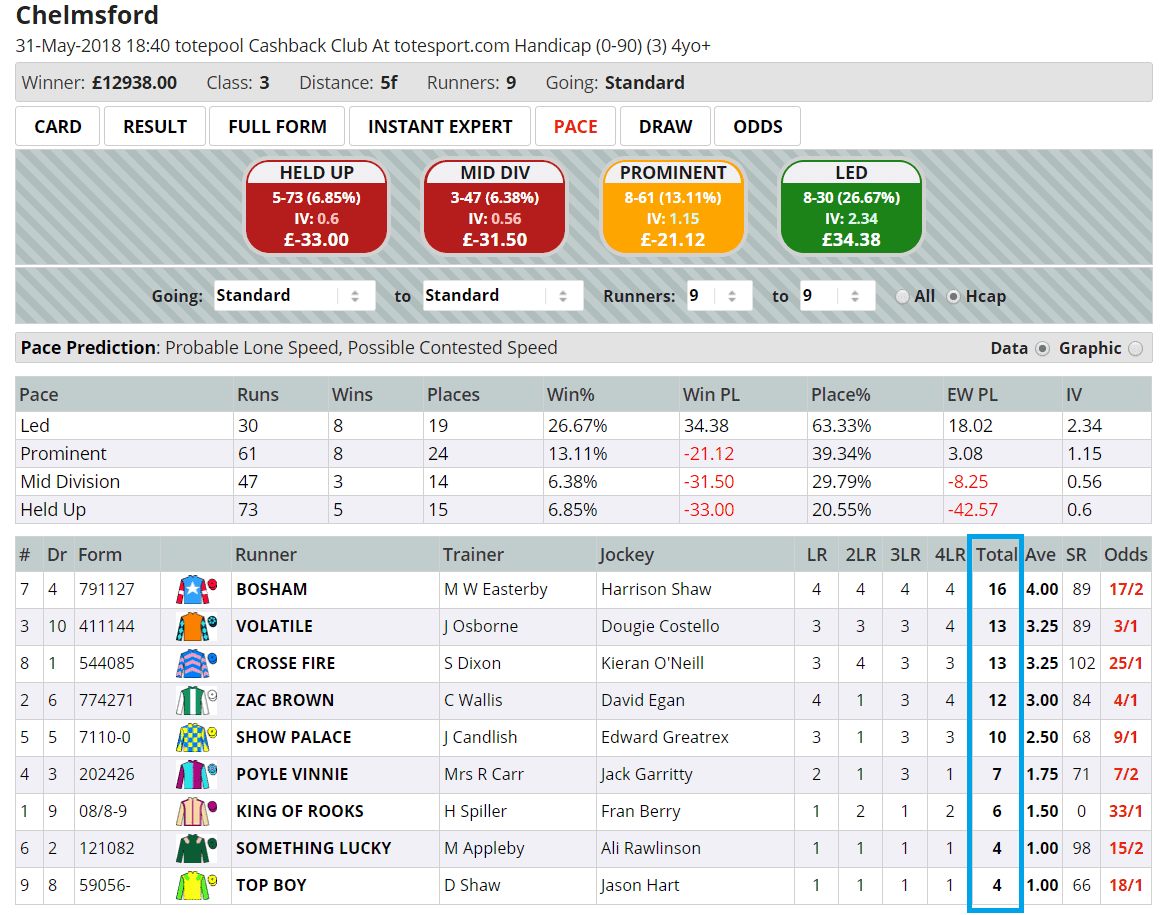
Bosham last raced on the 31st May at Chelmsford over 5f. This race was also a good example of when the Geegeez pace stats for the last four runs have worked perfectly. These were the runners in the race with their pace totals:
Bosham was a very likely leader on a speed-favouring track, and prevailed at 7/1
Bosham looked the most likely front runner having led in each of his last four starts and so it proved. Of course if you had looked at his career record this would also have pinpointed him as a likely front runner. Another positive was that he had a decent draw in 4 which meant he was close to the favoured inside rail. As it turned out, Bosham led early and went on to win relatively unchallenged at 7/1. For the record the joint-second rated pace runner, Crosse Fire, a 16/1 shot, raced in second early on before fading into fourth in the final furlong.
The data in this article cements the fact that early pace is be a highly significant factor in horseracing, and 5f handicaps in particular. Geegeez Gold offers users the insight for any race within the Pace tab, and subscribers are strongly encouraged to take some time to get to grips with it. Such time investment is quite likely to generate a robust financial return.
p.s. if you're not yet a Gold subscriber, you can get a taster of the pace functionality either by registering as a free user and checking the pace in our free Gold races (up to six daily), or you can take a 30 day trial for £1. Click here to start your trial.
https://www.geegeez.co.uk/wp-content/uploads/2018/04/chester_strongpacebias.jpg319830Dave Renhamhttps://www.geegeez.co.uk/wp-content/uploads/2022/10/geegeez_banner_new_170x78.pngDave Renham2018-06-03 19:30:202019-04-23 08:11:44The Importance of Pace in 5f Handicaps: Part 3
It's live, the new Instant Expert v2.0. Or maybe we'll just continue to call it Instant Expert, eh?
Most importantly, if you're in the Remain camp, do nothing and Instant Expert will continue to display the data as ever it did. However, if you're an Instantexpiteer (see what I did there? Not great, granted) then you'll want to have a watch and a listen to the below videotape, which explains all...
There is also an updated User Guide that outlines the changes. You can get that from the link on the My Geegeez page.
https://www.geegeez.co.uk/wp-content/uploads/2018/04/IEv2.png311830Matt Bisognohttps://www.geegeez.co.uk/wp-content/uploads/2022/10/geegeez_banner_new_170x78.pngMatt Bisogno2018-04-24 22:39:292018-04-24 22:39:29Instant Expert v2.0 is LIVE
Today, I'm pleased to introduce you to the latest Geegeez Gold feature, Report Angles.
As part of our commitment to extend greater flexibility and configurability to Gold users - in plain English, to let you do more of what you want to do! - we've created an aggregator for all reports. You can set it up as you wish, or not at all if that's your wish.
More details are in this video, and in the article beneath.
N.B. All angles are turned OFF by default. Read/watch on to discover how to turn them ON.
Report Angles: Overview
Report Angles highlight content from Gold’s existing set of reports against today’s runners as displayed on the racecards.
That is, for each report, there are now – as of December 2017 – a group of pre-set parameters which, when matched, will be flagged against a runner on the racecard.
Using the example from above, the Trainer Statistics report might have the following pre-set parameters for its Type 1 (i.e. 14 Day Form) sub-report:
10+ runs
30%+ wins
A/E 1.25+
Where a runner satisfies those criteria, it is highlighted on the racecard as such. There will be pre-sets for every report sub-type, e.g. Trainer Stats report will have four pre-sets, one each for 14 Day, 30 Day, Course 1 Year, and Course 5 Year.
Users will be able to select any or all of the pre-sets to be displayed on their racecard views. They will also be able to edit or restore to default the pre-sets. However, a user may only have one custom view of each report sub-type.
Report Angles are automatically built into the ‘My Report Angles Settings’ page. Users have the ability to activate, deactivate, amend or restore to default each Report Angle. They cannot create new Report Angles, however.
Report Angles: My Settings
Users can select, de-select, amend and/or reset the Report Angles configuration on the My Report Angles Settings page. However, users cannot create or delete Report Angles, though they can disable/enable them.
The Report Angles Settings page displays the report titles (i.e. TJ Combo, etc) on the left-hand side, with settings displayed for the selected report sub-types (e.g. 14 Day, 30 Day, Course 365 Day, Course 5 Year).
For each report/type combination, there are editable parameters as per that report’s individual report page. For example, below are the editable parameters for four sub-types of TJ Combo report:
N.B. Different reports have different parameters – users are advised to check each one individually, at least the first time they configure the settings.
At the bottom of the screen are three blue bars. The first, “Save Settings”, enables a user to save any changes made within the selected report.
The second, “Reset Defaults”, reverts the selected report to the ‘factory settings’. The third, “Reset All Defaults”, reverts all reports and sub-types back to their default settings.
N.B. These defaults are NOT optimal. Rather, they are presented as a balance between limited data and too much data appearing in the report. Users are encouraged to experiment with the settings to find the appropriate volume of report output.
Each report sub-type has a tick box next to its name. Selecting/de-selecting the ticks will include/exclude a sub-type from the report and racecard view.
Clicking the on/off buttons top RIGHT will select/de-select all tick boxes for a report.
Clicking the on/off buttons top LEFT will select/de-select all tick boxes for ALL reports.
Report Angles: The Report
Once a user has selected and/or activated report angles and parameters, all qualifying runners will appear on a report on the My Report Angles screen. The report looks like this:
Each row in the report table is clickable, and will open the race in question in a new window. All columns are sortable to enable users to configure the view to suit personal taste.
Report Angles: Racecard Inline
The racecard has been updated with a new ‘report’ icon, containing a numerical indication of the number of angles matched. Clicking the icon will reveal inline the qualifying Report Angles, as in the below example.
There is also a new icon with a ? in the top icon menu. Clicking this icon will open Report Angles in the card for all runners. Clicking again will close them.
Getting Started with Report Angles
By default, all Report Angles are switched off. To turn them all on, use the 'ALL On' button top left on the Report Angles Settings page. Alternatively, and preferably, take a few minutes to set the Angles up as you would have them.
The default settings, when all Report Angles are switched on, can be seen in the below table.
Report Angles are intended as an aid to successful betting; they are not to be used as an end in themselves. That is to say, Report Angles may highlight interesting elements about certain runners but, as with all other approaches, a more holistic consideration of the puzzle will always yield better results.
Good luck, and I hope you enjoy this new feature as much as I have been during the testing stage.
Matt
https://www.geegeez.co.uk/wp-content/uploads/2017/12/reportangles830x320.png320830Matt Bisognohttps://www.geegeez.co.uk/wp-content/uploads/2022/10/geegeez_banner_new_170x78.pngMatt Bisogno2017-12-13 17:35:362017-12-14 10:38:22New to Gold: Report Angles
Scarcity. An insufficiency or shortness of supply.
It's what makes stuff valuable: gold, bitcoin (depending on who you listen to), etc.
But it can also be manufactured to trick people into making bad investment decisions: fool's gold, bitcoin (depending on who you listen to), etc.
Returning to matters closer to home, how does it manifest in racing, and how can we use it to our advantage?
Scarcity in racing form terms equates to a trait or performance metric consistent in contenders but less prevalent in the race runner population as a whole. Put another way, the stuff which separates the winners from the also rans.
When trends are your friends
The most obvious use of this sort of scarcity metric is in big race trends. Most 'big races', be they major big field handicaps or top class Group races, have a scarcity about them as a matter of course: after all, there are only so many heritage handicaps, and the Pattern is only so big (though expanding inexplicably from year to year).
To compete in such a race a horse must either be within x pounds of the top-rated runner in the field (Class 2 handicaps), or possess either proven or implied class (Group races). Such animals are scarce and generally self-select - if a horse is good enough for a certain race, it will generally run in said race - but that doesn't help us punters.
We need a way to whittle the field once it is known, i.e. after the self-selection process. Trends are a popular means of doing this and, despite being bashed somewhat by employers of other methods, they can be a fine means of shortlisting.
The problem comes when data is misused. For example, knowing that nine of the last ten winners were chestnut in colour doesn't help if a) 95% of runners were that colour, and b) there is no logic to such an inference anyway.
However, knowing that nine of the last ten winners had been rested between 30 and 75 days, where only 65% of the runners matched that criterion is likely material. Better yet if such horses made the frame 78% of the time, or beat 60% of rivals - in other words, if they outperform bigger samples than just 'winners'.
We might deduce that horses entering such a race fresh are more likely to give their running than those who raced more recently or were rested too long.
With a trend like that, there is a logical scarcity. Some people like to use bigger populations of horses from which to infer meaning, for example using handicap chases over three and quarter miles or more as a starting point for Grand National trends analysis. I can see the general utility in this, but don't agree that it's a good approach for a handicap as unique in terms of distance, field size, number of obstacles and class as the National.
Another danger with trends - aside from 'unearthing' flawed patterns - is in throwing the winning baby out with the also ran bathwater. Again, this is a by-product of lazy rigidity. It can still happen of course, just as the ratings junkie can overlook the big-priced fourth top figure in favour of something with a sexier profile and a commensurately shorter price, or the form book guru can misinterpret the strength of a key formline.
As punters we have decisions to make. The vast majority of winning punters, and most losing ones as well, make many more poor - or at least ultimately incorrect - decisions than they back winners. Such is the nature of the game. But we're not in it for winners, are we? We're in it for profit. And the craic, natch.
Getting back to lazy rigidity and trends, if we unearth four or five solid looking angles which each filter out 15% or 25% of runners on a given characteristic, we can expect to be left with a short shortlist. Often zero, in fact. But the game is not to chisel away at our stone block until we have no sculpture, only chippings; rather, it is to produce the outline of a smart bet before digging into a bit of form or overlaying ratings or using some other method to cross-refer, sanity check and refine our early work.
There's no sense so uncommon as common sense, and it is that which we must apply to both the trends discovery phase and the shortlisting phase. Sometimes you'll be left with a long 'shortlist'. So what? That means you either need to take a punt at a price after further investigation, or pass the race. That, passing the race, is allowed, by the way 😉
Sensible everyday trends
There are plenty of schools of thought about what constitutes a solid basis for a 'trend'. I've intimated mine in reference to the National above and, for me, it's the bridge to bread and butter racing too.
The first thing I look for is what might be the most extreme element of a race. With the Nash, it's any or all of the distance, field size, number of fences and class/weight carried. I have to concede to filing that race under 'national spectacle' rather than 'punting vehicle' these days, however, and perhaps that is how it should be (except for the mug misconceptions visited on everyday horseracing as a consequence of that solitary exposure to the sport in most people's living rooms).
In more mundane - ostensibly at least: I'd rather back the winner of a Wednesday afternoon handicap than a faller at the first in the National! - events, there remain plenty of opportunities to spot material scarcity.
The winner of a Wednesday afternoon handicap...
Take this race from Beverley yesterday, for example, which conveniently enough popped up just as I was having a break and wanting a tiny interest dabble to recharge the flagging fingertips before round seven of my day's keyboard pugilism.
I checked the computer clock. It was 3.59pm. I had literally one minute to review the race, make a decision, and wager accordingly. Obviously stakes were kept to a minimum, but in that minute I could see it was a Class 5 five furlong soft ground handicap at Beverley. That immediately set me thinking about low draws and soft ground form.
Those, for me, are the two most important factors under such conditions. On quicker ground I'd replace going form with a speed rating over the minimum trip, but I'd still want a low draw.
Two horses, One Boy and Flash City, had plenty of soft ground placed form - at least 60% each on at least six soft ground runs - and they were drawn two and three of twelve. The clock had still not clicked over to 4.00pm by the time I'd staked a massive four quid on each. A moment later they were off. I was entertained through my tea break by the sight of the pair of them fighting out the finish.
They returned 16/1 and 16/1. My eight pound coins manifested into four twenty pounds notes, as near as damn it after the exchange had taxed it, which was all right for about 3o seconds analysis. I might have bet more if I'd taken longer to cogitate, but probably not: the wager was merely to revive the sagging synapses. [Click the images below to see my 20 second thought process visualised by Gold]
What's the point?
What's the point here? The point is this: look for those elements in a race which are both material and scarce.
In this case, there was a fixed scarcity, low draws, and a variable scarcity, soft ground lovers. There will always be low drawn horses in double-digit Beverley sprints and, all other things being equal, they will generally have an advantage up the hill and around that deceptively angular dogleg.
However, on another occasion, the ground may not be testing, or there may be an abundance of low drawn soft ground lovers, or the soft ground lovers may be drawn away from the low draws. None of those situations would have been as attractive as this setup. I'd have still wasted eight quid on the race, but I'd have been venturing far deeper into guesswork territory.
This is the way my brain looks at a race now. It is second nature, which is how I can assimilate the required intel in, literally, a few seconds. I also have tools which pinpoint what I'm looking for. So do you!
Example Scarcity Scenarios
Of course, it takes time to build up a picture of the requirements of a given scenario. So, in case you need a leg up, here are a few things I'm always on the lookout for. In each case, it is important to think about what is the least common, yet relevant, factor in the race.
Class 4 handicap hurdle on heavy ground: There are lots of handicap hurdles, and lots of Class 4 handicap hurdles. But there are not so many heavy ground races. The further away from middling going a track is, the more interested in proven ability to handle such terrain I am. Heavy and firm are polar opposite turf states and they tend to appeal to specialists. Better still, very often such horses will look moderate under most other conditions. Their unsexy form figures will add currency to their trading price, in the early go at least.
Instant Expert gives me pretty much all I need to know for a route in to such races.
Class 2 3m4f chase: Stamina and class are needed, but mostly stamina. I'd rather be with a Class 3 animal I know stays three and a half miles than a Class 2 beast stepping up from three miles flat, especially if the track is testing. The first thing I'm interested in is which horses have won beyond 3m2f and, ideally, between 3m4f and 3m6f.
Again, Instant Expert is my friend.
Class 2 3m4f chase, five runners: In small fields over longer distances, I'm on the lookout for a horse which might get a soft lead. A habitual front runner against hold up horses may steal four or five lengths with a quarter mile to go. If the leader is not outclassed, it will take a rare smart stayer to make up that sort of ground late in that sort of race. Almost all staying chasers are grinders; granting an easy lead to a horse in a staying chase and expecting to pass it late on would not be a good proposal for your mortgage advisor.
A two second glance at the pace map will reveal how things are projected to play out; check Instant Expert and the ratings to ensure the horse has the class and the contextual ability to contend.
Seven furlong heritage handicap, 22 runners: Big field, specialist trip. In big fields, I want to know if there's a track bias or a pace bias, or both (and are they aligned). I then want a horse drawn on what I believe to be the correct part of the track, that is proven in big fields; and I want them to have seven furlong form. If the going is soft or slower, or good to firm, I want evidence of effectiveness on that, too.
Draw tab first here, sorted by place for the bigger sample size that offers; then pace tab sorted by draw position to map out where the field looks likely to race; then Instant Expert (place view) Field Size column to see which horses have run into the frame consistently in big fields - and fit on other form-based credentials.
And so on.
Don't force it, and be careful...
It's important to remember that there isn't always an exploitable 'scarcity' element to a race. Indeed, there generally won't be such an angle. But on any given day they'll be lurking like truffles in the mud waiting to be snouted out by keen punters.
If you can't find anything material and scarce about the runners in the context of the race, then pass and move on. Or use a different approach to the puzzle.
Also note that this approach works best - perhaps exclusively - when all runners have exposed levels of form. That is, when all runners have had at least a couple of attempts at most of today's race factors.
Caution is advised when looking at horses doing things for the first or second time, especially if their human taskmasters have 'previous' in a given context. Horses can, and very often do, step forward markedly on their first or second run in a handicap; it is rather less common to see a horse improve ten pounds on its twelfth or fifteenth start in weight-for-ability races.
Summary
This post has attempted to offer a morsel of food for thought regarding an approach to the search for value in a horse race. We're looking for horses whose overall recent profile may not be terribly compelling but which are noteworthy against a material race factor where many/most rivals are not.
Demand a price about a horse in this context. If the market has already factored in significant improvement, move on.
Work out what your key differentiators - material elements - are; they're probably different from mine.
Have fun with it. This is just another of the myriad routes into picking a horse in a race. It can be done in very short order, which is part of the attraction for a busy person like me and, most likely, you. As well as the nags flagged at Beverley above, I used the same approach to snaffle those recent big-race Saturday winners (25/1 Mattmu, 14/1 Nakeeta) as well as last week's 8/1 runner up, Vibrant Chords. And each time I invested no more than five minutes into the process.
Now, sure, I fired two darts at those targets; and sure, over another three week period they all run rank. That's not the point at all. The point is the process - as Tony Keenan mentioned earlier this week in this excellent post, "Trust the process".
Don't expect instant success; don't use just one approach: different types of puzzle demand different tools from the box. Do enjoy mucking about with it. Don't bet the farm. Do look for some meat on the odds bone.
Hone your handicapping skills, and enjoy the trip. After all, if it's not fun we may as well get a job, right?
Matt
Appendix
For whatever it's worth, some of my 'material factors' - the ones which spring to mind while penning this - are listed below. Don't take them on trust; do your own digging, but hopefully there is enough herein to help you turn the first few shovels of soil.
Front runners: Catterick, Chester, Chelmsford, Newmarket, Pontefract, Yarmouth
https://www.geegeez.co.uk/wp-content/uploads/2017/09/chasersjumpingfence.jpg320830Matt Bisognohttps://www.geegeez.co.uk/wp-content/uploads/2022/10/geegeez_banner_new_170x78.pngMatt Bisogno2017-09-21 11:29:302018-05-09 16:52:04The Value of Scarcity in Race Reading
The whole point of betting on horses - betting on anything - is being able to accurately predict what will happen in the future. The more 'yesterday' information we have, the better able we are to forecast 'tomorrow'.
In Britain, horse racing punters were traditionally in the dark: for years, there was nothing more informative (ahem) than the little alphanumeric sextet of recent finishing positions to the left of a horse's name. 'Professionals' bought the Sporting Life and, more recently, Racing Post. This gave them a huge leg up on other newspaper readers, but was still seriously deficient in terms of projecting what might actually happen in a race.
The advent of the internet has, slowly it must be said, changed things; finally, punters are able to access a raft of insightful data which genuinely can give them the edge over the bookmakers. This edge is greatest in the early markets, where many of the horse race odds lines are algorithmically constructed: Deep Blue versus Kasparov this is not. The software creating the early markets is not exactly sophisticated, which means we don't need to be chess grandmasters to find the ricks.
Looking at past form cycles and profiles - that is, when a horse comes into form and under what conditions - is a blind spot in the algos, which focus too heavily on recent form. The starting price markets are much more efficient of course, but nobody bets SP, do they? Do they?!!
One of the last major vestiges of unpublished form, in Britain and Ireland at least, is pace. Pace can mean different things: it can be precise, by virtue of sectional times; or it can be more general, defining a horse's run style. In most of the established racing betting nations - Hong Kong, Japan, US - sectional times are ubiquitous. Commentators are able to quantify the speed of the horses in-running by a split time stopwatch in the corner of the screen.
Here, we have no such aides - the usual "who's going to pay for it?" arguments - but what we do have, and more so than in many of the aforementioned racing jurisdictions, are detailed in-running comments. These allow a bettor to work through past performances and develop a picture in the mind's eye of each horse's run style. It's laborious, for sure, and I know for a fact that most jockeys riding in Britain gather their understanding of how the races they're riding in will unfurl in this manner. Until now...
Geegeez Gold has had pace information, in the form of a data table, for quite some time. And, yesterday, we moved things up a notch by converting the numbers into a picture: a pace map. Pictures are much easier for us humans to understand than words and numbers. Consequently, we can get the gist of something - like, for example, how a race will be run - in just a second or two when the data is presented in pictorial format.
So, welcome to Geegeez Gold's new Pace Graphic view. It's not Deep Blue, and nor was it imagined by the genius of Kasparov (it was me, actually), but it does instantly visualise how a race might be run based on the last four UK/Ire runs of the horses in it. And that means its users have a significant edge on other punters, either in time or awareness terms or, in most cases, both.
It lives in the existing PACE tab, and looks like this:
In this race, Whos De Baby looked like he'd get a clear lead. That's exactly what happened, allowing him to finish 2nd at 12/1
In this example from yesterday, Whos De Baby was predicted to be 'Probable Lone Speed', meaning he was expected to be able to set his own pace and try to make all. He very nearly did, finishing a good second at odds of 12/1.
Below is a video where I show you the what and how of the new Pace Graphic. If you're familiar with pace and how to use it in horseracing there may be little new therein. But if you're still trying to get to grips with the importance of pace, and which scenarios to look out for, you really should watch it.
Geegeez Gold continues to be committed to provided the best information for punters in the most consumable, readily understandable format, so you know more than your competition (other punters, not bookmakers) in less time.
If you're not yet a Gold subscriber, you can join us here. That page includes a link where readers who have never tried Gold before can get their first 30 days for just a pound. Thereafter, Gold is £30 per month. If you're serious about getting ahead with your horse racing betting, I don't know how else you can have this sort of a chance for less than a pound a day. Granted, I am a tiny bit biased... 😉
Good luck, and thanks for reading/watching.
Matt
https://www.geegeez.co.uk/wp-content/uploads/2017/09/crystalball.jpg320830Matt Bisognohttps://www.geegeez.co.uk/wp-content/uploads/2022/10/geegeez_banner_new_170x78.pngMatt Bisogno2017-09-12 09:07:242017-09-12 09:07:24Pace Maps: Predicting the Future Just Got Easier…
We've added a new tool to the Geegeez Gold arsenal. It's called Draw Analyser and its layout will be familiar to those of you who already use our cards for flat race purposes.
Within each flat race card is a 'DRAW' tab. The data in this tab relates specifically to the course and distance of the race in question, and is broken down by draw thirds, constituent stalls and, most interestingly (perhaps), by draw/run style combination.
Well, we've taken the race specific draw tab, and created a more generic tool that can be used to view draw information for any course/distance combination. You can also group distances together (make sure you do it sensibly, so you're comparing apples with apples!), change the going range, view by advertised or 'actual' (i.e. after non-runners) draw, and by all races or handicaps only.
We think it's pretty neat. Much more than that, Gold subscribers are telling us they think it's very useful. Here's a short video showcasing what it can do for you...
In this post, I want to share a new feature which is going to be available very soon. I also want to politely remind you that today (Friday 27th January) is the last chance to secure your discounted (for life) Annual Gold subscription.
Let's cover that off first.
Geegeez Gold is continuing to invest in innovation. After this week's latest 'bell and whistle' enhancements - Pace Predictions on the pace tab, and Proximity Form on Full Form Filter - we have a much bigger enhancement in early stage testing. More on that below.
Unlike some publishers, we don't increase our prices for existing subscribers. Instead, we prefer to reward commitment and early adoption, by offering our best subscription rates to our most loyal community members, and by guaranteeing that the price at which you sign up is the price you pay for the lifetime of your subscription.
This means that, regardless of what new features we introduce or how much a subscription might cost in the future, you get the lot for the price now. That's only fair, after all, because without your investment in Geegeez Gold, we are unable to re-invest in you.
So, no big fanfare, but just to say that today is the last day you can lock in your subscription for 68p a day (£249 annually). From tomorrow, the annual price rises to £297 (81p a day), which still offers two months free against the annualised monthly subscription of £360 (99p a day). That's the very best value you can get, so if Gold is something you currently enjoy, and/or if the new feature highlighted in the video below excites you, then now is the time to upgrade.
Oh, and if you're currently a free subscriber, you can use that same link to upgrade directly to Gold Annual. One fee, swallowed (!) now, gives you full 'access all areas' for the entire year of 2017 - both flat and jumps, UK and Irish - and into January 2018. Nothing more to pay.
Enough already, because I think you probably already know if this is something you want to do... If you're still unsure, here's a sneaky peek at a 'COMING SOON' feature...
.
What do you think? Anything in particular you'd like to see included? Leave a comment and let me know.
Trainer Snippets is one of the newer Geegeez Gold features, and it's a brilliant insight into how trainers operate. I've written about the content before here, but was asked if I could record a video on the subject of Trainer Snippets. Well, Barry, happy to oblige (and thanks for the prompt).
In this video, I explain what Trainer Snippets are, the two places to find them, and why and when they're useful. I also highlight a few examples using this afternoon's racing.
I also reference A/E and IV in the video, with a link to more info on that. For expediency, .
Anyway, on with the show. I hope you find it useful...
https://www.geegeez.co.uk/wp-content/uploads/2016/10/Trainer-Snippets_101016.png4951080Matt Bisognohttps://www.geegeez.co.uk/wp-content/uploads/2022/10/geegeez_banner_new_170x78.pngMatt Bisogno2016-11-21 11:10:482020-05-16 19:51:27VIDEO: Using Trainer Snippets for Profit
It's Newmarket's Future Champions Weekend today and tomorrow, comprising eight races restricted to two-year-olds only. Such contests are notoriously tricky from a betting perspective, because we have little or no form to go on. Worse, most of the contenders are still unexposed to a lesser or greater degree meaning they can be expected to improve on what they've demonstrated so far. So how do we frame a puzzle like this?
The first thing to say is that, personally, I'm not a massive fan of such heats. I prefer an established level of form in the book, with only one or two possible (and predictable) improvers: for instance, a low grade handicap with a horse stepping up markedly in trip and another running for the first time in a handicap after a month off the course.
But still, there are times when I'm forced to have a view on races with little form, the most everyday of which is when selecting a six race placepot sequence.
Here are six ways to get a handle on a minimal amount of form... Oh, and by the way, most of these approaches apply equally to a novice hurdle at Chepstow in January as they do to a juvenile Group 1 in October at HQ, so keep an open mind in terms of the usable context of these hints.
1 Horse Form
The most obvious and logical place to start is always the form book. Incomplete as the picture may be, the basic ability indicators are located right there. The Instant Expert, which I would never use as 'alpha and omega' for this - or indeed any - job, does offer a view on the story so far. As you can see from this example, taken from tomorrow's Autumn Stakes, it is only a partially complete puzzle.
Autumn Stakes Instant Expert
Note two things in particular:
The large number of grey boxes. These denote the absence of form for a given horse under one or more of today's conditions. For instance, Rodaini has yet to race over the distance of a mile, nor in a field of 8-11 runners. That latter point is a touch misleading because he's won in a seven runner race and a twelve runner race, too. [Side note: I personally use field size - and going - primarily when the race is run on an extreme, i.e. very small field or very large field; heavy or firm going]
The number of red boxes where there is only one run to go on. It is extremely dangerous to draw strong conclusions from the evidence of one run, especially using the 'win' view on Instant Expert. Take a look at these two views of The Anvil:
The Anvil should not be discounted in spite of a line of red on the 'win' view
On the win view, it would be easy for an inexperienced - or cursory - eye to discount The Anvil's chance. But the place view, superimposed below for contrast purposes, reveals a very different opinion on his prospects.
Closer inspection of his most recent form line informs that he was a fast-finishing second over course and distance last time out in a better race: a Group 2 compared with today's Group 3.
However, getting back to the main image, we can also give Montataire a chance. He is the most exposed in the field, with eight runs already to his name, and he's achieved more than most of these. The question is whether he is now susceptible to those who have a lot more to come and, on the evidence of his last run - behind The Anvil - the probability is that he is.
2 Speed Ratings
Although, like with the form in the book, the race times in the book are a retrospective on the contenders which fails to account for future improvement, they can be very useful for two reasons.
Firstly, it is often hard for the casual punter to discern between one set of form figures that read '11121' and another. Naturally, we should be more sophisticated in our outlook than that but, largely through conditioning - looking at very partial racecards in the printed press, predominantly - the eye still wanders to the numeric string at the left of a horse's name.
Ratings, especially speed ratings in juvenile races, help us to form a hierarchy from the pile of similar looking form figures.
Secondly, because most two-year-olds are inexperienced and immature, they tend to race 'with the choke out' (i.e. the go as fast as they can for as long as the can, with limited ability to proportion their energy for the task in hand). This means that most juvenile races - typically run at five to seven furlongs before October - are not tactical and the numbers are generally more reliable than might be the case in longer runs.
Here's an example for this afternoon's Cornwallis Stakes, to be run over the minimum trip of five furlongs. Battaash is the highest rated on Geegeez Speed Ratings (SR column, his rating 94), and we can see that his only poor run was on soft ground. We can also see that he's 16/1.
He's not raced on good to firm ground before, so that's a question mark - one that we will look at shortly - but he might be overpriced. At least we know he can run fast in what will be a fast-run event.
Top Speed Rating, and 16/1 in the Cornwallis Stakes
3 Subsequent Form Value
Another way of separating the good 123's from the not so good 123's is to look at what has happened to the other runners in those races since the wins and places were achieved. Here at geegeez, we use something called 'Then What?', which you can see in Battaash's form lines above, and also in the below: a view of the form for those to have previously run in the 4.20 this afternoon, a maiden fillies' race.
Which of the runs so far have worked out best? 'Then What?' has some suggestions
In the above, there are a couple of very interesting points to note. First, the favourite, Highland Pass, has run relatively slowly (48) thus far, and none of the three horses to come out of her races since have made the frame. It's a very small sample but doesn't light my fire when invited to accept 7/2 about her chance.
Compare that with the 68 and 65 rated fillies - the top two speed figures in the field (though plenty are making their debuts today, more on that shortly) - and she has some stepping up to do.
Vigee Le Brun is top rated, and her run has seen one winner from four to exit the race to date. Note, however, that her prior start was on soft ground, versus good to firm today.
The 65 filly is Paradwys, whose two runs have worked out well. Moreover, the most recent was over seven furlongs on good to firm, on the July course here at Newmarket. Clicking on the form line opens up the result, where we can see that all of the runners to finish in front of Paradwys that day to have run again since, have won. Now that's more interesting; and she's a 12/1 chance!
Will punters be in Paradwys this afternoon?
4 Trainer Form / Patterns
First time out, second time out, first time in a handicap, second time in a handicap, up in trip. When a horse does something new, or we have little form to go on, the habits of the trainer can help fill in some of the blanks.
A horse called Fleabiscuit runs in the Group 1 Fillies' Mile this afternoon. She's run once, and she won. No horses have emerged from that race - less than two weeks ago - so how do we know if Fleabiscuit has a chance today?
Her speed figure gives her plenty to find but, with just one run to her name so far, she could step forward significantly. Take a look at her trainer's form:
Trainer Hugo Palmer's record offers plenty of hope
Hugo Palmer is in perma-good form. He's been scoring at a near 40% rate in the past fortnight, and better than one in four over the entire month. He has the champion jockey-elect riding for him, and note Palmer's 'snippets' in the blue box above.
They show his performance over the last two years under certain relevant conditions. For example, we can see that he's got a nigh on 30% win rate with last time out winners. Moreover, he has a 27% strike rate with horses making their second racecourse start.
These are rock solid numbers, as we might expect from geegeez's implied man of the year. Fleabiscuit is probably not experienced - or talented - enough to win a race of this stature so early in her career. But she's not definitely not, and at 20/1 her trainer's record offers cause for optimism.
5 Sire Form
Earlier in this post, I mentioned a filly called Vigee Le Brun, whose one run came on soft ground, as opposed to today's good to firm. How could we know if she'll act on today's surface? The short answer is that we cannot know that; but what we can do is look to her sire for clues.
As with trainers above, geegeez also publishes Sire Snippets, attempting to shine a light on the two-year performance of stallions. Here's Vigee Le Brun's sire, Dark Angel:
Dark Angel's Sire Snippets in the context of this race
We can see that Dark Angel has a close to 12% win rate overall in the last two years, which is incredible on 2264 runners. We can also see that two year olds and sprinters perform above the overall benchmark, at 12.22% and 12.63% respectively.
But what we can't see is how Dark Angel progeny have fared on good to firm ground. The reason for this is that the going can - and often does - change from when we publish this data to race time. Fear not, however, for we have that covered.
On the main race card, the going can be changed from a dropdown, and the revised going will reflect in both Instant Expert and Full Form Filter. In this case, we don't need to change the going, so we'll head straight over the FFF.
Dark Angel 5 year going form
As you can see, I've selected the Sire option top right, chosen Vigee Le Brun from the horse dropdown, then 5 year form, and going.
The Race Record box shows me Dark Angel's five-year record on today's (good to firm) going. It's 12.74%, which is again some way above his two year batting average overall, offering hope to backers of this filly.
I could also take this a step further and add distance to the filter, to see how Dark Angel's have fared over seven furlongs in the last five years.
Dark Angel five year distance and going form
Interestingly, this drops the win percentage back a good bit, and upon checking the two year form I noticed that it is even lower, so that would be a concern.
Full Form Filter is a very flexible tool, and its sire option is one of the most under-used elements of the entire arsenal.
6 The market
At the end of the day, in races where there is limited racecourse evidence on which to base a judgment, the market can be an insightful predictor. With a filly like Vigee Le Brun, I'd be very interested in whether she had taken support in the early skirmishes. Checking an odds comparison function, such as the 'Odds' tab on Geegeez, will shed some light.
Both Paradwys and Vigee Le Brun have taken support
During the time I've been writing this post, we can see that both Paradwys and especially Vigee Le Brun have taken support. They're not the only ones to be fancied, but this certainly helps - with confidence if nothing else - in making a wagering decision, allied to what we've learned for ourselves in points one to five of course!
**
Many people, including myself, use Gold mainly when the level of form is thoroughly exposed. But I hope the six suggestions above offer some food for thought in terms of how we can get a few inside lines on those where it is all in front of them. Gold is full of hints, tips and pointers, for all types of race. We just have to go a little 'off piste' in some situations. 🙂
Matt
p.s. Gold trial: 30 days access to the full Gold toolkit, speed ratings, tips, forum threads, reports, tracker, prize tipping league and more. One pound.
https://www.geegeez.co.uk/wp-content/uploads/2016/10/Oddstab_new2.png13491845Matt Bisognohttps://www.geegeez.co.uk/wp-content/uploads/2022/10/geegeez_banner_new_170x78.pngMatt Bisogno2016-10-07 10:30:452017-06-23 18:14:34How to Find Winners When There is Little Form in the Book
I'm not really sure why I started trying to assign a score to jockeyship. The notion hatched on the rattler to Salisbury last week, where I was going to meet David Probert, geegeez.co.uk's sponsored jockey. I guess, then, that is why...
My apprehension was - and remains - that jockey performance is so dependent on two other major actors, the horse and the trainer, that it is very difficult trying to pare the incidental from the coincidental.
What to measure?
The first question to answer then is 'what to measure?'
Number of wins or places is too simplistic. So is percentage of wins or places. Profit and loss is no more than a basic indicator, which can be heavily skewed by a single big-priced winner.
No, none of these will add much value, if indeed any value can be added from such figures.
Better barometers are percentage of horses beaten and / or performance against market rank.
But perhaps better than all of those is performance against market expectation. For example, even money shots win roughly 45% of the time. Thus any jockey winning on more than 45% of even money shots can be said to be performing above expectation (assuming the sample is of a reasonable size).
There is an inherent problem in that last sentence, one of sample size. Carving all results up into constituent starting prices, such that 10/11 is a different group from even money which in turn is a different group from 11/10 will do little towards achieving remotely representative sample sizes.
Instead, it makes sense to bracket odds together into groups. This will necessarily be arbitrary, but hopefully you'll see the general logic of the groupings.
*
Parameters
I focused on UK flat racing during the 2014 and 2015 seasons, breaking the runners up into the above odds bands. For a jockey to appear in an odds group, he/she had to have ridden at least ten horses with odds in that bracket.
For each odds bracket, we can see the runs, wins, win percent, level stakes loss, places, place percent, number of races, and ROI
I've highlighted three columns - win %, place % and ROI - which will act as baselines.
So, for example, in the 4/1 to 13/2 bracket, horses at those starting prices win 14.37% of the time, place 39.56% of the time, and have a negative ROI of 14.31%.
We can now compare the performance of jockeys to these baseline data, with only those whose record betters at least one of the trio of baselines appearing in the tables.
The Shorties...
Let's first look at the shortest odds groups, comprised of odds on and even money chances. In each grouping, I've highlighted in green the columns where the jockey's performance is better than the odds bracket benchmark. For the shorties, though, there is not a great deal of data to go on...
These are generally small samples, and there is little to note with the possible exception of Paul Hanagan's excellent showing across 40+ rides.
*
11/10 to 7/2
Slightly more data now, so a touch more optimism about the meaningfulness of the results.
Plenty of jockeys with a double positive for all three stats here, notably Paul Hanagan (again), Joe Fanning, Adam Kirby, Richard Kingscote, and Paul Mulrennan.
*
4/1 to 10/1
Into the bigger datasets now, and this is a group where some riders will reveal themselves as potential punters' allies.
Those appearing in both lists this time are Charles Bishop, William Carson, Paddy Mathers, Frankie Dettori (again), Paul Mulrennan (again), James Doyle, Robert Winston, Ted Durcan, Paul Hanagan (again again!), Harry Bentley, and David Nolan.
*
15/1 to 25/1
Now, just for fun, let's take a look at the bigger priced horses, from 15/1 (or more traditionally 16/1) to 25/1. This table is susceptible to fluke results - one big winner can skew a rider's performance - and should not be taken at face value. Still, it might throw up one or two interesting niblets.
In the context of what's gone before, it is interesting to note the presence as 'triple green' entries of Paddy Mathers, David Allan and James Doyle (all again, having featured at least in the previous section).
**
All good fun, but so what?
At the end of the day, the above reveals something and nothing. It is a circuitous route to demonstrate the lies and damned lies of jockey statistics, with various riders appearing at once brilliant and moderate, depending on which table one focuses.
However, some names do crop up repeatedly. Paul Hanagan and James Doyle could lay claim to being close to the pick of their peer group, based on this means of scoring at any rate; while Frankie Dettori also comes out well. Likewise Joe Fanning and Adam Kirby are seemingly more reliable than many.
Meanwhile, if looking for jockeys on the up - or currently under-rated - these data suggest the likes of Charles Bishop, Paddy Mathers and David Allan all deserve at least a second glance when jocked up.
They are, like the vast majority of jockeys, dependent on the form of their retained stables - in these cases, those of Mick Channon, Richard Fahey and Tim Easterby respectively.
**
At the end of the day, the difference between a horse winning and losing is probably not very often down to the rider, in my opinion. It should certainly be a given that the ability of the horse (duh!) and the trainer - both in conditioning and placing the horse - are of more importance.
Nevertheless, some jocks are better than others, and actual versus expected is a very good way of gauging jockey ability in the market context. In other words, whether jockeys might be profitable to keep onside (regardless of whether their performance is a function of horse and/or trainer form).
Geegeez Gold publishes jockey stats for four different periodicities:
14 Day Form
30 Day Form
Course 1 Year Form
Course 5 Year Form
For each, users can view both the Actual vs Expected (a figure greater than 1.0 implies a rider's runners are sent off at bigger odds than they should be) and Impact Value.
Impact Value attempts to state the likelihood, compared to the average, of a jockey winning. This is market agnostic (i.e. it doesn't consider the odds in its judgment).
A rider with scores greater then 1.1 for both A/E and IV on a meaningful number of rides is one to keep onside. Here's an example from the racecard, for Paul Mulrennan:
This view is available to all users of geegeez.co.uk racecards, even those not registered on the website.
For Gold users, our jockey report is a single view digest of all riders competing on a given day, and can be viewed by any of the four periodicities mentioned above.
Here's a filtered example of Monday's riders. In it, I've selected the Course 5 Year Form view, and I've added some filters (100+ runs, A/E and IV of 1.00 or greater)
I clicked on J(immy) Fortune's entry to reveal, inline, his rides today. Clicking on any of those line items will take you directly to the race in question. Of the trio, Northern Thunder was a non-runner, Great Fun was second and Irrevocable was a 10/1 third. So, no dice for Jimmy today, but he competed well, as his numbers suggested he would.
Note at the bottom of that quintet of pilots the name of David Allan, the only one with positive figures for both win and each way profit/loss. He's a name I'll be paying closer attention to, albeit towards the end of my form deliberations rather than as a starting point.
From the tables above or, better yet, from the daily jockey statistics report, you can start forming your own educated opinions on the riders worth a few extra pounds, both in terms of weight carried and stakes wagered!
https://www.geegeez.co.uk/wp-content/uploads/2016/05/jockey_odds_0.5orless.png160468Matt Bisognohttps://www.geegeez.co.uk/wp-content/uploads/2022/10/geegeez_banner_new_170x78.pngMatt Bisogno2016-05-16 21:02:192020-04-15 22:01:04Creating Jockey Ratings: A Few Thoughts
In November 2013, I wrote the post below. It remains as pertinent today as it was then. I have, however, updated some of the information - including my own betting profit and loss - to make it current. It's a really important piece, in my opinion, and I hope you get something from it.
**
I've been reading a book by a young Irish fellow called Kevin Blake. It's about betting on horses, and specifically it's about how he made over £40,000 from betting on horses this year on Irish flat racing.
The keys, you may not be surprised to learn, were discipline, selectivity, discipline, form study, discipline, specialization, and discipline.
The book, "It Can Be Done", is a good read and it's full of strong insights.
But it might be a bit lacking in fun.
Most pro backers are serious types who spend much of their time studying the form book and video replays to eke out their profit. In fairness to Kevin, he doesn't fit that archetype at all.
If that sounds a bit dull, then I have some good news. The book was a catalyst for me taking an early look at my own betting profit and loss for the year (I normally do this at calendar year end), and the results were as pleasant as I expected.
In a nutshell, I'm showing a profit of £6,186 [2013 figure] £4,574 from my betting so far this year, 2016, on a turnover of almost exactly £20,000 [2013 figure] £6,871 (which excludes most of a thousand still sitting in accounts). Please note three things:
1. The numbers are shared as context, not (obviously) to gloat (if indeed you might consider them 'gloatworthy')
2. I love a bet, and I have lots of action bets, and I have fun with my betting.
3. I do not bet massive amounts, in terms of stake size.
I want to remind readers of my unshakeable contention that betting for fun and profit is possible, and that these two are not mutually exclusive. And I'll share some of the keys to my philosophy, such as it, in this post.
Key Principle #1: Have fun!
Firstly, I do not set profit targets. My target is to have fun. I set enjoyment targets. That doesn't mean I don't want to win. Of course I do. But if winning is at the cost of entertainment, then I might as well get a job. (You know, a proper job, not goofing about on the internet scribbling a few paragraphs about whatever tickles my fancy).
No, it starts with fun. I'll bet almost every day. Some days, especially on Mondays when the racing is generally desperate, I might have one little bet in the afternoon, or do a placepot for a bit of interest while I'm doing whatever else I'm doing.
On Saturdays, I generally don't bet much because racing outside of the festival meetings is never more competitive than it is on a Saturday.
But on Sunday, and from Tuesday to Friday, I take a keener interest in what's happening.
Key Principle #2: Get V-A-L-U-E
If you still don't 'get' this, you're completely and utterly doomed. Betting 3/1 when you could have bet 4/1 is just plain unfettered idiocy. And, forgive me, if you're still doing this, you're either very rich and are keen to become less rich; or you're a plain unfettered idiot.
Look. You cannot can't CANNOT win if you habitually take under the odds about your fancies, no matter how smart you are. (And, in case you didn't get my, ahem, inference in the above, you're not very smart if you habitually take under the odds about your fancies).
geegeez trumpets the best bookmaker offers because the very best chance you have of winning is to avail of any concession you're still qualified so to do.
Let me put it another way, and this is becoming something of a catchphrase for me. "Any fool can bet 30% winners".
Just grab a betting slip, or pull up a bookmaker site, and etch onto it/tick the box which says 'Fav'. Simple. Dull. Uninspired. And a little bit sad.
It will also ultimately cause a financial death by a thousand cuts. Slow. Insipid. Inexorable.
Actually, in Britain since the start of 2015, that number is up to 35%. So, Any fool can bet 35% winners !
Now don't get me wrong. There are plenty of occasions when a market leader can be a value bet. But simply backing the 'fav' is a mug's game. It's the ultimate mug's game. And if you do it, you're a mug. Get over it, and try something different. You might surprise yourself.
So what is value? Well, you've heard the coin toss example probably a million times. The problem is not 'what is value?', but rather 'how do I identify value?'
And here's a thing: that's an open book of a question. There is no right answer.
Many people say to quantify value, you must create your own 'tissue', or forecast betting odds. That's all well and good, but on what do you base those odds?
I've done it a few times, and it's an interesting exercise for sure. Comparing your tissue with the actual starting prices will tell you what sort of a handle you have on the market.
But generally, I determine value by feel. If that sounds cheap - perhaps even a cop out - then so be it. The fact is, I don't have all the time in the world to review the racing. I run a business akin to a (very) small iceberg, the main visible element of which is this site.
It takes a lot of maintaining. There are a lot of people involved. I have a young son and a lovely partner with whom I want to spend time. And I like beer. Not as much as I used to, but I still like it.
Time is limited for me, as it is for most people. But that doesn't mean we can't bet profitably, and enjoy the process as well. Value is key.
A Shortcut to finding value
By far the biggest blind spot in the early markets is a recency bias. Specifically, a bad run last time out can double a horse's odds. Take Bobs Worth as an example. He was 5/2 for the Gold Cup before disappointing in his prep race. He drifted out to 5/1. Had his chance halved as a result of that seasonal setback?
[From the original article]: Well, time will tell of course, but to my eye he has so many more positive runs to that one negative effort.
And, here's where the concession thing comes in, if he runs poorly again he might not even go for the Gold Cup. So, backing him at top price with a bookmaker offering non-runner free bet, feels like a smart thing to do. My entire Cheltenham ante-post portfolio so far - which is only about six or seven bets - has been struck with BetVictor, with no bet bigger than the £50 limit on that free bet concession.
Why would I bet anywhere else if they're matching the top price? To do so shows at best a lack of value acumen, and at worst, plain unfettered idiocy. 😉
The point: look beyond a bad run, especially if there's a probable reason for the bad run. Ground, trip, fitness, pace setup, missing the break, whatever. If a horse failed to get his normal luck in running - or ideal race conditions - last time, there's a good chance the market has under-estimated that horse's chance today, assuming race conditions are more in its favour this time.
[Post script: Bobs Worth didn't win the Gold Cup, but he was sent off the 6/4 favourite. 5/1? About a 6/4 shot? Any and every day, please.]
Another shortcut to finding value
Check the bookmaker concessions. Check the best odds available. And be sure to bet at the best odds available, and the best concessions. For as long as you can before they close you down.
I've got a good few winning accounts, and a few losing accounts. For whatever reason, I've only got one restricted account. [Update: I've got several more restricted accounts now]
If you don't currently have an account with the firm offering the best price, open an account with them. Here are three reasons why:
1. You'll get the best odds on your fancy today
2. They'll almost certainly give you some free bet bait to sign up (always great when you were going to sign up anyway)
3. Next time they're top price, you won't have to faff about.
Key Principle #3: "Let The Bet Make You"
There's this American bloke called Michael Pizzola. He writes about racing, and he lives in Las Vegas, and he lounges in the racebooks (betting shops) there. He writes very, very articulate and compelling books, and some of his core ideas are generic. One I really like is his strap line, "Let The Bet Make You".
What he means is simply that if you don't fancy something in a race, don't have a bet. You don't have to bet. You won't stop breathing if you don't bet. Most days, you won't even have to wait more than ten minutes for another wagering opportunity.
If you really must have a bet when you don't have an opinion, make it a very small bet. When it wins, you can buy a cup of tea and a sticky bun. When it loses, you won't kick yourself too hard.
That's the thing about discipline: it doesn't need to be a straightjacket. It's your leisure pound, and you can spend it as freely as you choose. But once it's spent, it's spent. Unless you backed a winner. Bet more when you have more of a view. But never bet too much.
Key Principle #4: Contrast is Key
Have you seen the Instant Expert reports on this site? You know, the traffic light thingies, with loads of numbers on them. The idea is that they'll help you see, at a glance, horses in a race which are suited by today's going, class, course, distance and field size, and that may be handicapped to win.
The amber and red box outlines are deliberately similar colours, in order to accentuate the dark green boxes which symbolize a positive profile.
The ideal situation is a horse which has a line of dark green in a race where very little else can offer much, if any, of that verdant hue. Next best is one with green and amber where most are red or grey. Here's an example from later today, 10th May 2016:
Double Czech looks well suited to conditions, while plenty of others may not be...
With the ground having changed to good to soft, soft in places; and with more rain forecast, it could easily be soft by race time. Double Czech should relish that, and has great course form too. He also has the best speed rating in the field, though that's irrelevant for the purposes of this example. Let's just stick to the colours. DC is green and amber all the way. His rivals are almost all red with occasional blobs of amber (and Zaria's impressive 3 from 3 course record).
Double Czech is 7/2 as I write. He might not win, but that looks too big. I've had a cheeky £20 on him with a Best Odds Guaranteed bookmaker. He might be favourite. I've backed the favourite. He looks a value bet, irrespective of the outcome.
Summary
The point of this piece was/is not to gloat about winning at betting. After all, the tools on this website make winning from betting a distinct possibility.
And anyway, let's face it, there are plenty of people out there with far more to gloat about than me (though most don't have nearly as much fun 😉 ).
Rather, what I've tried to outline is a vague blueprint for profitable and enjoyable betting.
Profitable and enjoyable betting.
Those are the cornerstones of what geegeez is about.
Finally, in case you're interested, here's the summary of my betting activities, based on a sanitized download of my bank statement (i.e. I removed the occasional non-betting bank transaction - you know, like the mortgage, and the electricity bill).
N.B. The first image is from the original post, the second from May 2016's updated variant.
Betting P&L 2013
2016: a good year so far...
There may be some who don't believe these accounts to be true, and frankly I've long since grown tired of the trolls that hide behind their screens in cyberspace, so I won't be saying anything further than that I can assure you this is the full and complete record of my wagering deposits and withdrawals...
...except, as I mentioned above, that it doesn't include things like the £1,000-odd I have in various bookie accounts, or the £500 of unsettled football bets I have to come (placed last year, so 'kind of' irrelevant in this context anyway). 😉
I use Geegeez Gold. Obviously. I built it to suit my needs as a recreational punter who likes to win.
It seems to suit the needs of these guys, too...
And these guys do as well...
I have over 100 such emails in a file, and probably twice as many again that I've not captured from email into images.
People like you are using Gold in lots of ways to have fun...
...and they're backing big-priced winners. And they're making their betting pay.
Good luck with your betting. First and foremost, enjoy it.
And if you've any tips for readers on how to improve their own bottom line or fun factor, leave a comment below, and share your investment advice!
Matt
p.s. Although I love the buzz of backing a good winner, especially one that most people could never find in a hundred years, I also enjoy converting profit into good times. That 2016 number above - £4,574 - had already booked a two week family holiday for my family to Lake Garda in the Summer (yes, I'll be trying to take a few days off!).
And last night, it booked my flights to California for the Breeders' Cup at Santa Anita later in the year. It's not 'profit': it's hotels, flights, days out, calorific dinners, extravagant bottles of wine, and so on.
Again, indulge me for the point, please. The first thing is to enjoy betting on horses. The second thing is to stop losing so much, then to stop losing. After that, it's all gravy. Or jus if that's your thing.
https://www.geegeez.co.uk/wp-content/uploads/2016/04/buratinobeatsairforceblue.jpg320790Matt Bisognohttps://www.geegeez.co.uk/wp-content/uploads/2022/10/geegeez_banner_new_170x78.pngMatt Bisogno2016-05-10 09:52:052017-06-23 15:19:55“Any fool can back 35% winners”
The horse's name, the colour of the jockey's silks, a favourite number. These are all legitimate ways to choose a horse to bet. Sadly, they are all destined to be long-term losers for the committed (i.e. should be committed) follower.
As a reader of geegeez.co.uk, you obviously already know that, and are probably adopting a more scientific approach - occasionally if not consistently - to your handicapping endeavours.
In this post, I'd like to offer a few thoughts on the handicapping process: on how to find a horse to bet. The key word in the title is the smallest word in it - "an" - for there is no right or wrong way to handicap a horse race. There are better and worse ways, most being better than names, colours and lucky numbers.
Whilst on the subject of definitions, let me touch on what I'm trying to achieve with "the handicapping process". I'm not trying to find the most likely winner. I'll write that again, to be clear: I am NOT trying to find THE MOST LIKELY winner. Not necessarily, at least.
Rather, I am trying to eke out a long-term profit from backing horses whose chances are under-estimated by the market. In other words, I'm looking for VALUE. There will be no lecture, or even expansion, on the concept of value in this post - it has been covered ad nauseum elsewhere, including on this blog here (amongst other entries).
A better question than "What is value?" is always "How do I know if I've got value?". The answer to that second, more real world, question can be found on the balance of your betting ledger after a year. If it is positive, chapeau, you're on your way. If not, fear not, but pledge to work on your handicapping technique.
So, here follows an approach to the handicapping process. It is not the only approach, nor will it be the best or even necessarily an optimal one. But it has worked for me, and it may work for you too.
Why we need a handicapping process
As soon as one engages with the handicapping process, it is no longer enough to pick from the top two or three in the market based on the string of numbers to the left of a horse's name. A majority of horse racing punters have been conditioned into that by the presentation style of race cards in newspapers and on-course race day literature since forever.
It's just not that simple. It can't be, can it? Sure, if you don't keep score that will provide enough winners to convince the self-delusional that they're in front. But here is the cost of following the head of the market, in cash terms, since the start of 2015 in all UK and Irish races.
The wagering equivalent of self-harm.
Backing the top favourite in all UK and Irish races since the start of 2015 would have led to a winning bet bang on one in three wagers. And a loss of 8% will give you plenty of fun before you inevitably go skint.
As can be seen, the second and third market choices win roughly the same amount of races combined as does the favourite. But the financial cuts are deeper: self-mutilation versus punting masochism.
That is not to say that there is never value at the top of the market. On the contrary, there may often be more value there than anywhere else in the list of runners and prices. It is how we sift that decides our degree of success.
For many, bizarrely, the need for winners is predominant. A need for vindication, to be proven correct, to solve the puzzle, trumps the quest for profit. There are thousands - probably millions - of punters who are happy to "BOOM!!!!!!!" after 'nailing' a 4/6 winner (that should have been even money in any case). If you need confirmation of that, just search 'boom' on twitter any afternoon during racing.
The good news is that, for those of us who prefer to eat less often, but gorge ourselves when we do, figuratively and relatively at least, those bombastic boomers butter our bread.
A Process of Four Parts
The approach I'm about to set out consists of four elements. It starts in a place where most punters don't go. And it ends in a place where most punters - casual punters at least - start.
The four parts are thus:
- Race
- Horses
- Actors
- Market
By looking at the race conditions, its shape, and its apparent competitiveness, we can take an early view on whether it is playable or not. Although that view will sometimes be incorrect, choosing the right battles is of paramount importance.
A bookmaker has to price up - or at least lay pre-race market odds - on every race. As punters, we can be as discerning as we wish. Only if we like the look of a race do we have to step forward to look more closely at the horses.
When looking at the horses, we can split them into three main groups: OBVIOUS contenders, CONCEALED possibles, and UNLIKELY winners. Note that there is no "no hoper" group. Any horse can win any race: our objective is to measure a proposition in terms of price and prospects.
Or, to put it another way, to establish if a horse is over- or under-priced against the chance we perceive it has.
Where a race is comprised of horses with many form lines already in the book, most of the evidence can be found therein. However, in races where there is less form - maidens, novice events, and early forays into handicap or Group class - a consideration of actors should be made.
By "actors", I mean trainers especially, but also jockeys and, sometimes, owners. What do we know about their past performance that could impact on the ability of a horse to show a different level of form in today's race context? As a consequence of this analysis, our three groups - obvious, concealed, unlikely - may be re-shuffled.
Finally, a decision to bet can only ever be based on the availability of a compelling offer in terms of the horse's or horses' perceived chance(s). Thus the market is the final arbiter of whether a bet is struck or not.
We are far from the realms of rocket science at this stage, but the steps in the process - and, importantly, their sequence - are worth the time to outline. Having done that, let's step through things in a touch more detail.
Step 1: The Race
Understanding race parameters is a crucial first stage in the handicapping process. Race distance, class, the going (especially in changeable weather), are just some of the more obvious factors to bear in mind. So the first question to answer is,
"What do we KNOW about the race?"
We know the course it will be run on.
We know the race distance (give or take a few yards for unadvertised rail movements, etc)
We know the class of the race
By post time, we will know the number of runners (barring very late withdrawals).
Everything else, we perceive. We think we know. And that's fine as long as we know we don't absolutely know. If you see what I mean.
We perceive the state of the ground. The going is arguably the most important least scientifically recorded element in horse racing today. Whilst most people who bet even remotely seriously think that needs to change - as do horsemen and, well, anyone who doesn't run a racecourse - the official going remains a very unreliable piece of 'data'.
So what do we know about the going? Well, we know the weather forecast for the day, which can help us understand going changes before they're announced. And, after race one, we will know both the race time and the horses who performed well and/or poorly. From that we can make some educated guesses as to the state of the surface. In the land of the blind, and all that...
As you'll have noted, there is actually very little we can unequivocally 'know' about a race. Even things which ought to be unambiguous - the race distance, the number of runners, and, to a lesser degree, the going - may not be quite as they seem.
Happily, predicting the outcome of horse races rarely involves a microscope or an atom-splitter (whatever one of those might be). Thus, reasonable approximations normally suffice:
If there were ten runners but one was withdrawn at the start, it will likely only affect the rate of return on a successful bet (unless that horse is a key to the pace of the race - more in a mo). If the race was advertised as six furlongs, but a rail movement added ten yards, only in the closest finish will that have a material impact.
When it comes to going, we should rely on our own awareness more than the official report. If the going is reported as good, but we know it has been raining for three hours in the morning (or is forecast to do so), then we do not need to wait for the revised going statement after race one, nor for the further revision after race two. Successful handicapping is about leading not following, and about taking calculated risks others might not take.
"About what can we have a reasonable opinion in the race?"
There are three things about which I want to have a reasonable opinion if I'm betting in a race. First, competitiveness: how many horses are coming into the race with obvious credentials? Are there horses with 'back class'?
Based on the first point, do I think the favourite/head of the market is opposable?
Unrelated to points one and two, is there a distinct shape to the pace in the race?
Looking at your average race card, either in the newspaper, race programme, or online, won't reveal much. But there are some tools - and of course Geegeez Gold is one - that offer a lot of answers to these questions.
Competitiveness
The answer to the competitiveness question can be found on this site most simply in a view called Instant Expert. Here's an example of a competitive-looking race. [N.B. What looks competitive may not transpire that way; and, of course, the converse is also true].
Lots of green and amber suggests many are suited by conditions
This is a form profiling tool which aims to visualize the historical performance of all runners in a race against today's conditions. The presence of a significant amount of green and amber implies that this could be a competitive race, whereas what we may ideally be interested in are races that look uncompetitive at first glance. As I've said, they may not turn out that way, but it is a better starting point, especially when the market leader(s) is/are not ideally suited to conditions.
Here's an example of an ostensibly less competitive race:
Lots of red, not much else, implies one or two might be better suited than the rest.
In this instance, one horse - Most Honourable - looks significantly better suited to conditions than its rivals. Note that the example is based on 'win' data, where 'place' data may give a more rounded perspective.
At this stage it is important to say that I don't restrict my betting solely to uncompetitive races, for two reasons: firstly, there are plenty of other ways to whittle a field; and secondly, I'd have no problem with backing more than one horse in a race, if the prices were right.
The next opinion I want to form is whether the top of the market should sensibly be opposed. The key to value often lies in spotting a weak or false favourite. If there are solid reasons for looking beyond a 2/1 market leader, there could be plenty to go at elsewhere in the field.
We're wandering into element two, horse form, here so let's sit tight a while longer but, as you can imagine, the elements are intrinsically linked.
Race Shape
It is amazing to me that, even in 2016, most British and Irish punters don't give the shape of a race a second thought. Some will talk about draw bias in flat races, but generally without any real awareness of the difference between draw, pace and track biases.
Most however won't even go that far. Again, as a geegeez.co.uk reader, you can consider yourself ahead of many putting cash into the market, and you are hopefully already looking at the influence of pace in shaping a race. Geegeez Gold has two tools currently - soon to be improved/combined - for looking at pace and draw.
Let's take a look at some draw data for the five furlong distance around Chester's famously tight bullring circuit.
A very strong draw bias exists at the five furlong distance around Chester's track
The top chart and table displays the draw information in thirds, the bottom view shows the individual draw output. Both reveal an almost linear relationship between proximity to the rail and chance of, in this case, getting placed (note the dropdowns on the charts are set to place%).
A low draw then can be considered an advantage at Chester, especially when amplified by a pace-pressing run style. The Geegeez Gold pace tab reveals the early running position of the field in their last four UK or Irish races. Here's the Gold pace view for the same race, sorted by draw.
A low draw and prominent run style is favoured at Chester
This view looks complicated but it's really not. It shows, on the left hand side, the runner number, draw position, recent form figures, silks, horse name, trainer and jockey names; and on the right side, the last four pace scores (LR = last run, 2LR = second last run, etc), the total score, the percentage of the pace in the race, the master speed rating, and current odds.
Pace scores are from 4 to 1, as follows: 4 led, 3 prominent, 2 mid-division, 1 held up. Thus a horse may be scored from 16 (led in each of its last four races) to 4 (held up in each of its last four races) for four completed UK/Irish runs.
The above shows us that one of the (almost) guaranteed pace horses - Seve - is quite well drawn in stall five. Meanwhile, the other habitual front runner, Green Door, has been allotted a car park stall in 13: probably unlucky for him.
Three things worth noting in this particular example are:
The market looks quite strongly influenced by draw. Boxes 1-4, those closest to the rail, are the first four in the betting, while 12-15, those furthest from the rail, are the outsiders of the field.
Horses that do not normally chase the early pace may change their run style given a favourable draw. In that context, the likes of Roudee, Mukaynis and Kimberella could be gunned from the gate in order to take best advantage of their inside draw.
Although the race does not look overloaded with pace on the face of it, the prospect of inside duels could set things up for a later running horse. Based on a cursory look, I don't expect that to happen, but it is something to keep in mind when framing races like these.
In any case, what I would be reasonably confident of is that Seve, with a slow starter on his inside, will be on or close to the pace at the first turn. That alone could make him moderately interesting at around 14/1.
Step 2: The Horses
By now, we understand something about the race - how competitive it is, whether the favourite looks vulnerable, and how the early part of proceedings might pan out. It's high time, then, that we got our hands dirty with the form book, drilling down into the horses themselves.
You may remember I referred to three groups of runners in my introduction: OBVIOUS contenders, CONCEALED possibles, and UNLIKELY winners. A horse from any group may win the race, but this is about a rough classification of their prospects.
OBVIOUS Contenders
As the name suggests, these will generally be horses whose chance screams from the pages of the form book. As such, odds will generally be somewhat compressed. Generally, but not universally. Examples of OBVIOUS contenders include last time out winners running under similar conditions; horses reverting to well-touted favourable conditions; and runners from big stables and/or ridden by high profile jockeys.
Let's look again at our example race, that five furlong heat from Chester.
An open handicap, but some runners are more 'obvious' than others...
This is quite an open race, if the betting is any measure, with best prices showing 6/1 the field. The OBVIOUS horses in this race might be the well drawn winners within two starts Roudee, Mukaynis, and Avon Breeze.
With no Frankie Dettori or Ryan Moore, and no Sir Michael Stoute or Aiden O'Brien, there are no jockey/trainer entries of a very obvious nature. But that trio of well-drawn in-form horses merits closer inspection at the prices, especially given what we know about the mountain wide drawn horses typically have to climb in this context.
Roudee first. Here, I've used the new Full Form Filter version 2.0 (or FFFv2 for short) to look at course and distance form. [Click on any image to view full size, and without blur]
Roudee has very solid course and distance form
As you can see, Roudee has won over course and distance, and been placed second twice, on a range of going. Indeed, the win was at this meeting last year off a rating of 85. Today's mark is 94, nine pounds higher. However, it is worth noting the running line for Roudee that day: he ran loose to post having unseated the rider, and was drawn widest of the five runners. He still managed to win. That suggests he had a fair bit in hand.
And again, when second last June, he was drawn second widest of the seven runners. He has led too, so it looks as though a lot is in Roudee's favour in spite of that high rating.
Mukaynis comes here off a second place last time out and a win on his final run of 2015. He's run twice at Chester, over six furlongs and a mile, the mile effort (three years ago) proving the better effort. However, in four more recent spins over this trip, he's finished 4142, the second placed finish being the only turf start.
With a tendency to fluff the start on occasion - something which is hard to overcome at Chester - he's not as attractive a proposition as the inside drawn Roudee.
As for Avon Breeze, she's won five of her 16 five furlong turf races, including two of her last four at that range. But all her Class 2 form - today's grade - has been over six furlongs and she may just found herself outpaced early, and possibly crowded out as a consequence. Her quote of 10/1 just about accommodates that concern, but with little latitude to my eye.
So I'd still be interested in 6/1 about Roudee of the OBVIOUS horses at this stage.
CONCEALED Possibles
The next bunch are the CONCEALED possibles. They are usually made up of two types of runner: those near the head of the market with no recent form - in the image two up, ordered by market rank, look at Growl, Kimberella and Lexi's Hero; and those whose chance becomes evident from a look at form profiles or the race shape.
That latter angle throws the pace-pushing Seve into the CONCEALED possibles group, along with Blithe Spirit.
Scanning through these, I can quickly see that all of Growl's placed form has come in fields of six or fewer runners. This double digit cavalry charge won't obviously suit him, and at 5/1 or so he's overlooked in spite of the Doctor (Marwan Koukash, owner and huge supporter of Chester races) Factor. It's worth noting that he's generally tardy at the gate and has never run over five furlongs before. Whilst he could improve for it, the worries make him no sort of price to be finding out.
Kimberella is a course winner at a furlong further, and has won at York over this trip. He's reasonably treated on his best form, but five and a half furlongs might just be his best trip, and he also has a slovenly tendency when the stalls open (though he did ping them when winning at York). 6/1 is unappetising to my palate.
Most interesting perhaps is Lexi's Hero. At eight, he's getting on a bit now, and his form last season - debut win aside - was pretty moderate. However, that 2015 debut win was over course and distance - in this race in fact - and with similarly 'nothing' form figures. Rated 87 then, he's down to 83 now, with Sammy Jo Bell's three pound claim a further lightening of the load, to 80. But he was drawn four then, and is in box nine this time.
11/1 recognises all of those truths, and a charmed run will likely see this occasionally talented lad go close.
Seve has no recent form but may get the run of things on the front end. Trained, like Roudee, by local handler Tom Dascombe (of whom more shortly), Seve is three from ten at the trip, and has been placed in six of those ten runs. His two Chester efforts comprise a maiden win, and a close fourth in a Class 3 handicap, both at today's minimum distance.
Although well beaten in his most recent pair of runs, he has had a nice break and went well on his only prior start after two-plus months off. He'd be on the shortlist at 14/1.
Last in the CONCEALED group is Blithe Spirit. A veteran of seven course and distance sprints, this lad has form of 2411491 in that context. Drawn eight - sub-optimal but not impossible at the right price - he was down the field in this race last year, but his overall profile begs for a second chance. 16/1 grants it.
UNLIKELY Winners
The rest - Confessional, Noble Storm, Masamah, Lucky Beggar (a non-runner in any case), Lexington Place, Green Door and Snap Shots - are bracketed together in the UNLIKELY winners group.
In the case of Confessional, Noble Storm and Masamah, it is the combination of very poor draw (15, 10 and 12 respectively) and the passage of time that undermines their chance. Masamah and Confessional actually won this race in 2010 and 2012 respectively, the latter also running second last year.
Lexington Place has run well in defeat in his only two class and distance races, though probably wants the ground a touch faster. Snap Shots is a third string to Dascombe's bow, but he ran poorly on his only start here when eight lengths behind Roudee. Stall eleven hardly assists his claim.
Green Door has been unlucky with the draw, Robert Cowell's early speedster getting stall 13. Still, his gate speed should enable him to grab something of a position and, if he can break more alertly than Masamah on his immediate inside, there are five habitual late runners inside of that one. That could give him a midfield sit, and this former Group 2-winning juvenile (when with Olly Stevens) has plenty of 'back class'.
A winner of his last five furlong race in Britain (he's been running without much success in Dubai through the winter), the draw issue is clearly a big hindrance to his chance. But, with a fair shot at getting a reasonable early position, 33/1 might justify a piece of a portfolio wager (i.e. a bet covering a number of horses in the race).
**
Phew! Recap Time
This is a long post, because I want to talk theory and practice. If it seems involved, well, to some degree it is. If you want to make good bets, based on a solid understanding of the race, the runners, the actors and the market, it takes time. But with tools specifically designed for the job, it doesn't take that much time.
In fact, if I wasn't writing and explaining my way through this, I reckon I'd have spent little more than quarter of an hour to get to where we are so far.
And remember, the first thing we do is look at the race and make a call on whether we want to take a deeper dive. Generally speaking I'd leave a race like this alone, unless it was part of a big placepot pool I was targeting (as it will be - hint hint 😉 )
But it makes for a great example race, so that's that.
OK, things move a little quicker now.
Step 3: The Actors
Step three is about the 'actors': trainers, jockeys and sometimes owners. For the most part this is about trainers for me. However, at quirky tricks like Chester's very tight oval, jockeyship can be more important than at more run-of-the-mill circuits. And at this particular track more than most, one owner - Dr Marwan Koukash - is hellbent on getting winners.
Trainers first, and let's take another look at the Geegeez racecard:
Trainer pointers galore, both inline and at-a-glance
Firstly, have a squint at the trainer/jockey column. Notice the little green alphanumeric combinations? They denote trainer form, 14 day, 30 day, Course 1 Year, Course 5 Year - and are an instantly digestible measure of who is hot.
Next, look at the horizontally highlighted box. That contains the underlying data from which the green form icons are generated.
In a less Geegeez-specific, more handicapping process-generic focus, we are trying to ascertain whether any given trainer performs especially well at the course, and/or is in good form right now. The level of information here shows overall performance, but form students might care to look specifically at trainer performance with sprinters (or whichever distance range is relevant) or, on extremes of going, with runners on that type of test.
In the example above, Tom Dascombe has a lot of Chester winners, but historically they've failed to pay for the losers. This is a microcosm of the perennial punters' challenge: do you want winners? Or profit?
Dascombe will deliver winners at Chester, as sure as night follows day. But we need to know if they will pay for the losers, and leave a bit over to butter our bread. The answer over five years is that they won't, Tom D's 24 winners coming from a whopping 206 runners, for a level stakes loss of 53.54 points.
More recent evidence, however, offers greater hope. He's done well in the last year and, materially, he's in good form right now.
In some instances, a trainer's form - either current or long-term at the track - can be a stronger pointer to a horse's chance than the horse's own form. In this case, it is probably slightly positive to the chances of Dascombe's trio of runners, without adding notable ballast to the form credentials of those horses. However, importantly, nor is his form a negative.
Contrast that with the form of Dandy Nicholls and Kevin Ryan, as seen below.
In form, or not? Actors are important factors in the handicapping process...
Nicholls has had just one winner from 17 runners in the last fortnight, is 0 from 7 at the track in the past year, and three from 62 in the last five years. His place record at the course hardly offers hope either.
Kevin Ryan has a less than 8% win record in the last fortnight, though his place form is consistently fair (only fair, mind). Importantly, note the sea of red in the P/L columns, and the A/E (actual vs expected) of, generally, a lot less than one. These are complementary pointers to the general lack of value in these trainers' runners.
In the future, we are planning to introduce more contextual form into these inline boxes, covering things like the trainer's record first time in a handicap, or off a layoff, or a trainer switch, or with an unraced horse, or with a trip increment, or with a last time out winner.
The form line will only display when it is relevant - e.g. if a horse won last time, the trainer's record with last time winners will be displayed; if it didn't, it won't.
Trainer form is always important. When a trainer is hot, it can be a solid supplement to a middling horse's prospects. When it is cold, it can be, well, cold water to pour on the warmest fancy. Pay heed to stable form.
**
This same information is available on geegeez.co.uk for jockeys, and most of it is available for no charge. At Chester, it is quite well known that Fearless Franny Norton is the 'go to' guy. His winner record emphasises that.
Fearless Franny, Chester's main man...
He has both course icons, and a closer inspection of the inline form box shows he's actually in pretty good recent form too. Of course, he's riding for Nicholls, so one has to balance the various forces and make a judgement call on which is stronger when they're not pushing or pulling in the same direction, as this pair are not.
In this case - in most cases - it will be the price that determines which way to go. 6/1 is a no thank you for me, Franny or no Franny.
Dr Koukash has three in this race, and he'll have thirty-odd runners in three days on Chester's Roodee course, his eleven entries on the opening day attesting to that. Owner angles are not really my thing, except to look out for well-supported horses when connections are known to like a punt.
Sadly, this info is not available on geegeez.co.uk - nor anywhere else to my knowledge - but we are starting to gather data which could be used to this end, at some point.
Trainer form is especially important in races where there is little or no horse form - maiden races, unexposed handicaps, and the like. There, how a handler has performed in the specific context is often a huge 'tell' as to whether a horse might step forward markedly on previous racecourse evidence. This post about handicap first-timers is a must read if you've not seen it already (or even if you have - it's one of the best I've written, for what it's worth).
Step 4: The Market
If you pay more than you should, you'll go skint. I could leave it at that, but allow me to expound on that somewhat pithy statement. It is basically about getting paid a fair rate for one's endeavours.
Here's a question: when you spend twenty minutes, or an hour, or however long, researching a bet, how much do you want to get paid for it?
Let's say your normal bet size is £10 (it doesn't matter what it is, it's all relative), and you have the option to get paid £50, £60 or £70, which would you choose? I think you'll probably be with me and want £70 if you have the option.
And now what if you could get paid £70 flat rate, or £70 with a possible bonus for good (counter-market) research; which would you choose then?
Naturally, you'd opt for the potential of a bonus, all other things being equal. So, please tell me,
WHY THE HELL DON'T YOU HAVE ALL THE AVAILABLE BOOKMAKER ACCOUNTS AND ALWAYS USE BEST ODDS GUARANTEED WHEN YOU CAN?!!
Note: I know many of you do, and I know many of you can no longer avail of such concessions. But, for those who can but don't, this is like "winning at betting 101". If you continually under-value your efforts in this way, you are sabotaging your own bottom line. It's stupid and you shouldn't do it. So, please, for your sake, don't.
*puts soap box away (somewhere close by, will need it again soon)*
BOG is not the only option in town, and betting to win is not the only wagering option either. It is not within the province of this post to talk about 'bad each way', bookmaker arbitrage, or any of the other free money opportunities that will get you barred faster than a rocket-powered penguin (don't ask me, I was looking for a metaphor on google...)
But you should know that there are other marketplaces outside of bookmakers. If you don't need to get on early for fear of missing the price, then exchanges are a very good option, with plentiful liquidity in the immediate pre-race period. Tote pools are less attractive, for win and/or place betting at least. But they do have their, erm, place.
Exotic bets are an excellent way to compound value, by overlaying one opinion (say, the winner of a race, or a horse to make the frame in a race) with other opinions (the second horse in the race, to make an exacta; or a horse to place in five further races, a placepot).
The more you can balance the probable with the possible, the better your chances of long-term success. That is to say, the more you can recognise the strength (or weakness) of market leaders, and consequently when to go deep and when play tight, the better the punter you will become.
But it is all for nought if you fail to take the very best odds available to you.
Let's return to our example race, and the shortlist I tentatively drew up...
These prices are all Best Odds Guaranteed so, if I wanted, I could dutch them (i.e. back them all to achieve the same return, regardless of which one wins) at very close to 13/8 (£10 total stake returns £26.24).
In so doing, I would achieve a minimum profit of £16.24 for my example £10 stake. With BOG in my corner, that figure would grow if the starting price was greater than the price I took about any of the quintet.
But I don't think they each have an equivalent chance, and nor do I think they all represent the same value proposition. So I'd rather gear my stakes towards those I prefer: those I think have a greater disparity between their market price and their true chance.
I actually quite like Roudee (cue terrible run!) and think he should be closer to 4/1 with so much in his favour. From the same in-form stable, Seve appeals, as well, and I'd be happy to get the lion's share of any profit jam from that pair of well-berthed Dascombe dynamos.
So why not dutch this pair with £8, for a profit of £28.18 if either wins (total return, £38.18), and split the other £2 between the rest. Dutching that trio would guarantee a profit of £1.66 (return of £11.66) for a winner.
Now my preferred pair are worth £28.18 to me, as opposed to £16.24 in the first example. Of course, the lesser fancied trio barely cover the cost of the tea bag, let alone the hot water, should one of them prevail, but they do at least preserve the bank.
It was not really my intention to go into staking, so the above is what it is: an example of how one could play the shortlist. You might choose to back Roudee, as the main fancy; or to bet another each way, or to play an exacta combo, or whatever.
This is about the shortlisting process - the handicapping process - and it is but one approach to that infinitely-faceted conundrum.
Final Thoughts / Summary
Handicapping horses takes in as many elements of the narrow and broad fields of vision as the player chooses. For me it majors on four elements - the race, the horses, the actors, and the market.
Some people swear by ratings. I do not. Some people follow the money. I respect it, but generally have little desire to attend a wagering funeral having missed the wedding. I will, however, look to understand why a horse might have been backed.
Others follow the top of the market, or trainer form, or favourite jockeys, or last day winners, or whatever, in isolation.
But handicapping horse races effectively is a symphony performed by an orchestra of different sections, each bringing something significant to the composition, none especially pleasing of themselves. Together, there can be harmony - and sometimes discord - but the sum of those four sections is usually greater than any individual contribution.
The above may seem complex to the casual bettor, but with the right tools, and even average race selection in step one, the process will quickly become second nature.
I built Geegeez Gold to support this handicapping framework. With help from a small but dedicated development team, and suggestions from you, our passionate user, we are continuing to build.
This week sees a big change and a couple of small changes. The introduction of Full Form Filter v2.0 - showcased briefly in the above - is a size 13 step forward in terms of filtering form for all of horses, trainers, jockeys and stallions. Less significant but still useful, we're finessing our draw output; and have finally accounted for non-runners on the pace tab, updating the pace percentages accordingly.
In my opinion, the handicapping process should be fun. There are too many dry arses in racing for my tastes. (There, I've said it!). But that most definitely does not mean it cannot be profitable. More and more Gold users are finding their way into profit, and enjoying the journey as well as the destination.
I hope there has been at least something in this outline that you can take away and try. Thanks a lot for reading, and good luck with your betting, however you arrive at your selections.
Matt
p.s. Geegeez Gold is an evolving computer form book, with beautifully presented data/feature-rich racecards, form tools, and a suite of reports. You've seen some components in this post, and if you'd like to try it for yourself, you have two options:
If you haven't already, register a free account here. That will give you daily access to Races of the Day, which include ALL of the Gold features for those races. You'll also get a daily Feature of the Day - which might be a report, or a tool, or a tip. That register link is here.
Or, if you'd like unrestricted access, sign up for a ONE MONTH trial for just £1, and have a play with everything we have to offer. After your month is up, you'll be billed £36 monthly, or £360 for a full year. Naturally, you can cancel at any time, and we'll even sort you out if you forget for any reason. We're good like that 😉
It's something which has been long overdue, my own personal prejudices preventing its earlier arrival. But, finally, I'm pleased to report that draw data is now available to Geegeez Gold subscribers for all UK and Irish flat meetings. You'll find it under the 'Draw Beta' tab, and below is a 'ghetto video' explaining how it might be used for profit.
In the video, I cover the D + P + S = £ formula, a combination of information snippets that can be very powerful (and profitable) when used together.
If you can get past the first 40 seconds (!), I think you'll find this video very informative.
p.s. if you have a problem seeing the draw data, please refresh your browser cache - this link explains how.
**
I have updated the User Guide with draw information, too. You'll find that on your My Geegeez page, along with some other video links. Oh, and reference a couple of links in the video.
The first, an introduction to pace, can be found here:
If you have any questions or comments (about anything other than my singing voice - the less said, the better), please add them below, and I'll be happy to help.
Matt
https://www.geegeez.co.uk/wp-content/uploads/2016/03/drawtab3.png320830Matt Bisognohttps://www.geegeez.co.uk/wp-content/uploads/2022/10/geegeez_banner_new_170x78.pngMatt Bisogno2016-03-21 21:33:132020-05-16 19:49:45NEW: Gold Draw Data
There are as many ways to choose a bet in a horse race as there are punters looking for a winner. And, while on any given day in any given race, any selection methodology can have a moment in the sun (or the icy tundra), over the long term some strategies inevitably play out better than others.
In this post, we'll consider the pitfalls of five of the more common 'racecard short cuts' to wager selection; and I'll highlight what I believe to be some more meaningful information which could be presented to punters as readily as the anachronisms that clutter the cards just now.
1. Last time out winner
Any horse racing bettor with more than a few weeks of exposure to the game may find themselves instinctively drawn to the short alphanumeric string to the left of a horse's name on the racecard. It is, in many ways, the ultimate lazy man's route to the bet window. But how do last day winners perform?
Looking, as we will for each of this quintet of snapshots, at the calendar years from 2012, and covering all codes in both Britain and Ireland, we can see that horses who won their most recent start went on to win again 7,898 times from 42,389 runs.
That works out at a pretty healthy 18.63% strike rate...
...but this most over-used of data snippets would have lost 7,061 points at SP, a negative return on investment (ROI) of 16.66%. That's exactly one pound in every six you invest... lost.
It will take a while to exhaust a betting bank this way, but exhaust it one inexorably will.
2. Beaten favourite
Still common on the racecard, the 'BF' symbol permeates many national newspapers and most on-course and online cards. The theory is that a horse considered good enough to have been market leader last time must have under-performed to have been defeated and, therefore, could be expected to bounce back today. So much for the theory...
Since 2012, there were 30,037 runners that were beaten as favourite (including joint- and co-favourites) last time. That group scored 5,297 times at an acceptable 17.63% clip; though for an unacceptable loss of 5,174 points.
In ROI terms, beaten favourites returned 17.23% less than was invested and performed slightly worse than last time out winners.
3. Course and distance winner
Denoted by the letters 'CD' on the card, this symbol tells the reader that a horse has won over today's distance at today's course (not to be confused with C D, the space reflecting that the win(s) over today's course was/were not also over the distance at today's course).
It helps punters to know that conditions are in the horse's favour, to the extent of the suitability of the piste and range at least. But...
A one point level staked 'investment' in every horse running in Britain and Ireland since 2012 with at least one prior course and distance victory would have meant an outlay of 38,018 points.
There were 5,015 horses able to reprise their CD win, a strike rate of 13.19% (just better than one in eight); and cumulatively they returned 30,253 points. That's a loss of 7,765 which is a whopping 20.43% negative ROI, and a rapid route to the potless fraternity.
4. Headgear
This one is less straightforward to compute, on the basis that headgear is a generic term for a number of accessories. They comprise blinkers, cheek pieces, visor, eye shield, tongue strap, and hood. Moreover, these accoutrements can be worn in combination as well as one at a time.
The below table, taken - like all the data in this post - from horseracebase, is instructive:
Effect of headgear on performance
We can see that the best win strike rates were for horses who either wore no headgear, or only wore a hood. In fact, I can reveal that the non-headgear gang had the best win rate, at 10.875%, compared with the hood squad at 10.846%.
However, it is far more material to consider returns on investment than strike rates, and here is where the hood rises above most of its fellow headgear options. A negative ROI of 21.86% is nasty, but not nearly as nasty as the excruciating 36.22% losses inflicted by use of the eye shield.
Eye shield wearers also scored at comfortably the lowest rate - 8.02% - and I can only assume these implements are akin to a minor torture device used for the sole purpose of favourably handicapping an animal.
[Note, I don't actually believe that wearing eye shields would cause a horse any harm, of course. But, please, allow a little poetic license in what is turning out to be a fairly arid exposé!]
The headline messages in the table are clear if conflicting:
1. Horses not wearing headgear win more often than horses wearing headgear
2. Horses not wearing headgear lose more money overall than horses wearing headgear
The reality of 20+% negative ROI's is that it is of only academic interest to work through the apparent paradoxes of the data. A separate analysis of headgear may follow in a subsequent post. For now, the management summary is that while headgear should not necessarily be considered an advantage, nor is it especially more disadvantageous in performance terms than those unadorned by workplace millinery.
5. The forecast favourite
The province of generally desperate 'need a winner' players, checking the forecast odds for the favourite is, unsurprisingly, not a smart play. As an example (because the forecast favourite will vary from racecard to racecard), backing the 'tissue jolly' from sportinglife.com in all UK/Irish races since 2012 would have garnered 12,259 winners from 43,404 bets. That's a 28.24% strike rate, better than one in four. So far so good...
But strike rate is only (the easy) part of the battle. The reality is that those 12,259 winners came at a cost of 5,619 points, a negative ROI of 12.95%.
Ouch.
5b. The Control: unnamed favourite
All of the above can be gleaned from the racecard, and all will lose religious followers stacks (not that anyone would back one or more of these religiously).
For comparison purposes, let's include the performance of unnamed favourites, including joint- or co-favourites. Since 2012, they've scored 15,785 times out of 47,683 bets, which equates to a strike rate of 33.1%. That's comfortably higher than any of the racecard snippets.
That one-in-three trip to the pay window will keep you in the game, but the ROI of -6.91% means it's just a slower, less painful, route to bankruptcy.
**
Conclusions: The Status Quo
So where exactly does this leave us? The table below shows how each of the five racecard factoids measures up against the others, and against the control: unnamed favourite.
How racecard info measures up: not terribly well
There are all sorts of inferences which can be drawn from that little table. The key pair are:
- Consistently betting any 'obvious' racecard angle is punting suicide
- Traditional racecards in Britain are no longer fit for purpose (unless you're a bookmaker)
In fairness, there is an intrinsic cause and effect relationship between those data which are most prominently presented to the market, and the market's voracious desire to subsume such knowledge into the available odds.
In plain English, the most clearly displayed information is the most over-bet information.
Conclusions: The Future
What then can the time-pressed punter do to keep herself in front of the masses, and the market? Clearly, the crucial point is to NOT do what everyone else is doing. That's all well and good, but it would be immeasurably more helpful to understand what to do, rather than what not to do.
Below are a couple of suggestions that ought to sway the balance of probabilities more in your favour:
1. We now know what not to do. So... train yourself to ignore the form string to the left of a horse's name; the betting forecast; and, any letters/symbols on the racecard. Better yet, ignore the actual card itself* and instead focus on whatever form content is included alongside the list of runners and riders.
[*unless it's a Geegeez Gold racecard 😉 ]
You'll be genuinely amazed at how (relatively) easy it is to isolate value when you trust yourself rather than relying on some numbers thunk up by someone else.
2. Look for readily digestible data which is not in the mainstream public domain. Specialist racecard and form services are relatively commonplace, and there are some very good ones out there. Not least of which, naturally, is Geegeez Gold. Our racecards have additional, meaningful, symbols, such as (four different) trainer and jockey form indicators; and flags for horses running for a new trainer (TC) and/or in a handicap for the first time (HC1).
Clicking on the TC or HC1 indicators opens a report from which you can review the trainer's form (and all others with similar sorts running today) in that context over the past year, two years, five years, or at the course in the past five years.
These are often golden nuggets and, importantly, they're not known to the vast majority of the punting population. Here's a quick example from the 7.15 Uttoxeter tonight, which will hopefully win (all the best examples win!)
We know trainer and jockey are in form, and horse debuts for trainer...
Regal Park has form figures of P4P2P/ over jumps. Punters whose first port of call is that data string would leave this fellow well alone. However, he has his first run for Dr Richard Newland this time, and that gives reason to be more optimistic.
We can see (click the image to make it bigger if you're struggling to see) from the trainer form indicators that Dr Newland has the full set of four: two recent form ticks (14 30), and two longer term course form ticks (C1 C09+). Jockey Will Kennedy is also in top recent fettle.
Note as well the TC to the right of Regal Park's name. As I've written, that denotes a change of trainer since last time. So what?, is a perfect legitimate response. Well, let's click the TC and find out [click the image to open it full size in a new window]:
Hmm, this trainer can really improve a horse...
The good Dr Newland has taken charge of 26 second (or more) hand equines in the past two years, and he's won with eleven of them. That's a 42% strike rate. Moreover, the ledger shows a positive balance of 12.51 points at starting price. Taking early BOG prices or BSP would further embellish his already lustrous punting appeal.
It takes me - and anyone else who employs this gen - less than two minutes, literally, to compile this info. That's because I normally take the 'top down' route first: I check the Trainer Change report against my filter settings, and look more closely at horses that fit well.
Win or lose, Regal Park can be expected to step forward on what he's shown historically on the basis that his trainer has shown himself to be able to improve most of the horses he takes into his care. As well as improving them, his record screams of an ability to place those horses optimally.
He was 10/3 with Paddy when I wrote this at 10.40pm Monday night, and for those who can avail of best odds concessions, that will be the worst price you'll get (Rule 4's notwithstanding). Anyway, the point of the example is not to tip especially, but rather to highlight a simple route to finding useful information on the racecard, something that is all but extinct in most of the mainstream digital media and in all printed newspapers.
[STOP PRESS: Regal Park bolted up at 9/4. The Racing Post said "he ended up winning with any amount in hand".]
Now it's over to you: How do you read the racecard? Which elements do you look at first/most? More importantly, what information would you like to see displayed on the card?
Leave a comment below, and let us know.
**
To get a 14 day trial of Geegeez Gold for £5 (normal price is £24/month), click here.
Or, to enjoy some of the features of Gold via Race of the Day and Feature of the Day, click here to sign up for a free account.
https://www.geegeez.co.uk/wp-content/uploads/2015/07/1980racecard2.jpg233486Matt Bisognohttps://www.geegeez.co.uk/wp-content/uploads/2022/10/geegeez_banner_new_170x78.pngMatt Bisogno2015-07-07 07:48:232015-07-08 10:57:30Five Perils of Punting from Racecard Information
geegeez.co.uk uses cookies to improve your experience. We assume that's OK, but you may opt-out from the settings. Cookie settingsACCEPT
Privacy & Cookies Policy
Privacy Overview
This website uses cookies to improve your experience while you navigate through the website. Out of these cookies, the cookies that are categorized as necessary are stored on your browser as they are essential for the working of basic functionalities of the website. We also use third-party cookies that help us analyze and understand how you use this website. These cookies will be stored in your browser only with your consent. You also have the option to opt-out of these cookies. But opting out of some of these cookies may have an effect on your browsing experience.
Necessary cookies are absolutely essential for the website to function properly. This category only includes cookies that ensures basic functionalities and security features of the website. These cookies do not store any personal information.
Any cookies that may not be particularly necessary for the website to function and is used specifically to collect user personal data via analytics, ads, other embedded contents are termed as non-necessary cookies. It is mandatory to procure user consent prior to running these cookies on your website.