Read all sorts of commentaries and tips across a range of racing disciplines on the most popular horse racing blog in Britain, from staff and guest writers.
In this extended double edition of Gold Nuggets, I cover two topics that I feel are super important for sharpening our understanding of value:
1. Result REviews: this is about looking back at the bigger priced winners on the day and trying to find snippets of form/data that gave the winner a chance. The objective is to a) better understand that every horse has some sort of chance, and b) start thinking more about that chance in terms of the odds available.
2. Creating a 'Tissue': That follows neatly into PREviewing a race and using the available information to rank horses in approximately order of their chance, and then to try to create a 'tissue' or odds line from the information you've aggregated. It's a great way of honing your skills and isolating value. Remember, we're comparing the tissue prices we come up with against the Starting Price market, not the early prices!
Don't forget, you can speed me up by clicking the little cog icon bottom right on the video, selecting 'Playback Speed' and then your choice from there - maybe 1.5x
Contents:
00:00 Introduction
01:40 Reviewing Results scene setter
03:15 Classy Al
11:45 Easy to find 20/1 winner (with Geegeez Gold!)
21:50 Point and shoot pace angle winner
25:15 Setting up your tissue on Geegeez Gold
26:15 Tissue overview: race helicopter view
30:50 Horse note taking
1:03:30 Converting notes into odds/probabilities
1:10:05 Comparing tissue with early prices
1:12:25 Summary: why we should do this from time to time
UPDATE: It's fair to say that I significantly under-estimated the chance of Love Your Work in the market. Incredibly, to my eye at least, he was sent off an odds-on shot. Regardless of the result (he was only fourth), I felt 4/6 was way too short - though I probably should have had him no bigger than 3/1 and just got it wrong, plain and simple.
Bookmark was extremely weak in the betting, presumably looking less than cherry ripe on his seasonal debut, but ran a very good race to be a closing third; he'll be an interesting one going forward. Swinton Noon was never going and ran as though something wonky, while Spantik was tenacious and stayed on well (as expected) in second (not expected) but just didn't have the pace to match Carrigillihy. Whatwouldyouknow and Quoteline Direct were fifth and sixth, pretty much in line with how I had them priced up.
The winner returned 5/1 and was 7/2 joint favourite on my tissue; second was 11/1 (7/1 on my tissue); and the third was 12/1 (7/2jf on my tissue). So a good race for me on this occasion but, it bears repeating, when the price disparity is as big as it was with Love Your Work (and Bookmark), it is more often than not the tissue compiler who has it wrong!
In the first article in this series I looked at how the draw can influence the market and how the market can change over time to compensate, writes Dave Renham.
Occasionally the market still gets it wrong regarding draw bias but that is increasingly rare. This is because horse racing betting markets are usually extremely efficient (by the time the race goes off, at least), not just taking the draw into account, but multiple other key factors. In this article I am going to share more draw-based research that I hope you will find interesting and ultimately useful for your own betting.
For those Gold members of Geegeez, the good news is that you are able to research the draw in two places: the Draw Analyser and the Query Tool. How you use each to study the draw is partly personal choice, but I would suggest that best insights are obtained when deploying both, not just one or the other; I use both tools for my research. Essentially, if I am just looking at the draw and nothing else I will use the Draw Analyser, but if I want to use the draw in conjunction with other factors then I’ll use the Query Tool.
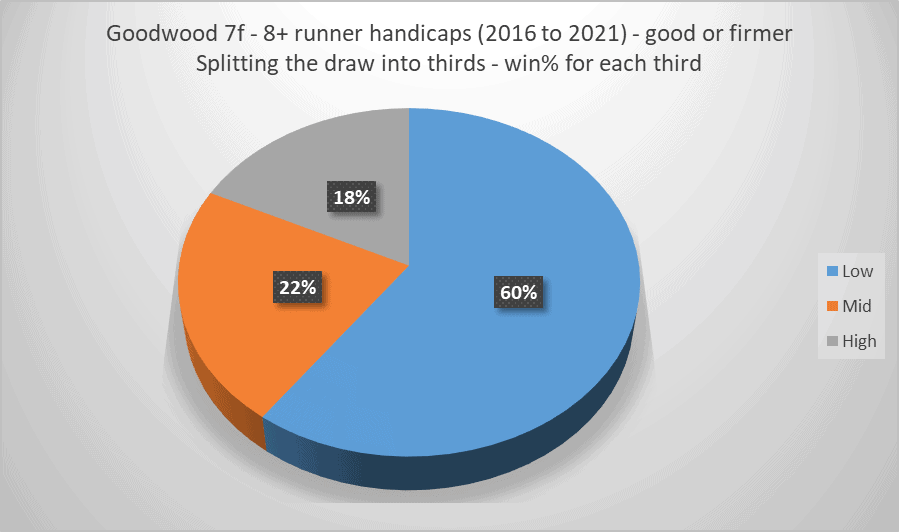
When using the Geegeez Draw Analyser the stalls are split into three sections or ‘thirds’ – low, middle and high. What this means is that in a 12 runner race for example, draws 1 to 4 would be in the low third, 5 to 8 in the middle, and 9 to 12 high.
TYPES OF DRAW BIAS
I want to start by talking about types of draw bias. I believe there are two types of bias. Firstly a bias that favours a particular section of the draw; secondly a bias against a particular section of the draw. Let me illustrate with a couple of examples using draw data from 2016 to 2021. Unless otherwise stated, in this article I am going to focus on 8+ runner handicaps during this six-year period.
Pontefract 1m 2f
It is rare to get effective draw biases at distances of 1m2f or more, but Pontefract is an exception. If we look at the track configuration we can perhaps see why this bias exists:
Low draws are positioned on the inside and with an early left turn this gives them the advantage of taking the shortest route assuming they break well. In contrast, higher drawn runners are either stuck out wide round the first turn or forced to tuck in mid pack or near the back, or they need to be rushed forward to get a position thus using energy very early in the race.
There is a second left hand turn after about another two furlongs cementing the early positional advantage for low drawn runners; and there is a third turn about a quarter mile from home which again favours those racing near to the inside rail. Let’s look at the most recent six-season data now:
The stats show a clear advantage to one section of the draw (LOW); there is a significant advantage in most areas. Low drawn runners win more often, place more often, have higher IV values and higher PRB figures, too. However, backing all such runners to SP would have made a small loss and the A/E index value is lower than the middle section’s A/E value. This factor was referenced in the first article: the market at Pontefract clearly appreciates there is a draw bias. Just because one section of the draw is clearly favoured, this not in itself a license to print money! For the record, however, you would have made a small profit of £11.98 during this period backing low draws to Betfair SP.
Pontefract over 1m 2f is an example of a bias strongly favouring a particular section. With middle draws out-performing higher draws, this is an example of a fairly linear relationship: the lower the draw the better. Draw 1 is better than draw 6; draw 6 is better than draw 10 etc.
Now for an example of a draw bias against a particular section of the draw.
Musselburgh 5f
The sprint 5f trip at Musselburgh is essentially a straight five but there is a slight kink to the left at the 3f pole which can slightly hinder wider drawn runners. With Musselburgh being a right handed course at longer distances, it means horses drawn next to the rail are the higher drawn runners. Here are the stats:
This is far from being a strong draw bias, but there is a bias against lower drawn runners compared with high and middle drawn runners. Low drawn runners come out comfortably bottom in all of the parameters as shown in the breakdown above. Looking at 2009 to 2015 we get a similar picture which gives further confidence that this is likely to continue this season and beyond.
It does seem that the kink to the left at the 3f pole is enough to make life more difficult for the wide (low)-drawn runners.
Indeed if we ignore 8- and 9-runner races (the smallest fields), and look at handicap races with ten or more runners we get the following results:
All of the low drawn variables deteriorate further, and such horses are winning only just above half of the races they statistically should (IV 0.53, an Impact Value of 1.00 being on par). Consequently, both middle and high draws are winning more races than they statistically should. One would expect to see those wider draws (low) struggling more over 5f at Musselburgh as the field size increases. However, it is always good to see results in black and white - as per the image above - to back up a theory.
INDIVIDUAL DRAWS / STALLS
A question: when you look at draw biased course and distances, what do you focus in on? The so called favoured third of the draw only? The favoured half of the draw? Or do you go further and have a preference for specific draws / stalls?
There is an argument to back the horse that is in ‘pole position’ especially on a turning track. One would think that would be the horse housed closest to the inside (i.e. drawn 1). However, the stats I have uncovered suggest differently. The stats suggest the second closest horse to the inside (i.e. actual draw 2 - 'actual' draw being the real position a horse was drawn, after accounting for any non-runners) is generally most favoured.
To show this in more detail I have looked at all 8+ runner handicaps over 5f and 6f run around a bend (2016-2021). For the record there are 12 UK courses where 5f and/or 6f races occur round a bend (seven turf courses and five on the all-weather).
Firstly I want to compare win and placed strike rates (N.B. Place SR% includes winners with the placed runners).
The margins may look quite small but they are significant as the data set covers over 2400 handicap races over 5/6f. All other key stats also point in favour of 'actual' draw 2. Firstly A/E values:
Runners drawn 2 have been far better value than those drawn 1. This is a much bigger difference than I had expected.
Next a look at profit / loss figures. Firstly a comparison of traditional SP figures (to £1 level stakes):
Losses of nearly 26p in the £ if backing all horses drawn 1 are bankruptcy territory; a smaller 8p in the £ loss for all horses drawn 2 would see a far more protracted slide to the proverbial poorhouse. But, here's Betfair SP to save the day:
The flow of bleeding has been stemmed from stall 1 but there are still bank-destroying losses; whereas trap 2 is now in the black!
But... we already know that profit / loss figures can easily be skewed by big-priced outlier winners, especially using Betfair odds. So I thought it worth comparing stats for the two draws when the Betfair SP was no bigger than 16.0. Here is what I found:
We can now see that big priced winners are not skewing the stats. Draw 2 once again has a better strike rate (both win and placed), better returns and a much stronger A/E value.
So what is actually happening here to promote stall two above the notionally best-drawn box, stall one? That is something I have pondered for many years because I have seen this type of pattern repeating time and again.
One plausible theory is that it may simply be down to the fact that horses drawn right next to the rail have less room for manoeuvre. With a rail on their inside, if they break from the stalls poorly then they are very likely to be stuck behind one or more horses. Their options are compromised until they've completed the turn by which time it may be too late. Meanwhile, horses drawn 2 have a little more space either side of them and hence more options if they break slowly. Whether this theory is true or not I obviously cannot say, but there is logic there, and it is a pattern replicated in US dirt racing at sprint distances around a turn.
What is clear in terms of the stats: in 5-6f handicaps round a turn it is preferable to be drawn 2 rather than 1.
Before moving on, I mentioned that 12 courses were in that sample and, of those 12 courses, only Kempton saw a clear advantage to horses drawn 1 over those drawn 2. Two courses - Epsom (6f) and Wetherby 5½f - had limited data (just 16 and 15 races respectively), while the other nine courses all favoured horses drawn 2 over horses drawn 1, most of them fairly strongly.
GOOD DRAWS WITH PRICE CONSIDERATIONS
As we have seen, backing a specific draw / stall under certain conditions could produce a profitable scenario. However, this idea is full of risks as we are pinning our hopes on one stall position and nothing else. So, how about combining a good draw with market factors? This is what we are going to look at next.
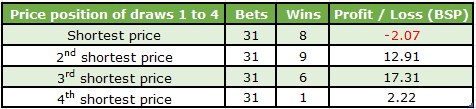
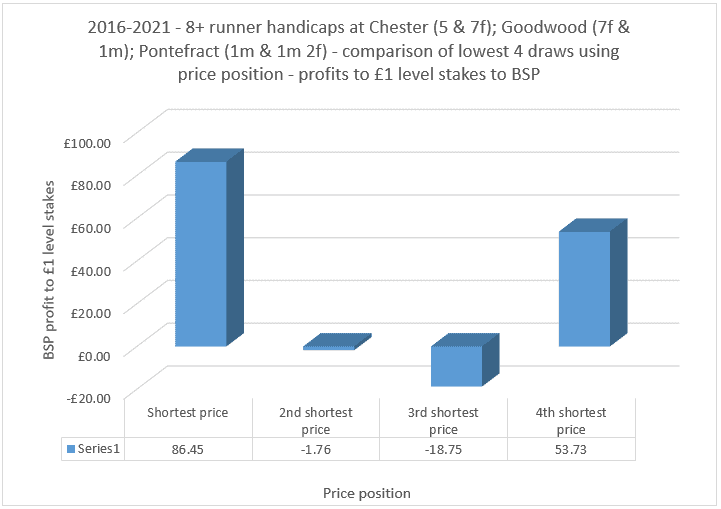
I have taken six of the strongest draw biases from the past six seasons (these are Chester over 5f and 7f; Goodwood over 7f and 1 mile; and Pontefract over 1 mile and 1 mile 2 furlongs). From there I have focused on the four stalls closest to the favoured inside rail: actual draws 1 to 4. Then I have ordered them depending on price. My idea is to compare price position of these good draws to see if there are patterns to be found.
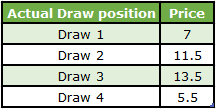
By way of an example, let’s imagine the following scenario:
That would mean an order as follows:
Here are the actual results for the six course/distances (profit/loss has been calculated to Betfair SP and we are again focusing on handicaps with eight or more runners):
Chester 5f
Chester 7f
Goodwood 7f
Goodwood 1 mile
Pontefract 1 mile
Pontefract 1 mile 2 furlongs
Combining the six courses we get the following results:
It seems therefore the best value lies at either end of the price position spectrum. The shortest priced runners drawn 1 to 4 have made the biggest profit. They have also had a decent strike rate of 28.6%. The biggest priced runner from draws 1 to 4 have also made good profits although it would have been a bit of a rollercoaster with just 13 wins from 258 runners (SR 5%).
So is this the way to go? I'm not sure, but I believe the idea is worthy of more digging in the future. I’ll add it to my rapidly expanding research list!
- DR
https://www.geegeez.co.uk/wp-content/uploads/2020/04/Pontefract_Pipalong_BillesdenBrook.jpg319830Dave Renhamhttps://www.geegeez.co.uk/wp-content/uploads/2022/10/geegeez_banner_new_170x78.pngDave Renham2022-04-26 07:16:002022-04-26 07:16:00Draw Bias 2022: Part 2
“It’s a long way to Tipperary”, the first world war British army recruits used to sing as they trudged along the blasted fields of France, writes Tony Stafford. More than a century later, Ryan Moore fitted in an afternoon there sandwiched in between two successful days in Surrey, with a winner apiece at Epsom and Sandown Park.
Tipperary also provided a victory for Aidan O’Brien on Thursday but when the private jet touched down for its second Irish hop for Navan on Saturday, the serious business began. It is, after all, Guineas week – yes April 30th rather than the first Saturday in May - and the barely started flat-race season will be two-fifths of the way through the 2022 Classic races by May Day.
If we needed a sign that O’Brien senior, like his main adversary for the first Classic, Charlie Appleby, has his team in form, then Navan would tell us. Before the meeting Ryan told a mutual friend that all the maidens would run well.
In the event Ryan got on three of O’Brien’s five winners, Aidan matching stay-at-home Paul Nicholls’ tally on the final day of yet another victorious jumps championship at Sandown. Understandably, Nicholls preferred saving his best horses for the two four-runner and one five-runner highly-priced (if not as highly-prized as the swollen jumps pattern would wish) contests largely free from Irish interference. *Note: If you would like a detailed, reasoned evocation of the negative effect on the sport of the ever-growing jumps pattern, read editor Matt Bisogno’s highly informed piece on the subject.
Where the Irish did challenge, in the £90k to the winner Bet365 Gold Cup (nee Whitbread), they mopped up the prize, via 16/1 shot Hewick, trained by Shark Hanlon. Why he, of the flaming ginger hair, should be called “Shark” remains a mystery to me.
Indeed why he alone should have that designation when so many of his compatriots make an equally skilled job of matching and bettering his exploits by turning equine base metal into gold is probably a case for the Monopolies Commission, assuming of course that his nickname was acquired from his training days. But then it sometimes feels like there are other aspects of Irish stables’ domination of the major British jumps prizes every season that need referring to that body. All else seems to be failing as this year’s early false dawn at Cheltenham soon reverted to the usual bloodbath for the home team.
As a domestic aperitif to their top teams’ coming over at the weekend to Newmarket, there is the small matter of Punchestown, five days starting tomorrow and concluding on the day the 2,000 Guineas welcomes Luxembourg from the Coolmore boys to challenge the two prime Godolphin candidates, red-hot favourite Native Trail and market second-best, Coroebus.
Coroebus’ style had many admirers on the day he and Native Trail both won their 2021 finales, the favourite in the Dewhurst and the back-up in a lesser race.
But Native Trail is the only unbeaten colt of the pair, a distinction shared by Luxembourg and just two others from the 24 that stood their ground before the field is whittled down once more at noon today. I dealt with the case of William Knight’s Checkandchallenge, winner of a deep race at Newcastle last weekend. Coincidentally the other unbeaten colt is also trained in Newmarket, in his case by David Simcock. He is Light Infantry, twice a winner last year, and like Checkandchallenge, a son of the deceased Fast Company.
At the time he was in training as a juvenile with Brian Meehan, Fast Company showed many of the attributes of a potential Classic winner, but after an excellent half-length second in the 2007 Dewhurst behind the following year’s Derby winner, New Approach, he never raced again.
I was a regular on Thursday work mornings at Manton in those days and it was a great disappointment to Brian when Fast Company was sold to Godolphin and sent to be trained by Saeed bin Suroor. If either of these relative longshots wins on Saturday it will be a long-awaited accolade for a horse that had been under-valued for all his stud career despite being in the care of Darley throughout.
In the manner of such things, now Fast Company’s son Checkandchallenge has inevitably been attracting interest from people who could more easily shrug off the disappointment of a below-expectation run in the race – be that fourth or eighth as anything better would be a triumph - than Mr Hetherton whose colours he has carried hitherto.
I recall a last-minute pre-Derby sale by Karl Burke around a decade ago that probably made all the difference financially to his training career which at the time looked to be stalling or probably worse. I hope this very smart, sweet-travelling colt does his owner (whoever he may be on the day) and his talented trainer proud.
I make no apology for interjecting here on the Nicholls plans for Punchestown this year which are miserly in the extreme. Nicholls has never been as enthusiastic a Punchestown challenger as Nicky Henderson – I travelled to see Punjabi at the meeting four years in a row for two wins, a nose second and a pulled up (wind).
At time of writing on Sunday afternoon, Clan Des Obeaux, the impressive Aintree winner, is ranged alongside Allaho, Minella Indo, Galvin and Al Boum Photo in Wednesday’s Punchestown Gold Cup. He is a 3-1 shot, a short-enough price for all the domination of Aintree if that quartet turns up.
The only other possible for the UK jumps champ is Monmiral, slated to take on the two wonderful mares Honeysuckle and Epatante, the latter another Aintree winner, in her case over further. With around €160K to the winner in each of a dozen Grade 1 races over the five days, you would think sending a horse with place chances might be worth the risk even for cautious Paul.
Yet tomorrow’s card, worth in all €735k, hasn’t attracted a single English, Welsh or Scottish challenger. It will be great to watch on Racing TV all week but with the wistful thought that surely things should be different.
Back in the Guineas, Camelot, by Montjeu rather than the more influential Galileo (both sons of Sadler’s Wells) but hardly his inferior in terms of producing Derby winners, is Luxembourg’s sire.
When asked about his abilities, Aidan O’Brien said he has superior speed to Camelot, a horse that just saw off French Fifteen in an epic battle for the 2,000 Guineas ten years ago. He followed up in the Derby and the much-sought third leg of the Triple Crown was denied O’Brien and son Joseph when Camelot lost the St Leger by three-quarters of a length to Encke, a horse trained by the subsequently disgraced Mahmood Al Zarooni for Godolphin.
That was Camelot’s first defeat after five successive wins and prevented the first English Triple Crown since Nijinsky graced the 1970 season for an earlier O’Brien – the revered Vincent.
It's always great when the champion two-year-old gravitates to winning the 2,000 Guineas and after his bloodless Craven Stakes return that is entirely possible. Charlie has the horse with the form, but Luxembourg has the Coolmore badge all over him, not just on the sire’s side, but the dam is by Danehill Dancer, a sprinter that ran in Michael Tabor’s colours but far exceeded his decent racing ability when sent to stud.
The mare Attire provides another major link to the glorious past of Ballydoyle. Ben Sangster, her owner-breeder, is of course a son of the late Robert Sangster whose inheritance from his Vernons Pools-owning father funded the domination of the international bloodstock market in the 1980’s and 90’s. Along with Vincent’s supreme training skills and the business acumen and animal husbandry of Vincent’s son-in-law, John Magnier, they were an unbeatable partnership for more than two decades.
I’m with Luxembourg to prove on Saturday that blood is thicker than form lines and take him and Ryan, not to mention Aidan and the Coolmore team, to beat Native Trail with the underdog Checkandchallenge coming from the pack late on to clinch third. Easy, really, this flat racing.
I have loved the 2021-22 jumps season as my little daily job editing fromthestables.com which involves sharing the thoughts of around 15 trainers, ended with a nice win in the William Hill Radio Naps table. The 2022 summer table started yesterday and we were off to a flier when Rogue Millennium won for Tom Clover at 9/2. Only seven months to go!
- TS
https://www.geegeez.co.uk/wp-content/uploads/2022/04/luxembourg_VertemFuturity_2021_Doncaster.jpg319830Tony Staffordhttps://www.geegeez.co.uk/wp-content/uploads/2022/10/geegeez_banner_new_170x78.pngTony Stafford2022-04-25 07:30:172022-04-25 07:30:17Monday Musings: Of Ryan, and Raiding Parties
Racing fans, at least within their social media microcosm, tend to get aerated about all sorts of passing flotsam and jetsam. Often, there is little substance at the heart of the vexation; but not always.
This week, racing twitter has been raging about the fact that the longed-for clash at Punchestown between the Champion Hurdler, Honeysuckle, and Supreme Novices' Hurdle demolition job, Constitution Hill, will not come to pass. The reality, we're given to understand, is that it was never more than an accidental ejaculation from the understandably excited owner of the latter, Michael Buckley. He was, it seems, about ten months premature.
Seen by many as a 'swerve', it may be considered perfectly reasonable at the end of the season that one horse - or the owner or trainer of said horse - should call time on the campaign. However, that sharp quill of Kevin Blake's outlined here the wider issue of the ease with which top class (or even those relatively close to top class) animals can legitimately avoid each other through the season, and even at the spring festival finales, particularly in Britain.
The other debate, if one can call it that, has been about the prospect of a fifth day at the Cheltenham Festival. There's no market on Betfair for this but, if there was, 'Yes' for a fifth day by 2025 would surely be 1.01 in spite of most racing fans being staunchly opposed to the proposal.
That got me thinking about the National Hunt Pattern, and jump racing field sizes in general and, ultimately, a good bit more besides. Here's where I got to with it all...
How are field sizes generally in UK National Hunt racing?
In 2009, the first year in our Query Tool database, there were 34043 runners with 3375 winners (including dead heats). That gives an average National Hunt field size in 2009 of 10.09. Here are the annual figures from then until the end of 2021, the last full year of data:
The wins column likely includes some dead heats, but we don't need to split atoms with this dataset to get the gist. What stands out for me is that the number of runs (second column in the above table, blue bars in the below chart), 2020 / Covid aside, have been remarkably consistent at around 31,500 to 33,000. That's plus or minus 5% in the main. But the number of races has risen significantly in that time meaning that field sizes (right hand column in the table, orange line in the chart) have declined notably:
What is the National Hunt Pattern?
What the National Hunt Pattern is not is part of the European Pattern Committee (EPC), whose function is to determine the most important races across the continent, allocate a grading system to them, ensure their ongoing quality for the allocated grade, and manage the race programme to avoid clashes as far as is possible. The EPC works under the umbrella of the International Federation of Horseracing Authorities (IFHA), but leads the way globally in this area. More details of their work can be found here. In essence, the EPC serves the primary purpose of helping to ensure the ongoing quality of the breed through an appropriately hierarchical race programme.
The Jump Pattern Committee (JPC) "aims to assist the provision of a co-ordinated programme of quality races in each age, sex and distance category" for British jump racing. Fair enough, on the face of it at least. But the JPC is a largely autonomous UK-only entity and, as such, does not come under sufficient scrutiny to ensure its race programme is fit for purpose.
The Jumps Pattern comprises Grade 1, Grade 2, and Grade 3, with all Grade 3 contests being handicaps. There are also Listed races which are on the periphery of the Pattern. The composition of the Jumps Pattern is described thus:
The Committee aims to achieve a balance of Grade 1, Grade 2 and non-handicap Listed races within the Pattern and Listed race structure, so that there are more Grade 2 races than Grade 1, and that the total number of Grade 2 and non-handicap Listed races should be at least double the total number of Grade 1 races
There are challenges within the relationship between the volume of lesser Pattern non-handicaps (G2 and Listed) and the volume of Grade 1 races. These challenges are exacerbated by the expansion of flagship meetings like the Cheltenham Festival from three to four (and soon to five?) days: for every additional Grade 1 there may need to be two lesser Pattern races added. As we will see, this is hard to legitimise against the wider context of a dwindling horse population, particularly in jump racing.
How are Pattern Race field sizes in UK National Hunt racing?
Having set the scene with the macro field size vista, let's now call in on Pattern races in particular. For the purpose of this analysis, I'll include Listed races.
We again see a consistency of runners, in fact a slight increase up to around 2018. But those runners have had to be shared amongst a much larger number of Class 1 (Grade 1,2,3, Listed) races. In 2009/10, the two-year average number of such races was 151 (and a half). In 2019/21, the years around Covid2020, the average number of Class 1 National Hunt races in the UK was 208 (and a half). That's inflation, over the course of a single decade, of a staggering 37%.
Predictably, field sizes have shrunk, from north of 11.5 in 2009-2011 to south of 10 since 2017.
But it gets worse.
When we remove the Grade 3 handicaps from the picture, what is left is deeply concerning.
Although the Pattern inflation is less stark - 'only' a 26.5% rise between 2009 and 2021 - the average field size has dropped from a high of 10.57 in 2010 (and a three-year average of 10.23 between 2009 and 2011) to 7.67 last year, and a three-year average of 7.84.
Oh. Dear.
As a reminder, in 2009 the average UK jump race field size overall was 10.09 and last year it was 8.6. The proliferation of Class 1 additions has seen field sizes in those races plummet in relation to all NH races in Britain, and the trendlines are disconcerting, to say the least.
Why does field size matter?
Why should we even care about declining field sizes anyway? The main reason is that there appears to be a fairly reliable correlation between the number of runners in a race and its competitiveness; and, further, to public interest and engagement, best measured by betting turnover. More betting turnover normally equals more money to the levy, which gets ploughed back into the sport for things like prize money, administration, and equine and human welfare projects. It's a pretty virtuous cycle, if you ignore the fact that some punters have to lose in order to keep the cycle rotating.
The magic number in field size terms, from a betting turnover perspective, tends to be eight. That is the number of runners at which a race pays three places for each way bets, a factor that is, I understand, a strong driver for bet placement.
What are the underlying problems?
There are broad issues and a more narrow one in play here. The broader issues are economic and equine; specifically, how affordable it is to keep a jumps horse in training in a recession; and how breeding, allied to modern training practices, is perhaps not allowing horses to stand as many races as was historically the case.
The narrow issue is probably the one upon which to focus. It must be apparent to absolutely everyone, regardless of agenda, that there is too much racing. There are too many fixtures with too many races at each fixture for the horse population to service.
These are the total number of races run in UK National Hunt, by year, since 2009, as per the excellent BHA data resource here.
And here are the percentages of races with fewer than six runners (i.e. five or fewer) over the same time frame:
There is strong correlation between the overall number of races in a given year, and the percentage of small field races in that year. Which, again, ought to surprise absolutely nobody. These charts are included as merely another representation of the "too much of a good thing is a bad thing" mantra espoused by anyone who cares about the sport.
Looking only at Class 1 races, the same issue is clearly at play; but also, many of these races have benefited from the ratings inflation of the past decade, and may no longer satisfy the quality criteria outlined at the end of this Jumps Pattern document. Of course, there is likely to be a revision to the quality tariff to accommodate this season's downward re-engineering of official marks.
A (way too) simple solution
So how do we arrest the decline and put the sport back on the front foot, in terms of competitive racing at least?
Let's recast the landscape. What if we had the 2009 fixture list and the 2021 volume of runners? And let's imagine this might happen by 2025: some chance, but we're in the realms of hypothesis so here goes...
In this far from outlandish projection we've got about 450, or roughly 12%, fewer races. That's 64 or so fewer fixtures, assuming seven-race cards. Little more than one a week.
And the payoff for that brave stance is a field size average of nearly ten, which is close to optimal from both bookmaker/betting turnover and human interest perspectives.
To counter the "it wouldn't work" brigade, there is a precedent for culling a chunk of races and achieving a satisfactory outcome: in 2019, France Galop reduced the number of races by 20% with virtually no impact on betting turnover. Indeed, British bookmakers, having historically driven the clamour for 'more product', are now on the side of 'less is more'.
Moreover, there is a precedent in Britain, too. In 2014, the BHA garnered agreement for the removal of around 100 chase races which were under-subscribed. However, from the press release which accompanied the announcement it was clear how reluctant certain signatories - notably the Racecourse Association - were to the arrangement.
And there is one further, more recent, piece of evidence upon which to call. In 2020, as the world became infected, British racing was, alongside football, the first professional sport to return to action. It did so with an innovative plan that addressed the situational needs of both maintaining a right to operate during a pandemic, and tailoring a programme to the horse and stakeholder populations. We had a normal Royal Ascot, in terms of timing at least, with the 1000/2000 Guineas shortly before and the Derby/Oaks shortly after.
This fixture list was formulated by the BHA and featured fewer fixtures, with more races per fixture; and a focus on moving some of the top end prize money to the lower tiers of the class spectrum in order to keep owners/trainers in the sport. These changes, which - granted - were satisfying pent up demand from a six-week hiatus, produced better field sizes and stronger betting turnover when it was needed most. [It also led to the decision to permit jockeys to ride only at one meeting per day, which has been retained and which has led to both an increase in jockey wellbeing and a greater spread of opportunity in the riding ranks].
Less was more, post-Covid. Less was more in France. Less was more when the chase programme was re-imagined.
In the Class 1 space, there are far too many races. As can be seen in the tables below, where comparisons are again difficult due to the recent Covid interruption, the three years 2009-2011 (green table) had a total of 290 Class 1 non-handicaps (give or take dead heats), which was just about the same number as in the two-year period of 2019 and 2021 (blue table). How did we get here?!
The ongoing (though now largely complete) reconfiguration of the shape of the handicap ledger should be used as benchmarking against which to downgrade and/or delete 12-15 races from the current Pattern. After all, ratings inflation is quite likely an accidental but key factor in why we have aggregated such a bloated Pattern in the first place.
An alternative, which has been touted by that man Kevin Blake amongst others, is to convert all UK Grade 2 races into handicaps to complement the existing Grade 3 arrangements. This would have the general effect of rendering such contests more competitive both in terms of field size and win chance (i.e. fewer odds on shots). It's a bold shout but we are in desperate times and, as such, desperate measures are called for.
Why this won't happen
There are lots of good, eminently sensible reasons why changes similar to those mooted above, and elsewhere by others, ought to be implemented for the health of the sport going forwards. Unfortunately, there are two reasons such beneficial amendments will not occur.
The first is funding: racecourse funding comes, in large part though to varying degrees, from 'media rights' payments. These are amounts of money paid for the live pictures (by bookmakers, mainly) for the right to consume/broadcast that content. The image below, taken from a DCMS-sponsored analysis of the funding of horseracing, infers as much.
The problem is that this part of the racecourse business funding model amounts to a 'more races equal more money' situation, not entirely unreasonably perhaps. But, as we're seeing increasingly in football, the expansion of the programme - be it the never-ending Champions League, a preposterous 48-team World Cup in 2026, or myriad low grade seven furlong handicaps at Wolverhampton - leads to a dilution of the product and a commensurate dampening of interest in the mind of the customer.
The funding model needs to focus more on incentivised payments for a broader contribution to racing's ongoing wellbeing. To that end, with a little topological thinking, less can be more without impacting racecourse payments negatively. Indeed, such a move may lead to a positive impact on media rights payments.
However, racecourses do not only generate revenue from media rights. Some actually wash their faces at the turnstiles, too! As a consequence, any proposed reduction in fixtures or number of races is likely to be perceived as a threat to on-site profits for all that there must surely be a way to condense predominantly from those fixtures that could not exist without media rights funding.
Further, the legacy nature of the allocation of fixtures means that racecourses assert a right of ownership over a subset of historical fixtures that exist outside of the BHA's core list. If these fixtures exist outside of the core - which one can assume means outside of what the BHA considers healthy for the sport - why do they still receive Levy Board funding as well as media rights payments? After all, the Levy Board are working towards "the improvement of horseracing" according to their mission statement. Funding a surfeit of races/fixtures which are unilaterally staged by the racecourses is sustaining the over-supply - and therefore diminishing field sizes - and must be counter-productive to engagement with the sport. If tracks want to claim ownership of these fixtures, they should not expect Levy funding to support them. The Levy is funding all (bar one) fixtures in 2022, but should take a much stronger stance on fixture funding in 2023 and beyond.
A further problem with the historical fixtures is that they seem impervious to performance metrics. That is, regardless of whether they are failing to produce requisite runner numbers their place in the calendar is assured; meanwhile, other tracks - which have fewer or no 'historical fixtures' - offer excellent prize money (that typically leads to satisfactory field sizes), but cannot claim the same fixture allocation as those maintaining a sort of birth right on the fixture list.
The second, closely related, is politics. Racecourses are by a mile the most powerful organism in the industry's food chain. If they don't want to do something, they don't do it. And it will take an extremely skilled practitioner indeed to persuade them of the leap of faith required to pivot towards the model suggested up above.
They argue that it is not the volume of fixtures but, rather, the number of times each horse runs in a year that is the problem: if the horses just run half a race more on average, we're all good. Sounds logical enough, doesn't it? Until you realise that one of these factors (annual runs per horse) has been virtually constant for a long time. Because bill-paying owners want horses to run as frequently as is prudent these averages are almost impossible to change - successive chief executives at BHA have tried; so if horses cannot run more often, and if we cannot get more horses in training (see second chart below), the only controllable component is the volume of races.
It is not only the tracks, however, in the political pyramid of racing that would likely wail and gnash teeth at any proposal to reduce the Pattern. Plenty of horsepersons - trainers and owners, mainly - would seek to maintain or even extend the current status quo: for many of these men and women, any Graded race is a good one to win, regardless of how hollow the verdict, or the implications for the sport.
What we need
In the end, this gets to be about the political hierarchy of British racing, and how it is fundamentally - and perhaps irreparably - fractured. Since 2015, there has been a structure in place called the Members' Agreement, widely known as the tripartite agreement, which defines how decision-making can happen. In a nutshell, who needs to approve what.
It was widely heralded as a new united frontier for the sport; in reality, sadly, it has been no such thing. Indeed, we are now at the point where racecourses and some parts of the Horsemen's Group, primarily the Racehorse Owners' Association (ROA), seek greater power and autonomy from the BHA, racing's regulator. They want to say yes to more money without a bother for the implications on the race programme, or anything downstream of that, such as the breed or public sympathies. Charlie Parker, President of the ROA, and who therefore purports to represent owners but has never sought our opinion on, well, anything, was strongly critical of the money being turned down in this leader late last year.
To be clear, the 'more money' offer was based on 'more races'. True, that was for all-weather racing, an area not referenced in this article, but once the genie is out of the bottle...
In January of this year, incoming chief executive of the National Trainers' Federation, Paul Johnson, stated his organisation's commitment to increasing prize money in the sport via means other than more races, noting that the scourge of small fields was a major challenge. Johnson was formerly Head of Racing at the BHA, responsible amongst other things for race planning, and therefore knows better than almost anyone the difficulties of producing a balanced programme despite persistent requests for more races.
To Charlie Parker, and others at ROA, however, the checks and balances introduced by the tripartite agreement are now, just six years later, suffocating. They want to own the decision-making process in spite of demonstrating their absence of pastoral care for the sport. The likes of Jockey Club Racecourses, whose 'About Us' page loudly trumpets, "The mission of The Jockey Club is to act for the long term good of British racing in everything we do" is currently fighting off outcry relating to selling rights of heritage races to Playtech who will use them in fixed odds games of chance - at a time when they, like all others in the industry, should be distancing themselves from such games for the short term good of British racing; and also dealing with the firestorm emerging from their fait accompli to add a fifth day to the Cheltenham Festival. More product, less quality, less interest. Plenty of seven and a half quid Guinness sold, though, so, yeah...
These entities and their money-grubbing, even in the face of charters that expressly reject such behaviour, are precisely why we don't just continue to need a committee - that includes the BHA - to make decisions, but why the golden vote should sit with the regulator.
Much is wrong with the balance of power in racing and it very much suits certain stakeholders for the sector's issues to be laid at the feet of the BHA. But the myopic machinations of others sitting around that table could derail the whole industry within ten years and, were that to happen, the first to go would undoubtedly be jump racing.
- Matt
https://www.geegeez.co.uk/wp-content/uploads/2019/11/Cyrname_Altior_Ascot2019.jpg320830Matt Bisognohttps://www.geegeez.co.uk/wp-content/uploads/2022/10/geegeez_banner_new_170x78.pngMatt Bisogno2022-04-21 09:10:412022-04-21 10:35:30UK National Hunt: An Indefensible Pattern and an Existential Threat
In this episode of Gold Nuggets I consider a part of the puzzle that is often overlooked, and one that - if done even nearly correctly - gives us the very best chance of coming out in front. It is particularly relevant now that the longer days mean numerous evening meetings and a daily race count regularly north of forty. So, in the video that follows, I cover the crucial art of race selection.
In the video, I refer to a previous mini-series I produced called 'The Price Is Wrong', which you can look at here.
Contents:
00:00 Intro
00:40 "The Price is Wrong"
03:25 'Top down' Race Selection
05:20 How "My Races" helps
07:40 Quick Race Analysis Example
13:15 'Bottom Up' Race Selection
19:45 Summary
https://www.geegeez.co.uk/wp-content/uploads/2022/01/goldnuggets.jpg320830Matt Bisognohttps://www.geegeez.co.uk/wp-content/uploads/2022/10/geegeez_banner_new_170x78.pngMatt Bisogno2022-04-20 12:05:062022-04-20 12:09:38Gold Nuggets #12: Choose Your Battles
It has been a couple of years since I wrote some articles on the draw and, with the flat season hitting stride now, it is a good time to revisit the subject, writes Dave Renham. The draw will always have special place in my heart because it was essentially where my racing journey began.
Sprintline 2002: The Effects of the Draw - co-authored by Dave Renham
While at university I became interested in horse racing stats and I soon realised that there was a potential betting edge in focusing on certain sections of the draw at a few specific courses. Back then, in the late 80s and early 90s, the courses and distances with the strongest biases were at Beverley over five furlongs, Thirsk over five and six furlongs (especially on firmer ground), Chester from five to seven furlongs, Lingfield (turf course) five to seven furlongs, and Sandown over five furlongs when the stalls were placed on the far side. The beauty back then for draw punters like myself was that there was a decent edge for those of us who considered ourselves ‘in the know’. I was able to find plenty of betting opportunities that represented good value.
Unfortunately, if predictably, it was not long before draw biases started to be shared in racing articles which were then followed by comprehensive books on the subject. Indeed, I co-authored one of them!
As with many things, when a good source of highlighting value bets is found, within a few years the edge starts to disappear. This is very much a horse racing trait: good ideas have their initial edge because the majority of people are not aware of that value finding approach. As time goes on, however, the betting public and the bookmakers catch up and, as a result, prices tend to contract and the value begins to erode. This has happened to some considerable extent with the draw over recent years.
Using Chester’s five-furlong trip as an example, let us examine what has happened to the prices of the ‘best’ two stall positions over the past several years. The stalls in question are draws 1 and 2, those closest to the inside rail. I am looking here at handicap races with eight or more runners where draw bias tends to be more consistent:
Chester’s tight track has long shown a bias to lower draws and this has generally been well documented and widely understood. However, nowadays your average punter has had more exposure to draw biases than they did twenty years ago which explains the diminishing price pattern. The graph above shows that horses drawn in stall 1 had an average decimal SP price of 6.58 from 2003 to 2007, dropping to 5.19 over the most recent five-year period. Likewise, we have seen the prices of horses drawn in stall 2 dropping from 9.06 to 6.46.
Some statisticians may observe that despite the relatively solid sample sizes average prices can be skewed by an occasional bigger-priced runner. That would certainly be possible, so it make sense to compare the median prices as well. To remind you of your school maths class, median is the middle value when all are ordered from lowest to highest. This gives us another type of average, the findings of which are here:
Once again we see the same pattern: the prices for both draws 1 and 2 have dropped quite significantly over the period of study.
A further measure to illustrate how the draw affects the prices at Chester is if we look at all stall / draw positions from 2017 to 2021 and compare their average prices. We already know that the average for horses drawn in stall 1 has been 5.19 and stall 2 is 6.46. I have graphed the average prices for each stall over 5f at Chester, although due to small sample sizes in higher drawn runners I have combined those drawn in stall 8 or higher:
As we can see, despite a slight ‘blip’ with stalls / draws 6 and 7, the average price increases as the stall position increases (and is thus further away from the favoured inside rail). Looking at these data, we could confidently argue that at Chester over 5f the draw impacts on price more than any other factor.
I briefly want to go back to discuss the price reduction we saw earlier in the lowest two stall positions when comparing 2003-2007 average SP prices with 2017-2021. This has actually not coincided with the draw bias getting stronger; in fact, the draw bias has stayed roughly the same. This can be illustrated when breaking our draw data into three time frames between the years 2003 and 2021. The actual draw positions are also split into three: low third, middle third and high third.
As can be seen, low draws have continued to dominate in each time frame. This is further evidence of the fact that the price reduction is almost certainly down to more punters being aware of how fundamentally important the draw is to the business of finding winners at Chester over this minimum 5f trip. From a betting perspective, therefore, much or all of the value in lower drawn horses has now evaporated. This can be illustrated in terms of percentage returns (ROI%) if backing all horses from the bottom third (low) of the draw over different time frames.
I still find it remarkable that up to 2015 you could have made a blind profit at SP by backing all low drawn horses in 8+ handicaps over five furlongs at Chester. All good things come to an end, however, and that has not been the case in recent years. In the five year period 2016 to 2021, losses accrued were 13.7% of stakes. Ouch.
Appreciating and therefore deploying draw bias is not merely about looking at the performances of different sections of the draw; no, we also have to be acutely aware of how the market adjusts for such factors.
Being able to exploit the draw to one's advantage has also been affected in recent years by racecourse officials using other means of negating any potential bias. One way this can be done is by moving running rails which potentially changes part of the ground over which races take place as well as sometimes subtly changing the race distance by a few yards. The other, more notable, fly in the ointment has been the change in watering systems that most tracks now use. Some 20 or 30 years ago many course watering systems were badly affected by wind speed and direction, and hence certain parts of the track remained drier - and therefore quicker - giving rise to draw biases. Nowadays, though, the equipment has become more sophisticated and the water is spread much more evenly.
I mentioned earlier that Beverley over five furlongs used to be one of the strongest draw biases back in the day, and this can be seen when you look at the data. From 1998 to 2003 in 8+ runner handicaps the low third of the draw housed the winner 63.3% of the time, while the highest third won just 10% during that period. From 2004 to 2009, the strength of this bias appeared to dip a little but the low third still accounted for 53.4% of all the winners (high won a still dismal 15%). However, from 2010 to 2015 the low win percentage dropped to just under 42%, while high had narrowed the gap with 23.1% winners; and, from 2016 to 2021 it dropped to 40.8% low and 26.5% high. Over time, that's quite a big change. Yes, low draws are still favoured but the huge edge that there once was is no more.
Exactly why this has happened I cannot be sure; it is probably down to better watering and maintenance of the track. However, what is interesting is the fact that the prices on the best drawn horses have not changed much. Comparing the 2003 to 2007 segment with 2016 to 2021 here are the average prices for stalls 1 and 2:
Horses drawn in stall 1 have, on average, started at slightly shorter prices in the last five seasons (12 versus 11.42); stall 2 has seen an increase but a modest one when you consider the draw bias is nowhere near as potent these days. The median prices back up the raw average data as the table below shows:
What seems to be happening here therefore is the market at Beverley is still assuming the draw bias is as strong as it was back in the early 2000s. Unlike the Chester market, which has adapted as one might expect, this Beverley market has not: in reality, the odds should on average be higher than they currently are. The bitesize takeaway is that lower draws are generally poor value.
Another thing that has changed markedly in the past few years is the general appreciation that draw bias does not only occur over sprint trips. Pontefract, for example, over a mile and a mile and a quarter, boasts two of the strongest draw biases currently in play. Looking at 8+ runner 1 mile handicaps at Pontefract, it can be seen that this is a case of the betting market now cottoning on to the draw bias. This is in stark contrast to data gathered in 5f handicaps at Beverley.
Let’s compare once again the same two time frames - 2003 to 2007 with 2017 to 2021. Here are the average prices for stalls 1 and 2:
The average price of horses drawn in stall 1 has nearly halved; the figures for horses drawn in stall 2 have also contracted quite noticeably. Once again the median prices correlate strongly:
What this means, therefore, is that although low draws hold a significant edge over 1 mile at Pontefract the current prices on offer are so low on average, that they too are now generally poor value. We can see this in black and white when I share the fact that from 2009 to 2013 backing all low drawn horses at Pontefract over 1 mile in 8+ runner handicaps would have yielded a 13% profit; from 2017 to 2021 this flipped to a 22% loss.
This Ponte pattern mirrors the change we saw earlier in the Chester 5f prices and subsequent poorer value of low drawn runners in recent seasons.
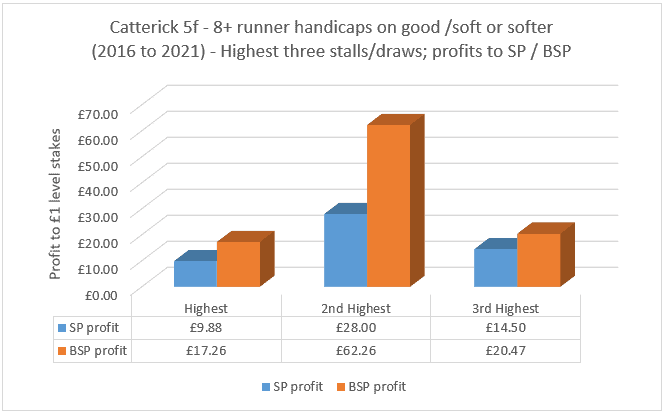
In order to fully make the most of draw bias, or indeed perceived draw bias, it is clear we need to be aware of market factors, not just the raw draw data splits. Let us close with a look at Catterick over six furlongs – again focusing on 8+ runner handicaps. Because this six-furlong trip is contested around a bend there is a perception that lower draws have a slight edge. This is borne out when we compare the combined average prices of the three lowest drawn runners with the three highest drawn runners going back to 2016.
A difference on average of two and a half points. That may not seem much of a difference but over several races it can make a critical difference to our bottom line. During this time frame both sections of the draw have won virtually the same number of races (26 versus 27), implying that there is no bias to lower drawn runners at all. At least partly as a consequence of this perception, backing the three lowest drawn stalls would have produced crippling losses of 45.8% to SP, while blindly supporting the top three stalls would have produced a profit of 10.5%.
One observation when comparing odds over time might legitimately be that field sizes truncating has had a bearing on prices. While that impact should be spread across the full range of stalls anyway, this final chart also helps to imply that field size is likely not the main factor at play here.
It is a little 'busy', but essentially we have two lines which we might expect to be correlated - perceived win chance (expressed as SP) and actual strike rate (expressed as win %). Although the win strike rates jump around a bit, the blue dotted 'trendline' shows no advantage; compare that, however, with the orange trendline for average win odds which rises from low to high.
*
The aim of this article is to illustrate the important links between draw position and price, and to highlight the changing nature of some draw biases. Profitable betting is about getting value – well drawn horses only offer us value if the price is right. Also, we need to be aware that 'poorly' drawn horses can also offer value, but again only if the price is right.
- DR
https://www.geegeez.co.uk/wp-content/uploads/2017/05/chester_roodee.jpg320830Dave Renhamhttps://www.geegeez.co.uk/wp-content/uploads/2022/10/geegeez_banner_new_170x78.pngDave Renham2022-04-19 07:58:122022-04-19 08:10:00Draw Bias 2022: Part 1
I have a friend who, whenever he sees the name Fast Company against a runner in a race on soft ground or worse, thinks it’s going to win, writes Tony Stafford. More often than not, his inability to back anything much beyond 5-2 prevents his turning intuition to action, thereby preventing his backing a nice long-priced winner.
The fact Fast Company horses do win in extreme conditions exercised my curiosity yesterday morning and I thought I’d better look at the facts. Actually there is little difference between the late stallion’s stats - he died two years ago at a time when his fee at Kildangan Stud was €12,000, the highest of his ten-year career.
From good to firm through all readings to heavy, his winning ratio moved little away from the 23% achieved on heavy ground. What he hasn’t got so far though is a top-class three-year-old colt. Jet Setting, trained by Adrian Keatley, did break the mould with an unexpected defeat of the brilliant Minding in the 2016 Irish 1,000 Guineas, a run that was out of kilter for much of her form. Twice well behind Minding either side of that, she did win a Group 3 easily as an older filly.
Now, though, Fast Company has a Classic contender, and from an unexpected source. In Friday’s opening Listed race on Newcastle’s All-Weather finals day, Checkandchallenge thrust himself into the consciousness with a smooth defeat of a trio of 100-plus rated colts.
Winner of his only previous start at two, when he got up to beat a Karl Burke horse (rated 80 before Friday) he had only inches to spare, but that was after having at least six lengths to make up inside the last furlong.
I was at William’s stable coincidentally last Tuesday when we saw Checkandchallenge quite by luck in the distance. “There’s my Guineas horse”, said William with a laugh, adding that Newcastle on Friday would tell him whether the idea was fatuous or had legs.
Legs it certainly has. With Danny Tudhope at his unobtrusive, business-like best, Checkandchallenge sat at the back of a six-runner field leavened with a couple of three-year-olds who had followed Godolphin’s number two for Saturday week over the line at Newmarket last October.
Coroebus, preferred in some quarters last year to the number one and European champion 2021 juvenile, Noble Trail, won the Autumn Stakes by two lengths from Imperial Fighter with Dubai Poet third. At Newcastle, Checkandchallenge had that pair behind him but in reverse order when the winning margin was slightly less, although Tudhope hardly had to exercise his arm muscles to achieve the result.
Obviously now, after his 4-1 on cakewalk in the Craven Stakes last week, Noble Trail is shorter than ever as the 5-4 market leader, but Coroebus is still next in line at 7-2 ahead of the leading Coolmore / Aidan O’Brien contender Luxembourg, who is a 9-2 chance.
As one very long-tested punter always used to tell me: “you can’t eat value”, but there seems to be a wider disparity in the prices of said Coroebus and Checkandchallenge than the collateral form merits. Ladbrokes and Coral, who work in concert (same firm) for the most part these days, both offer 40-1 about the Rathmoy Stables horse, whereas he is more like 16-1 elsewhere.
Incidentally, when with my Editor I ventured up the steps to meet the trainer in the luxuriously-appointed owners’ room, among the guests enjoying the facilities and watching the day’s racing was Karl Burke.
On Friday morning, when discussing Checkandchallenge with his trainer, Knight ventured: “Karl really likes Aasser <the horse Checkandchallenge beat at Wolverhampton> and thinks he’s much better than 80. That’s why he runs in the handicap at Lingfield today!” He won it comfortably if narrowly at 7-2!
By then Checkandchallenge had already endorsed the previous form and the wonder of it was how little the Lingfield market was affected in the last moments before the race. He’ll go up a few pounds tomorrow while Checkandchallenge, having won both his races, will be eligible for a mark and it won’t be anywhere in the 80’s!
Imperial Fighter, about whom the Sky Sports Racing team laboured to find an excuse to explain the reversal of his form with Dubai Poet, ended 2021 rated 110 and Dubai Poet was 104. Coroebus was 115 and Noble Trail 122. I reckon Checkandchallenge deserves 114 but the officials might go with the “favourite didn’t get a run at a crucial time” get-out and mark Knight’s horse down accordingly.
William Knight spent much of his early career assisting Ed Dunlop at Newmarket before moving to Sussex for ten years, training with success at the late Anne, Lady Herries’, Angmering Park.
When the chance unexpectedly came around two years ago to take over a vacancy left by David Lanigan at Neville Callaghan’s former Rathmoy Stables in the Hamilton Road, he jumped at the opportunity. No wonder! The yard had been totally rebuilt – apart from the trainer’s house – by its new absentee owner.
Last year, his first full season, brought an equal best number of winners and a clear best in terms of prize money. Sir Busker, a large part of the success in recent years, collected $150,000 for finishing fifth in one of the Dubai World Cup feature races last month and the signs already are that better is to come for this upwardly-mobile trainer.
New owners are the life-blood of established trainers and at Newbury on Saturday, Moktasaab, a Shadwell discard picked up for 110,000 guineas last autumn, adorned Harry Redknapp’s colours and won most impressively first time out from a big field.
Moktasaab is due for a big hike and looks a natural for the valuable summer handicaps around ten furlongs, and another of Saturday’s winners is in line for even more drastic attention by the officials.
Last autumn, Ian Williams took the opportunity to strengthen his stable with a few judicious purchases from Arqana and the most dramatic result from the new intake came at Musselburgh in the £100k, better than half of which to the winner, Betway Queen’s Cup over one mile, six furlongs. Ridden chilly at the back, again by Tudhope, Enemy came through in the last two furlongs, eased clear and, while winning by four-and-a-half lengths, ten would be a closer estimate of his superiority.
Williams is one of the more innovative of trainers and Enemy, before he’d broken sweat in the UK was sent as part of the team to Dubai earlier in the year. Originally with John Gosden but transferred midway through his three-year-old season, he joined the Graffard stable which now houses the bulk of the Aga Khan horses.
A consistent strong finisher in his French races, he had been running at just short of ten furlongs there but after Williams secured him for €92k for Tracey Bell and Caroline Lyons, he made the team for Meydan.
Non-country-owning proprietors have the chance to have their horses’ travel paid if they can get two runs on the board during the Carnival and Williams is an ace at contriving that for his inmates. East Asia, Dubai-owned and a money-spinner from nowhere in the UK last year, was lined up for a Group 3 where Godolphin’s Manobo was the stand-out in February, but Williams added Enemy to the field to secure the reimbursement, having given him a warm-up run on arrival.
After East Asia finished well, vastly exceeding anything he’d achieved before to take a lucrative second place behind the favourite, Enemy came through in his wake for a closing fourth. Unfortunately, whereas it is possible to find films of pretty much every horse race around the world, it proved beyond the wit of me to do so.
I just had the trainer’s assurance that if he had not been baulked on the home turn, Enemy would have come out on top in the domestic battle of the 66-1 shots. That resulted in a rise in his mark from 94 to 99, matching East Asia’s new rating.
When I sat down in the buffet at Park Paddocks on Tuesday for the first stage of the Craven Breeze-Up sales, Williams and his shrewd assistant Ben Brookhouse told me they had got 8-1 with four places about Enemy, by which time he had shortened generally to 4-1.
I resolved then to make him my nap for Saturday in the ongoing quest for the William Hill Radio Naps Table prize but deserted him on the morning, idiotically noting a “suspicious drift” back out to 8’s. Ian tried to reassure me. “It won’t start that price!” he asserted. It didn’t, the SP was a ridiculous 11-1.
I guessed the Chester Cup might be the target but yesterday Ian said that he’s always wanted a proper Melbourne Cup challenger and this very sound animal fitted the bill, as he surely does class-wise. With the ability to quicken at the end of a 14-furlong handicap here, the racing requirements of Flemington look assured.
“We had Magic Circle a few years back. He won the Henry II and the Chester Cup but he didn’t have the soundness you need for the race. Hopefully this horse has the full armoury”, said the trainer. You wouldn’t put it past him.
- TS
https://www.geegeez.co.uk/wp-content/uploads/2022/04/Moktasaab_Newbury_April2022.jpg319830Tony Staffordhttps://www.geegeez.co.uk/wp-content/uploads/2022/10/geegeez_banner_new_170x78.pngTony Stafford2022-04-17 22:50:472022-04-21 09:03:37Monday Musings: Racing Chess via Knight, Queen’s and a Check mate
Inspired by Dave Renham's excellent recent trilogy of articles around trainer micro angles, this week's Gold Nuggets is about empowering anybody curious enough to go searching for such morsels of wagering goodness for themselves. In it, I show you how to do it, where to store your tasty titbits, and offer two examples to get you started.
It's all in the video below, or you can cut to the chase using the handy contents list here:
00:00 Intro
00:34 What is trainer profiling?
04:15 How to avoid back fitting your angles
07:05 Example 1: Paul Midgley
23:00 How to store trainer profiles within Geegeez Gold
28:00 Example 2: Johnny Murtagh
Oh, and when you find something you like, if you're happy to share, please do leave a comment at the bottom of this post.
It was a perfect day for it. Under a warm bright sky lightly doodled with cloud, a fair smattering of racing's hardcore convened on Newmarket's Rowley Mile to greet the awakening flat season. The mood was relaxed, sleepy perhaps, as the overture to the 2022 Classic campaign played out across the Suffolk sward.
I was among the gathering, there - like most - to welcome back a dear old friend. And, more specifically, to catch up with two dear young friends, David Probert and Marco Ghiani. Between them, in their geegeez-liveried breeches they've amassed 826 wins, and counting, in Britain: David with 679 since May 2016 and Marco with 147 since July 2020.
As well as being sponsored by this website, they have another thing in common: both have been crowned Champion Apprentice. David's title was in 2008, jointly with William Buick, with whom he looks set to contest the jockeys' championship this year; Marco's was last year, and followed on from his All Weather Champion Apprentice title, the first rider, we think, to win both awards.
Remarkably, that's not the last of the silverware these two have aggregated, as David holds a 20 winner edge over his nearest rival in the All Weather Jockeys' Championship, which draws to a close this Good Friday at Newcastle. His lead is unassailable and the championship is due reward for one of the hardest-working and most professional pilots in the peloton. Given that this is a cohort defined by its consistent endeavour and professionalism, to stand apart is a difficult task indeed.
The switch to agent Neil Allan has been a major catalyst in David's ascendant profile over the past five years when, in 2016 after his lowest annual total since 2008 (60 winners), he has since come home in front 94, 102, 112, 98 (Covid), and last year a whopping 170 times. With 55 on the board already in 2022, David is poised to challenge his own high score once more.
Asked if such a hectic riding schedule has allowed time to reflect and enjoy, he conceded, "it's been a bit manic, but with only riding one meeting a day you get a little time to yourself. It has sunk in a little bit, and I'm delighted with the achievement. I've usually been thereabouts through the winter, finishing second a couple of times, and I was lucky enough to get a good lead early on, which I've been able to maintain. I don't have to share this one either!"
With fourteen years having passed since his Apprentice title, Probert's latest accolade is testament to that aforementioned graft mentality and to the support of Allan and a growing rolodex of trainers large and small. For a quietly spoken man based away from the racing heartlands of Newmarket and Middleham, it's a brilliant achievement.
Although it feels almost churlish to move on to the turf flat season without due reflection on the fruits of the winter passed, such is the hemispheric nature of the sport. I ask about aspirations for the turf and the response is immediate and unequivocal. "I want to ride better horses. I've got a few chances this year with the likes of Sandrine [as short as 14/1 for the 1000 Guineas], who looks really well and has filled out since last year. She did a good piece of work over a mile the other day so we're very hopeful she'll stay the Guineas trip. She's going to go straight there. And there's a few nice three-year-olds coming through, too."
As we were speaking, the current champion jockey, Oisin Murphy, was part of a convoy including Dominic Ffrench Davis and Gay Kelleway en route to Poland on a mercy mission. His absence from defending his title has been well publicised but the implications in terms of riding plans at Andrew Balding's Kingsclere stables, provider of a sizeable chunk of the champ's total in recent seasons, less so. "Being a part of that yard has always been good and given me plenty of winners. I think this year I'll ride the majority, with some of the nicer horses shared out between myself, Rob [Hornby] and Jason [Watson]. Obviously, things change so we'll just have to play it by ear."
And what about the Flat Jockeys' Championship? "It's a dream. To do that, it's all about doubles and trebles and getting a good book of rides. As long as I can ride some good ones along the way I'll be happy." As short as 8/1 to win the title, it could be more realistic than the average dream.
Away from the All Weather Championships, I was keen to ask David about a few other issues. Firstly, how the new surface at Southwell is riding. "It's getting better all the time", he relates. "At the beginning, I think they maybe didn't have the right equipment for the new tapeta 10 surface and were relying on the old fibresand harrows. It wasn't binding as well as they'd hoped to begin with, so it was riding very 'dead' and tacky compared to Wolverhampton where they have a more established tapeta surface. But now it seems to be riding really well."
Also, how is the weighing room since Covid? "It's changed. We had individual booths during Covid and now the tracks are redeveloping the facilities to be mindful of safeguarding requirements for younger jockeys, and also to provide better changing rooms for the women riders. I think Covid has actually forced these changes through a little bit where these things might not have got done for a few more years, so that's been really positive."
*
As we are chatting, a familiar grin emerges from the weighing room. It is the perma-smiling Marco Ghiani in customary happy mode. He exchanges a greeting with David and then sits down to share a few thoughts on his own story so far.
Since joining Stuart Williams as an apprentice in 2019, Marco has finished in front 171 times from 1096 rides at time of writing, a fantastic career win rate of 15.6%. After a winless 2018, albeit from only 11 rides, 2019 saw the Sardinian score 22 times from 131 rides, starting with his first mount of the year, Lunar Deity, at 33/1. 2020 was blighted for everyone by Covid, and apprentice jockeys found opportunities severely restricted. But, thereafter, it's been a relentless tale of success for Marco, capped by that memorable Apprentice Championship double. Now he's riding off level weights with the big boys and relishing the prospect.
This time last year, Marco was about to be crowned Champion All Weather Apprentice. Recalling that period, he says, "It was really good but also very scary, because I only won by four and I was always looking over my shoulder. At that time, I was given 21 days off and Laura [Pearson] took three weeks off, and we still managed to be first and second. If she didn't take the time off maybe she would have been closer still. It felt amazing. I couldn't ride a winner the year before but after Christmas it started really picking up."
As already touched upon, being a jockey offers little time for celebration with the turf season following hard on the heels of its all-weather twin. And, after a quiet enough start, Marco was at it again, racking up 51 winners, 16 clear of the next best. The undisputed highlight was, of course, Real World's incredible near five length win in the Royal Hunt Cup at Royal Ascot.
"I didn't expect it", remarks Ghiani, mirroring the view of most punters given the 18/1 at which he was returned. "He was very well handicapped, because I was carrying only eight stone six. He'd been running in Meydan but not showing that much. I rode him the day before in his work, and he was so laid back; and after, he was blowing that hard, I thought he'd probably need the race. But he showed a really good attitude, and obviously progressed all season. He's the best horse I've sat on, so far."
A certain other Italian, now in the veteran stage of his career but riding as well as ever, took over aboard Real World for a Group 2 triumph at Longchamp before a second G2 score, this time in Meydan under Danny Tudhope. Then followed a couple of relatively lacklustre efforts on the dirt in the Saudi Cup and Dubai World Cup. Marco remains hopeful of getting back on top when Real World reverts to British turf action, but he acknowledges that may not now be so easy.
Ascot was Marco's happy place last term and, a couple of months later, he was back there on British Champions' Day to receive his Champion Apprentice title; and this time - with Covid's spectre diminishing - his family were there to witness it.
Also in 2021, Marco's son, Louis, was born, his dad just 22 at the time. "I think it really helped me, to concentrate more on the job rather than going out or doing other things. And he's made me very happy", says the clearly content young father. Asked about plans for a brother or sister for Louis, the smile broadens still further in spite of a firm rebuttal, for the time being at least.
Now sights are fixed firmly forward: he'll be riding freelance this year, but with a retained jockey position for prominent owner Ahmad al Shaikh, whose Khalifa Sat was second in the 2020 Derby. Ghiani is excited about the ride on Hoo Ya Mal in the Craven as the starting point of that new relationship.
Elsewhere, he has been riding out for George Scott, William Knight, Marco Botti, Ed Dunlop, Owen Burrows, Roger Varian and Charlie Hills, as well as old boss and mentor, Stuart Williams. So, he's keeping busy in good company and hoping the opportunities will follow as the season progresses. "This season is about getting more experience, and more contacts, and hopefully winning some more big races."
Both Marco and David are striding boldly into the new season with every chance of it being a memorable one. All of us at geegeez.co.uk wish them the very best of luck.
https://www.geegeez.co.uk/wp-content/uploads/2022/04/David_Marco.jpg320830Matt Bisognohttps://www.geegeez.co.uk/wp-content/uploads/2022/10/geegeez_banner_new_170x78.pngMatt Bisogno2022-04-13 14:26:492022-04-13 14:34:14Geegeez Jockeys Looking Forward to the 2022 Flat Season
In the past couple of articles - here and here - I have been researching and sharing some trainer-based systems for flat racing (turf and all weather combined), writes Dave Renham. And in this piece, I have one more group of flat trainer systems to share. Once again, the focus will be on UK racing from Jan 1st 2009 to Dec 31st 2021 with all profits quoted to Betfair Starting Price (less 5% commission).
As a researcher and writer I feel my job is to share facts and figures and, from there, the reader can make an informed choice. Systems do not have to be rigid: we can use them that way of course, but we have options that allow the selection process to be more flexible. With that said, here are the final four of twelve trainer angles for the flat.
I have discussed before that in general the simpler the system the better – this is a case in point. Here are the overall stats for the last 13 seasons:
These are sound figures overall, especially across nearly 3000 qualifiers, and the system has produced returns in excess of 8%. Here are the stats broken down by year. The graph below shows the yearly Return on Investment % to BSP. I am using ROI% as I tend to do with bigger sample sizes:
There have been nine winning years and four losing ones, with three of the losing years back in 2012 or before. The last five years have all returned a profit so there's some good overall consistency, which is backed up when we look at the yearly win strike rates of these 3yos:
In twelve of the 13 years, Beckett has returned a strike rate of 15% and above, and only in 2009 did he not exceed this figure (SR was 14.1% in that year). This gives greater confidence in the base line figures.
Digging a little deeper we can see there is further consistency when we split the results by distance. Dividing into three we get the following:
All distance ranges have made a profit and the returns have been similar at that.
This angle in its raw form will give us a decent number of qualifiers each year. For me it is a case of looking at each qualifier on an individual basis and examining the races they are contesting in more detail. From there I will decide if the horse looks a value bet or not.
Andrew Balding – The 2yo non-handicap system
Andrew Balding has successfully followed in the footsteps of his father Ian starting back in 2003. His strike rate in all races is solid, averaging around the 15% mark, and he is at or near this figure year in, year out. The system I want to share with you relates to his juvenile runners. The rules are:
Flat racing (Turf / All weather)
Trainer – Andrew Balding
2yos in non-handicaps
This system has produced the following results:
That is an absolutely huge profit over the past 13 years. There have been a good number of bets again and here is the annual breakdown data, via Return on Investment (ROI%):
As can be seen from the upward spikes, there have been several extremely profitable seasons, with ten in the black and just three losing years. However, as you might suspect, this system has been blessed by several big-priced winners: in fact, ten winners have returned at a BSP of over 50.0! Clearly, then, a good proportion of the overall profits are down to these runners. The results are definitely a touch skewed.
However, before thinking this may not be the system for you, it should be noted that horses whose industry SP has been 10/1 or shorter have made a profit as well. OK, we are only talking about 9%, but if your shorter priced runners are making a profit, then I think this type of approach has ‘legs’. To reproduce the amazing profits of the past 13 years it will need the odd big-priced winner, but even if these are less frequent, there is a good chance this system will still make a long-term profit.
Finally I want to share the Balding stats in terms of ground conditions (going). He has been profitable on all types of turf going as well as making a profit on the sand:
Clive Cox – The 3yos in 3yo+ races system
Clive Cox has saddled over 850 winners and, last year, saw his highest tally of winners, 79. Indeed, since 2009, if you had backed ALL of his runners in every single race you would have made a profit of 8p in the £. Not bad considering the sample size is in excess of 5,200 runners. Also, six of the last seven years would have produced a blind profit which is impressive.
Clive Cox has done especially well with his three-year-old (3yo) runners since 2009, especially when they are racing in 3yo+ races. The system reads:
Flat racing (Turf / All weather)
Trainer – Clive Cox
3yos in 3yo+ races
Again, there are very few rules which, as I have stated before, is important for the logic to stand up. The overall results show good profits:
Looking at the annual breakdown, the below figures using BSP profit to £1 level stakes:
2009, 2010, 2017 and 2018 were all very profitable and these years are why the system has an overall profit. What is interesting, though, is that Cox has not really had any bad seasons. Even in 2019 and 2020 the losses were very modest considering the raw nature of this system. So, despite four seasons contributing to virtually all the profit margin, this system shouldn’t in my opinion be written off due to inconsistency. Whether it is the type of system for you, only you will know. Again my personal approach would be to highlight qualifiers using the rules and then take a more pragmatic approach by doing further research into the horses in question and their rivals in the highlighted race.
A couple of extra pointers: firstly Cox has done better at shorter distances (less than 1m 1f). Secondly, horses that finished in the first five last time have produced 126 winners from 609 runners (SR 20.7%) showing a profit of £299.44 (ROI +49.2%). Breaking the annual results down for this second subset of runners sees an impressive twelve winning years out of 13. Of course we need to ask, is using a last time out finish in the first five back-fitting? Possibly, but even with extra stipulation this angle still has very few rules. Also, if you had restricted to a finish in the first three last time out, the results would have been similar.
There is no easy answer sometimes to whether an extra rule or two is a good idea to a very simple system. If the additional rule(s) has logic then you could argue it either way; if it is not logical then there is no argument – it is definitely back-fitting!
Mick Appleby – The 3yo handicap system
Mick Appleby started training in the summer of 2010. He had just three winners that year followed by 15 in 2011. From 2012 his stable increased in size and, over the next two seasons (2013 & 2014), he saddled 101 winners. In the last five years, Appleby has saddled at least 90 winners each time.
The system is thus:
Flat racing (Turf / All weather)
Trainer – Mick Appleby
3yos in handicaps
Again a system with very few rules. They have produced some decent returns as we can see in the table below:
This time we have a slightly lower strike rate than the other angles I have shared, but in handicap races this is generally likely to be the case. Here is the annual breakdown.
It's a bit of a roller-coaster, truth be told. 2016 and 2021 were huge years but both had one very big-priced winner which helped the bottom line considerably. In 2016, Mick had a winner that effectively paid 253/1, while in 2021 he had one that paid around 194/1 (prices adjusted to account for commission). This takes the overall profit figure down to £246 which still equates to a tidy profit of 18p in the £.
Regarding outliers, Appleby had only one other winner that paid over 50/1 (it paid 70/1 after commission). Restricting the Oakham trainer's runners to an industry SP price of 14/1 or less, his figures remain good: 156 winners from 919 runners for a profit of £154.52 (ROI +16.8%).
Another point worth sharing is that his record is considerably better in 3yo only handicaps. In such contests, the strike rate increases to 14.2% and profits stand at £655.45 (ROI +94.7%). Overall it would have given a much smoother ride from a yearly perspective.
Most systems that solely use handicap races are likely to fluctuate somewhat and hence come with risk. Thereafter, it is the old risk / reward conundrum. For me, once again this system is a case where I would be noting the qualifiers and undertaking further research to determine whether a horse is a betting opportunity or not.
*
So there you have it, the last four trainer systems from a group of 12. It will be interesting to see how they fare over the next two or three seasons. Time will tell.
- DR
https://www.geegeez.co.uk/wp-content/uploads/2022/04/CliveCox.jpg319830Dave Renhamhttps://www.geegeez.co.uk/wp-content/uploads/2022/10/geegeez_banner_new_170x78.pngDave Renham2022-04-11 15:11:222022-04-11 15:11:22Racing Systems: Flat Trainers, Part 3
It wasn’t necessarily the story we were expecting beforehand but Grand National day always delivers, writes Tony Stafford. Sam Waley-Cohen obviously had his retirement speech ready on Thursday when, partnering Jett - the horse on which he led the 2021 Grand National field a merry dance until tying up half a mile from home - he and everyone else assumed he would make all the running in the Foxhunters’ Chase.
After his failure even to get to the front thanks to an uncooperative James King riding the 2021 winner of the race, Cousin Pascal, Jett went the way of most horses denied their customary lead – he gradually went back through the field before pulling up.
After being quizzed by Luke Harvey at the top of the steps going into the world’s highest weighing room, Sam went over his great career in a few moments before announcing to Luke’s shock, that Saturday would be his last ride.
Jett, formerly with Jim Dreaper (son of Tom, Arkle’s trainer) in Ireland but now playing the family game with Sam’s father Robert at the homestead farm in Warwickshire, had been backed down to a ridiculous price (5-2) considering the demands of any race around these obstacles.
But, of course, he had the Sam factor, six wins in 40 rides around the track I think he said in that great chat. The ability to find gaps where others run into traffic has always been his friend – helped by the fact that, for many of his races, especially in the Foxhunters’, he was meeting riders of a lesser ability.
Now within days of his 40th birthday, too busy in his business life – he runs a dental empire with 3,500 employees – to be anything but (according to dad) a 30-rides-a-year man, he is the potential champion jockey that might have challenged A P and Ruby if he had come from a different family.
Instead, he has been the true embodiment of the old Corinthian tradition and, in Thursday’s race, his nearest equivalent, David Maxwell, went close to winning it, his Cat Tiger just failing to see off the strong finish of the brilliant Gina Andrews on Latenightpass, last year’s runner-up in the race.
The difference? Maxwell uses his own money to buy the horses. Covid must have questioned him as to whether, given he was already in his 40’s, he should continue to shell out the training fees to Paul Nicholls and the rest. Then we saw his face – nothing like an A P or Ruby countenance after a near miss in a big race – beaming in an ecstasy that no other experience could match.
But where Maxwell looks more from the Chris Collins, Dick Saunders, John Thorne and dare I say it the late, lamented (by me anyway) Brod Munro-Wilson riding book, Sam could be another Aidan Coleman as watching his wins up the run-in at Aintree didn’t look too much different on Noble Yeats.
Yes. Finally I’ve got there. A horse bought by Robert Waley-Cohen, not out of the Emmet Mullins stable, but very much to stay with his already upwardly-mobile young trainer. Nephew to Willie, cousin of Danny, whose dad, Tony, of Dawn Run fame, has been such a help to my life.
Emmet Mullins has master-minded, with his pal Paul Byrne, not just the rise of Noble Yeats but many of the gambles such as that with The Shunter at the 2021 Cheltenham Festival that Mullins has delivered.
Byrne was approached to see whether Noble Yeats was available for sale back in February and as he says, “you have to keep turning them over when you can take a profit”. Asked whether he regretted missing out on the £500k winner’s prize, he simply said he was delighted for everyone concerned.
After the race you had to scratch your head. The winner, obviously by the great flat-race multiple Gold Cup scorer, Yeats, was a seven-year-old. I know my memory isn’t what it was – ask the Editor – but I couldn’t remember the last time it happened. Looking through the records, no wonder. The last one was in 1940, years before I was born.
In the last pre-War decade victory for that vintage was almost de rigueur, with Gregalach, Kellsboro Jack and Golden Miller – during his five-time winning spell in the Gold Cup – all great names of jumping, each winning as a seven-year-old. But Bogskar in the first Wartime National, was the last so to do, 82 years ago.
I sat on my son’s sofa to watch the race on Saturday and as soon as I noticed the brown and orange colours – the orange sleeves actually – inching forward I exclaimed: “The best rider over Aintree fences is going to win on his last ride!”
He came there and jumped ahead two out but then he was outjumped at the last by Mark Walsh on the 2021 runner-up, Any Second Now. Surely the top youthful Irish pro would be able to put away the near 40-year-old amateur? But there was no amateur to be seen as he re-rallied Noble Yeats for a memorable win. It cost him a £400 fine for excessive use of the whip and, as he said later, “I’m the first rider ever to be out of pocket for winning the race!” – I’m sure dad will pay the fine if nothing else from his half-million pay-day!
The problem for Waley-Cohen senior is where to find anyone with his son’s ability when he returns for a repeat in 2023. This was only a second win over fences for Noble Yeats, but surely once Ahoy Senor had seen off the best of the staying novices earlier in the week we should have taken notice. Had Noble Yeats not run Lucinda Russell’s top-class young horse close when they met at Wetherby in February?
It was Sam’s second ride on dad’s bright new hope - they had a nice spin round together at Cheltenham last month when after making a little ground out wide he gradually weakened. Quite a nice warm-up for horse and rider you might say.
There was no weakening on Saturday and another measure of the performance was the 20 lengths back to the third, Delta Work, a five-time Grade 1 winner who did best of the seven Gordon Elliott runners.
There was no Fairy Story 2 for Rachael Blackmore on the day the wonderful documentary of her life, broadcast astutely on the morning of her repeat attempt by ITV, answered many of the questions to her talent and toughness. An outgoing, confident girl from the outset, she has transformed into a captivating woman and exceptional rider.
The morning on ITV also offered a computerised prelude to the race. Minella Times, to the shock of the watching Bob Champion fell and, in the race itself, was brought down at Valentine’s, the ninth fence. Snow Leopardess, who won that computer event, never got to her desired place near the front of the huge field and was eventually pulled up.
Red Rum, of course, came out on top in the Champions’ race, just outbattling Arkle – 1970’s course form bettering 1960’s and probably all-time world best. Noble Yeats, with Tiger Roll out of the equation, has the best chance for decades to match Rummy’s record with time on his side.
*
After Cheltenham it took me at least a week to get over what I felt was the immense injustice done to Party Business in the boys’ race. Stopped dead twice he came from miles back to be fifth. Our each-way bet paid off at 25/1 with so many runners but when you are trying to win a naps table that was a blow and a half.
Ian Williams said afterwards he would probably find a nice novice race for him and aim at a big handicap next season. Williams and owner Mark Sheasby, boss of Eventmasters, decided to go again at the last minute and their decision paid a deserved dividend in Saturday’s opening three-miler.
In a forerunner of the big race, two horses came to the last obstacle in close contention, one in the McManus colours later to be denied on Any Second Now, and Party Business. I had reckoned that his troubles probably cost Party Business upwards of 15 lengths, but on Saturday the horse that confronted him had finished a place behind him there.
Ilikedwayurthinkin was now on only 1lb better terms but he ran Party Business a couple of lengths closer than at Prestbury Park. It was great for Sheasby, a client and friend of Williams’ for 20 years, and the thousand guests he had at the track for the big day.
Did I nap him again? Of course not, but Micky Hammond came good at Wolverhampton on Saturday night. Thirteen days left to scour the William Hill Radio Naps table to see whether their assorted experts can catch From The Stables, under whose banner I nominate my pick of the trainer’s reports each day. Given I can select only from our trainers’ horses, it speaks volumes of their skill and vitally, their openness, that FTS is again top of the pops, for the time being at least. 🤞
- TS
https://www.geegeez.co.uk/wp-content/uploads/2022/04/NobleYeats_GrandNational2022.jpg320830Tony Staffordhttps://www.geegeez.co.uk/wp-content/uploads/2022/10/geegeez_banner_new_170x78.pngTony Stafford2022-04-11 08:26:522022-04-11 08:27:10Monday Musings: Of Sam’s Fairy Tale Last Hurrah
With orange segment munched and hairdryer treatment still ringing in our bleeding lugholes, we embark chastened from the dressing room for the second half of 'Gold Nuggets: The Flat Season Prep One'.
So, in this concluding part, I go into more depth on Draw Analyser, including the pivotal importance of understanding track layouts when undertaking research; and we look at the potentially highly lucrative game of horse profiling through a worked example. Contents list below, and referenced links are beneath the video.
00:00 Introduction
00:50 Course Guides / Track Layout context
07:30 Draw and Run Style Analysis
20:56 Horse Profiling intro
22:40 How to Profile Horses
27:20 Example: Ugo Gregory
https://www.geegeez.co.uk/wp-content/uploads/2022/01/goldnuggets.jpg320830Matt Bisognohttps://www.geegeez.co.uk/wp-content/uploads/2022/10/geegeez_banner_new_170x78.pngMatt Bisogno2022-04-06 06:15:092022-03-31 18:39:46Gold Nuggets #10: Prepping for the Flat Season, Part 2
In my last piece I looked at trainer based systems in flat racing (turf and all weather combined), writes Dave Renham. I will be revisiting the same idea in this article and in one more that follows next week. As before I have analysed UK data from January 1st 2009 to December 31st 2021 with all profits quoted to Betfair Starting Price.
In terms of the systems discussed here, my plan is to provide some facts and figures from which we may make an informed choice. Systems can be flexible; nobody is ‘forcing’ us into backing every selection!
The first trainer offering this week is based on an idea that I shared last time with a different trainer. Then it was Roger Varian; this time it's...
Saeed Bin Suroor – Six month system
Saeed Bin Suroor somewhat exploded onto the racing scene with the Godolphin outfit in the mid-1990's. He had won four UK trainer titles by 2004 and looked unstoppable. As the years have passed, however, his success in Group races has diminished; nevertheless, he still regularly hits a strike rate of over 20% (all races) in Britain. In fact, since 2009, in ten of the 13 seasons bin Suroor has achieved this. Overall his strike rate is an impressive 22% and backing all his runners to BSP would have yielded a loss of only around 3p in the £.
That is a fairly good base therefore to find a profitable system. Here are the rules I have used:
Flat racing (Turf / All weather)
Trainer – Saeed Bin Suroor
180 days or more since last run
SP 10/1 or less
Let us have a look at how this system has fared since 2009:
These are a very solid set of figures comprising an impressive strike rate, good profits, and a healthy return on investment. His overall results are quite similar to the Roger Varian equivalent angle, but bin Suroor has a slightly stronger bottom line with returns equating to an extra 3p in the £.
For the record, all his horses priced exactly 10/1 lost (17 in total) but I was not going to change the SP cap just to improve his results. As stated in previous articles, back-fitting is to be avoided at all costs if you want to have any confidence in your research.
The chart below shows the annual breakdown using profit figures to £1 level stakes.
bin Suroor has enjoyed ten winning years out of 13 and, importantly, shows excellent year to year consistency. The counter, however, is that two of the last four seasons have ended up in the negative. 2020 was the worst but, as I have mentioned before in other articles, we have to be a bit wary about 2020 data due to COVID and the truncated flat season that ensued. 2018 saw the Godolphin trainer hit the post several times including a spell when he had four seconds from four starters so he could easily have posted a small profit that year. He certainly bounced back in 2021 producing returns of 62p in the £.
Another barometer of consistency is when we look at his results across different classes. He has made a profit at every single level:
His Class 2 results are weaker, but he is still in profit; only two runners raced in Class 6 company but he still has sneaked into profit there, too. Saeed Bin Suroor is still a trainer to have on your side and this system looks very promising.
Roger Charlton (& Harry Charlton) – 2yo system
Roger Charlton trains in my neck of the woods in Wiltshire and has enjoyed good success since he started in 1990. He served his apprenticeship under Jeremy Tree for 12 years. That was a stable that contained such greats as Rainbow Quest and Danehill. Indeed, in Charlton's first season in charge in 1990, he won the French Derby with Sanglamore and, less than a week later, he had landed the English Derby with Quest For Fame. It's only downhill from there! Nowadays, he is formally assisted by his son Harry, the pair sharing the licence.
When you look at Charlton’s overall record (all UK races) going back to 2009 he has been the model of consistency.
His strike rate has been above 16% in all but two years and, even then, the lower returns were still a highly acceptable 14.6% and 15.6%.
The Charlton stable has done particularly well with their 2yos in non-handicaps. Hence the system to share reads:
1. Flat racing (Turf / All weather)
2. Trainer – Roger Charlton
3. 2yos in non-handicaps
Here are the system results:
An impressive set of numbers here, with returns close to 30p in the £, and a solid strike rate considering they are juveniles. Onto the yearly breakdown by profit / loss to £1 level stakes at BSP:
There have effectively been four break-even years, two losing and seven winning years. 2017 produced just over 40% of the overall profits but even without this outlier year the figures look solid. Crucially, there have been no really bad years at all, his worst - in 2016 - losing just £6.29 to £1 level stakes.
When looking at Charlton runners in more detail, the best returns have come from debutants and those having their second career start. These runners have also made up nearly 80% of all his starters, suggesting the yard does not over-race their young horses. Males and females have both done well; males have returned 33p in the £, females 25p in the £.
If you wanted to tweak the system to give a higher strike rate and even greater consistency then you may wish to consider a price cap. As we know price caps can be tricky to implement at times, but Charlton's 2yo non-handicap starters sent off 3/1 or shorter have produced the following results:
These are similar returns to the original system but provide players with a slightly smoother ride due to the much improved strike rate. Also, there are no big priced winners skewing the results.
Working with a higher price cap, then if we use the same one as the Bin Suroor and Varian systems, 10/1 or less, the results still look good:
The Charlton system in its raw form is not one I would use blindly as personally my betting portfolio does not involve many two-year-old bets. However, I would not put anyone off using it, with or without price cap considerations.
Charlie Appleby – 3yo system
Charlie Appleby is, like Saeed bin Suroor, a trainer who operates under the Godolphin flag. He was appointed by the stable in July 2013 so the data crunched starts from then rather than 2009. His strike rate in ALL races has been an impressive 24% and in four of the last five years that win rate has exceeded 28%. The system I wish to share is as simple as it gets:
1. Flat racing (Turf / All weather)
2. Trainer – Charlie Appleby
3. 3yos
There have been nearly 1500 qualifiers as you can see below. This is a good chunk of data:
This system has produced very modest returns on investment of just under 3p in the £ but, considering its simplicity and Appleby's high profile, a blind profit is still mightily impressive. The graph below shows the yearly Return on Investment % to BSP. I am using ROI% due to the bigger sample size:
There have been five winning years and four losing losing ones. The overall performance is stronger since 2016, which is a positive (profit of £110.16 and returns of 13p in the £ from 2016 to 2021). Also there have been no really big-priced winners that have skewed the stats.
I see this system as an excellent starting point, with system qualifiers worth further scrutiny from a form reading perspective. Here are a few more stats / facts about Appleby three-year-olds that may help with that process:
1. Appleby has three jockeys he uses regularly – William Buick, James Doyle and Adam Kirby. Two of the three have made blind profits as the table below shows:
Combining the three would have given a profit of £121.04 with returns close to 14p in the £. Decent A/E values for all three riders add to confidence, so when one of these jockeys is booked I would see it as a plus.
2. I touched briefly on the fact he had no big priced winners previously. To give the meat on the bones, any horse that started bigger than 16/1 SP has lost. Charlie Appleby is 0 from 59 with such horses.
3. His male runners have outperformed female runners from a strike rate and profit perspective: a win strike rate of 26.2% for males and 21.4% for females, with correlating placed strike rates of 51.6% for males and 42.5% for females. Looking at returns we see males making a profit of 8p for every £ bet, whereas females have lost just over 12p in the £.
4. Horses that were odds on last time out have performed very well with 56 wins from 168 runners (SR 33.3%) for a profit of £47.90 (ROI +28.5%).
Sir Mark Prescott – Low Grade 3yo handicap system
Sir Mark Prescott is still going strong aged 74, but that might mean any Prescott system is on borrowed time. The wily baronet has always done well with 3yos in handicaps and this system exploits that fact. Sir Mark has made a decent overall profit with ALL 3yo handicappers since 2009 (£198.89 to £1 level stakes with an ROI of 15.1%), but he seems to excel when tackling lower class races. Hence the system reads:
1. Flat racing (Turf / All weather)
2. Trainer – Sir Mark Prescott
3. 3yo's in handicap races
4. Class 6 or 7 (NB. Just one qualifying Class 7 race, so essentially Class 6)
The results are shown in the table:
Those are some very strong looking figures, with a win rate close to 1 in 3 and returns of a whopping 41p in the £. The annual breakdown by profit to £1 level stakes to BSP is shown below:
There have been nine winning years, one break even (a 51p profit in 2019), and three losing years with those three having each seen only very small losses (less than £6 each time). Last year (2021) saw a small reverse, but Prescott had several near misses including placed runners at BSP prices of 12.7, 22.0, 15.0 and 12.5. If just one of those had won it would have been another profitable year.
The consistency can also be seen when we break the results into time of year. Splitting the years into quarters we get:
There were not many qualifiers in the first three months of the year but still a good profit and a remarkable ROI. Indeed, the numbers are very solid across the board with positive A/E values as well. All in all I do not think there is any need to modify this system - it's not broken, so let's not try to fix it - although, again, exactly if/how you deploy it comes down to personal preference.
*
So, four more systems for your consideration. I'll have another quartet to share next week in the final part of this mini-series. If there are any trainer-based systems you would like me to look into, do leave a comment below.
- DR
https://www.geegeez.co.uk/wp-content/uploads/2022/04/CharlieAppleby_Adayar_AdamKirby_Derby.jpg319830Dave Renhamhttps://www.geegeez.co.uk/wp-content/uploads/2022/10/geegeez_banner_new_170x78.pngDave Renham2022-04-05 04:46:472022-04-01 10:08:37Racing Systems: Flat Trainers, Part 2
He could hardly have stage-managed it any better, writes Tony Stafford. Trainer Charlie Longsdon faces five days of anxiety and excitement as he prepares his grey mare, Snow Leopardess, to attempt what will be a doubly unique achievement in Saturday’s Randox Grand National.
Not only is the ten-year-old a mare and a grey to boot, but also uniquely one that has had a foal which has now reached racing age.
For the record – repeating (and I hope accurately) facts I trotted out when the aim was mooted a few weeks back – there have been 13 winning mares of Liverpool’s great race, but only two, Sheila’s Cottage (1948) and Nickel Coin three years later, in the past 120 years.
Three grey horses have won the race in its 183-year history since Lottery won the inaugural race in 1839. The Lamb in 1868 and 1871, Nicolaus Silver in 1961, and Paul Nicholls’ Neptune Collonges ten years ago, were the trio.
As far as I know none of the first 11 winners taking us up to 1902 had a foal, but in those days of milk-cart pullers turning up to have a go round the fences having walked miles to get there, who can say?
Snow Leopardess fulfils all three requirements and can also boast a win around the Aintree fences – in the Becher Chase, the middle of three unblemished appearances this season. And as if the portents hadn’t been positive already, having been some way out of the top 40 before her last win at Exeter, withdrawals mean she is safely in at number 38.
Longsdon sent her to that mares’ Listed race to gain the few extra pounds he reckoned it would take to guarantee her place in the field, but the jumps handicapper was unimpressed, leaving her unchanged on 145 after a ten-length romp. The Grand National gets special treatment and she resides there 1lb higher and, in these days of blanket Irish entries, it was just as well.
Looking at the race I think we should deal not much lower than the top 40 as it would take an idiot to neglect the opportunity to run for half a million sterling on a track presently officially good to soft and with a few showers to top it up. So little used, Aintree’s Grand National course invariably offers a sympathetic surface.
When the dry spell was continuing, the prospect of fast ground on Saturday was a worry for Longsdon, but if it stays as advertised she should be fine. Also, she is ideally placed, right at the bottom of the weights and therefore not in danger from a lightweight taking advantage of a hefty weight allowance.
The make-up of the race is interesting. Looking at the top 40 horses, 24 are trained in Ireland and 16 in the UK. Gordon Elliott (or rather owner Michael O’Leary) has declined to allow Tiger Roll to attempt the Red Rum-equalling third win, but they do have Delta Work, the horse that beat him in that thrilling battle in last month’s Cheltenham Foxhunters, to carry the maroon and white colours.
Delta Work, 8-1 equal-favourite at this stage with compatriot Any Second Now (Ted Walsh/J P McManus) and Snow Leopardess, is one of eight Elliott horses, all in the top 22, which can represent the trainer.
While he is no longer pilloried for the events which led to a suspension last year, he must have found Cheltenham an ordeal as he watched his great rival and obvious role model Willie Mullins winning ten races at the Festival. Mullins has a low-key trio (among the top 40) in on Saturday of which Burrows Saint looks his best chance.
If he had not run his last race, when beaten miles in third behind close contenders Any Second Now and Elliott’s Escaria Ten, Burrows Saint would surely have been higher in the market especially as he started favourite that day. He remains one under the radar and everyone knows Mullins’ capability of pulling rabbits out of hats.
It’s always fun to hear trainers and owners moaning about their horses’ treatment at the Grand National weights unveiling and Henry De Bromhead duly joined that group in complaining that Minella Times, last year’s record-breaking winner under Rachael Blackmore, had too much weight.
Pointing to this year’s two runs – a pulled up and then a fall as evidence – he reckoned he should not have been higher than when running in those two races. I am 100% behind the handicapper and 2lb for the long-established Aintree factor looks fair enough for me, especially remembering how easily he won last year’s race for J P McManus.
There is no incentive for trainers guaranteed to get their horses in the race to over-exert them in the season leading up to it, but I think Colin Tizzard deserves credit for the attacking policy he has pursued with Fiddlerontheroof, runner-up giving away plenty of weight in last November’s Ladbrokes Trophy at Newbury.
The Fiddler then went to Ascot for an excellent second to Fortescue in the Swinley Chase attempting to concede 17lb. He jumped the last in front of Henry Daly’s horse and subsequent revelation that he lost a shoe possibly enhances the merit of the performance.
Sometimes one modest run is enough to convince the betting public that a horse’s improvement may have come to an end. When Chatham Street Lad toiled home 22 and again 22 lengths third behind A Plus Tard and Royale Pagaille in the Betfair Chase at Haydock in November, he immediately dropped out of the subconscious.
But Michael Winters, his trainer, is a dab hand at the big races and it is probably wise to remember the ease of his runaway Cheltenham win in December 2020 and last May’s equally impressive victory in a Graded chase at Limerick.
A combination of Kauto Star and Denman would not have stopped A Plus Tard that day, nor indeed at Cheltenham last month when he was the most impressive of Gold Cup winners. Chatham Street Lad is my best outsider.
De Bromhead got A Plus Tard back to that peak – and what a peak! - at the right time for Cheltenham after a hit-and-miss campaign for much of the winter, and now you have to think Minella Times will have been precisely and single-mindedly aimed at this second shot. Repeat wins are less infrequent than you might think, and he could easily do it again. Imagine the noise if they did. Champion Hurdle, Gold Cup and another Grand National for Rachael in the space of three weeks? It could easily happen.
Apologies for another truncated offering – trouble getting my Internet sorted! – but I must end with a salute to Christian Williams and his achievement in supplying the first two in the Scottish Grand National last weekend.
His nine-year-old mare, Win My Wings, was held up a long way back for much of the four miles at Ayr but came through strongly in the straight. Leading halfway down she moved easily into the lead and scooted clear of stable-mate Kitty’s Light in a show of complete control.
Williams can now be sure she will be raised enough to qualify rating-wise for next year’s Grand National proper – her 140 will be raised at least to 150 unless the official was looking elsewhere on Saturday.
In the meantime a mare one year senior to her will have her chance to make the headlines and history. I hope Snow Leopardess can add a final accolade to her already impressive tally of achievement and win the Grand National. Chatham Street Lad, Fiddlerontheroof and Minella Times complete my four for the exotics. Good luck to everyone and let’s hope they all come home safe and sound.
- TS
https://www.geegeez.co.uk/wp-content/uploads/2022/04/SnowLeopardess_Aintree2022.jpg319830Tony Staffordhttps://www.geegeez.co.uk/wp-content/uploads/2022/10/geegeez_banner_new_170x78.pngTony Stafford2022-04-04 09:11:592022-04-04 09:11:59Monday Musings: Having a mare for the National
After a fortnight off, it's the return of Gold Nuggets, a (usually) weekly vidcast where I try to bring the Geegeez Gold toolkit to life for you, so that you can go and do some good (or gooder!) stuff for yourselves.
In this week's instalment, I reveal the reports I use to know more at the start of the flat turf season; and I also introduce Draw Analyser as a research tool that can put you miles in front of your fellow (non-geegeez) bettors. Next week, I'll dig further into that tool as well as illustrating some ways to profile individual horses for profit. That's for the future, but now let's get to today's Gold Nuggets...
Featuring:
00:00 Intro 01:28 Reports overview 02:36 The Shortlist 05:10 Trainer Jockey Combo Report 06:52 Report Angles [See also first link below] 08:35 Trainer Statistics 14 Day view 13:55 Trainer 1st Handicap Start 16:10 Trainer Change Report 18:40 Trainer 2yo 1st Start Report 21:40 Draw Analyser [See also second link below]
https://www.geegeez.co.uk/wp-content/uploads/2022/01/goldnuggets.jpg320830Matt Bisognohttps://www.geegeez.co.uk/wp-content/uploads/2022/10/geegeez_banner_new_170x78.pngMatt Bisogno2022-03-30 17:53:402022-03-30 17:53:40Gold Nuggets #9: Prepping for the Flat Season, Part 1
geegeez.co.uk uses cookies to improve your experience. We assume that's OK, but you may opt-out from the settings. Cookie settingsACCEPT
Privacy & Cookies Policy
Privacy Overview
This website uses cookies to improve your experience while you navigate through the website. Out of these cookies, the cookies that are categorized as necessary are stored on your browser as they are essential for the working of basic functionalities of the website. We also use third-party cookies that help us analyze and understand how you use this website. These cookies will be stored in your browser only with your consent. You also have the option to opt-out of these cookies. But opting out of some of these cookies may have an effect on your browsing experience.
Necessary cookies are absolutely essential for the website to function properly. This category only includes cookies that ensures basic functionalities and security features of the website. These cookies do not store any personal information.
Any cookies that may not be particularly necessary for the website to function and is used specifically to collect user personal data via analytics, ads, other embedded contents are termed as non-necessary cookies. It is mandatory to procure user consent prior to running these cookies on your website.