Read all sorts of commentaries and tips across a range of racing disciplines on the most popular horse racing blog in Britain, from staff and guest writers.
As some readers will know, I have been a member of the Horseracing Bettors Forum (HBF) since its inception in late 2015; and more recently I became the Chair of that group.
Last week I was interviewed about HBF, geegeez.co.uk and a range of other horse racing betting-related subjects, and those videos are now available below. It's in three parts, the first being the longest. See what you think.
[N.B. The interviews were content for a bookmaker website so please forgive the branding within them, it's not an endorsement - though, to balance that, I don't have any negative opinion of them either. And, to be clear, I received no payment from, and am not affiliated with, them in any way. Phew, right here are the vids...]
https://www.geegeez.co.uk/wp-content/uploads/2018/07/HBF.png318830Matt Bisognohttps://www.geegeez.co.uk/wp-content/uploads/2022/10/geegeez_banner_new_170x78.pngMatt Bisogno2018-07-20 08:48:032018-07-20 08:48:03A Voice for Racing Bettors
I emailed the geegeez.co.uk mailing list yesterday to alert them of a brand new betting opportunity which is currently loaded in favour of the punter. While that short-term situation may change in the not too distant future, there are other solid reasons to stick with this innovative firm - and especially to get stuck in right now.
This has all come about due to the end of a seven year exclusive license Fred Done (Betfred) had on pool betting on UK racing. Friday 13th July was supposed to hail the brave new era of pool betting as a result of Britbet, a company created by racecourses to generate revenues for racecourses: "By racing, for racing" as their strapline almost got it right.
However, Britbet were usurped at the eleventh hour by a shadowy collective operating under the somewhat presumptuous title of "Together for the Tote" (TftT hereafter). As a result of not actually knowing who is behind this consortium or what their proposition is, either for the customer or indeed for racing, it is pretty hard to be 'together' with them, and rather easier to demand they show a little - actually, a lot - more of their hand.
Regardless, in the short term, their arrival on the scene has meant Britbet have deferred on revealing their own suite of products to rival totepool until at least October. Why is this relevant? Well, quite apart from the interesting, perhaps typical, racing back story - the words "p155 up" and "brewery" again spring to mind - there is a sort of vigilante offering which has emerged.
'Vigilante' is not quite the right word, because Colossus Bets are a stand up firm that has been in business for a few years now, operating predominantly in football markets where they have a £1 million jackpot wager.
What they also have, which is what attracted Britbet to them in the first place, is an industry-leading tech platform. In fact, it's not just industry-leading, it actually laps the opposition. Colossus were doing cash out, and partial cash out, before it was cool to do cash out; they offer consolations in many of their markets when you go close but one (or sometimes two) let you down; and they have a 'syndicates' feature which enables 'captains' to create a ticket and crowd fund it. That's what I emailed about yesterday, and what a number of you joined me in.
The technology is slick, as is the interface - on both desktop and mobile - but what about the bets?
It's very early days so things can be expected to progress from this opening gambit. But a current provision of 'place 6', which exactly replicates the placepot but with a lower takeout (20% versus 27% on Fred's ticket); and win bets for sequences of four and six races ('Pick 4' and 'Pick 6'), with consolations for 5/6 and 4/6, and 3/4, offers plenty of appeal.
In the long-term the products will be judged by their liquidity - how many people bet on them, and how much they bet - but for now there are guarantees which extend beyond the actual amount of money wagered. These 'seeded' pools make for good value: essentially we're talking about a 'top up' of free money, akin to a small rollover.
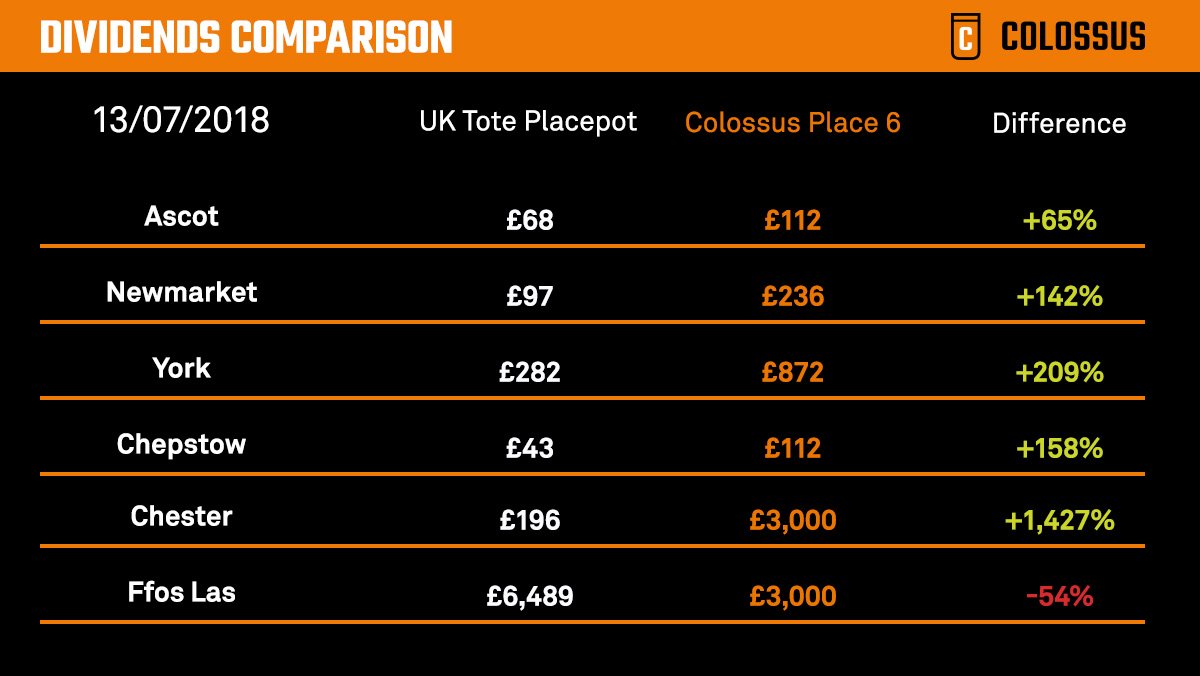
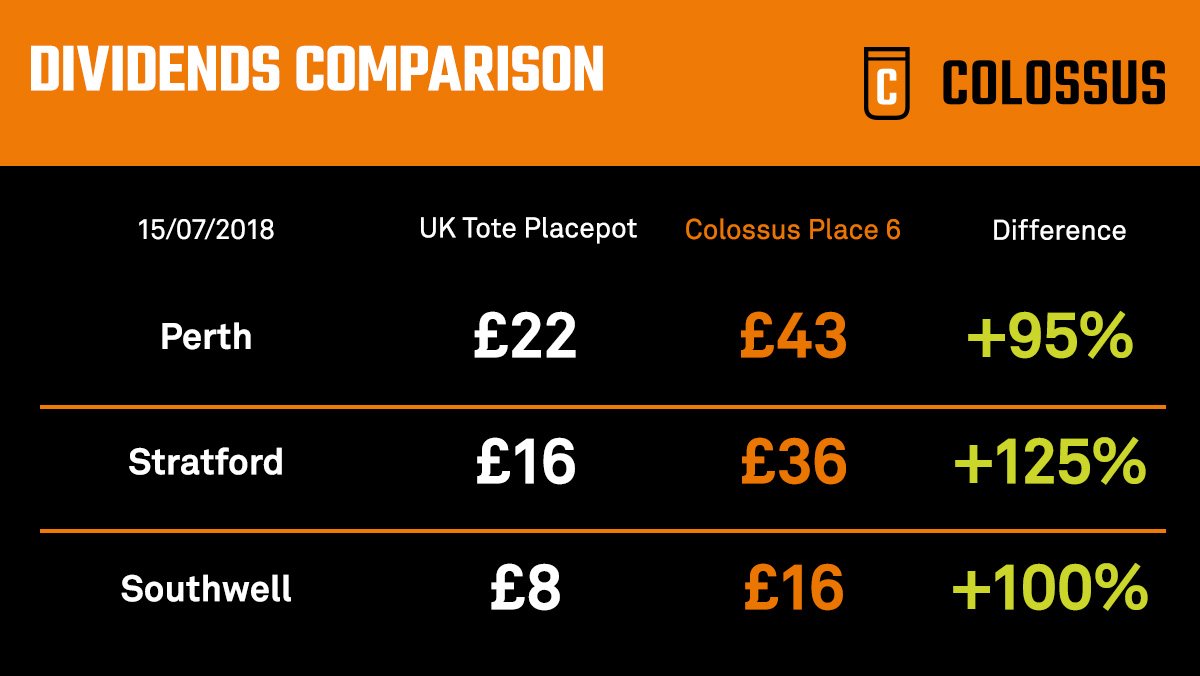
And the dividends have been significantly out-performining SP and the placepot.
The three syndicates I ran yesterday yielded a pretty good return on investment in the two winning bets (the other was a five out of six job where the placepot was not won - anyone with one of the three placed horses in leg four (12/1, 14/1 twice) would have scooped the whole pool. Pool scooping, even on small pools, is a very satisfying thing...)
I took 20% in each of the syndicates - captains can take anything from 10% to 50% - and geegeez.co.uk readers took the other 80%. As you can see, my outlay was around £80 and the return roughly £275. Nothing life changing, but a decent profit for not doing anything remotely ground-breaking. Indeed, our £80 ticket collected £979.48 for players.
A couple of nice early strikes in the Colossus Bets place pools
And I did personally have a crack at the Southwell Pick 6, with its £15,000 rollover and four short-priced favourites. I bravely (*stupidly) banked on Gustav in leg two, who failed by a fine margin to get back up; and that after Classic Jewel had done the same in the opener with a third as much running-on money as the winner. I dropped about £90 across 15 ABCX tickets using the geegeez pool bet ticket builder. Ho hum.
With just £3,000 actually wagered on Sunday on top of the rollover, the dividend was a massive £5,577.06 for a £2 line. The same £2 at SP paid just £779.63.
Close to a decent payout on the Pick 6
Ultimately, these pools have to wash their face for the provider, so it will be interesting to see how liquidity grows in the next few days and weeks, and also to what level the pools are guaranteed. But the fact that the takeout is notably less than the traditional placepot is a big ongoing plus.
As things stand, I'm putting all of my pool bets through Colossus until such time as the dividends suggest that's no longer sensible. As you can see, that's the right thing to do currently, unless you think there's going to be a greater than 3000/1 dividend.
Day 1 (Friday)
Day 2 (Saturday)
Day 3 (Sunday)
.
Day 4 (Monday)
How do you get involved with these great betting opportunities?
Account Registration
You need a Colossus account. If you haven't got one, you can sign up here and Colossus will fund your account with the same amount you bet in your first 72 hours, up to a maximum of £100. YOU MUST USE THE REFER A FRIEND CODE TO GET THE BONUS (SEE BELOW).
You can be a friend to geegeez by using the 'Refer A Friend' code, geegeez - Colossus will then send a small rebate to us from their takeout when you bet. They welcome winners and you absolutely do not need to lose for us to get our small commission. In fact, they give us a tiny bit more when you win, which is why I'm keen to promote them. So please, take down some of the big pots, would you?! 🙂
Joining one of my syndicates is easy. Click this link, choose which one you want to play and for how much, and that's it.
If the page says 'No syndicates available', that means it's filled up already. You can 'follow' me on there, and I'll also tweet out when I've created a syndicate ticket on the @geegeez_uk handle.
At this stage, I'm not committing to a particular time of day nor even that I will necessarily put syndicate tickets up (I also bet privately into some of these pools, and suggest/recommend any placepotters reading this do likewise).
But it is very likely there will be tickets to join if you'd like every day this week, and probably for every meeting - or at least as many as I have time to cover. [I do have some quite handy time-saving info-packed tools to call on... 😉 ]
It's going to be a fun few weeks, and will also be really interesting to see how tote fights back and how the TftT/Britbet story unfolds. Do join the party if it sounds like your kind of thing!
Matt
p.s. I'm writing a few notes on the syndicate action on the forum at this link. [Gold subscribers only in the forum, I'm afraid].
https://www.geegeez.co.uk/wp-content/uploads/2018/07/CB_830x320.jpg320830Matt Bisognohttps://www.geegeez.co.uk/wp-content/uploads/2022/10/geegeez_banner_new_170x78.pngMatt Bisogno2018-07-15 20:39:452018-07-17 11:04:25**THE hottest betting opportunity right now**
On 5th July the first of more than two hundred nurseries - 2yo handicaps - programmed for 2018 was staged, at Haydock Park. They are a feature of the second half of the calendar year and, due to the unexposed nature of many of the runners, have often been considered off limits to large swathes of punters.
But nursery handicaps are just like any other group of races: they have distinct characteristics which require a primary focus in certain key areas. Happily, there are plenty of data on which to chew and from which to attempt to draw meaningful inferences.
In this post, I'm going to focus on nurseries since 2014 - four years' worth - and in the UK only. I'll exclude the five races already run in 2018 at time of writing, so we have complete years from 2014 to 2017.
During that time 8618 runners contested 972 races, none of which culminated in a dead heat. There are therefore 972 winners in the sample. Average field size can quickly be calculated as 8.67, meaning plenty of opportunities for each way punters (609 of the 972 races had eight or more runners). Let us try to determine some characteristics which separate the winners from much of the rest of their fields. To do that we'll start with an old adage I heard in my formative punting years, but first some context...
"Back the top weight in 2yo handicaps"
I don't know who first coined this, or why. It is predicated on good sense inasmuch as horses tend to win handicap races in descending order of weight rank. That is, the highest weighted horse wins most often, the second highest weighted horse wins next most often, and so on. But nothing so straightforward was ever missed by the market, meaning backing top weights in handicaps will send you skint quicker than an afternoon playing find the lady on a grubby street corner.
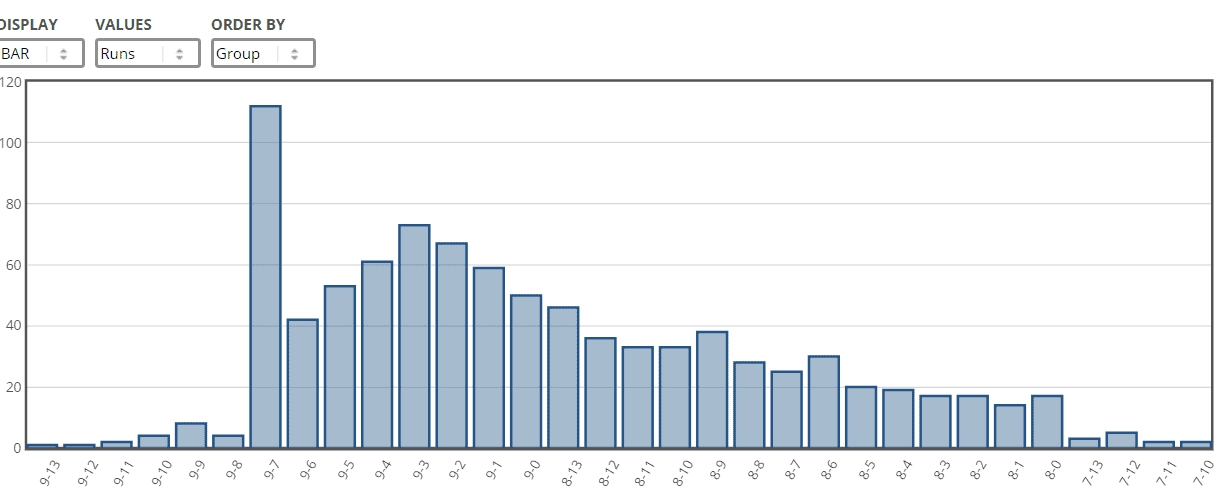
Ignoring those races - amateur riders and the like - where horses are asked to carry in excess of ten stone (the pattern is the same), the below shows the effect of weight carried on win percent in all flat handicaps in UK between 2014 and 2017.
Win strike rate in UK flat handicaps, 2014 to 2017, by weight carried
That is what one might call a pretty robust correlation. More weight equals a greater chance of winning. But here's how that chart looks when expressed as return on investment at starting price...
Return on investment at SP in UK flat handicaps 2014-17, by weight carried
What this basically tells us is that, ignoring the most lightly weighted horses, there is a vague consistency in losses down to around 8-04 (eight stone four pounds). In other words, although more weight equates to more winners, from a betting perspective it amounts to similar losses almost regardless of the equine's impost.
[In the image above, I hovered over a data point merely to illustrate that further intel can be gleaned from these charts; there is no specific relevance of highlighting the 9-13 group of horses].
The above preamble is intended as context for what follows, namely a similar perspective on nursery handicaps. This is how the diffusion of weight affects a horse's chance of winning in such races:
UK nursery handicaps, 2014-17, performance by weight carried [max 9-07]
In the image this time, I've included one of the variables on the left hand side, so you can see I've truncated the weight range at 9-07. This is because there are a handful of runners which carried more than that, some of which won at 100% (i.e. one from one), thus skewing the line.
We can see the trend generally follows the 'all age' flat handicaps superset. Below is the impact of weight on ROI in nursery handicaps, and as can be seen it offers a far less clear picture:
ROI by weight in UK nursery handicaps, 2014-17
Not only do lower weighted horses win less often, they also lose more cash. Meanwhile, at the top end of the weight spectrum, we have a couple of spikes either side of nine stone that creep comfortably north of break even. Of course, in the general sense it's not especially helpful because there's no reason why horses carrying 9-01 should be more profitable than those carrying 9-00: it's just a quirk of the data.
But there is something of an ROI cliff at around the eight stone mark, and horses carrying less weight than that in nurseries can generally be treated with contempt. The reality is that many of them are simply not good enough to ever win such a race, perhaps any race.
Getting back to our "back top weights in nursery handicaps" starting point, the next chart shows win strike rate and return on investment (SP) by weight rank:
Win percent and ROI by weight rank, UK nursery handicaps, 2014-17
Ignoring the obvious outlier (rank #19) with its big priced winner, the blue bars show how win strike rate diminishes as we drop down the weights; and the orange bars show how one would have lost less by sticking to the higher weighted runners.
As interesting as this may (or may not) be, it is academic for those of us looking to butter our bread. As with absolute weight, so weight rank confirms that one will lose money more slowly rather than win money following higher rated, and therefore weighted, horses.
The value of experience in nursery performance
All juveniles intending to run in nursery handicaps must have either won their first two races or run at least three times. In both cases, the lack of racecourse evidence and/or experience can lead to horses improving significantly as they strengthen up and get the hang of things. And, yes, as they are presented with a test for which they might have been bred.
We can examine the bearing this has on nursery handicaps by looking at performance by number of career runs. Here, received wisdom says that a horse's best chance of winning may be when stepping into handicap company for the first time. But the data do not bear that out:
Nursery handicap debutants (0) win at a rate of 10.77%, whereas those having their fourth nursery start or more win 13.1% of the time. Those with intermediate levels of experience win incrementally more. There is then a correlation between amount of handicap experience and an increased win chance. But what of profitability?
Here, an interesting picture begins to emerge, although still somewhat ambiguous. Looking at exchange prices, we can see that not only are those with more nursery experience more likely to win but, unlike those carrying bigger weights, they are also profitable to follow (at exchange prices).
Greater experience in nursery handicaps should be considered a plus for a horse.
The virtue of ratings
Although there are occasional blind spots in the public consciousness such as, arguably, the benefit of experience in nurseries, a better way to get an edge is to create or derive some information not available to the masses. That could be a system, methodology or a set of ratings.
Geegeez Gold publishes Peter May's 'SR' ratings under license and they reveal some interesting things in the context of nursery handicaps. This next chart shows nursery win rate by SR rating rank:
Win strike rate by SR rank, UK nursery handicaps 2014-17
The top rated horse in nursery handicaps in the four year study period won 18.44% of the time for an SP profit of - drumroll please - 0.95 points! While nobody ever went skint taking a profit, an ROI of 0.1% is more for your institutional investors than us profit-minded adrenaline junkies.
But it is a pretty good starting point to look at thing like race distance, weight, going, field size, market rank and class. One needs to be a little careful not to fit the story around the data, but it might be reasonable to assume that shorter distances - and therefore more consistently truly run races - would fare better from a rating perspective (when that rating has both a speed and form element within it). Likewise, perhaps bigger fields should yield better results for the same reason. And, based on earlier conclusions, those carrying more weight may be expected to at least win more often if not show a profit. Finally, perhaps ratings will manifest themselves as a marketable differentiator of class.
SR and Race Distance
Starting with race distance, we get some credence to the 'shorter distances are better' perception, as follows:
Top-rated SR, by race distance, UK nursery handicaps, 2014-2017
The pure sprinters at five furlongs have won almost one in four when top-rated, and have been profitable to back blindly to boot. Indeed, taking all sprint race distances - which I generally classify as seven furlongs or shorter - we see a pleasing hit rate, supported by a solid place strike rate, and a solid ROI:
Runs
Wins
Places
Win %
EW %
Win PL
EW PL
ROI
A/E
IV
708
137
288
19.4
40.7
69.66
1.64
9.84
1.02
1.73
SR and Weight Carried
Next we can see the distribution of top rated nursery runners by weight carried. Top weight in such races is generally allocated 9-07, and it is interesting (though not altogether surprising) to note the strong coincidence of top weight - which equates to top official rating - and top SR rating.
Distribution of top-rated SR nursery runners, by weight, UK 2014-2017
But what of profitability? Here, an interesting anomaly emerges:
Impact of weight carried on top-rated SR horses, UK nursery handicaps 2014-2017
Those 9-07 horses, with their confluence of top public and private ratings, are notably unprofitable to follow. My assumption for this relates to the public element - that is, officially top-rated - and to the aforementioned 'back top weights in nursery handicaps' mantra espoused by so many for so long.
What is more interesting is that immediately below the top rated/top weighted, there is a full stone range in the weights where backing top SR runners yields both a high strike rate and an SP profit. Nevertheless, I'm not entirely comfortable with discounting the top weights: the pursuit of sustainable profit is rooted in sensible logical analysis. Conveniently discounting strands that don't fit is a surefire way to secure disappointing outcomes thereafter!
SR and Going
I struggled with this one a fair bit when I saw the output. Why? Because there is a correlation in the data that looks plausible. But I just cannot find a way to explain it. Here's what I mean:
Top SR in UK nurseries, 2014 to 2017, by going
The firm ground category consists of six runners, of which none won (as you can see from the above), but five were placed! Good to firm and good ground have produced slightly lower win strike rates than slower surfaces but the place strike rates are broadly comparable, leading to my discomfort in 'conveniently' excluding faster turf.
Lawns on the soft side of good or slower, and all weather surfaces, have been highly profitable. I will leave it to the reader to attempt to justify quick turf runner excommunication...
SR and field size
What of field size? My hypothesis is that bigger fields, and therefore more reliably run races, should yield better results, in terms of profit if not strike rate (there obviously being more horses to beat in the latter case). The data don't really support the hypothesis, however:
Runners
Runs
Wins
Places
Win %
EW %
Win PL
EW PL
ROI
A/E
IV
2-5
114
39
59
34.21
51.75
5.98
-4.84
5.25
1.15
1.53
6-8
326
68
142
20.86
43.56
6.87
-29.74
2.11
1.06
1.47
9-12
364
51
135
14.01
37.09
-6.90
-56.51
-1.90
0.84
1.44
13+
118
12
33
10.17
27.97
-5.00
-10.37
-4.24
0.84
1.46
We would of course expect strike rate to diminish as the number of runners increases; but the theory of more truly run races leading to better results for top SR horses holds little water, notwithstanding that all runner groups are within fine margins of break even one side or the other. In short, there's little of positive or negative utility in field size.
SR and class
My premise with regards to class is that the ratings may fare better in better class races; the rationale is that in such races, where many unexposed recent winners or good grade placers lock horns, the winner may be underestimated by the market but not by a private handicap (which is, in essence, what any set of 'unofficial' ratings are).
This time the theory does seem to stand a test.
Class
Runs
Wins
Places
Win %
EW %
Win PL
EW PL
ROI
A/E
IV
2
91
16
37
17.58
40.66
28.08
36.91
30.86
1.25
1.73
3
77
19
32
24.68
41.56
11.17
-3.20
14.51
1.18
1.77
4
195
42
83
21.54
42.56
3.28
-23.84
1.68
1.02
1.53
5
291
52
113
17.87
38.83
-40.20
-78.02
-13.81
0.96
1.57
6
268
41
104
15.3
38.81
-1.38
-33.31
-0.51
0.84
1.63
Without wanting to get too unequivocal, there are some strong looking patterns. Actual versus Expected, a measure of the value proposition (more info here), slides in a linear manner from best class to worst, with Class 2 to 4 offering degrees of positive expectation.
In profit terms, all bar Class 5 have made a surplus at exchange odds, and even the 40 point-losing at SP Class 5 fares close to even at exchange prices. A focus on better races looks a beneficial means of deploying the Peter May SR figures in nurseries.
SR and the market
There are so many ways to slice and dice the dataset, and one more is to overlay market information: odds and / or odds rank.
Odds
Runs
Wins
Places
Win %
EW %
Win PL
EW PL
ROI
A/E
IV
Odds on
20
14
16
70
80
3.79
2.50
18.95
1.18
3.78
Evs to 2/1
100
39
62
39
62
-1.41
-16.39
-1.41
1
2.78
85/40 to 7/2
200
59
109
29.5
54.5
32.07
13.87
16.04
1.15
2.37
4/1 to 6/1
237
32
88
13.5
37.13
-48.50
-100.73
-20.46
0.8
1.25
13/2 to 10/1
213
15
61
7.04
28.64
-77.00
-118.82
-36.15
0.64
0.66
11/1 to 18/1
112
9
27
8.04
24.11
20.00
16.00
17.86
1.16
0.8
20/1 +
62
4
11
6.45
17.74
65.00
85.25
104.84
1.7
0.73
This is quite interesting, there appear to be three distinct areas: a profitable and high strike rate top of the market; an under-performing mid-market, in both profit and strike rate terms; and a surprisingly robust 'long tail' for those who can suffer losing runs in the pursuit of big winners.
The thirteen winners priced at 11/1 or bigger SP paid an additional 109.94 points at Betfair SP. Even taking out the 50/1 scorer (95 BSP), Celestine Abbey, still leaves 64.94 extra units of profit at BSP. But anyway, if you're backing the rags, why would you exclude the best of them?!
Conclusions / Pulling it all together
From the beginning of July to the end of the calendar year, there is a nursery handicap - or two, or three - almost every day. Knowing how to play the odds specifically for such races is an edge most punters don't bother to look for; and it is one where a few rules of thumb may help separate out a lot of the losing chaff.
The first relates to weight: those horses carrying eight stone or less won less than 5% of the time, and lost a massive 57% of stakes at SP across 356 runners. The story is broadly similar longer term: since 2009, 58 from 1142 were able to win (5.08%) for an ROI of -43.46%. Ouch.
Treat nursery runners carrying eight stone or less with grave suspicion.
In terms of experience, more is definitely better, both in terms of winning chance and profitability. In the four year sample period, it was shown that horses won more often with each additional run in nursery handicaps and, moreover, that with at least two prior nursery starts were profitable to back at exchange prices.
Favour experienced handicappers in nurseries.
So far so generic. But still, using nothing more than a daily paper, you ought to be able to find qualifiers for a system - more than eight stone, more than three prior nursery runs - that has made a profit of 27.46 points at starting price and an enormous 251.9 points at Betfair SP in the four year review period.
How can Geegeez Gold's ratings assist?
We've seen earlier in this article how our SR figures are most effective in shorter races, specifically at up to seven furlongs. Back top rated SR horses carrying more than eight stone at distances of seven furlongs or shorter has yielded 136 winners from 689 runners (19.74%) and a profit at SP of 71.66 points. I don't have the exchange data yet, sadly, but this group includes the two biggest priced winners from the 11/1+ analysis above, those two being worth an additional 51.31 points at Betfair SP. So let's be conservative and call it 150 points profit on 689 bets (21.77% ROI).
I couldn't justify logically leaving those 9-07 top weights out, but if you can, you might be able to replicate the better historical rate of 114 from 585 for 102.67 points at SP. <<< Caveat emptor: you need to be comfortable that there's a legitimate reason to exclude the top weights.
Focus on top-rated SR horses at distances up to and including seven furlongs.
Going was likewise difficult to assimilate: the data say strongly that top-rated SR's perform best on softer than good or all weather surfaces, but there is no obvious reason why faster surfaces should yield lower strike rates and poorer ROI's. Of course, the fact that we geegeez.co.uk licenses the ratings means they are 'black box' to us and, therefore, that we/I cannot discount that there is something in the algorithm to support what those data say. I'm still struggling though...
It may pay to focus on softer turf and all weather...
Those are three solid guiding principles which are worth committing to memory/the notebook:
1. Treat nursery runners carrying eight stone or less with grave suspicion.
2. Favour experienced handicappers in nurseries.
3. Focus on top-rated SR horses at distances up to and including seven furlongs.
For fun, and as something to add to my QT Angles watch list (facility coming soon, I promise!), I'm going to add the following which may make more experienced punters cringe even though I hope I've sufficiently explained/excused/caveated/apologised for each element in what preceded:
- More than eight stone and less than 9-07 (top weight generally)
- Top-rated on SR
- Seven furlongs or shorter
- Softer than good, or all weather
It looks very good, but it may be that the veneer hides something less credible. Please handle with care...
Year
Runs
Wins
Places
Win %
EW %
Win PL
EW PL
ROI
A/E
IV
2014
86
16
35
18.6
40.7
86.70
96.92
100.81
1.04
1.66
2015
107
26
45
24.3
42.06
6.55
-2.16
6.12
1.26
2.17
2016
86
16
34
18.6
39.53
25.16
15.42
29.26
1
1.75
2017
114
30
53
26.32
46.49
40.09
36.41
35.17
1.42
2.33
ALL
393
88
167
22.39
42.5
158.5
146.59
40.33
1.2
2.02
I will personally also manually check for levels of experience when such runners crop up, as we don't currently have such variables in our Query Tool.
**
Nursery handicaps are a significant part of the flat programme book in the second part of the season, and I hope that the above has offered a few morsels worthy of consideration when playing such races.
Good luck!
Matt
p.s. this post was put together primarily with the aid of Geegeez Gold's Query Tool, which enables users to ask questions of our database and to display the answers to those questions in numerous table or chart output formats. Gold subscribers can try Query Tool here.
Racing is not known for embracing new things, the pace of change in the sport often perceived as glacial; but might that be a little harsh?, writes Tony Keenan
After all, who in 1998 could have imagined what would happen in the 20 years since? The creation of Betfair, the rise of super-trainers, the festivalisation of race meetings, the increased globalisation of flat racing, the development of not one but two sport-specific TV stations are just some of the headline events which have occurred in past two decades.
Imagining what racing will look like in 20 years’ from now is difficult, a fool’s errand even. But that doesn’t mean we shouldn’t try and having some sort of vision for the sport, no matter how differently things may turn out: it’s a bit of fun if nothing else. With this in mind, I posed five questions about where racing might be in 2038 to four people involved in the sport at present.
Brian O’Connor is racing correspondent for The Irish Times and has written three novels about the racing industry. Simon Rowlands is a time and sectionals expect who has worked in racing all his life, filling a variety of roles such as Timeform handicapper, newspaper editor and he was the first chair of Horseracing Bettors Forum. Ger Lyons is a Group 1-winning Irish racehorse trainer who has been based at Glenburnie Stable for over 20 years. James Knight is Racing Trading Director at GVC Group having previously been Head of Racing at Ladbrokes Coral.
Is horse racing still socially acceptable in 20 years’ time? Sports ebb and flow in their popularity and I think it is at least possible that something like American football becomes a bandit sport in the next few decades with all its problems with concussions and injuries. Racing is not at that point yet but is there any chance it gets there with a rise in animal welfare concerns? Where will we be at with the whip by that stage?
B O’C: Judged on international trends, if racing here has future problems in terms of social acceptance it will be probably be with National Hunt racing. It shouldn't be on a major scale since the sad fact is humanity's relationship with the animal kingdom is vastly more fraught in so many other sectors. But jump racing sells itself as 'Thrills N Spills' entertainment and those spills inevitably produce some fatalities. Every effort must be seen to keep casualties to a minimum. So while it may not be particularly edifying the reality is that there are far worse animal welfare issues out there than specifically bred and pampered equine athletes being asked to jump.
As for the whip I would hope in 20 years’ time that racing has long acknowledged how there's no way to make hitting a dumb animal to make it go faster look good. And by then I would hope trials where whips are used only for correction purposes have proved that there's still a first, second and third with punters able to bet and calculate accordingly. It will be different. But different doesn't mean the same thing as wrong.
SR: One of the few things you can say with confidence, based on past form, is that some things in racing will not change as much as they need to. There is a deeply conservative element in the sport and many aspects of racing may well not be very different in 20 years’ time. That informs what follows, rather than its being a ‘vision’ with which I agree.
I expect flat racing still to be socially acceptable in 2038, but less so jumps. The latter will need to address concerns about equine fatalities and the sport’s legacy association with hunting. There is a reasonable chance that, by then, the whip will be allowed to be used for ‘safety’ reasons only.
GL: Racing was here before us all and will be here after we have gone despite our generation of ‘PC do-gooders’ that try to suck the joy out of everything we enjoy. Jump racing could suffer more from the welfare groups than the Flat will but ultimately racing will survive as it’s too big an industry not to. We as a group need to stand strong and say enough is enough and stop giving oxygen to people who thinks it’s fun to keep dragging us into disrepute.
JK: I think it still will be socially acceptable but the sport can’t afford to be complacent. I’d see the whip issue as being much less of an issue than equine fatalities in terms of presenting a structural risk to horse racing (and particularly National Hunt racing). Whether those of us close to the sport like it or not, the Grand National remains a disproportionately large shop window for the sport, so every effort needs to be taken to make that race as safe as possible.
I think Aintree have done an excellent job over the past few years to that end, but I’m sure they will want to make it safer still. The other area in which progress needs to be made regards the wellbeing of jockeys. It is essential to have a sport where the human participants can lead a healthy lifestyle whilst competing and I think racing perhaps needs to look at minimum weights and how races are structured.
The race-day experience, at least in the UK and Ireland, has looked the same for a long time: six, seven or eight races, run at rough half-hour intervals, over the course of an afternoon or evening. Could this look different in the future? Will we have four-race cards because people haven’t the attention span for more or will we go the American route with epic ten-race cards? Will the races themselves be different? Floodlit jumping, three-furlong races, etc.?
B O’C: Race-day 'experiences' will probably only count in terms of the big festival fixtures. The current everyday reality whereby race meetings are mostly just another betting opportunity is likely to have accelerated massively in 20 years’ time. So it'll be fast-food action shovelled out quickly – obesity, racing style!
But on the big days I hope the racing experience doesn't alter too much. One of the major selling points of racing in this part of the world is its tradition. You couldn't dream of a technically worse racecourse than Epsom but it's where history is played out every year. Racing down Pall Mall might sound trendy now but nothing dates faster than trendy.
SR: Big race days, particularly at weekends and on evenings, will more clearly be a ‘simulcasting’ experience in which racegoers alternate between the live action in front of them – still seven-race cards on average – and the action from elsewhere, both elements broadcast on large screens and hand-held devices, with runners easily identified on-screen by their saddlecloth numbers.
Betting itself will be more ‘tournament’-like, with individuals and groups competing against each other, on- and off-course, using apps. There will be kudos – and benefits – to be had in being part of a gang who finished in the top 10 in the Melrose Stand on Ebor Day, say, or in coming out top in your group of 15 at Newbury on a Stag or Hen Do.
Jumps races are started from stalls, placed on all-weather mats that are removed before the runners come round for the second circuit. A small number of valuable four-furlong handicaps will be permitted, such as at British Champions Day, but much too late for Caspian Prince to be crowned Champion Sprinter!
GL: Absolutely not! You simply can’t run the races any tighter, we tried it in Ireland and 30 mins is a push. The only people that don’t have the attention span to stay the distance are folk that don’t know the game and we should absolutely stop pandering to them. Stop dumbing down the game, if you want to follow our sport make an effort to get used to our language and ways, why should we always be explaining ourselves? For me it goes back to my basic argument which is to concentrate on the people in the sport rather than worrying about those that are outside, if they see us having fun then human nature dictates they will want a piece of the action, simple!
As it is in the UK at present they already have too much racing hence the disgracefully low prize money. So logic dictates that more races on the card will mean even lower prize money and how LOW can you go?
JK: Racing has become more commercially minded over the past few years and the current betting data is telling us that more money will be returned to the sport via levy if courses put on seven- or eight-race cards as opposed to six – so I definitely think the trend would be for longer cards as opposed to shorter. I’d be all for experimenting with new race formats like four-furlong bullet races – or even individual horse time trials.
Again, Racing can’t afford to be complacent and there may be some different formats which appeal to new audiences. The key with all these things is to give them a chance with a proper trial and then if they don’t work – just can them and try something else. By trialling and failing fast, we might just stumble across racing’s T20 – i.e. something that, perhaps surprisingly, appeals to a wider audience.
There was a time when the only way you could watch most races was by going to the track. The modern media landscape has changed that utterly where every race is now televised and available on our devices. Are we at the high-point of racing coverage now and how will it look 20 years from now? Will there still be terrestrial TV coverage and specific racing channels? Could individual courses be running their own feeds?
B O’C: Will there be terrestrial telly? Will there even be telly? Racecourses could flog their own feeds but who's to say they won't be subsidising punters to bet in 20 years’ time. The big question though is what will the market be. If the buzz is the bet who cares about the medium: is Portman Park the gambling future?
SR: The consequences of Brexit on the economy and the continued mishandling of racing by those in power will have finally led to a degree of belt-tightening by the sport. Racecourses are down in number to about 40, half of which are really struggling, and the size of the fixture list has been trimmed commensurately.
Terrestrial TV coverage of racing is a distant memory – indeed, terrestrial TV itself may be – but one consequence is that those racing devotees left can see all the action on one dedicated racing channel, with any pretence at editorial independence from the bookmaking concerns that ‘sponsor’ them having been ditched. Subscription comes at a very affordable 100 Euros a month, Britain having back-tracked and re-joined the EU in 2023.
Despite the culling in numbers of races, there will be a shortage of jockeys due to the majority of them quitting after just a few winners to work in the racing media. Yes, individual racecourses could be running their own feeds, but under an umbrella organisation after initial efforts at going it alone in broadcasting pictures proved absurdly amateurish.
Far from being a golden era for data provision, the successor to the successor to the BHA has pawned the family silver by finally privatising all forms of data. You will have to pay to find out which horses are running, which jockeys are riding, which weights are being carried, let alone what a horse’s striding and sectionals were, while connections will be able to buy favourable circumstances (weights, draws, etc.) for their horses, but you will also have to pay to find this out, obviously.
GL: We are spoilt for choice now so much so that you don’t have to go racing anymore to see the action. As with all, the IT will keep developing and evolving and no doubt the future will give us more WOW moments as avid gadget users. I’ve no idea where it will all end but I do think that attendances will continue to struggle because of TV coverage.
JK: Who knows? It was quite hard to predict we’d all spend every waking hour glued to our phones 20 years ago, so I almost dread to think what technology will have done to us by 2038! We’ll probably be shouting orders at a screen and then, as if by magic, a virtual Matt Chapman will appear and shout back at us. I’d like to think there would still be a place for Racing specific TV channels, but my guess is that the whole concept of ‘Terrestrial TV’ will be done by 2038.
My children’s generation aren’t really tied to the idea of watching something specific at a specific time on ITV or Channel 4 and for them, it is assumed that TV is something that is consumed on demand. That trend will likely continue and you could easily see events just being streamed live via Twitter, Facebook or whatever new social media channels we are wasting our lives on in 2038.
Betting aside, technology probably hasn’t affected racing quite as much as it has other ways of life but it surely will over the next decades. Where do you see this impact happening, be it in training, breeding, viewing, riding and so on?
B O’C: Those old April Fools’ gags about jockeys being wired to trainers and owners in the stand like F1 drivers will probably come true next year, never mind in 20. The potential of 'AI' is vast. But it's the prospect of another 'AI' in the breeding sector [artificial insemination] that could start to make a compelling technological and commercial case. That will be another example of how advancement doesn't mean the same thing as improvement.
SR: Analytics and sophisticated data will be used more and more in breeding and training, and will exist (e.g. horse weights, sectionals, striding, heart rates, etc.) on raceday but may not be available to the public at large (see above).
‘Jockey-Cam’ technology will extend to the option to view the race – e.g. from the back of the favourite in the Derby – as it happens and to being able to ‘ride’ the race after the event, complete with personalised commentary, captured for posterity.
GL: Horses will always need to be exercised and no technology will be invented that will take the human element out of that and if it does then the game is F****d! We need jockeys to keep being bred and we need to do whatever necessary to help us as employers to attract the younger folk to come and work in the industry. Governments have to become more educated to this as right now we are at staff crisis point, God only knows where we will be in twenty years’ time.
JK: It’s happening now isn’t it and I think to excel or get an edge in any aspect of the game –
whether it is training, breeding, betting, riding, whatever – people are going to have embrace technology and use it to supplement their existing skills. For example, the smart buyers at the sales are now using big data to inform their choices. That means using modelling techniques to rate pedigrees or machine learning to analyse areas previously considered ‘dark arts’ like a horse’s gait.
All elements can and eventually will be modelled and I could see there being something of an arms race in terms of who can get their hands on the best predictive models. That’s not to say there won’t still be room for some human interpretation, but we have to let the computers do what we humans aren’t very good at, which is crunching through millions of bits of data.
Silver bullet time. Money is no object and there is one thing you can do to future-proof the sport. What is it?
B O’C: Virtual reality is divorcing more and more people from the living, breathing reality of horses as creatures rather than simply a set of form figures. Conversely that will make animal welfare an even greater issue and it's in racing’s own interests to be seen to invest in animal welfare. Whatever cost there is in being seen to do that is dwarfed by the threat of accusations of cruelty or negligence. Animal sports will become even more defined by their treatment of the animal itself.
SR: Embrace data and its analysis, and make it as freely and widely available as possible. Far from being ‘off putting’, things like sectionals and horse weights can shine a light on numerous sub-plots within a race and add hugely to the interest in the sport if framed in intelligible and interesting ways. Clearly, the media – such as it will still exist – will need to change its ways considerably to allow this to happen.
If I was allowed a second bullet then it would be that a forward-thinking, competent and ‘can-do’ regulatory authority would regain control of the fixture list in a well-funded sport.
GL: I would start again on betting and media rights. Use Hong Kong as the model and all income generated by the sport should be reinvested back into it and be self-sufficient. We can’t pat ourselves on the back as being the ‘great I am’ when we still need handouts from respective governments. There’s too much pointless bureaucracy involved in running the business side of racing now and with technology improvements things should be made easier and not harder.
Central stewarding is something we should aim for and make the current system of enquiries a thing of the past. No time should be lost on race day playing the ‘yes sir’ no sir’ game to these prehistoric men and women who are clinging onto anything to keep themselves relevant. Before the horse has pulled up and returned to the parade ring a decision by central stewards should be made and the winner called. Connections can always have the right to appeal later on but with the technology now available it’s a pointless exercise having jockeys going in and explaining themselves, it’s pathetic and outdated.
JK: Money is an object and that’s the problem! To future-proof the sport, we need it to be sustainable financially for all of the constituent parts. I think it ties in with other areas your questions have touched upon, but I think the sport just needs to get smarter all round. Racing needs to embrace technology and data so that when a decision is being made, it is backed by facts rather than the gut-feel that maybe was the best we could do before the data revolution. In this way, the sport can maybe start to get a bit ahead of the curve, rather than always being dragged along just behind it.
https://www.geegeez.co.uk/wp-content/uploads/2018/07/racingin2038.jpg320830TonyKeenanhttps://www.geegeez.co.uk/wp-content/uploads/2022/10/geegeez_banner_new_170x78.pngTonyKeenan2018-07-03 09:35:062018-08-09 05:55:45Racing into the Future: 5 Questions, 4 People
After hours, actually weeks of number crunching, I am able to share my most recent findings regarding pace in 5f handicaps, writes Dave Renham.
In this fourth article I have started to look in more detail at the Geegeez pace data focusing for the most part on the last four runs of each horse. Links to the first three articles are here:
Horses on the Geegeez racecard have pace figures assigned to their last four runs, with the most recent run to the left. To recap the pace figures are split into four groups - Led, Prominent, Mid Division and Held Up. Pace points are given to each group - led gets 4 points, prominent 3, mid division 2 and held up 1. Therefore totals can range between 4 and 16.
My focus for this piece has been 5f handicaps (turf and all weather) with at least 6 runners from 2017. There were 465 such races in total and at present I have manually collated data for 200 of these, from which I will share my initial findings. The plan next month is to complete the research and report back on the results for all the races. Handicaps are generally the best medium for this type of research because one is usually dealing with seasoned campaigners who have raced many times in their careers.
I have noted before that front runners have a significant edge in these short sprints and this is clearly seen from the pace figures of these 200 winners:
Pace figure of winner
4
3
2
1
Win %
25%
43.5%
8%
23.5%
As we can see 25% of all races have been won by the horse that took the early lead. Considering front runners made up around 13% of runners in the sample, we can say that front runners have won nearly twice as often as they should (25% versus 13%); this is assuming all horses have an equal chance in each race. Of course, that may not necessarily be the case, but the 13% figure is not going to be too far away from the true chance. For the record, prominent racers provided 40% of all horses so this pace bracket also win slightly more often than ‘one would expect’; horses that raced mid-division provided around 13% of all runners so have under-performed statistically, as have hold up horses who provided around 34% of all the runners.
As I have mentioned in previous articles, with such an advantage in 5f handicaps it makes sense to investigate ways of trying to predict the front runner. In the third article I looked at the most recent race only and the pace figure gained from it. This time I am going to look at the performance of the top-rated pace runners using the last four races.
In each of the 200 races I collated the pace figures for each horse by putting them in order of pace points, then looking to see from which pace position the winner came. I was hoping of course to see a bias towards the top-rated pace horses in terms of number of wins.
Here are the findings:
Pace rank
Wins
Races
SR%
1
26
200
13.0
2
21
200
10.5
3
26
200
13.0
4
31
200
15.5
5
23
200
11.5
6
17
200
8.5
7
21
179
11.7
8
10
153
6.5
9
10
127
7.9
10
4
96
4.2
11
7
68
10.3
12
2
48
4.2
13
1
32
3.1
14
1
22
4.5
15+
0
9
0.0
Hence the top-rated pace horse (the one with the most pace points) won 26 of the 200 races (13%). On the face of it this does look a little disappointing. It should also be stressed at this point that there may have been 200 races, but due to several of these having joint top-rated pace horses, there were in fact 266 horses that were top- or joint-top ranked.
That brings the win strike rate down to under 10%. Before you reach for the Kleenex, I do have some positive news. If you had backed these top-rated pace horses to level stakes, your 266 selections would have yielded a small profit to SP. Even better returns would have accrued if you had backed them at Betfair SP – at £10 per bet the profit after commission would have been just under £530. This equates to a return of about 20p in the £. Very satisfactory returns for what is essentially a simplistic method.
With a notable difference between the number of winning front-runners and the number of winners with the highest pace rank coming into the race, what these findings indicate once more is that predicting the front runner is far from an exact science. It is clearly not just a case of picking the horse in the race with the most pace points from their last four runs. What that table does seem to indicate though is that the more points you have the more chance you have of winning.
The top-rated pace horse did lead in nearly 40% of the races; the table below shows the run style of the top-rated pace horse in the reviewed races:
Pace Figure
Races
% of horses
4 – Led
105
39.5
3 – Prominent
106
39.8
2 – Midfield
23
8.6
1 – Held up
32
12.0
So those top-rated pace horses coming into a race have generally led or raced up with the pace, which is clearly what one would expect. However, when I started this series of articles I was hoping to find a method that would predict the front runner at least 50% of the time, if not 60%. Not around 40%! It is interesting to note that in the third article I found that horses that had led in a 5f handicap last time out, went on to lead in their next race 42.5% of the time. So perhaps the most recent race is more important than combining the last four when looking at pace figures, though in truth the difference in terms of the sample size is negligible.
My next port of call was to look at the actual pace figure gained by the top rated or joint top-rated pace horse. 16 (four pace figures of 4) is the highest pace figure a horse can achieve.
Here are the findings:
4 race pace total (top rated horses only)
Wins
Runs
SR%
16
2
31
6.5
15
8
78
10.3
14
7
87
8.0
13
5
32
15.6
12
2
32
6.3
11
2
5
40.0
10
0
1
0.0
These figures suggest nothing particularly clear cut at this stage – however, when I have looked at all 465 races hopefully a pattern may start to emerge.
Before moving on I would like to discuss a theory. There is a perception that if there are two or more potential front runners in a race, then that race will be set up for a ‘closer’. The theory is that there will be a strong battle for the lead where the leaders essentially ‘cut each other’s throats’ – allowing a horse to come from off the pace and win.
I wanted to try and test this theory as best I could. I decided therefore in each race to work out the pace average of the top four rated pace horses. If the theory held any validity, then I expected the record of the top rated pace horse would be poor when the four horse pace average was higher. Here are the findings:
Top four rated pace average
Top rated pace runners
Wins
SR%
BSP profit to £10 stakes
ROI%
14 and above
48
3
6.3
– £220
– 45.8
13 to 13.75
77
5
6.5
– £193
– 25.1
12 to 12.75
69
5
7.2
– £232
– 33.6
11 to 11.75
51
7
13.7
+ £363
+ 71.2
9 to 10.75
21
6
28.6
+ £320
+ 152.4
It seems that this theory does hold water, although I appreciate that not all top-rated pace horses lead. Having said that most top-rated pace horses race up with the pace and thus are not coming from ‘off the pace’ to win. The races where the top four horses averaged 14 or above produced the lowest strike rate and the worst returns. Conversely the races with relatively low averages produced extremely positive returns.
I have also looked at the combined win and placed strike rates to see if they correlate with the win strike rates:
Top four rated pace average
Top rated pace runners
Wins / places
Win/placed SR%
14 and above
48
10
20.8
13 to 13.75
77
19
24.7
12 to 12.75
69
22
31.9
11 to 11.75
51
19
37.3
9 to 10.75
21
12
57.1
It is pleasing to see the win and place strike rates increase as the four horse pace average decreases – just like the win data showed.
This takes me onto the second theory where there is a perception that if there is just one ‘genuine’ front runner in the race, that runner has a good chance of getting a ‘soft’ lead and this increases their prospects of leading all the way. The table above seems to suggest when there is less ‘pace’ in the race, potential front runners have a better chance of winning. However, we cannot be sure that a race with, say, a top four rated pace average of 11 has a sole front runner. Consider the following two scenarios:
Scenario 1: Pace average of top four pace horses = 11
Horse A – 15
Horse B – 10
Horse C – 10
Horse D – 9
Scenario 2: Pace average of top four pace horses = 11
Horse A – 12
Horse B – 12
Horse C – 11
Horse D – 9
One way to perhaps test this ‘soft’ lead theory is to look at the gap between the top rated pace horse and the second top rated pace horse. Here are these findings looking at the performance of the top rated pace horses in each case:
Gap between top and 2nd rated
Top rated pace runners
Wins
SR%
BSP profit to £10 stakes
ROI%
0
126
10
7.9
– £364
–28.9
1
75
4
5.3
– £495
–66.0
2
44
7
15.9
+ £323
+73.4
3
15
4
26.7
+ £525
+350.0
4
5
0
0.0
– £50
–100.0
5
1
1
100.0
+ £85
+850.0
This once again is not a perfect test because the top rated pace runner does not always lead! However, what it does seem to suggest is that the top rated pace horse has done extremely well when there has been a gap of at least 2 points between them and the second rated. I appreciate the data set is relatively small, but nonetheless the signs are good. I did look at the win and placed data here and the correlation was less strong – the problem perhaps is the data set for a gap of 3 or more is so small. I will revisit this after looking at all the races and share that data. [Alternative theory for lack of place correlation is that trail blazers are often binary types, who either win or drop out completely – Ed.]
For the final part of this article I want to look at the profile of the 200 winners in terms of pace. I initially looked at their four race pace totals and noted that 128 winners (SR 64%) had a total of 10-16 while 72 winners (SR 36%) had a total of 4-9. It seems therefore at first glance that the horses with higher pace ratings have outperformed those with lower ones. However, we can all manipulate data and hence we need to know how many runners were in each of the two pace brackets. Fortunately we have a relatively even split as the table shows:
4 race totals for all runners
Win SR%
% of actual runners in all races
Between 4 and 9
36%
48.5%
Between 10 and 16
64%
51.5%
To clarify this means that horses with a pace total of 10 or higher (from their last four runs) have won 64% of all races from 51.5% of the total runners. Hence, as we would have hoped, horses with higher pace ratings do perform better in 5f handicaps than lower pace rated horses. In reality if ‘pace’ made no difference whatsoever then these horses should be winning 51.5% of races not 64% - in reality, they are roughly 1.25 times more likely to win than statistically they ought.
So, it’s time now to start looking at the other 265 races to see whether the statistical patterns noted in this article are replicated over a bigger sample. At present we can make the following observations:
Front runners have a huge edge in 5f handicaps
Top pace rated runners (using the last four races) have a relatively low strike rate but have shown a 20% profit to BSP
Top pace rated runners have taken the early lead around 40% of the time (led or raced prominently in just under 80% of races)
Top pace rated runners have a much better strike rate in races where the top four pace rated runners produce an average of less than 12
Top pace rated runners have a much better strike rate in races where they have a 2 point or bigger gap to the second pace rated horse
Horses pace rated 10 win almost twice as often as those rated 9 or lower
https://www.geegeez.co.uk/wp-content/uploads/2018/06/DancingStar_Probert_StewardsCup2016.jpg316830Dave Renhamhttps://www.geegeez.co.uk/wp-content/uploads/2022/10/geegeez_banner_new_170x78.pngDave Renham2018-06-29 08:01:372019-04-23 08:11:31The Importance of Pace in 5f Handicaps: Part 4
I love both reading and betting so combining the two is time well spent, writes Tony Keenan. More than any other subject, I tend to reread books on racing/betting in the hope that 0n the second or third run-through I will get more out of them. Below are four of my favourite books on the subject and feel free to add your own suggestions in the comments section below or on Twitter @RacingTrends; I’m always on the lookout for the next good one.
‘A Fine Place to Daydream’ – Bill Barich
Racing people and writers often exist in a bubble where ways of thinking become ingrained; sometimes it takes an outsider’s perspective to draw interesting stuff from insiders because they look at things in a different way. Recent interviews on Newstalk with racing figures like Davy Russell and Willie Mullins support this view and Bill Barich is another example.
Barich is an American writer with an interest in the turf if not an obsession and his account of the 2003/4 National Hunt season in Ireland shows what a fresh set of eyes can do for a topic. After landing in the country with his new partner Imelda, the author is drawn into the jumping scene and moves through all the big meetings from October to March, starting at Down Royal for their November meeting onto the Open at Cheltenham and Leopardstown at Christmas, the Thyestes and back to Leopardstown before ultimately finishing up at the Festival.
The book is populated with great characters: Moscow Flyer and Jessica Harrington, Beef Or Salmon and Michael Hourigan, the nascent perennial Champion Trainer Willie Mullins, Tom Costello, Father Breen, Noel O’Brien. In truth, it is all pure nostalgia at this point; written in 2005, before the 12-month Cheltenham news cycle and the arrival of super-trainers, I love – if time permits – to reread it before the Festival if only for the sheer romance of it all.
‘Beyer on Speed’ – Andrew Beyer
You should read anything by Beyer and despite the fact that he hasn’t written a book since 1993, his four efforts – ‘Picking Winners’, ‘My $50,000 Year at the Races’, ‘The Winning Horseplayer’ and ‘Beyer on Speed’ – remain relevant. There is a confidence that borders on arrogance in Beyer’s writing style as he moves from one uncompromising account to another and none of jockeys, trainers or the integrity of the sport are spared. But that self-belief comes from being a long-term winning bettor and basically inventing the modern speed-figure so all is forgiven.
His approach to betting is a mix of objectivity and subjectivity and if you don’t learn something you are probably reading it wrong. Beyer gets across the aspirational side of gambling and the idea that the pursuit of profit is a worthwhile use of your time is never far from his pages. ‘Beyer on Speed’ is my favourite of his canon at present as I’m using times more and more in my betting, but they are all excellent.
‘The Undoing Project’ – Michael Lewis
‘Thinking, Fast and Slow’ by Daniel Kahnemann (with more than a nod to the deceased Amos Tversky) is apparently a bible of sorts to many modern professional punters; it might be a must-read but it can be a struggle. If you want to take an easier approach then Lewis’s biography of the two men is a more palatable version and covers many of the main ideas in their fields of behavioural economics and prospect theory.
The opening two chapters barely mention the two Israeli economists however as the focus is on Daryl Morey, General Manager of the Houston Rockets basketball franchise. This is familiar ground for Lewis, author of ‘Moneyball’, and he looks at what mistakes Morey tries to avoid making when evaluating talent which are very similar to the ones we should steer clear of when betting. For instance, Morey has banned comparisons of young prospects to players of the same race by scouts in his organisation which can be applied to racing; all too often we lazily compare horses to other horses that have run in same colours or are with the same trainer. There is also a hilarious description (and a warning against judging too much by appearance) when he tells of how some scouts vastly misjudged the talent level of All-Star Marc Gasol because he had ‘man boobs’ and just didn’t look like a basketball player!
We’re more aware of thinking biases than ever now with ‘recency bias this’ and ‘confirmation bias that’ thrown around everywhere but that doesn’t mean we are a whole lot better at avoiding them. Constant refresher courses on the subject are needed and Lewis’s book is an excellent one.
‘Tony10’ – Tony O’Reilly and Declan Lynch
Aside from its subject matter, ‘Tony10’ is a brilliantly written book from outset when Lynch describes O’Reilly’s upbringing in Carlow and how the town revels in its own nondescript nature. After that, it has a three-part structure: O’Reilly’s early life in the provincial town, a period of what could only be described as intense degenerate gambling and finally the time spent in jail and life afterwards. You simply cannot stop reading the middle section as it captures a life spiralling out of control with the ratcheting up of stakes, the betting on obscure sports, the nights spent punting on the computer as O’Reilly’s wife and new-born slept in the next room.
It is a masterpiece of ‘show, don’t tell’ as the reader is allowed to draw their own conclusions about what unfolds in the narrative and while most of this is utterly foreign to people who take gambling seriously and are trying to win, it is an important reminder to be wary of the compulsive streak within most of us. And even if we don’t have such a trait, perhaps we should watch out for it in others.
Lynch himself has been on an interesting journey with gambling, starting out with his 2009 book ‘Free Money: A Gambler’s Quest’, essentially a diary of his own punting, through ‘The Ponzi Man’, a 2016 novel about a pathological gambler whose pyramid scheme has come tumbling down, and now to this. He has become polemical in his anti-gambling stance and while that might be too much at times, there is an argument that Irish society with its outdated gambling laws needed to be given a shake.
Rereading books like these is great fun but it does point to something else: there haven’t been too many good racing/betting books penned in the recent past. I enjoyed Paul Jones’s ‘From Soba to Moldova’ though for more experienced punters it may be considered more refresher course than anything else, carried by the author’s inimitable style. Things have changed so much in the modern betting landscape (or that horrible word ‘space’) with statistical models, account restrictions, automated betting and rapidly moving prices among the issues that deserve a fuller treatment. There is interesting material being covered on YouTube and podcasts with Simon Nott’s interview series and the ‘Business of Betting’ with Jake Williams standing out but there is definitely space for a book or two as well; consider that that the challenge laid down!
- Tony Keenan
p.s. which one (or two) books would you add to this list? And, importantly, why? Leave a comment to help build the bibliography!
https://www.geegeez.co.uk/wp-content/uploads/2018/06/racing_books_smallerimage.jpg451830TonyKeenanhttps://www.geegeez.co.uk/wp-content/uploads/2022/10/geegeez_banner_new_170x78.pngTonyKeenan2018-06-04 20:45:452018-08-09 05:55:49Four Racing/Betting Books You Should Read
The data suggest that some courses offer a much stronger pace edge than others. However, all the research points to the fact that front runners in 5f handicaps have a definite edge almost regardless of where the race is being run. When I say ‘definite edge’ perhaps I should clarify that front runners win far more often than statistically one might expect.
To recap, when I talk about pace my main focus is the initial pace in a race and positions the horses take up in the opening couple of furlongs. As mentioned before the Geegeez website splits pace data into four groups - Led, Prominent, Mid Division and Held Up. These groups are assigned numerical values – led gets 4 points, prominent 3, mid division 2 and held up 1. When I used to tip ‘back in the day’, I created similar pace figures, but used values from 5 to 1, and also used the last six runs rather than the last four. I don’t think there will ever be a ‘perfect’ method for creating pace figures, but I am sure the Geegeez method is as good as any.
Horses on the Geegeez racecard pace tab (data view) have their last four UK/Ire runs highlighted, with the most recent run to the left and each horse has an individual total for their last four runs. Hence the highest last four races pace total a horse could achieve is 16 (four 4s), while the lowest is 4 (four 1s). This is assuming of course that they have had at least four career runs.
With such an advantage in 5f handicaps it makes sense to investigate ways of trying to successfully predict the front runner. One starting point would simply be to look at the horse’s combined pace figures in the race in question and choose the horse with the highest figure. Let us look at a recent example to help make this idea clearer to the reader. The race was run on the 31st May at Hamilton – it was a 5 furlong handicap with 7 runners. Pre-race the 7 runners had the following pace totals:
5f sprint pace tab example
One difficulty for predicting the front runner in this particular race was that you had three horses at the top with very close figures. Also none of the runners had led a race early in more than one of their last four starts meaning that they were not ‘out and out’ front running trail-blazers. As the race panned out, the three most likely front runners took up the first three positions early on: Jabbarockie led narrowly to Jacob’s Pillow who in turn raced just ahead of Dapper Man. Hamilton’s 5f favours front runners reasonably strongly, as can be seen from the green pace ‘blobs’ in the image, and not surprisingly perhaps the winner and runner up came from these three.
As we can see, this race panned out in a very similar way to how the pace figures had predicted it would. However, correctly predicting the front runner of the top three rated was clearly not ‘a given’. This of course is one of the problems with blindly going for the highest rated pace horse. Having said that, one would expect the highest rated pace horse to lead far more often than the lowest rated pace horse! My aim is to look at this idea in more detail in the future.
For this article I am using a slightly more simplistic approach. I am focusing on the most recent race only. To begin with I looked at horses that gained a pace figure of 4 (by leading early) last time out in a 5f handicap to see what pace figure they achieved in their very next run. I was hoping of course that a decent percentage led early on next time out. Here are my findings:
Pace figure
(next run after leading over 5f LTO)
4
3
2
1
% of runners
42.5%
39.2%
8.3%
10.0%
This is quite encouraging with 42.5% of runners leading on their very next start. In addition less than 20% of them raced midfield or further back in the pack early on. At this juncture, it should be noted that horses that were taken on for the lead last time out scored slightly lower in terms of leading next time (led roughly 34% of the time). These are the horses that gained comments such as ‘with leaders’, ‘disputed lead’ etc – for the record these runners still gain a 4 score for these comments.
I then looked at the data for horses that had gained a 4 pace score last time out in 6f handicaps. 6f races are still considered sprints, and the front runner generally has an edge in these races too. However, this edge is less strong than it is over 5f. I was intrigued however to see how the next time out figures panned out – would last time out front runners, lead again? This is what I found:
Pace figure
(next run after leading over 6f LTO)
4
3
2
1
% of runners
31.0%
44.4%
12.5%
12.1%
Down to around 1 in 3 who managed to lead next time, although 75% either led or tracked the pace (which I guess can be taken as a positive). The figures for horses that were taken on for the lead last time out again scored lower (just 21% of these runners led next time).
It seems sensible given this initial data to concentrate on 5f handicaps for the remainder of this article. This does not mean we cannot gain a pace edge over other race distances too, but I feel the front running bias works best over the minimum distance of 5f.
My next port of call was to look at horses that had gained a pace score last time out in 5f handicaps of 1 – these are the horses that raced at the back of the pack LTO. I was hoping to see that they predominantly raced at the back of the pack early on in their next run, or at least did not lead early very often. This is what I found:
Pace figure (next run after a pace score of 1 LTO over 5f)
4
3
2
1
% of runners
7.9%
35.5%
22.1%
34.5%
Interestingly a pace score of 3 has been achieved the most, although a score of 1 was not far behind. Pleasingly from a research point of view only 8% of runners that were held up at the back LTO scored a 4 and led early on their next start. The stats suggest therefore that horses that gained a 4 pace score LTO in 5f handicaps are over 5 times more likely to lead next time out than horses that gained a 1 pace score.
There are of course many factors that determine how likely a horse is to lead – not just their pace score over their last four runs, or their pace score LTO – but as I have alluded to earlier the pace competitiveness of the other runners in the race. One huge factor that has to be taken into account is the draw at certain courses. If we look at Chester over 5f one can see that it is extremely difficult to lead from a wide draw. In handicaps with 8 or more runners horses from the top third of the draw have managed to take the early lead just 13% of the time. This drops to a measly 7.5% when there have been 10 or more runners. Chester is not unique in that respect either – Beverley in 5f handicaps (10 runners or more) has seen the top third of the draw lead early just 16% of the time whereas the bottom third of the draw has assumed an early advantage 52% of the time. Thus the draw must be factored in at some courses.
I looked next at whether leading in a bigger field made it more likely you would lead next time – my theory being that to lead a bigger field would need more early pace than if you were running in a smaller field. I looked at 5f handicaps with 12 runners or more, and it should be noted that if the race had split into more than one group, I chose the overall leader only. However, the figures virtually matched the overall 5f figures as the table below shows:
Pace figure (next run after leading over 5f LTO in a 12+ runner race)
4
3
2
1
% of runners
42.4%
39.8%
7.6%
10.2%
My next port of call was looking at horses that had won a 5f handicap LTO by making all the running – these runners earn comments such as ‘made all’, ‘made most’, ‘made virtually all’, etc. My theory was that horses in form that had led LTO were more likely to lead on their very next start. This time, the data backed up the theory:
Pace figure (next run making all or making most over 5f LTO)
4
3
2
1
% of runners
51.2%
36.8%
4.8%
7.2%
For the first time we exceed the 50% mark in terms of horses that lead.
Perhaps at this juncture it is worth elaborating on why being able to predict the front runner in 5f handicaps is worth the effort. It has been noted that front runners win more often than they should statistically, but the key point is that they potentially offer huge profits. Now clearly you are never going to be able to predict the front runner all the time, but the higher percentage you achieve, the greater your chances of making decent long term returns.
Finally in this article I want to offer another approach in terms of trying to predict the front runner in 5f handicaps – this is simply focusing on individual horses that traditionally have shown a desire to lead early. Now, this is likely to limit your potential bets considerably but if you were able to create a list of say 25 such horses you would have a good chance of turning the stats in your favour. Let me look at one such horse – Bosham. At the time of writing (June 1st 2018), Bosham has raced 67 times in his career and has led early in 41 of those races – this equates to 61.2% of the time. We can improve upon this by digging a bit deeper into his record: it improves to 63.8% in 5f races; in 5f races in single figure fields (9 or less runners) this improves to 71.4% (from 21 races); in 5f races running round a bend this improves to 76% (from 25 races).
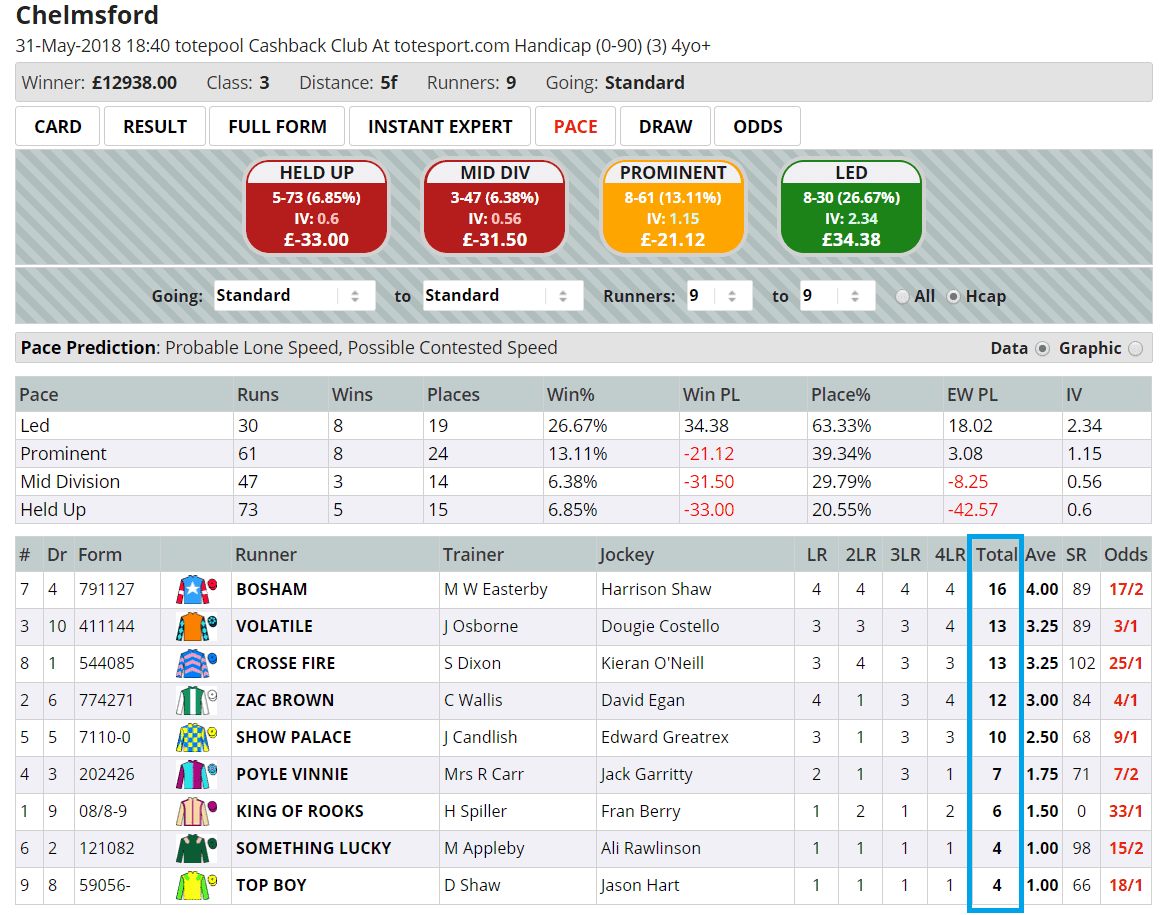
Bosham last raced on the 31st May at Chelmsford over 5f. This race was also a good example of when the Geegeez pace stats for the last four runs have worked perfectly. These were the runners in the race with their pace totals:
Bosham was a very likely leader on a speed-favouring track, and prevailed at 7/1
Bosham looked the most likely front runner having led in each of his last four starts and so it proved. Of course if you had looked at his career record this would also have pinpointed him as a likely front runner. Another positive was that he had a decent draw in 4 which meant he was close to the favoured inside rail. As it turned out, Bosham led early and went on to win relatively unchallenged at 7/1. For the record the joint-second rated pace runner, Crosse Fire, a 16/1 shot, raced in second early on before fading into fourth in the final furlong.
The data in this article cements the fact that early pace is be a highly significant factor in horseracing, and 5f handicaps in particular. Geegeez Gold offers users the insight for any race within the Pace tab, and subscribers are strongly encouraged to take some time to get to grips with it. Such time investment is quite likely to generate a robust financial return.
p.s. if you're not yet a Gold subscriber, you can get a taster of the pace functionality either by registering as a free user and checking the pace in our free Gold races (up to six daily), or you can take a 30 day trial for £1. Click here to start your trial.
https://www.geegeez.co.uk/wp-content/uploads/2018/04/chester_strongpacebias.jpg319830Dave Renhamhttps://www.geegeez.co.uk/wp-content/uploads/2022/10/geegeez_banner_new_170x78.pngDave Renham2018-06-03 19:30:202019-04-23 08:11:44The Importance of Pace in 5f Handicaps: Part 3
Hi, it’s Matt here with a geegeez update on GDPR, the big new privacy rule you’ve likely heard a lot about lately. Specifically what it means for you as a visitor to geegeez.co.uk...
Data protection: Why you're getting so many emails about privacy
You'd be forgiven for thinking those privacy emails you've been getting are all because of the recent Facebook scandal - but you'd be wrong.
From Facebook to booking.com, your favourite restaurant to your internet or broadband provider - you will have noticed they've all been in touch.
That's because a BIG new statute is about to become law.
The General Data Protection Regulation (GDPR), passed by the EU and applicable to all businesses operating in that collective, was scheduled long before the Cambridge Analytica bombshell hit the news.
Why am I getting these emails?
Ppretty much every email list you've signed up to (including this one, if you were directed here via a geegeez email), ecommerce shop you've bought from, or website you're part of (including geegeez.co.uk) stores information about you.
In almost all cases, there is nothing sinister about this: it absolutely doesn't mean they've done anything with your details that they shouldn't have. Geegeez obviously hasn’t. But this new regulation, which replaces the Data Protection Act 1998, is designed to give you, the customer, better control over who has what data.
In a nutshell, you have the following rights as an individual:
the right to be informed;
the right of access;
the right to rectification;
the right to erasure;
the right to restrict processing;
the right to data portability;
the right to object; and
the right not to be subject to automated decision-making including
profiling.
These emails you've been receiving - and this article - are essentially telling you that they've rewritten their terms and conditions to account for the above rights of the individual, i.e. you.
What's new?
Those labyrinthine terms and conditions pages that you probably scrolled straight to the bottom of, because they are really long and legalistic, now need to be written in language that's easy to understand. Geegeez's terms have always been pretty clear, and can be found here.
You, as the individual, must also specifically 'opt in' to receive emails, or to allow your data to be shared, and can ask for it to be removed at any time. Given that every email on our mailing list was permission-based, i.e. you opted in if you're on there, and given that in ten years online we have never shared and will never share your data, there is nothing new from a geegeez.co.uk perspective except to tell you about GDPR and our obligations.
No, unless you want to. It's obviously worth knowing which businesses are storing your data and the emails you’ve been receiving are a solid pointer to that.
Plus, it's a really good time to spring clean your inbox. If you're getting emails from people you don't much care for any more, then take the opportunity to unsubscribe.
Naturally, we hope you’ll remain part of the geegeez community, but you retain the right – as you’ve always had – to opt out by clicking the link at the bottom of each email we send you.
All fine, but what data exactly do geegeez.co.uk collect?
Good question, and the primary purpose of this article, in fact. Apart from the more obvious data such as your email address (provided by you for the purpose of communicating) and your user account details (provided by you for the purpose of accessing permission-based content, i.e. member services, on geegeez.co.uk). we also store the following:
- Your Gold preferences (so you see the views and data you choose to see)
- Pages you visit on geegeez.co.uk – we use this in a general sense, via Google Analytics (i.e. not specific to you) to understand content that is hot (we’ll produce more of that in future) and content that is not (we’ll produce less of that in future)
- Facebook pixel – from time to time we advertise some of our content on facebook. The idea is to introduce geegeez.co.uk to people who may not have heard of it – there are more of these guys than you might think! But we do not follow you around the internet, like some companies do. I can’t honestly say we’ll never do that, but I can say there are no plans for us to do it, and we certainly won’t be doing it in 2018. Clearly, if this position does change, it will be broadcast and our terms amended accordingly.
- Social media connections – we use a bit of code to make it easier for you to share our great content with your mates on social meejah. It connects, with your permission, to your preferred social account(s) and posts, when you click send/post/like, to that account.
What if I don’t want some or all of that to happen?
Here at geegeez.co.uk, we take your data privacy very seriously. We always have. I personally operate on the basis that I don’t want to waste people’s time who don’t consider hanging out with me/us/geegeez a pleasurable way to spend time.
That’s why we’ve always had opt out links in our emails; and why users can request deletion of their unwanted geegeez website account(s) (we purge unused accounts after two years, also).
Those elements listed above are the only data we store on our servers. Payment information is not stored by us but, rather, by our payment partners at PayPal.
Cookie info is stored on your machine locally, and you can delete that at any time via your browser’s privacy settings.
Ultimately, we have always looked after our subscribers’ rights, and we always will. You continue to have complete control over your data, and if you have any questions about anything in this note, please do contact me/us. We’ll be happy to help clarify anything.
Thanks for reading this. It may be a little 'boring' in one sense, but the behaviour of some of the biggest digital companies in the world in recent years has fully justified, indeed necessitated, it. As a matter of fact, I was so incensed by what facebook did that I changed my profile to be a 113-year-old woman with no other personal data stored (except for a link to geegeez.co.uk, and an obligatory email as a means of having an account there - see image below) - I get very few ads on there now, and those that are presented to me are... interesting (see below below).
geegeez.co.uk ain't no facebook. And, happily, nor are most businesses whose profit can be measured in smaller denominations than billions. But the GDPR is a good piece of legislation in my opinion, which will help protect us all from automated scumbaggery by the mega-wealthy autobots.
Matt
Interesting profile...
These are the ads that get served to me...
Yup, as a 113-year-old I'm keen to better understand my mood... and I'm certainly keen to "feed my fashion hunger"!
https://www.geegeez.co.uk/wp-content/uploads/2018/05/GDPR.png320830Matt Bisognohttps://www.geegeez.co.uk/wp-content/uploads/2022/10/geegeez_banner_new_170x78.pngMatt Bisogno2018-05-01 11:33:062018-05-01 11:41:37geegeez.co.uk, GDPR, and You: An Outline
It's live, the new Instant Expert v2.0. Or maybe we'll just continue to call it Instant Expert, eh?
Most importantly, if you're in the Remain camp, do nothing and Instant Expert will continue to display the data as ever it did. However, if you're an Instantexpiteer (see what I did there? Not great, granted) then you'll want to have a watch and a listen to the below videotape, which explains all...
There is also an updated User Guide that outlines the changes. You can get that from the link on the My Geegeez page.
https://www.geegeez.co.uk/wp-content/uploads/2018/04/IEv2.png311830Matt Bisognohttps://www.geegeez.co.uk/wp-content/uploads/2022/10/geegeez_banner_new_170x78.pngMatt Bisogno2018-04-24 22:39:292018-04-24 22:39:29Instant Expert v2.0 is LIVE
In my first article I looked at pace in 5-furlong handicaps focusing on the running style bias angle. The figures clearly showed a huge difference between the front running chances of horses depending on which 5f course he/she was running. In this second part, we will revisit the course angle and aim to offer a more complete picture.
To recap from the first article, when I talk about pace my main focus is the early pace in a race and the position horses take up early on. The Geegeez website splits pace data into four groups - Led, Prominent, Mid Division and Held Up. These groups are assigned numerical values – led gets 4 points, prominent 3, mid division 2 and held up 1. On each Geegeez racecard these figures are assigned to every horse in the race going back four UK or Irish runs.
We can use these numerical figures to create course and distance pace averages. I have done this by adding up the pace scores of all the winners at a particular course and dividing it by the total number of races. The higher the average score, the more biased the course and distance is to horses that lead early or race close to the pace. Here are the 5 furlong handicap C&D pace averages for all turf courses in the UK.
Course
5f pace average
5f Pace Rank
Lingfield (turf)
3.33
1
Chester
3.3
2
Epsom
3
3
Catterick
2.97
4
Ripon
2.97
5
Redcar
2.88
6
Chepstow
2.86
7
Hamilton
2.85
8
Nottingham
2.84
9
Thirsk
2.82
10
Windsor
2.78
11
Musselburgh
2.77
12
Newbury
2.73
13
Beverley
2.72
14
Leicester
2.72
15
Pontefract
2.69
16
Goodwood
2.64
17
Ayr
2.63
18
Newmarket
2.58
19
Haydock
2.57
20
Wetherby
2.56
21
Bath
2.54
22
Doncaster
2.51
23
Salisbury
2.5
24
Sandown
2.5
25
Brighton
2.49
26
Carlisle
2.49
27
York
2.47
28
Ffos Las
2.38
29
Yarmouth
2.24
30
Ascot
2.24
31
Lingfield (turf) tops the list, but in truth they have very few 5f handicaps so we perhaps out to take this figure with the proverbial pinch of salt. Chester comes next which is no surprise based on the stats from the previous article. In that article Chester had exceptional winning percentages for front runners and very poor percentages for hold up horses. A 3.3 C&D pace average is huge, so let us look at Chester 5f in more detail.
Running style
Chester 5f
Wins
Runners
Strike rate (%)
IV
Led
31
88
35.23
3.38
Prominent
21
194
10.82
1.04
Mid Division
5
109
4.59
0.44
Held Up
4
194
2.06
0.20
As can be seen, 52 of 61 Chester races have been won by horses that have either led or raced prominently. Essentially these figures indicate that the winner is almost six times more likely to be racing in the front half of the pack early on, than the back half.
Epsom are third on the list but they have only had 25 races so, as with Lingfield turf, the data is limited. Let us instead look at the Catterick who lie fourth on the list. Catterick have had 145 races so a bigger sample to breakdown:
Running style
Catterick 5f
Wins
Runners
Strike rate (%)
IV
Led
47
196
23.98
2.51
Prominent
65
672
9.67
1.00
Mid Division
15
175
8.57
0.93
Held Up
18
473
3.81
0.4
The stats for Catterick are not in Chester’s league in terms of pace bias to front/prominent racers, but the tendency is still strong. Front runners especially have a very potent edge. Digging deeper, if we focus on races at Catterick with 12 to 14 runners the pace bias does increase significantly:
Running style
Wins
Runners
Strike rate (%)
IV
Led
15
66
22.73
2.88
Prominent
22
227
9.69
1.23
Mid Division
5
88
5.68
0.72
Held Up
4
201
1.99
0.25
37 of 46 races were won by early leaders or horses that raced prominent early. The winner is roughly four more times more likely to be racing in the front half of the pack early on, than the back half.
At this juncture I decided to dig a little deeper looking to see whether the going made a difference to the overall 5f course pace averages. In the past I have heard two contrasting theories connected with front running horses which would potentially affect the course pace average on a specific type of going:
Theory 1 – horses that lead on softer ground are difficult to peg back because horses find it harder to accelerate from off the pace on such going;
Theory 2 – horses that lead on firmer ground are likely to get less tired at the front due the faster conditions and this accentuates their front running edge. (Plus on quicker ground the race is likely to be run in a shorter overall time again meaning the front runner is expending less energy).
So which one is true – or is neither true? If front runners do have a bigger edge under certain going conditions it will push up the overall course pace average.
I decided to split the results into two – races on good or firmer; and races on good to soft or softer. Here are the course pace averages for all 5f handicaps split into these going types:
Going
Course Pace average
Good or firmer
2.72
Good to soft or softer
2.67
As we can see the difference is minimal and not statistically significant. I plan to look at more extremes of going when I have time – looking at soft or heavy versus good to firm or firmer. However, looking at these initial figures, I am not expecting to see a huge variance.
My final area of research in this article is concerned with ‘class’. There is an argument, which I believe is a fair one, that the higher the class, the harder it is for horses to lead from start to finish – due to the more competitive nature of the opposition. Hence, at courses that run more higher class handicaps one might expect their course pace averages to be lower as a result. How to calculate ‘class’ at a particular course is difficult – do you use class levels, prize money, average Official Ratings across all races? I have decided to use a relatively simplistic approach by creating average class levels for each course by adding the class levels for each race and dividing by how many races there were. Hence, for example, if a course had had 10 class 2 handicaps and 10 class 3 handicaps their class average would be 2.5. Here are the course class averages for 5f handicaps (lowest class averages at the top):
Course
Course Race Class Average
Course Class Rank
Chepstow
5.47
1
Hamilton
5.43
2
Catterick
5.32
3
Brighton
5.26
4
Ffos Las
5.12
5
Beverley
5.11
6
Yarmouth
5.08
7
Bath
5.03
8
Carlisle
5
9
Nottingham
4.96
10
Redcar
4.95
11
Lingfield (turf)
4.92
12
Musselburgh
4.85
13
Ayr
4.77
14
Leicester
4.67
15
Ripon
4.57
16
Wetherby
4.56
17
Pontefract
4.53
18
Salisbury
4.45
19
Windsor
4.44
20
Thirsk
4.09
21
Goodwood
4.04
22
Newbury
4
23
Sandown
4
24
Doncaster
3.85
25
Haydock
3.79
26
Newmarket
3.64
27
Chester
3.02
28
Epsom
2.81
29
York
2.8
30
Ascot
2.62
31
As you would expect, most of the Grade 1 courses are near the bottom of the table. Three of these courses - Ascot, York and Epsom - have the most competitive 5f handicaps in terms of class.
To see if there is a correlation between course pace averages and average course race class I have ranked both lists next to each other, and produced an average rank. For there to be a strong correlation you would expect the majority of the courses to be in similar positions in each column – in other words the higher course 5f pace averages should correlate with the lower course class averages; likewise the lower course pace averages should correlate with the higher course class averages.
Course
Course Class Rank (low>high)
5f Pace Rank
Class / Pace Average
Catterick
3
4
3.5
Chepstow
1
7
4
Hamilton
2
8
5
Lingfield (turf)
12
1
6.5
Redcar
11
6
8.5
Nottingham
10
9
9.5
Beverley
6
14
10
Ripon
16
5
10.5
Musselburgh
13
12
12.5
Brighton
4
26
15
Bath
8
22
15
Leicester
15
15
15
Chester
28
2
15
Windsor
20
11
15.5
Thirsk
21
10
15.5
Ayr
14
18
16
Epsom
29
3
16
Ffos Las
5
29
17
Pontefract
18
16
17
Carlisle
9
27
18
Newbury
23
13
18
Yarmouth
7
30
18.5
Wetherby
17
21
19
Goodwood
22
17
19.5
Salisbury
19
24
21.5
Haydock
26
20
23
Newmarket
27
19
23
Doncaster
25
23
24
Sandown
24
25
24.5
York
30
28
29
Ascot
31
31
31
At both ends of the list, sorted by Class/Pace Average, we have the most valid correlations. For instance, Catterick, Chepstow and Hamilton all strongly favour front-runners and all host a majority of low grade five-furlong handicaps.
Meanwhile, Ascot and York, as well as to a lesser degree Sandown, Doncaster, Newmarket and Haydock, all generally host high class sprint handicaps where the early pace holds up less well.
I hope you have enjoyed this second instalment and, as always, comments are welcomed.
https://www.geegeez.co.uk/wp-content/uploads/2018/04/Catterick_Sprint.jpg319830Dave Renhamhttps://www.geegeez.co.uk/wp-content/uploads/2022/10/geegeez_banner_new_170x78.pngDave Renham2018-04-17 09:05:022019-04-23 08:11:55Part 2: The Importance of Pace in 5f Handicaps
This is my first article for www.geegeez.co.uk and before I start I would like to share with you my racing background, writes David Renham. I have worked for the Racing Post as a Spotlight writer and the Racing and Football Outlook as a trends ‘expert’; I have also written several books, mainly on draw bias, back in the early 2000s. And I have been a tipster with some success – and some failures! In all, I have written over 700 racing articles for magazines, newspapers, and websites.
Matt asked me to write on an ‘ad hoc’ basis which suits me as I have a full-time job outside racing at present. I hope you will find my articles interesting, useful, and ultimately lead to some profitable betting opportunities. However, as we all know, making money from backing or indeed laying horses is not easy. You need a combination of many things I believe – hard work; a good understanding of what you are trying to achieve; some sort of specialism as I feel there is simply too much racing and too many horses to gain a handle on if you don’t specialise; and, last but not least, a bit of luck.
For this article I am going to discuss pace in a race. When I talk about pace my main focus is the initial pace in a race and the position the horses take up early on. One of the many useful aspects of geegeez.co.uk is the pace section and the stats I am sharing with you in this article are based on the site’s pace data (found in the Pace tab on the racecard).
The pace data on Geegeez is split into four - Led, Prominent, Mid Division and Held Up. Let me try to explain what type of horse fits what type of pace profile:
Led – essentially horses that lead early, usually within the first furlong or so; or horses that dispute or fight for the early lead;
Prominent – horses that lay up close to the pace just behind the leader(s);
Mid Division – horses that race mid pack;
Held Up – horses that are held up at, or near the back of the field.
So after each race all the horses are assigned points in regards to what position they took up early in the race. Leaders get 4, prominent runners 3, horses that ran mid division 2, and those held up score 1. Geegeez has over 1,059,000 runners’ pace comments scored, from a total of about 1,100,000. [The others are things like unseated rider at the start, or where there is no discernible pace reference in the comment].
If you click the pace tab on the website you are presented with pace data regarding the specific course and distance of that race, and pace data for each horse covering their last four UK or Irish runs. For this article I am concentrating on the course data and creating pace figures for specific course and distances – namely handicap races run over 5 furlongs. I have always been a fan of sprint handicaps and early pace in sprint handicaps generally gives a bigger advantage to front runners than races over longer distances. In addition to this, some courses offer a bigger advantage to front runners than others as you will see.
The first set of data I wish to share with you is the overall pace stats for 5f turf handicaps (minimum number of runners in a race 6):
Pace comment
Runners
Wins
SR%
Led
3450
637
18.5
Prominent
9987
1078
10.8
Mid Division
3187
235
7.4
Held Up
8465
567
6.7
Horses that led, or disputed the lead early, have a huge advantage in turf 5f handicaps. So, if we could predict the front runner or front runners in each race we should be ‘quids in’, and indeed would be. Unfortunately, it is not an exact science and how best to do this I will leave for a future article.
Best performing 5f handicap tracks for front runners
My aim for this article is to show you the differences in the course figures for 5f handicaps and how some courses are more suited to early leaders/front runners than others. Here are the courses with the best strike rates (minimum 40 runners):
Course
Front Runners
Wins
SR%
P/L SP
IV
Chester
88
31
35.2
120
3.38
Catterick
196
47
24
177.71
2.51
Hamilton
170
39
22.9
130.29
2.04
Beverley
197
44
22.3
167.29
2.51
Epsom
50
11
22
45.5
2.96
Nottingham
219
48
21.9
224.08
2.32
Leicester
88
19
21.6
60.75
1.91
Windsor
160
34
21.3
100.31
1.9
Chester has amazing stats for early leaders: the tight turning 5f clearly suits front runners and, when combined with a good draw, front runners are clearly hard to peg back. Another round 5f, Catterick lies second with excellent figures also. Keep in mind that the average strike rate is 18.5% for all courses over this minimum trip.
Worst performing 5f handicap tracks for front runners
At the other end of the scale here are the courses with the poorest stats for early leaders/front runners in 5f handicaps:
Course
Front Runners
Wins
SR%
P/L SP
IV
Newmarket (July/Rowley combined)
88
12
13.6
-8.37
1.19
York
106
14
13.2
21
1.78
Haydock
146
18
12.3
-18.17
1.25
Sandown
119
13
10.9
-19.37
1.04
Yarmouth
96
10
10.4
-39.58
0.86
Ascot
98
8
8.2
-30.5
0.99
Doncaster
90
6
6.7
-32.5
0.81
It is interesting to see York in this list – York is often considered a decent front running track, but not according to our figures.
Chester performance by number of runners in race
Looking at Chester in more detail, we can split the data by number of runners:
Runners in race
Front Runners
Wins
SR%
P/L SP
IV
6 to 8
36
18
50
90.5
3.65
9 to 11
35
11
31.4
23.5
3.22
12 to 14
17
2
11.8
6
1.46
Here at geegeez.co.uk, data regarding number of race runners is calibrated slightly differently to my table, but you are able to change the figures on the site to suit your own personal requirements.
Overall performance by number of runners in race
As we can see from the Chester figures, the smaller the field size, the better it has been for front runners. The general perception of punters I believe matches the Chester data – in other words most punters believe front runners are more likely to win in smaller fields. It makes sense I guess as there are less rivals to pass the leader. However, is this really the case? Here are the data:
Runners in race
Front Runners
Wins
SR%
6 to 8
1214
264
21.7
9 to 11
1205
223
18.5
12 to 14
624
106
17.0
15+
407
44
10.8
The stats back up the basic theory, but a 17% win rate for early leaders/front runners in 12 to 14 runner 5f turf handicaps is a strong performance, especially when you take into account the likely prices of such runners. Hence, one could legitimately argue that the best front running value lies in the 12-14 runner range.
Best performing 5f handicap tracks for hold up horses
Of course, early leader/front runner stats are not the whole story when trying to build up a ‘pace’ picture of each course. We need to look at the stats at the other end of scale – those for hold up horses. Firstly a look at the 5f courses that offer hold up horses the best strike rates:
Course
Hold up horses
Wins
SR%
P/L SP
IV
Yarmouth
195
27
13.8
-33.04
1.16
Bath
332
41
12.3
-9.5
1.1
Brighton
258
30
11.6
-68.97
0.89
Newbury
99
9
9.1
-31.92
0.82
Salisbury
66
6
9.1
-23.5
0.8
Leicester
178
16
9
-51.87
0.79
Carlisle
192
17
8.9
-55.25
0.82
Interestingly you would expect these courses to match those that have the poorest stats for early leaders/front runners (see above). However, only Yarmouth appears in both groups. Hence the importance of not just looking at the ‘led’ data in order to appreciate pace biases at particular courses.
More materially, perhaps, all courses are firmly negative at SP, and most have an impact value of less than 1, meaning such types are less likely than horses with other run styles (1 meaning the same likelihood).
Worst performing 5f handicap tracks for hold up horses
Now a look at those courses with the worst strike rates for hold up horses:
Course
Hold up horses
Wins
SR%
P/L SP
IV
Chepstow
187
10
5.3
-104.42
0.5
Musselburgh
746
39
5.2
-346.17
0.5
Ripon
200
8
4
-122.42
0.38
Redcar
307
12
3.9
-200.92
0.41
Catterick
473
18
3.8
-312.17
0.4
Epsom
113
3
2.7
-98.25
0.36
Chester
194
4
2.1
-160.5
0.2
Chester, Catterick and Epsom appear in this table – courses that appeared in the top 5 for front runners. However, once again the correlation between good courses for front runners / poor courses for hold up horses is not as strong as one might expect.
What can be said with a degree of confidence is that these tracks are graveyards for hold up horses and such runners make abject bets in the main.
Summing Up
So how should we use the data discussed in this article? There are numerous ways to do this, some of which I will elaborate upon in a future article. Ultimately however, it is important to appreciate the differences between each course and distance in 5f handicaps, especially their configuration and favoured run styles, points which should inform your betting when you decide to use pace data as part of your betting strategy.
For example, if you feel you have found two ‘nailed on’ front runners in two different 5f handicaps, at say Chester and Yarmouth, you need to appreciate that whoever front runs in the Chester race, has, according to past data, over 3 times more chance of winning than your Yarmouth trailblazer. Of course your ‘nailed on’ front runner might not lead early but that is not really the point I am trying to make!
I hope you have found this article interesting and potentially useful from a betting perspective. If you have yet to use the pace data on geegeez.co.uk, I hope I have sown some seeds of interest and that you may start to think about how to incorporate pace handicapping into your betting armoury.
https://www.geegeez.co.uk/wp-content/uploads/2018/04/chester_strongpacebias.jpg319830Dave Renhamhttps://www.geegeez.co.uk/wp-content/uploads/2022/10/geegeez_banner_new_170x78.pngDave Renham2018-04-09 06:52:522019-04-23 08:12:10The Importance of Pace in 5f handicaps
We recently (well, just over 7 weeks ago : I actually forgot to do this piece back then!) came to the end of the sixth full calendar year for Stat of the Day, which was Geegeez' first real venture into daily tipping, which was launched to our unsuspecting readers more as a daily pointer rather than an actual tip back in November 2011.
We know that we acquire lots of new subscribers every year thanks to previous years' successes from this service and also due to more savvy punters looking for better data, information and racecards than they'll find anywhere else on the 'net, so a brief overview of SotD is as follows...
Whilst form and other variable parameters come in to play when normally making a bet, SotD's first port of call is find runners who fit a stat (or usually a number of stats) suggesting they will go well.
We aim to have the selection online in the early evening before racing (around 6-7 pm) where possible but occasionally due to home-life, travel plans and/or holidays, it can be later, but there's a selection every day except Sundays and we don't take Bank Holidays, Easter nor Christmas off!
We try to find runners priced around the 3/1 to 6/1 mark at BOG prices and look for some value in the odds achieved, but sometimes we have to stray outside those parameters a little. A large proportion of our selections run at much shorter odds than we advise and constantly beating SP is a key in making long-term profits. Basically, our profit figures aren't massaged by some freakishly long priced winners, nor is our strike rate bolstered by a string of odds-on jollies.
What we do have is a consistent approach that aims to highlight one value selection per day and although this "one-a-day" stats-based approach to bet selection suffers all the obligatory peaks and troughs associated with betting on horses, we did manage to make a decent profit yet again in 2017.
Without blowing the collective trumpets of myself, Steve and of course, Matt, we're very proud of the figures accrued to date and we can safely say there aren't many (if any!) better services around. In fact, most paid-for services would kill for our figures.
Where possible, we'd like SotD to cover your subscriptions to Gold, making the rest of the site free to use as you see fit and in 2017, a level stake of £2.65 was all that was needed to cover a £297 per year annual subscription. This was achieved via 10 profitable months from 12 (we lost 2.75pts in July and 4.37pts in August)
Number of bets/selections/pts wagered: 294 (exactly the same as 2016!) Winning Bets: 83 (up from 70 in 2016) Strike Rate: 28.23% (2016 = 23.81%) Average payout from winning bet : 3.89/1 (2016 = 3.86/1)
Yearly Profit: 112.05pts (2016 = 46.24pts) Profit on Stakes Invested: 38.11% (2016 was 15.73%)
These are pretty impressive figures considering we give a selection every day rain or shine, if we say so ourselves and we'll be doing our level best to maintain our success in 2018, although we're very well aware it'll be a tough ask!
That said, the first seven weeks of the year have gone well and with profit already guaranteed for February, we'll now have made money in 18 of the last 20 months. The challenge now, of course, is to maintain that consistency.
Thanks for sticking with Geegeez and SotD, Chris, Steve, Matt and the whole Geegeez team.
***Stat of the Day is just one component of the excellent package available to all Geegeez Gold Members, so why not take your £1/30-day trial now?
https://www.geegeez.co.uk/wp-content/uploads/2016/01/sotd-updates.jpg320830Chris Worrallhttps://www.geegeez.co.uk/wp-content/uploads/2022/10/geegeez_banner_new_170x78.pngChris Worrall2018-02-19 09:16:302020-05-02 06:50:40Stat of the Day: The 2017 Review
Original post published 26th March 2012. Latest revised list published 1st February 2018
The Racing Post last Friday published a controversial list of 'Racing's Top Tweeters'. It listed the top hundred racing personalities, by number of followers.
So why was it controversial? Well, in my opinion, anything which is based on quantity over quality must be flawed. I mean, imagine if there was a 'racing's top blogs' based on the same notion. geegeez would be very close to the top... I rest my case! 😉
As an example, the number one racing personality according to the Racing Post, was Michael Owen! Yes, you know, the occasional footballer and occasional racehorse owner, Michael Owen. Number four was Alex Hammond. Very attractive, especially as a twitter-follower-magnet... but adding value? Come off it.
So, partly in rally against such a lazy piece of journalism (in my opinion), and partly because I'd love to encourage a few more of you into the tweet space (for reasons I'll share at the end of this piece), here is my strawman top twenty-t'ree Twittery tweeters.
By strawman, I mean this is intended as a starting list, which is up for discussion. It is based on a subset of the people I follow, and of course there are squillions of others out there, many of whom will also be worth following. So, where you see a glaring omission, leave a comment, and I may update the list. It's my aspiration to create some sort of living guide to the top tweeters.
I should say that I've deliberately omitted any trainers or jockeys, largely because anything they say which is worth knowing gets re-tweeted by some of the below. And trainers and jockeys generally tweet a load of old crap around the occasional important snippet. (There are probably exceptions but I've yet to find any. I welcome suggestions in this space).
[Note, with respect, I'd encourage you to suggest other people's twitter feeds rather than your own. Thanks!]
To sign up for a Twitter account, just go to https://twitter.com/ and follow the (very simple) prompts.
As and when you're a registered user, you can follow my suggestions below - should you so wish - by clicking their @name, and then clicking the 'Follow' button that appears in the newly opened window. Simples, as a certain fictional meerkat of dubious origins might say.
They say: The official twitter feed of the British Horseracing Authority (BHA).
I say: what they said! A great resource to keep abreast of top table goings on in British racing.
They say: Official feed of the British Horseracing Authority Stewards. Enquiries, notices and raceday information.
I say: A one stop shop for stewards' reports, jockey changes and other important/instructive raceday updates.
They say: Daily going reports across all tracks from the Racecourse Association. Information correct at time of posting.
I say: My first port of call each morning when I'm having a bet. Latest going as of the morning of racing.
They say: Horseracing Bettors Forum. Officially recognised voluntary body representing views/concerns of those who bet on British horseracing.
I say: Increasingly credible lobby group for British punters. Good source of news updates on progress. [Full disclosure: I have been a Forum member since its inception]
They say: The PJA supports professional jockeys and promotes, protects and represents their interests and welfare.
I say: Useful source of jockey-related info, usually at the general level.
They say: Geegeez is the #1 independent UK racing site, with its Gold service offering leading edge form tools, and a proven profitable tipping service.
I say: Yes, all of that. And so much more.
She says: Racing fan. And journalist. Stalker update: Lie Forrit, Taws & Djakadam are used to it. Beware, Vanishing: you're my latest fixation. I miss Antigua Sunrise.
I say: Articulate, honest, passionate, knowledgeable. Everything I believe a racing journo should be. Top class. Easy enough on the eye too… (can I say that?!)
He says: Irish Horse Racing punter. Form, pace, video analysis. Write for @BetfairRacing, @geegeez_uk and @racingaheadmag. Contrary bastard.
I say: Top scribe, always thought-provoking, always data-driven, often found on the virtual pages of geegeez.co.uk.
He says: Muck out, ride out, and talk about horses on radio and television for a living. Just started producing, filming and editing on my own and loving it....
I say: Luke Harvey. Lovable joker. Occasional buffoon. Deservedly won the 2017 HWPA Broadcaster of the Year award.
He says: Guardian and Observer racing editor
I say: A bit ‘establishment’ perhaps, but then he has a serious day job to jeopardize. Also a hopeless PNE romantic (as all fans of lower league football should be).
He says: Write about horse racing for The Guardian. Just looking for the next winner. "A journalist of no doubt good repute" (BHA barrister)
I say: One of the most determined journos in the game (apols for damning with faint praise somewhat), and a solid value judge to boot.
He says: Racing correspondent. Brighton & Barca fan. Love baseball too. All views mine.
I say: The third brain at Guardian. Strongly held views, always well articulated. Covers much of the overseas action for his 'paper.
He says: Racing Post hack generously voted racing journalist of the year by some ever so nice people. A lover of the gee gees, Strictly Come Dancing and home baking.
I say: Just about the only Racing Post journalist worth reading (sad but true), and surely not long for that world as the bright lights of TV will tempt him away. Eloquent, erudite, and just a little bit soft. Lovely.
He says: TV presenter on Attheraces and ITV Racing. 2010 HWPA Broadcaster of the Year. Winner of the 2010 Racing Post Broadcasters' World Cup.
I say: Matt Chapman. As you can see from his blurb, not shy when it comes to self-promotion. And of course not shy when it comes to broadcasting. Extremely well-connected modern day Thommo, which is probably the biggest back-handed compliment I can pay anyone. In any case, an occasional guilty pleasure. I do enjoy his opinionated candour.
He says: Freelance betting journalist/consultant/tipster./broadcaster.
I say: Opinionated. Lover of value longshots, and sometime guardian of the betting markets.
He says: Journalist. Interests include horse racing, football, Olympics.
I say: Francis Keogh. The sort of feed for ‘you heard it here first’ news, often in the wider sporting context.
He says: ex-various things.
I say: Unquestionably one of my favourite racing journalists ever. Now dealing with serious illness, and sharing the bittersweet battle in typically sanguine fashion. Top tweeter. Terrible tipster. 😉
He says: Timeform Radio pundit, Cheltenham resident, new husband, hopelessly optimistic broodmare owner. You say: Rory Delargy. Knows his nags, not a prolific tweeter but always makes sense
He says: Ex-Timeform/J R Gask. Now freelance racing journo (RP, Irish Field etc), horse breeder, business owner and kickboxer. Topped the 2011 Irish Field Naps Table. You say: Very knowledgable, outside-the-box views, ATR blogs worth a read
He says: The Racing Club, Hong Kong.
I say: Former RUK stalwart, currently exiled in Hong Kong. Often pithy interjections on UK racing, Man City and rugby league
He says: Associate editor at the Racing Post. Facilitating exponential change (nice one that, got it out of a mag). Opinions etc
I say: One of the wittiest racing writers you probably don't know about. Always worth looking out for his weekly column.
They say: Keep up to date with the latest racing news & enjoy our great competitions. Followers must be 18+.
I say: A great account to keep up to date with the latest racing news.
They say: The biggest horse racing channel in the UK and Ireland - on TV, online and on our award-winning app
I say: Some really good video snippets, as well as updates on ATR-covered racecourses
He says: Freelance racing writer and form/time analyst. Chips into: Timeform, ATR, Irish Field, others. Chair HBF. Fellow RSS, Judicial Panel.
I say: Simon Rowlands. Some very interesting analyses of racing from outside of the usual spectrum of interpretation, as you'd expect from one of the top number-crunchers in the game. Colleague (chairman) on Horseracing Bettors Forum.
He says: Horseracing mainly, work as Flat Editor for @Timeform. Enthusiastic only about running these days, despite perennial injuries. My views, not my employers
I say: Obviously sound judge of flat racing.
He says: Racing, football, occasionally cricket.
I say: Eddie Fremantle. Former Guardian journo, now freelance with RUK and others. Fulham fan and forthright racing analyst.
He says: Full time sports punter/analyst and writer/broadcaster on RUK. Most sports esp racing, NFL, cricket, rugby league and football. Former Betfair staff. You say: Tweets plenty of interesting stuff and because he travels to different meetings each day is good for updates on travel problems and any other live snippets from the course. Very good on the NFL too, if you like that sort of thing.
They say: Horse Racing's favourite Podcast previewing the biggest races with an array of special guests.
I say: Excellent craic, strong opinions, and generally thought-provoking as well as laughter-inducing.
He says: Horse racing publisher, syndicate manager and punter. Creator of the Geegeez Gold next gen formbook... Opinionated, vocal and frequently wrong. AFC Bournemouth.
I say: You don’t need me to tell you what I’m like. You already know well enough! My Twitter presence is a bit more ‘snapshot’ (i.e. less considered) than most of my blog ramblings. Might be worth a look though.
He says: Writer of the Daily Punt, monthly writer for Betting Insiders, bits & pieces for Radio Winchcombe, Normally mooching on a racecourse somewhere.
I say: Smart guy. Funny guy. Nice guy. Eminently readable output!
He says: Author of Horse Racing Trends book 'Narrowing The Field - Using The Dosage Method to Win at National Hunt Racing' - Member of the Twitterati, owners of Trending.
I say: Ben Aitken. ‘Hairy Ben’ as I call him. Dosage guru, trends analyst and all round hairy man. Prefers jumps to flat, but then, don’t most people?
He says: Lucky enough to have worked in Ballydoyle, studied Equine Science in U.L & now working with ATR. Blogger for Paddy Power. Big sports fan too, Man Utd & Tipperary.
I say: Declan Rix. Interesting perspectives on Irish horses, and the sort of chap likely to reply to your questions. Twitter should, in my opinion, be about access / information, and Declan fulfils the remit.
He says: Trends compiler. Highlights are The Festival and York Ebor meetings. Proud to have owned a winner in MISS WIZZ.
I say: Tony McCormick. Trends analyst, and owner of Irish Big Race Trends. (Strong) opinions, and also writes the popular Each Way Double Dutch thread on the Gold Forum…
He says: I wrote the first book ever written about betting on football Win At Fixed Odds Football Betting back in 1993 with nine subsequent horse racing books penned.
I say: Our own placepot and stats man, Mal tweets some interesting snippets on the racing most days.
He says: Managing to eke out a profit in the clandestine world of UK racing. Any info provided is given in good faith but in Racing things can change at short notice. You say: Very, very useful! Reveals declarations
They say: Average racing fan. Work for the Press Association. One For Arthur's biggest fan. Views my own and not of my employer. You say: People with such a passion are always worth listening to and Adam looks at things differently.
He says: CEO of Great British Racing & British Champions Series Ltd. Husband. Dad . Seagull. Avocado farmer. Runner.
I say: Rod Street. The man behind Racing For Change and Great British Racing. Partly responsible for racing’s recent renaissance. Rod is a keen tweeter, and often shares interesting titbits from the wider world. Just fancy that!
He says: Racing. Betting. Other.
I say: Coral head of racing trading. Frequent tweeter, often deliberately antagonistic. Usually gets a bite from somewhere...
********
As I said, I'm keen for more of you to dip your toe into the warm Mediterranean waters of Twitter, and savour sound bites in easily digestible format from your favourite racing bods, and perhaps even me! 😉
To sign up for a Twitter account, just go to https://twitter.com/ and follow the (very simple) prompts.
As and when you're a registered user, you can follow my suggestions above - should you so wish - by clicking their @name, and then clicking the 'Follow' button that appears in the newly opened window. Simples, as a certain fictional meekat of dubious origins might say.
And if you're already connected on there, do leave a comment/suggestion below as to who you reckon is well worthy of a 'follow'.
Thanks!
Matt
https://www.geegeez.co.uk/wp-content/uploads/2012/03/twitterimage.jpg320830Matt Bisognohttps://www.geegeez.co.uk/wp-content/uploads/2022/10/geegeez_banner_new_170x78.pngMatt Bisogno2018-02-01 09:43:472018-02-04 17:34:07Horse Racing People to follow on Twitter
The bookmaker-punter divide is one where the boundaries are permeable with many people playing both sides, writes Tony Keenan. Ian Marmion is one such example: Ian has worked with a number of the big betting companies as well as punting professionally for a time; and, along with some friends, he has a few horses in training, not least Ch’Tibello with Dan Skelton.
Much of what I write for Geegeez tends to be punter-centric but it is worth remembering that there are multiple sides to any story. With that in mind, Ian was kind enough to give me his thoughts on the state of the betting industry at present as well as on how racing interacts with it.
Let’s start with some biography Ian, what’s your background and how long have you been working in the betting industry?
I suppose I was always a keen punter and got into the industry with various jobs like a cashier and betting shop manager. I then worked in the raceroom at Paddy Power before moving to Victor Chandler where I progressed through the company, coming back to start operations in Ireland in 2005 when we go some pitches and shops. I thought I was home for good but one day I was over in Gibraltar for a meeting and having been very critical of the firm’s trading policy (which I felt was antiquated) I was asked by Victor to sort it out!
In truth, I was a mug punter up to that point, though I was strong numerically and had a good eye for product. We had a lot of high-stakers and lead accounts, which is very different to how that firm operates now, and I was able to educate myself on how to win. We were aggressive punters in the market and I was following others’ opinions but learning plenty. Over a period of years it got to a point where I was making more money punting than working and having had a tempestuous relationship with Victor I thought I was good enough to give it a go full-time.
I reckoned my bets were coming from about 30% what I got in Chandler’s, 40% other contacts I had made along the way and 30% my own opinion though I probably got that pie wrong! It started badly as I had two consecutive losing months for the first time in a long while but it soon turned around and I was at it full-time for five years.
My skill was getting money on, that’s what I was good at. I was doing business for warm punters with about 10 lads in shops. They’d be ready to go at 10 in the morning, know what shops to do at 10.15, get the message what to bet at 10.30 and have everything done by 11. Getting on is as important a skill as picking winners.
You’ve since come back into the betting industry proper; what was your reasoning for stepping back from the punting and joining BetStars as trading director with their sportsbook?
There were a few different reasons. With the punting, I was getting a bit sick of it and some of the developments in the game weren’t helping. It was certainly harder to get on with overnight pricing killing a lot of what we did in the shops in the morning, and the machine [Betfair] was definitely getting more of a grip on Irish racing. Where once we were getting twelve monkeys [£500 at 12/1] at half-ten in the morning, now it was three hundred at 7s. With BetStars, PokerStars were launching a sportsbook and it was going to be based in Dublin; I thought if I turn this down I’m never going back to Ireland and I’m here three years in which time the punting has taken a back-seat.
The elephant in the room is account restrictions so we may as well deal with that. When I talk to punters, rightly or wrongly, it’s the only issue they want to discuss. Now maybe there’s some selection bias there as I talk a bit to people who have an idea what they’re doing but restrictions are happening. What are your thoughts on them, both from a work perspective and personally?
With BetStars, we are a new sportsbook so we’re trying to attract customers and inevitably you attract sharp business first. Our horse racing runs profit to 4% return after Best Odds Guaranteed, 7% before BOG which is reasonable and we’ve restricted about 6% of customers this year. Recreational customers have a typical profile. They bet in or around your average stake, they play a good mix of singles and multiples, they tend to do multiples early and singles off the show and they tend to play on higher grade racing. As a new entrant we get a lot of customers that fall outside this typical profile. We don’t have many punters who bet in or around our average stake of €xx [redacted] who we have to restrict. Typically there will be a blatant reason to restrict them and more often than not that blatant reason will be they are arbers.
I’ve been both sides of the fences and for many reasons – cost and technology for example – undoubtedly the quality of trader is not what it once was. There is a part of it where ‘arbers’ is just an excuse where a trader doesn’t want to make a difficult decision, playing lads that aren’t inside the model. That said, I don’t think this is a problem for the tenner and score punter in shops and even online but outside of that, there’s a nervousness and good punters do get caught up due to lack of skills in trading rooms. However, bookmakers have no obligation to feed money to pros or non-recreationals, arbers or bonus abusers.
When I’m looking at it, there are a couple of reasons I wanted to bet a punter. Firstly, when I had a fair chance of beating him and secondly if he told me something I didn’t know myself and that includes bets to a reasonable size. I didn’t want followers or people just following the machine; you’re not going to beat them and they’re not offering you anything. You can have some winning accounts but you don’t need to pay everyone for the mark.
As for the punting side, a friend says to me that people who can’t get on don’t work hard enough. If you’re that serious and hard-working about it, you’ll get around it. There aren’t as many recreationals as we know it left and, while everybody always criticises bookmakers in saying that they won’t lay without looking at the machine, nobody ever says that the same is true for punters who won’t strike a bet if it is bigger on the machine. We’ve reached a point where nearly every single bet we strike is borderline with the machine price, which is basically borderline zero margin price.
Let’s go into a little bit more detail on some of these things. Line tracking seems to be the new term for arbing and people at it are copping plenty of flak. Is there much of this going on and can it be done with computer programs?
Punters can do this robotically with programs like OddsMonkey which flag up arbs and automatically places the bets for you. [I ask at this point doesn’t this business stand out a mile.] The biggest industry that has grown up around it is the show arbers, playing off show not earlies. There’s a significant time lag on show and machine prices, where you might have someone backing a horse at 5/2 that is 3.4 on the machine and that business can look square.
I actually think it’s impossible to lose betting show arbs on the front two or three in market with best odds guaranteed as the bookies are betting overbroke. And that’s a scourge for the ordinary punter that people don’t really think about. Recreational punters have to lose to enable some of that money to be distributed to the winners.
Some people have suggested that a minimum bet or lay-to-lose guarantee could be a way to go. How would the maths of that stack up?
We have to ask ourselves if can we sustain a minimum bet guarantee without altering the experience of the ordinary punter and I don’t think we can. If minimum bet guarantees came in then best odds guaranteed would have to go and margins would have to increase. Ordinary punters have never had it so good and the fact is that most punters never reach a limit. Increasing margins might well satisfy people who aren’t the typical punter but you would have to remove concessions too. Maybe those who are better than the market would be better off but the ordinary punter won’t be.
You’ve mentioned overnight prices earlier. What are your thoughts on them?
They’re the single biggest tool in the bookmakers’ armoury at present as they’re getting to 10am when they typically increase limits and open shops and have prices right for two-eighths of nothing. No one is getting on to any size bar a few VIPs who are big long-term losers and in effect they adjust after every bet and keep adjusting until they get it right. The firms don’t win on overnights and even pre-10am bets and are actually happy to lose as when the limits are upped they are more confident about their prices. Remember, the vast majority still play on the show with the breakdown being roughly 70% show, 30% earlies.
On the subject of punters beating you are there any cardinal sins that they can avoid or that make them stand out? And if you don’t like their business, do you think there would be any point in having a yellow card-type system where they are warned about how they are operating?
Customers who consistently beat the Betfair SP are impossible to beat long-term. They are buying something for a dollar and selling it for a dollar ten. Followers who are price sensitive and just follow warm money either because it drops under on the machine or because they work in a trading room offer no long term value. Customers who abuse antiquated systems like traditional each way terms or Rule 4 are no good to you either. On the subject of bad each-way, a lot of that is a problem with the system and the rule 4 model is broken too, completely out of date. If I had my way, I’d get rid of each-way terms and have separate win and place books. There would be a correlation between the win book and the place book but there would also be changes depending on the make-up of the race. The each-way system is too entrenched though and another thing we’d be better with is decimal pricing as 6/4 to 13/8 is too big of jump, what about 2.55 or 2.6?
I don’t mind anyone having the conversation about how they are betting. We don’t do this well as an industry and this is where the skill deficit is coming into play. You should be good enough as a trader to look at an overall basket of goods to see he’s getting the better of me overnight but not overall. So I can’t let him win the lot overnight but you can have more on the show. The problem is when you get restricted with most of the firms, BetStars included, it doesn’t matter what you want to bet on, whether it is the Gold Cup or a seller at Lingfield, which makes no sense.
Technology has contributed to this in a big way. More and more firms don’t have a call centre and make hard and fast rules about limits to be applied online. A few have an over-ask tool that allows you to request bigger bets but it’s generally not afforded to non-recreationals.
In the past year or so, regulation has become a much bigger deal in the UK. How do you think the industry is responding to this?
Responsible gambling has become a massive part of our industry though I do think it’s important to say that being a high staker and being a problem gambler are different things. For some people, big stakes are normal. There are plenty of important developments going on in UK at the moment including staking limits on FOBTs, the Gambling Commission and firms being held accountable for responsible gaming.
As an industry we’ve been let get away with too much for too long. I had a boss who used to say ‘never feel sorry for them [punters]’ but in this day and age that’s not acceptable. Gambling is 24/7, and punters have access to so many opportunities to feed an addiction. I know it sounds hypocritical of me to say I’m anti-FOBTs when I get my living from people losing money but I’m not a fan of them. They prey on a demographic that shouldn’t be preyed on. There’s a counter-argument that they can go online and do it just as easily but I’m not so sure they can as you need debit cards and access to funds in a bank account.
I remember reading an article about FOBTs where a manager in a William Hill shop said ‘I’ve never seen anyone play them happily’ and that about sums it up for me. Obviously they are an incredible money-making machine with over half of Ladbrokes’ profit from them and you saw the impact of reducing the stake limit had for the GVC bid for Ladbrokes Coral. Personally, I’d much prefer to see 1,000 punters lose a tenner than one lad lose €10,000 as it’s just more sustainable. Stuart Kenny [one of the founders of Paddy Power] was an absolute visionary in this regard as he wanted the punter to go away thinking he got value for his few quid, it was something he intrinsically believed and it was him who came up with money back specials and such like.
Racing remains a big part of your life, Ian, and you have a number of horses in training, not least Ch’Tibello with Dan Skelton. I always thought it was a little unusual that you opted to have your horses trained in the UK rather than at home in Ireland, allowing that Skelton is excellent. What are the reasons for that?
There are two reasons. When we got into them, we were abroad and it didn’t matter while latterly, it’s too hard to win a race over here. Dan has trained about 105 winners this season for 40 different owners but with the stranglehold the pair of boys [Willie Mullins, Gordon Elliott] have over here, Ch’Tibello would struggle in graded races so there is a better chance of him winning one in the UK.
The punting opportunities are better too. It’s impossible to get on in the mornings in Ireland but you have half a chance of getting on in the UK. We landed a small touch with one last January and got to back him at midday when he was still 25/1 which would never happen in Ireland.
I was at Fairyhouse for Bar-One day earlier this month and there was a great crowd and atmosphere but it was like Jebel Ali with the same colours going around race after race. Maybe I’m being negative but I can’t see us winning graded races over here; though it must be said that what Elliott has achieved is incredible and we all should have stood up and noticed when he won the Grand National way back.
What do you think racing is doing right at the moment and where do you think it could improve?
For one, we’ve so much more wrong with the game than the declaration of wind ops. I think racing and betting are one and the same and we need to look at changing the demographic of who is going racing. In Ireland, we’re not too bad at it but in the UK you have silly stuff where they won’t let you into the owners and trainers without a tie. I would abolish enclosures and some of the entrance prices in the UK are ludicrous.
From a betting point-of-view, integrity is still an issue. With Douvan and the Tingle Creek, Altior and Nicky Henderson it is more transparency than integrity. Racing is competing for the betting euro with sports that have 24/7 transparency or at least the perception of such, football being the main example. If that is their expectation then it’s important that we try to emulate that. The ordinary guy in the street thinks racing is crooked to start with, which he doesn’t think that about a football game, and racing needs to work against that notion. The younger trainers are much better at this but we need to reach a level of transparency where when an owner tells a trainer to stop a horse, the trainer tells him to eff off.
The bad racing during the week has integrity issues. Battle-hardened punters know how to factor that into equations and to use it in the decision-making process but if we’re trying to attract an ordinary guy to spend his leisure pound on us, it’s never going to happen. Maybe racing just doesn’t have a product that it can sell to a punter Monday to Friday. Football is the one that is targeting the betting pound more than any other with the good stuff spread out over the week, group races most days in racing parlance, where we’ll have dross Monday to Friday.
I don’t know if this is practical but perhaps we should have a more concentrated programme, less racing but better racing. Some of the issue is horses rated 45 on the flat that are simply useless; what are they even running for, they shouldn’t be able to get into races. If they were not able to get into them, they’d as soon not be bred and the industry would be better off in the long-term after a period of pain.
I know you’re not a fan of the bookmaking firms using trainers and jockeys to provide content through blogs, and your horses with Dan Skelton don’t run under the Ladbrokes sponsorship that his yard has. What’s your thinking here?
I don’t think from a transparency point of view that bookies should be sponsoring trainers and jockeys. For the ordinary guy in the street who don’t forget thinks racing is bent anyway, this looks terrible; how many guys told you Ruby jumped off Annie Power? Optics is the big word at the minute. Nor do I buy the content argument that they are providing material that engages people in racing; if that were so, why aren’t they doing it for Geegeez or the Sporting Life or for free? It’s for money.
The firms are doing this for marketing first and foremost, you are associating your brand with something premium which is always a plus. Bwin did this well with Juventus and Real Madrid a while back and people believe in you instantly when you associate your brand with another premium brand. I don’t take any of them seriously as I don’t believe you’re ever being told anything significant.
Let’s wrap up with a final question: Where do you see the industry going in the future? I listened to a podcast recently with Marco Blume of Pinnacle where he said e-sports were their sixth biggest market which I couldn’t believe. Is this the case and what else is coming down the line?
I think the e-sports stuff is a lot of spin. I don’t believe in them as a fixed-odds betting product, it’s like badminton in terms of turnover. Pinnacle might be trying to popularise it, Marco Blume has a background in that area, and to be fair the age of your typical e-sports punter is lower than that of football, 27 and 40 in our case. It makes sense trying to make a go of it in that regard but I don’t buy it. Mind you I didn’t think cash-out would work so I’ve not exactly got a strong pedigree in this area!
There are massive changes coming in football around how markets are done and presented. The whole Request-A-Bet stuff will be automated and we need to remember that football betting looks the way it does because that’s how a football coupon looked in a shop 40 years ago. We still tell punters what they want to bet on but in 6 months’ time punters will tell you what they want to bet on. They will be able to drag in what they like to bet on. The maths isn’t the most difficult aspect of this, it’s the tech that is the hard part with issues of how you present it and do it quickly.
We are all trying to convert betting into gaming where the punter can circulate his money, bet on next corner, throw-in or goal. Nobody has got this right yet but it’s coming. The thing is when a punter has a bet on the win-draw-win in football, he is dead for 2 hours. I’m not sure how this would work with racing, perhaps with punters who miss the off or are waiting for a bet to settle or have had a faller in a race and want plough back in again. This appeals to the young demographic who want things quickly. We are a world that doesn’t read anything anymore and is so used to 140 characters, and punters are naturally the same.
The views expressed above are the personal opinions of Ian Marmion and not necessarily representative of The Stars Group.
Tony Keenan (twitter: @racingtrends) was talking to Ian Marmion (twitter: @marmobet), sports book trading director for BetStars
https://www.geegeez.co.uk/wp-content/uploads/2017/12/bookieboard.jpg320829TonyKeenanhttps://www.geegeez.co.uk/wp-content/uploads/2022/10/geegeez_banner_new_170x78.pngTonyKeenan2017-12-19 16:53:032018-08-09 05:55:56Tony Keenan: The Bookmakers’ Perspective
Today, I'm pleased to introduce you to the latest Geegeez Gold feature, Report Angles.
As part of our commitment to extend greater flexibility and configurability to Gold users - in plain English, to let you do more of what you want to do! - we've created an aggregator for all reports. You can set it up as you wish, or not at all if that's your wish.
More details are in this video, and in the article beneath.
N.B. All angles are turned OFF by default. Read/watch on to discover how to turn them ON.
Report Angles: Overview
Report Angles highlight content from Gold’s existing set of reports against today’s runners as displayed on the racecards.
That is, for each report, there are now – as of December 2017 – a group of pre-set parameters which, when matched, will be flagged against a runner on the racecard.
Using the example from above, the Trainer Statistics report might have the following pre-set parameters for its Type 1 (i.e. 14 Day Form) sub-report:
10+ runs
30%+ wins
A/E 1.25+
Where a runner satisfies those criteria, it is highlighted on the racecard as such. There will be pre-sets for every report sub-type, e.g. Trainer Stats report will have four pre-sets, one each for 14 Day, 30 Day, Course 1 Year, and Course 5 Year.
Users will be able to select any or all of the pre-sets to be displayed on their racecard views. They will also be able to edit or restore to default the pre-sets. However, a user may only have one custom view of each report sub-type.
Report Angles are automatically built into the ‘My Report Angles Settings’ page. Users have the ability to activate, deactivate, amend or restore to default each Report Angle. They cannot create new Report Angles, however.
Report Angles: My Settings
Users can select, de-select, amend and/or reset the Report Angles configuration on the My Report Angles Settings page. However, users cannot create or delete Report Angles, though they can disable/enable them.
The Report Angles Settings page displays the report titles (i.e. TJ Combo, etc) on the left-hand side, with settings displayed for the selected report sub-types (e.g. 14 Day, 30 Day, Course 365 Day, Course 5 Year).
For each report/type combination, there are editable parameters as per that report’s individual report page. For example, below are the editable parameters for four sub-types of TJ Combo report:
N.B. Different reports have different parameters – users are advised to check each one individually, at least the first time they configure the settings.
At the bottom of the screen are three blue bars. The first, “Save Settings”, enables a user to save any changes made within the selected report.
The second, “Reset Defaults”, reverts the selected report to the ‘factory settings’. The third, “Reset All Defaults”, reverts all reports and sub-types back to their default settings.
N.B. These defaults are NOT optimal. Rather, they are presented as a balance between limited data and too much data appearing in the report. Users are encouraged to experiment with the settings to find the appropriate volume of report output.
Each report sub-type has a tick box next to its name. Selecting/de-selecting the ticks will include/exclude a sub-type from the report and racecard view.
Clicking the on/off buttons top RIGHT will select/de-select all tick boxes for a report.
Clicking the on/off buttons top LEFT will select/de-select all tick boxes for ALL reports.
Report Angles: The Report
Once a user has selected and/or activated report angles and parameters, all qualifying runners will appear on a report on the My Report Angles screen. The report looks like this:
Each row in the report table is clickable, and will open the race in question in a new window. All columns are sortable to enable users to configure the view to suit personal taste.
Report Angles: Racecard Inline
The racecard has been updated with a new ‘report’ icon, containing a numerical indication of the number of angles matched. Clicking the icon will reveal inline the qualifying Report Angles, as in the below example.
There is also a new icon with a ? in the top icon menu. Clicking this icon will open Report Angles in the card for all runners. Clicking again will close them.
Getting Started with Report Angles
By default, all Report Angles are switched off. To turn them all on, use the 'ALL On' button top left on the Report Angles Settings page. Alternatively, and preferably, take a few minutes to set the Angles up as you would have them.
The default settings, when all Report Angles are switched on, can be seen in the below table.
Report Angles are intended as an aid to successful betting; they are not to be used as an end in themselves. That is to say, Report Angles may highlight interesting elements about certain runners but, as with all other approaches, a more holistic consideration of the puzzle will always yield better results.
Good luck, and I hope you enjoy this new feature as much as I have been during the testing stage.
Matt
https://www.geegeez.co.uk/wp-content/uploads/2017/12/reportangles830x320.png320830Matt Bisognohttps://www.geegeez.co.uk/wp-content/uploads/2022/10/geegeez_banner_new_170x78.pngMatt Bisogno2017-12-13 17:35:362017-12-14 10:38:22New to Gold: Report Angles
geegeez.co.uk uses cookies to improve your experience. We assume that's OK, but you may opt-out from the settings. Cookie settingsACCEPT
Privacy & Cookies Policy
Privacy Overview
This website uses cookies to improve your experience while you navigate through the website. Out of these cookies, the cookies that are categorized as necessary are stored on your browser as they are essential for the working of basic functionalities of the website. We also use third-party cookies that help us analyze and understand how you use this website. These cookies will be stored in your browser only with your consent. You also have the option to opt-out of these cookies. But opting out of some of these cookies may have an effect on your browsing experience.
Necessary cookies are absolutely essential for the website to function properly. This category only includes cookies that ensures basic functionalities and security features of the website. These cookies do not store any personal information.
Any cookies that may not be particularly necessary for the website to function and is used specifically to collect user personal data via analytics, ads, other embedded contents are termed as non-necessary cookies. It is mandatory to procure user consent prior to running these cookies on your website.