Read all sorts of commentaries and tips across a range of racing disciplines on the most popular horse racing blog in Britain, from staff and guest writers.
The Stewards’ Cup is one of those races that many punters will file under ‘impossible’ each year but as is often the case, Geegeez Gold can be used to narrow down the field significantly and highlight the best angles.
Low or High Draws In This Cavalry Charge?
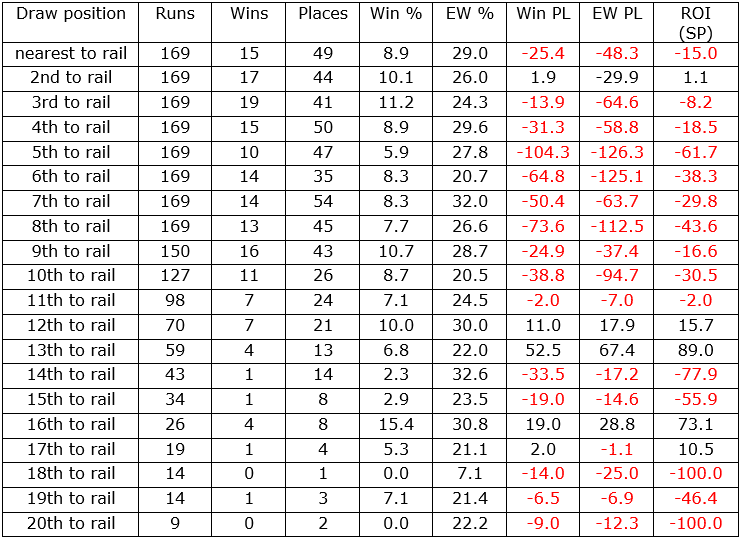
As usual, pace and draw are going to be key here. Statistically speaking a low draw has been a huge advantage in 16+ runner 6f handicaps at Goodwood run on good to firm ground.
Nine of the last thirteen qualifying races have been won by horses running from the lowest third of the draw whilst the middle and high draws have accounted for just two winners each. These win figures are backed up by place and PRB (percentage of rivals beaten) figures, admittedly less comprehensively, suggesting that we really want to concentrate on low drawn runners here.
Digging deeper into the exact stalls successful runners have emerged from; stall 1 has been most successful with three winners whilst stalls 1-6 have provided nine of the thirteen winners from qualifying contests, despite stall 2 contributing none of those wins.
Relying on win figures only can sometimes be misleading, especially with small samples, so let’s look at the places. Again, the low stalls have dominated with thirty-three of the fifty-two placings going to horses drawn stall 12 or lower and twenty-three of those coming from the lowest seven stalls. Stall 1 has not only been most successful in terms of wins (three), it’s also seen the joint most placings alongside stall 3 (six).
So how well found are these low drawn winners and placers in the market? Nine stalls have produced an each way profit in these qualifying races and five of those were in the lowest seven stalls. Three of the four most profitable stalls were 7, 1 and 3, with stall 7 most profitable of all with an each way LSP of 20.75 and it’s interesting that all of that profit came from the place returns.
So to summarise, it’s not impossible to win from any draw (even stall 23 has a win) but it seems a big advantage for win and place purposes to be in the lowest seven stalls.
Extreme Rides Keep You Out Of Trouble
So what about pace?
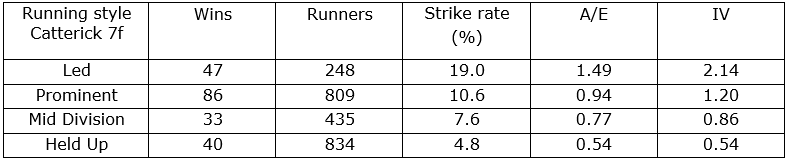
Backing front runners in qualifying races has been a profitable angle with an LSP of 3.00. The least profitable angle has been backing horses that race in mid division, they have produced an LSP of -72.00. This is likely to be down to those runners often being boxed in when the race develops with plenty of ground still to make up. Whereas those held up right at the back have more to do but get more options in choosing their path to progress. The place and draw heat map backs this up with most places coming from low drawn horses who either lead or are held up in the rear.
Stewards' Cup Pace Map
There is possible contested speed in this race.
The low drawn horses are likely to be led by Meraas, one of just two 3yos in the race . The classic generation have accounted for three of the last five winners of this race from just eleven runners and those winners all came from the lowest four stalls.
Aljady could take the higher drawn horses along. Meraas is drawn in stall 4 and his only defeat in four starts this season came on soft ground, which he certainly won’t encounter here. It’s worth noting that Call Me Ginger, who was 2nd to Meraas last time out, runs in the consolation race earlier in the card and a good run for him would be a strong pointer towards Meraas.
There are three runners drawn 7 or lower who are likely to be held up and they are Kimifive (1), Gulliver (3) and Venturous (7). Kimifive was 10th in this race last year off the same mark when drawn high, Gulliver was 6th last year from a low draw when rated 7lbs lower. Both will be ridden by talented claimers (Cieran Fallon and Angus Villiers respectively). Venturous ran in the consolation race last year and finished 2nd off a 4lb lower mark. His last two wins have come over 5f and he didn’t seem to quite see it out a year ago so could be vulnerable again for win purposes at least.
Hot Form Worth Following
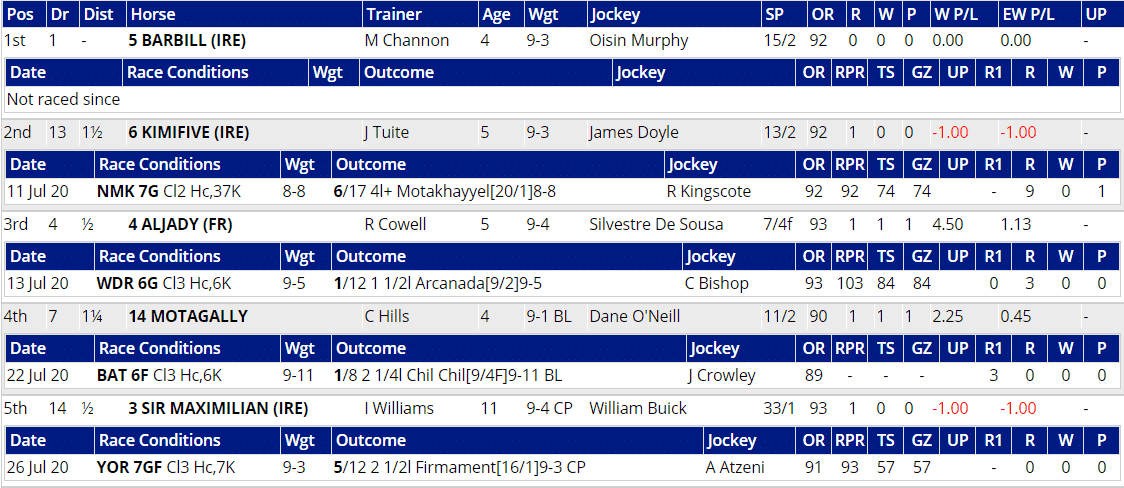
Of the trio Kimifive appeals off the same mark as last year. His only run over this trip since last year’s race has worked out well when 2nd to Barbill.
The Geegeez Future Form indicator shows the 3rd and 4th have both won on their next starts whilst even the well beaten 5th, Sir Maximillian, ran very well in a tough York handicap up in trip. It’s worth noting that Barbill also runs in this race but he’s drawn in stall 21 which may compromise his chance.
https://www.geegeez.co.uk/wp-content/uploads/2018/06/DancingStar_Probert_StewardsCup2016.jpg316830samdarbyhttps://www.geegeez.co.uk/wp-content/uploads/2022/10/geegeez_banner_new_170x78.pngsamdarby2020-07-30 19:51:262020-07-30 19:51:26Stewards’ Cup 2020 Preview: Recent Evidence Suggests Low Means Go
To Friday, the fourth day of five at the Qatar Goodwood Festival - Glorious Goodwood to you and me. Goodwood Friday is one of those days in the calendar marked off on January 1st, along with Cheltenham week, Royal Ascot, and the Breeders' Cup, when I am planning to be at the track for the very best of what the sport has to offer.
But not this year, alas. This year, I - like everyone else - will be confined to the sofa for my Glorious viewing. No bad thing in the context of what's going on around the globe but, for all that it is a first world problem, they are days like these when I feel those invisible bars constraining my liberty. On...
1.10 TDN Australia Handicap (1m3f, Class 3 0-90, 3yo)
We commence with another of those inscrutable, to me at least, three-year-old handicaps. I'm trying to look to the form of races which are working out well, but this year's fractured programme means there are less of those. The ratings boys will have a better handle than me on this one so I'll largely leave it to them - Peter May's numbers, for example, scream Al Qaqaa, the eight length last day victor. A nine pound rise is unlikely to stop him if he is in the same mood here.
I was a fan of Celestran after his Yarmouth win but, for all that he's run well in defeat since, that race hasn't worked out as well as I expected it might. He's not one to give up on yet, however.
Possibly the most interesting, Al Qaqaa aside, is Summit Reach, trained by the wily and in-form 'Raif' Beckett. He made all to hack up in a mile event at Chelmsford which has worked out very well and, while he's failed to go gate to wire over this sort of distance twice since, he ought to have a squeak of stacking them up on this pace-favouring piste. Stall ten won't be an issue for him.
In truth, this is not a betting race for me.
1.45 Oak Tree Stakes (7f, Group 3, 3yo+ fillies & mares)
Low draws have dominated in the Oak Tree Stakes historically. Since 1997, the winner has been drawn 2,2,2,1,5,1,6,6,1,1,1,10,9,2,2,9,10,10,5,1,6,3,10
Put another way, the inside three stalls - after removing non-runners - have won 12 from 69 runners; the outside three stalls have won one from 69 runners. The heat map, which shows all similar races run over this course and distance since 2009, accentuates the point still further:
Invitational has to be of interest. She'd won two at seven furlongs - in slightly lower grade, granted - prior to patently failing to stay a mile on the stiff Ascot track behind Nazeef last time. Back to seven, with a favourable draw and front rank run style, 14/1 is too big.
One Master is in the one box and is a genuine Group 1 filly dropping into Group 3 company. She has a big class edge on Invitational but will need luck in running on this notoriously cambered course. If she gets a clear run she'll probably win.
A Group 3 winner over seven is Breathtaking Look whose draw in nine is acceptable and will be mitigated by a pace-tracking run style. She ran a bold race over six at Newmarket on her 2020 bow (second to July Stakes hero, Oxted) and was only just touched off in a York G3 last time, again over a furlong shorter. Seven is well within her compass as that Sceptre Stakes score last September attests so she ought to go well.
Charlie Appleby runs Althiqa, a Listed race winner in France last time and Godolphin have a second dart in the more exposed Final Song. Fourth in the 1000 Guineas, that one may not have appreciated the soft ground the last twice; even if that's right, however, she has stall 13 - unlucky for most at this range - to overcome.
Anna Nerium and the French filly Wasmya both have good draws if they're lucky in the run.
With a clear passage, One Master will be very hard to beat; but her run style does offer wagering hope that the race sets up for one kept out of trouble. I'll risk Invitational, in spite of her having to concede weight to the three-year-olds and ostensibly being as much as a stone 'wrong' with some of her peers. She'll be near the front, sees out seven well, and looked progressive prior to failing to stay last time.
2.15 Thoroughbred Stakes (1m, Group 3, 3yo)
Just the five go to post for this Group 3, the four-and-a-half length Britannia Stakes winner, Khaloosy, being a shade of odds-on as I write. That was on soft, this will be good to firm; that was 22 runners and truly run, this will be five runners and potentially tactical; that was a handicap, this is a conditions race. He very well might still win.
Against him are a couple of uber-unexposed colts in My Oberon and Tilsit. The former won a York novice last time by six lengths, showing a ready turn of foot. That attribute could be valuable in a contest with no obvious pace angle and, with just two runs to his name thus far, he can progress again.
Tilsit has a similar profile: the second of his two runs to date was a 19 (nineteen!) length romp on the straight track at Newcastle. It's virtually impossible to quantify that in the context of this race except to say he's clearly a capable individual.
The other pair look a lot more exposed.
This is a very different test for Khaloosy and, as such, taking odds-on doesn't appeal. My Oberon looks the more likely of the other two last day wide margin scorers, and he's a sporting bet at bigger than 3/1.
2.45 Golden Mile Handicap (1m, Class 2, 3yo+)
The strongest draw bias race in the calendar just about: low draws have it, high draws do not. Recent winners of this race have been drawn 4,15,9,5,4,2,1,3,3,5,1,1,15,7,1,8,13,5,9,1,3,3,3
Backing the lowest three drawn horses in that time arbitrarily would have returned a profit at SP of 40.75 points.
Moreover, when the going has been good or faster, stalls 1-5 have been responsible for the winner in five of the last seven years, and the second in the two non-winning years.
Here's the pace/draw heat map for ALL handicap races over a mile at Goodwood on quick ground with 14+ runners. Good luck if you fancy Montatham: he'll be a mighty horse to win from there.
Mark Johnston won this in 2012, 2010, 2009, 2001 and 1997 but has had plenty beaten since his last success. He's triple-handed this time and has lucked in with the draw for two of them, the forward-going pair Vale Of Kent and Cardsharp.
Joe Fanning is likely to set the fractions on Vale Of Kent, who was second in the race last year off a seven pound lower mark. That, incredibly, was from stall 17 and he has trap 3 this time: he's a definite player with Goodwood form of 2142 including three big field spins and is generally available at 10/1.
Cardsharp has Will Buick steering and emerges from box five. He has yet to run at the track and looks more of a seven furlong horse.
The highly progressive Prompting is drawn in stall two and is favourite. For all that he won well last time that was in a Class 4 seven furlong handicap on the wide open expanses of the Knavesmire: he looks like he'll be ridden for luck in a better race over further and is therefore not exciting at the price. His trainer, David O'Meara, is in excellent form and he could still be competitive with a clear run.
Another who will come later and need to be commensurately lucky in transit is Sir Busker. He's been impressive this term at a mile and shaped as though needing those extra yards when just failing to get up over seven at Newmarket last time. Up another five pounds for that effort won't help but the 'capper has been struggling to keep tabs on William Knight's progressive four-year-old.
Almufti has the inside stall and a nine pound weight pull with Sir Busker on Ascot running two starts back. He, more than most, will need the splits to arrive but he remains playable for small money at 14/1, hard luck potential notwithstanding.
Mostly, though, I think Vale Of Kent looks likely to run his race and is attractive at 10/1 with extra places if you like.
3.15 King George Stakes (5f, Group 2, 3yo+)
This race is all about Battaash, who is a very very fast horse and oozes class. His price of 4/11 reflects the strong likelihood that he'll win so you'll need plenty of elevens to be prepared to risk them to get some fours.
I had a good bet on Liberty Beach to finish second to Battaash at Ascot where she got chinned on the line by Equilateral. She's since been beaten into second in a Listed race but she won the Molecomb here last year and the slightly easier finish looks more to her tastes. She's my idea of the second and 7/4 without Battaash is the bet if you don't just want to cheer the high class jolly's anticipated procession.
Glass Slippers looks like she will appreciate a bit more give in the ground and perhaps another tilt at the Abbaye is where we'll see her best this term. Al Raya might not be impossible but the rest, including the French runner Ken Colt, probably are just about.
3.45 Glorious Stakes (1m4f, Group 3, 4yo+)
Treacherous punting territory in spite of just seven lining up. The last winner at a double figure price was in 2001 so I'll use that as an excuse to overlook Le Don De Vie, Spirit Of Appin and, reluctantly, Thundering Blue.
That leaves a quartet at 5/1 or shorter headed by Communique, a horse who has forgotten how to win a touch. In fairness, he's been second three times since a Group 2 score in July last year, and was only a half length behind Eagles By Day over arguably a trip too far last time.
Desert Encounter has won absolute bundles - over a million quid, in fact - from his globetrotting exploits and he added another 57 'bags' (bag of sand = grand) when nicking this under a typically late Jamie Spencer ride last term. At around 3/1 he's a less appealing price this time than the 15/2 he returned then, but his case is more obvious. Jim Crowley takes over from Jamie.
Alounak is another to have acquired more than just air miles from his world tour, aggregating better than £330,000 to date. Alas, that was pretty much exclusively for his previous, German, trainer. Andrew Balding has managed 'just' the £30k with the son of Camelot in three spins to date, but he nearly stole the show in the Group 2 Hardwicke Stakes at Royal Ascot last month. A capable fellow on his day, he's another who usually runs well in defeat.
That's a comment which can be applied to the 2-from-13 Pablo Escobarr also, though one of his brace was achieved in a maiden race here. This is a different level of difficulty and not one about which I'm excited for his chance.
Thundering Blue was such a devil a couple of seasons back putting his trainer, David Menuisier, on the map. He ran mostly flat last term, however, and it remains to be seen how much affection for the task the now seven-year-old retains. Likeable old sausage, all the same.
This is the sort of race where one arrives at a wager by a process of elimination. All have been serial non-winners in recent times with the exception of the reigning champ, Desert Encounter. He's very far from bombproof but is less unreliable than his rivals and gets the nod on that basis!
4.20 Nursery Handicap (6f, Class 2, 2yo)
I just don't know. Maybe Rooster or Perotti, both off the track for a month and more, both expected capable of better after the break, both representing respected Goodwood trainers. Next.
4.55 Fillies' Maiden (6f, Class 4, 2yo)
The bar beckons.
**
And that's Friday's somewhat truncated preview. I hope you don't mind me skipping the last pair: you shouldn't because I genuinely have no idea on those - even more so than the 30-odd races which preceded them this week!
As is customary, I will leave you to your own devices on Saturday and wish you well. And, as is customary, you may be very grateful of that come the time...
Many thanks for reading this week, and I hope you've both enjoyed the sport and perhaps found a nicely-priced winner or two.
Matt
p.s. There will be a crowd at Goodwood on Saturday. It will be the first occasion since mid-March that racegoers have been permitted to indulge their passion on site and, in these nervous tentative times, that feels like a small win. Let us hope that the macro situation allows for this to become our 'new normal', as there are plenty of racecourses up and down the land who rarely get more than the ceiling 5000 in attendance. In other words, they might get back somewhere close to business as usual, which will be good for all of us one way or another.
And so to Day Three, Thursday, at Glorious Goodwood 2020. In the preview that follows I'll offer the usual thoughts and tips, with the standard caveats emptor in situ. The feature race of the day is the Group 1 Nassau Stakes for fillies and mares over a distance of a mile and a quarter.
We start shortly after one o'clock, the first race being the...
1.10 Mirabeau En Provence Handicap (5f, Class 3 0-95, 3yo)
Some nippy three-year-olds do battle in the opener, a few of them in form, too. Somewhat unusually, five of the nine declared are fillies.
The pace looks set to be contested between, primarily, Glamorous Anna and Electric Ladyland, two of that filly quintet, and they may be joined by a third, Hand On My Heart.
It is Hand On My Heart that is of most interest of the early speed: she ought to be able to get a nice tow into the race, allowing for the fact that she is drawn on the outside and will have to tack across. The Clive Cox-trained Iffraaj filly makes her handicap debut here for a handler who boasts a 19% strike rate with 'cap debs in the past two years. Jockey Adam Kirby has a fine record at Goodwood and when riding for Cox.
Hand On My Heart does have to show that she's trained on, however: her form has tailed off - albeit in higher grade - since a debut win in a quite valuable fillies' stakes at Windsor last June. Three runs since, all in Class 1, have offered little hope.
Of the boys, 3/1 Bal Mal is on a hot streak having won his last four and five of his last six. The key has been the drop to five furlongs, where his record is unblemished thus far:
This mission is tougher again, of course, but the 'Then What?' figures on the right hand side tell us that his form is working out well enough. He ought to bid boldly for a sixth straight win at the minimum. He, too, should get a prominent early position and, from stall two, looks the most likely winner.
1.45 Unibet Handicap (1m2f, Class 2, 3yo)
A second three-year-olds only handicap, this time at ten furlongs. In what is a very trappy encounter, it looks a case of Mark Johnston versus the unexposed brigade. The winner of this race is normally rated 90+, as 15 of the last 17 were. However, I suspect the average OR in the race this term is slightly lower as a result of there having been less opportunities to advance a mark that far.
On that basis, I'm going to risk opposing the exposed Johnston pair in favour of less exposed, potentially more progressive rivals.
Johnston's Zabeel Champion is hardly exposed, with three wins from five starts, but he has shown more of his hand than many. Al Salt for example has won his last two of three career starts, none of them on turf, and represents a trainer - William Haggas - with a 25% strike rate first time in a handicap, as this lad is.
Roger Varian brings the only twice-raced Magnetised, narrowly beaten last time but recording a big Racing Post Rating. He steps up two furlongs in trip and improvement is likely rather than possible.
John Gosden has Magical Morning, another stepping up from a mile on this fifth career start. He was beaten on good to soft last time having won twice on good to firm previously. That shouldn't have been the decisive factor, but the extra range here might eke out more.
Plenty more improvers up and down the card, including Celtic Art whose father and son training team of Paul and Oliver Cole have won with three of their six handicap debutants so far this season. David Probert rides the top weight, who has already been second and first on these slopes.
And Oisin Murphy, the champion jockey, jumps on Starcat, a horse thought good enough to contest the 2000 Guineas two back and who may have resented the soft ground in Ascot's Britannia Stakes last time. Of course, an alternative theory is that he simply hasn't trained on; but I have sufficient respect for his trainer, Hughie Morrison, to note this one at a price.
It's a very difficult puzzle indeed.
2.15 Richmond Stakes (6f, Group 2, 2yo)
It is hard to know what to make of a seven-runner Group 2 where the top three in the betting were all beaten last time out, and two of them were out of the frame...
Favourite Yazaman has at least improved as he's gone up in class from race to race, with his second to Tactical in the G2 July Stakes reading well in this company. He led there as they got to the hill so this easier track could help him.
Mark Johnston trains Qaader for owner of the season, Sheikh Hamdan al Maktoum: this son of Night Of Thunder got closest to the 150/1 Coventry Stakes boilover, Nando Parrado, but was then three lengths behind Yazaman. There's no obvious reason he should reverse placings.
Further back in the Coventry was Admiral Nelson, who was never travelling there. Obviously the O'Brien/Moore/Coolmore connection has always to be respected but their two-from-eight record in this came 18 years apart. Both were similarly lesser lights in the yard's hierarchy, however.
Clive Cox saddles Supremacy, who stepped forward from first to second start and made all to win well in a minor event at Windsor 24 days ago. The sectionals tell us that he was able to quicken off the reasonable gallop he'd set there and nothing laid a glove on him. This is much harder but he deserves his place.
Gussy Mac did well to win the five furlong Listed National Stakes at Sandown last time and has now won his last two of three. He's trained by Roger Teal, who is a whizz with sprinters as evidenced both by the brilliant win of Oxted in the Group 1 July Cup and his two-year statistics:
This extra furlong looks right for him now and he is one of the few that still look progressive for all that it may be too early to write some of his rivals off. He'd be a super postscript to Oxted's G1 success.
Lauded ran a similarly mediocre race to Admiral Nelson in the Coventry so, while any horse can be forgiven one poor run, he only had one good run previously and I don't really see why he should reverse with Qaader either.
This seems quite a disappointing turnout for a Group 2. Yazaman might appreciate the easier test after Newmarket, and Qaader is the main player bidding to salvage the Coventry form; but perhaps 8/1 Gussy Mac is the value against those who have already tried and failed at Group level. Supremacyis another of more interest at the prices than the black type losers atop the market.
2.45 Gordon Stakes (1m4f, Group 3, 3yo)
Historically a trial for the St Leger and a benefit for Sir Michael Stoute, whose seven wins since 2001 will not be added to in 2020 as he is unrepresented. If the Richmond Stakes has a disappointing looking level of quality, the Goodwood beaks will be buoyed by the presence of four Derby runners in this renewal of the Gordon Stakes, including the second and the fourth.
The 2020 Derby has its place in infamy now as a race where the leaders appeared to steal it; Khalifa Sat had the cat-bird seat throughout and maintained it to the finish behind wide margin victor, Serpentine. The cavalry arrived too late with both English King and Mogul promising more than they delivered.
But were they as unlucky as they looked? Whilst the answer to that is "probably", this re-run between the three - and also the not-really-ever-in-it Highland Chief - will at the very least fuel the fire of those who have a strong view on the matter.
English King performed best of the closers and had previously delivered the best audition in the Lingfield Derby Trial. He is short in the market here but deservedly so in my view.
Khalifa Sat will have his supporters: he's a two-time scorer here including in the Listed Cocked Hat Stakes, and bettered that form when running up in the Derby. He has the chance to show he's been under-rated in some quarters.
Meanwhile, Mogul's juvenile reputation has yet to be vindicated on the track in this campaign. For all that excuses can be made for his two 2020 efforts, they've both been underwhelming and he has to prove he's trained on.
The one who brings unequivocal form to the table is Al Aasy, who followed up a mile and a half novice stakes win with a victory in the 1m5f Group 3 Bahrain Trophy at Newmarket three weeks ago. Both of those wins were with give in the ground, however, leaving the suspicion that this sharper track on a quicker lawn might not play to his obvious stamina strengths.
Mark Johnston runs the tough and consistent Subjectivist who, along with Khalifa Sat, may set the pace. It's never a surprise when a Johnston runner wins at Goodwood but this one would rate a disappointment if he was to lower the colours of the Derby form.
English King is the logical play here, but he's very short at around 6/4. I really like Al Aasy but not for this gig: he'd be interesting ante post for the St Leger if finishing well in defeat. Mogul has plenty to prove for me, so 9/2 Khalifa Sat might be a smidge of value. But it's a race I'll likely be watching without wagering.
3.15 Nassau Stakes (1m2f, Group 1, 3yo+ fillies and mares)
The feature race of the day, and a line up long on quality if a trifle short on quantity. Such is life this season with so many big races squished together after the resumption. Far better this way than any other, in my view.
Last year's shock winner Deirdre bids to double up. Now six, the Japanese raider was well beaten on her prep run last term and reprised that type of rehearsal in the Eclipse 25 days ago. This will have been the plan with an easy ten furlongs looking optimal; but there could be a lot less pace in the race this year than last, where she came with a devastating burst late on. Her form behind Magical looks pretty solid in the context of this field - in the context of most fields, in truth - and she sets a good standard.
But she's not favourite. That honour goes to Donnacha O'Brien's Fancy Blue. Donnacha, following in brother Joseph's footsteps as a son of Aiden to move from riding into training, won the Prix de Diane (French Oaks) last time with this filly having been second in the Irish 1000 Guineas the time before. Regular readers will be bored to tears by now of me decrying the value of French form but, again, the Diane featured three Irish runners in a field of eleven where the remainder were domestic fillies. The Irish finished 1-2-3. It's a desperate state of affairs across La Manche currently.
That's a verbose way of saying I'm against Fancy Blue - certainly at the prices. Both Alpine Star and Peaceful - mile Group 1 winners this season - may not have got home, and the rest were French. Fancy Blue can win, duh, but she's short enough.
Between Donnacha's and Deirdre in the betting lists is the wildly progressive John Gosden inmate, Nazeef. Only third on debut, she's rattled off six straight wins since, most recently in a Group 2 at Royal Ascot and then the Group 1 Falmouth Stakes at Newmarket. She fits here on ability, then, but all of her winning has been achieved at up to a mile to this point: the step up to ten furlongs is not out of the question on either pedigree - out of a Dubawi mare - or performance (she tends to lead late in her races hinting that she might go further), but it is an unknown. The perceived absence of a strong early tempo would be in her favour.
Magic Wand is a legitimate Group 2 filly and, in this strange year, there are plenty of Group 1's to be snaffled with such a type. But not this one, I don't think. She finished just in front of Deirdre at Sandown and also in the Irish Champion Stakes last September, but I have the feeling that this is Deirdre's seasonal target whereas Magic Wand is expected to attempt to produce many more rabbits from hats yet.
I'd be struggling to make a cohesive case for any of Queen Power, One Voice and Lavender's Blue, although this trip is likely to suit all three better than the shorter ranges over which they were beaten last time.
A cracking race in prospect, but perhaps a tactical one. That slightly puts me off Deirdre, though I respect her chance greatly; and I instead favour the 11/4 about Nazeef who, if she does have suspect stamina on the step up in trip, may find that mitigated by the combination of the easier track and the projected steady pace. She's bidding for a seven-timer and might just develop into a champion we've yet to recognise.
3.45 Nursery Handicap (7f, Class 2, 2yo)
Impossible stuff here as eleven of the dozen runners make their handicap bows. Messrs Johnston and Hannon have won plenty of these down the years, normally with a fancied runner. Johnston's pair are at double figure odds as I write, while one of Hannon's brace is 6/1 Running Back.
He was a (well beaten) second to Qaader, who runs in the Richmond Stakes earlier on the card, on debut; then only just seen off in a Kempton novice. Both of those races were six furlongs and this extra eighth looks right for a son of Muhaarar. I'm totally guessing, of course, but if I had to draw one of these in a sweepstake I'd be happy enough with this fellow. Oh, and he's in Qatari ownership, which may suggest this has been the target all along given their overall sponsorship of the meeting.
Good luck if you're playing. I doubt I will be.
4.20 Fillies' Maiden (7f, Class 2, 2yo)
Moving on...
4.55 Tatler Nursery Handicap (5f, Class 2, 2yo)
Another guess up, this time though we have horses that have mostly raced over this minimum distance. It's a new race and an interesting one, which is not to say that I have any iota regarding who might win. In this clueless spirit, I will offer two.
Nigel Tinkler's squad were pretty slow out of the traps after resumption but have warmed up a little in recent weeks. He saddles 13/2 Acklam Express, who improved from first to second start to win readily at Hamilton 18 days ago. His trainer doesn't saddle many at Goodwood: in fact, this will be only the third Tinkler runner at the track in the last five years. The other two finished second and first, the winner coming in a nursery handicap.
The other is 15/2 Different Face, whose Yarmouth second to Yazaman may look very good - or pretty moderate - after the Richmond Stakes. He made all on his only subsequent start in an average Lingfield novice, and his trainer is in white hot form just now, as you can see below. Crisford also has an excellent record with handicap debutants, though I'd read less into that in a race where they're virtually all squeezing into that overcrowded train carriage.
The favourite, and odds on at time of writing, is Winter Power. Trained by Tim Easterby he put two bronze medal finishes behind him when lashing home by five lengths in a Redcar nursery on Monday. He carries just the six pounds penalty here prior to reassessment and was clearly put in too low by the handicapper ahead of that assignment. Unless you like risking more than your potential reward in fields full of unexposed types, the better question to answer here might be which others have been underestimated by the assessor?
*
Good luck with your Day 3 Goodwood wagers. It's not easy - it's not supposed to be, I guess - but it does look terrific sport, and the Nassau Stakes is a very interesting, and high class, race indeed.
Day two of five, Wednesday, at the Qatar Goodwood Festival - Glorious Goodwood to you and me - and another septet of equine head-scratchers, chin-rubbers and brow-furrowers upon which to ruminate. As with Tuesday we begin at 1.10pm, and as with Tuesday, we begin with a fillies' handicap, the...
1.10 British Stallion Studs EBF Fillies' Handicap (1m2f, Class 2 0-105, 3yo+)
Eight go to post on good ground for this first of seven on the afternoon. Three fillies represent the Classic generation, each in receipt of nine pounds of weight for age.
I've tried twice to find a way into this race, and I've failed both times. I don't want to deliberately mislead anyone, which I'd be in danger of doing, so we'll move swiftly on.
1.45 Unibet Goodwood Handicap (2m5f, Class 2 0-105, 3yo+)
An extended two and a half miles around the loop means traversing all of Goodwood's ups and downs, in some cases in both directions. It's a test of balance and stamina as well as requiring a hint of class. They don't bother with starting stalls so you need a horse that's not going to lose ten lengths at the tapes: even over this marathon trip a missed kick spells game over. My route into all Class 2 staying handicaps is Ian Williams.
In the last five years he's chiselled out a small starting price profit - and a much greater exchange or early price edge - as well as hitting plenty of placed runners (30%), as the image below articulates.
This race has gone to Williams on three occasions (2017, 2014, 2008) and he is double handed in the quest for a fourth Goodwood Stakes.
The Grand Visir won the Ascot Stakes (2m4f) last year and was second in the Queen Alexandra Stakes (2m6f) last month, so he loves Ascot and staying trips on the flat. This is not Ascot, however. He's up from 100 to 104 which might not be enough to stop him, though whether he has the same affection for this track I'm not sure. Still, he has plenty of ticks in boxes for a game like this.
Meanwhile, Blue Laureate is developing into a cliff horse for me: a lamentable effort in this year's Ascot Stakes was sandwiched between two close enough placed spins in Class 2 staying handicaps. His overall win record of 1 from 16 in flat handicaps is sub-optimal but I have to have him in my corner as he still looks well handicapped and is in the right hands. James Doyle takes over the driving today.
The likes of the admirable Coeur De Lion, as well as Oleg and Hollie Doyle, and Mark Johnston's Summer Moon will all have their supporters. But I'm siding with Ian Williams, at 9/1 and 16/1, a long-term EV+ play in these races.
2.15 Unibet Handicap (1m4f, Class 2 0-105, 3yo)
A three-year-old handicap over twelve furlongs where we're required to project on from what horses have already achieved - often over shorter trips - to today's challenge. Eleven runners but 6/1 the field tells you how tough this is.
One means of undertaking such projection is to look at how well races have worked out. Three runners catch the eye in that context.
The first of them is Mambo Nights, trained by Richard Hannon. He's won his last two, and before that was third in a Salisbury novice from which the runners have collectively raced 39 times since. They've managed to win 15 of those races (38%). Indeed, as you can see from the below (right hand side 'Then What?' section), ALL of his races have worked out well. He's bred for this trip, unexposed at it and no horse has got to within two lengths of him so far this season.
Although George Scott's form is not great just now - still time to turn that around - his Sarvan is also an improver whose form is panning out. See the image below, which shows not just how Sarvan's second to Spectrum Of Light looks well, but also (at the bottom) the excellent record of George Scott when placing a runner into a handicap for the first time. I alluded to the Scott/Curtis trainer/jockey combination on Tuesday; it appears again, as one of my three Report Angles, for this chap today.
And thirdly Cozone, trained locally by Amanda Perrett, a lady who just loves a winner at Goodwood (I know, who doesn't?). We can see how well his non-winning pair of races in 2020 have unravelled in the ensuing weeks from 'Then What?' again and, in the extended view below, I've also inspected the trainer's and sire's performance.
To that end, we can see that Mrs P is in good form (note the place percentage of 40% in the past fortnight) but that she's struggled to get winners on the Sussex Downs in recent times for all that she has tried. If that's a knock, the breeding - by a Derby winner out of a mare bred from Dansili - offers hope. He might at least win the Fred Winter if failing here! (Whilst that may appear harsh, he has an excellent pedigree for that change of direction).
Of the rest, A Star Above may get a form boost from Au Clair De Lune, whom she beat last time, that one fancied (by me at least) in the last on Tuesday.
Yes, it's very trappy, but I will lean nervously in the direction of 9/1 Mambo Nights, who threatens plenty more at this trip and whose form is rock solid.
2.45 Molecomb Stakes (Group 3, 5f, 2yo)
A flying five for fast juveniles, the Molecomb has advertised the ability of the likes of Cotai Glory, Kachy, Havana Grey and Liberty Beach in recent years. This is all about speed.
The one I like most is Sardinia Sunset. Second in a hot early season novice, she then finished a fine fourth in the Group 2 Queen Mary Stakes at Royal Ascot. Dropped to Listed grade last time she made no mistake, scoring by a length. She has the highest Topspeed figure, the highest Racing Post Rating, the highest Peter May 'SR' figure, and is best in at the weights with her fillies' allowance. She was also fast enough to lead in her first two races yet tactically versatile enough to sit in behind when winning that Listed pot last time.
There are plenty of dangers, including Michael O'Callaghan's impressive debut scorer, Steel Bull. He was slowly away that day and, if breaking more alertly for the experience, will be a threat to all.
I'm not mad about Significantly, who has found one too good on each of his three starts and has recorded regressive time figures in the process; but Wings Of A Dove could conceivably take a step forward. Behind Sardinia Sunset in both that Newmarket novice and the Queen Mary, she showed up really well having fluffed the start behind Ubettabelieveit in the National Stakes at Sandown.
Army Of India reverts from a turning six on the all-weather to a straight turf five, the Mark Johnston-trained dual scorer having the pace to contest the running and the stamina to see out any burn up on the front end. He'd be far from a shock winner for all that he lacks the class of some of these.
9/2 Sardinia Sunset looks decent to me.
3.15 Sussex Stakes (Group 1, 1m, 3yo+)
What a race in prospect. What. A. Race.
This mile set-to includes the winners of the 2000 Guineas (Kameko), the Irish equivalent (Siskin), the Queen Anne Stakes (Circus Maximus), and the Summer Mile (Mohaather). Throw in Wichita, close third in the St James's Palace Stakes, and Vatican City, runner up behind Siskin at the Curragh - and San Donato, second to Mohaather - and we have a sumptuous serving of something special.
Stepping away from the individual ability of this septet to stare at some cold facts for a moment reveals that three-year-olds have won 13 of the last 21 renewals (62% of the winners, from 42% of the runners). That's a nod to how many three-year-olds are retired at the end of their Classic season as much as the weight for age allowance but, regardless of which you place greater store by, the fact is that the younger gang have historically had an advantage.
Favoured is the unbeaten Siskin, who did well to extricate himself from a pocket in the Irish 2000 and win by daylight. That looked unlikely for much of the race and is testament to the acceleration of Ger Lyons's colt, a son of First Defence. He travels well, has tactical speed and is unbeaten: what's not to like? Well, perhaps nothing; but maybe the fact that he was withdrawn from the Middle Park Stakes after getting extremely worked up in the stalls at Newmarket on his only trip outside Ireland.
That might just have been a freak, of course, but he is unlikely to truncate in price in the early yards of the race so, if you love him, it could be worth backing him once the gates have opened and he's shown himself to be focused on the job. There is a very good chance I'm over-analysing what happened at Newmarket, however.
More recently at the same Suffolk venue, Kameko came with a sustained run to score in the 2000 Guineas. While there was no fluke about that, the perception remains that he's a ten-furlong horse who got away with it on a stiff straight mile track. This easy turning mile just may test his speed too much and his stamina not enough.
Siskin's trainer is most afraid of Mohaather, the four-year-old Showcasing colt who bounded away from his rivals in an Ascot Group 2 on the round course at the Berkshire track last time. Steady early fractions made for a sprint finish and he proved much the best in that context. It was also steady early over the same track and trip - but on the straight course - when he couldn't cope with Circus Maximus's masterclass in front end control in the Queen Anne. Mohaather has yet to do it in Group 1 company - beaten five lengths on both occasions he's tried. While it is too early to say he cannot win a G1, he looks short enough even if there were credible excuses for both his defeats at the top table.
Circus Maximus re-engages here, having been a close second in this race last year. There, he gave best only late on to the excellent-on-his-day Too Darn Hot, and his overall CV is impressive, including Group 1 mile wins in the St James's Palace and Prix du Moulin as well as that Queen Anne score. He's tough and high class but probably does need to grind it out from the front; that makes him susceptible on a speed track like this.
His barn mates, Wichita and Vatican City, are not without hope. The former represents this year's St James's Palace form in the absence of Palace Pier and Pinatubo, small margins in front of him at Ascot. I presume he'll chase Circus Maximus's lead - it certainly doesn't make sense for them to take each other on. Previously a neck second to Kameko in the 2000 Guineas, he may reverse placings with that one on a track which, as mentioned, is more about speed.
Vatican City was another to suffer interference in the Irish 2000 but still did best of the rest behind Siskin. It's a stretch to suggest he'd have beaten the winner with a clear run, so I won't; and it is hard to find a reason why he should reverse form here, for all that there is not necessarily a huge amount between them.
The 25/1 outsider San Donato may outrun his odds without perhaps being good enough to make the frame. His winning form is at six furlongs so it's a fair shout that a mile on Ascot's uphill finish, even in a steadily run race, asked too much stamina-wise. This easier mile threatens to be just as much about speed as that Ascot Group 2 but a little less about stamina. He'll be held up for a late run and I'd be happy to take evens he doesn't finish last!
This is a great race but not an easy one from a betting perspective. To be frank, I don't really like any of them enough at the prices to bet. So I won't. So there. 🙂
Really looking forward to watching it, though, natch.
3.45 Alice Keppel Fillies' Conditions Stakes (Class 2, 5f, 2yo)
I'm not going to pretend I have a line on this race.
What I will say is that Jane Chapple-Hyam's unraced filly is interesting, a) because this is a deep end in which to lob an unraced filly, and b) because Jane has a very good five-year course record. She is also capable of saddling debut winners as the image below shows:
The red 14/30 imply that J C-H is in poor form; while no winners from 20 runners in the last 30 days is frustrating, a quarter of those have made the frame which is in line with her two-year place strike rate (see the 'All' row). In a race where the standard of opposition is not quite top class, there will be worse throwaway penny wagers than 33/1 Lady Amalthea this week.
4.20 Theo Fennell Handicap (7f, Class 3 0-95, 3yo+)
We close with a seven furlong handicap where as many as twenty runners line up. Seven furlongs is a draw bias trip, as we can see from the image below which displays 'percentage of rivals beaten' (PRB).
The PRB3 line - rolling three-stall average PRB - shows an almost linear relationship from low (very good) to high (dreadful).
The draw / run style heat map relates a similar tale. Low, and especially low and led, is the way to go.
Let's try to apply that information to the actual pace map for the race:
There's a bundle of pace on by the looks of it, so I'd want to be siding with a low drawn horse ridden for luck. They aren't drawn any lower than 1, from which stall Arigato (at around 17/2) will emerge. He's a seven furlong specialist, and maybe also a Newmarket specialist, but he has conditions and is in great form.
Dirty Rascal is 12/1, won the race last year and has stall four for his repeat bid. He's changed trainers, from Richard Hannon to Tom Ward, but not owners, and he runs off the exact same handicap mark as last year. His chance is obvious.
18 others who could play a part but draw is my kingmaker angle.
In this week of this concertinaed and truncated whirlwind season in this topsy-turvy year, racing hosts its summer landmark Glorious Goodwood festival. Without crowds for the first four of five days, the final card on Saturday will welcome racegoers to a British track for the first time since mid-March. Hallelujah for that: on, and up.
To the racing and, for the first four days of Goodwood - the Qatar Goodwood Festival to give it its correct name - I'll be offering some daily thoughts on the action. Readers are advised to familiarise themselves with the content of this draw and pace article, both elements having a strong bearing on proceedings under certain conditions at the Sussex Downs venue.
I'm taking the chance that the going will be good on the opening day and, with a dry week forecast, tightening up to good to firm later in the week. Day One is Tuesday 28th July, and the feature race is the Goodwood Cup, a Group 1. But before that, and more briefly than is often the case, we commence at 1.10 with the...
1.10 EBF Fillies' Handicap (1m, Class 3 0-95, 3yo+)
A three-year-old-plus handicap where eight of the twelve declarations are of the Classic generation. They receive both an eight pound weight for age allowance and are generally open to more improvement, a double whammy against their elders.
John Gosden is in bamboozling form right now as the below image demonstrates, and he saddles handicap debutant Wasaayef. Gosden has struck at a 30% clip in the last two years with horses off a layoff, has a 23% win rate with 'cap debs, and currently boasts a 34% strike rate for the past fortnight.
A neck second to Queen Daenerys in a novice last September, she was spotting that one six pounds. The winner was fourth in the Oaks, and the third and fourth have both won since, so this is strong handicap form. Expect her to race handily, and she's available at around the 3/1 mark.
1.45 Unibet Handicap (1m2f, Class 2, 4yo+)
After the relative calm of a dozen fillies comes the storm of 18 older horses traversing the round course before clambering over each other and the camber (cambering over each other?) in the straight. Ten furlongs is the trip.
Four- and five-year-olds with at least a distance win have taken out 17 of the last 18 renewals of this race, according to Andy Newton's Goodwood Day 1 trends. Higher weights and multiple winners have had much the best of it so my shortlist is comprised of Sky Defender, Babbo's Boy, Derevo, and Alternative Fact.
Sky Defender is one of only two in the race for Mark Johnston - who took this pot in 2016, 2014, 2012, 2009, 2006 and 2000 - with the other being the better fancied but unproven at the distance, Maydanny.
Sky Defender has second top weight but also has the assistance of Joe Fanning, who rides this track for Johnston so well. Ignoring a last place finish at York last time, he won a Class 2 handicap at similarly quirky Epsom over this trip two back. His is a bold 'catch me if you can' style generally, and there are plenty of alternatives for the lead in a race thick with both quality and quantity. But very few riders have Fanning's ability to judge the fractions, making 28/1 tempting for very small money.
Babbo's Boy is interesting, too, and at 33/1 in a place. A Class 3 winner two back over ten furlongs, he ran poorly last time when upped in distance. With a liking for a bit of juice in the turf, any rain will help his cause and trainer Ralph Beckett calls up Rossa Ryan for the steering: they're 7/21 in the last year together (+15.87, A/E 1.88, IV 3.27)
Sir Michael Stoute offers Derevo for our consideration. A typically well-bred Juddmonte colt, he is both bound to improve for his seasonal bow and likely to improve for being a year older, Sir Michael being a master of patience. Derevo notched three wins from his five starts last term, though they were all in small fields. He could fare no better than a 12 length sixth in a 19-runner late season handicap at Newmarket which is a niggle. So, too, is his car park stall - 18 of 18 - and those two knocks mean he's not for me at single figure quotes.
The last of my trendy quartet is Alternative Fact: Ed Dunlop trains this one, an experienced three-time winner including once at ten furlongs. A hold up horse with a turn of pace he's interesting for all that he'll need plenty of fortune in transit.
All four are drawn 13 or wider, however, and that's a concern. In the circumstances, I'll be treading very carefully with Sky Defender and Babbo's Boy with as many extra places as I can get.
2.15 Veuve Clicquot Vintage Stakes (7f, Group 2, 2yo)
The first group race of the week and a strong favourite in the imperiously-bred Battleground. By War Front he's out of the superstar mare, Found, herself winner of an Arc and a Breeders' Cup Turf. The Naas maiden in which he was a two and a half length sixth on debut has worked out extremely well: as well as Battleground himself winning the Listed Chesham Stakes at Royal Ascot, the ninth placed horse won the Group 2 Railway Stakes with the winner of the Naas maiden finishing second in that G2. Indeed, here's the Future Form view of selected runners from the maiden, with the bottom line P/L bottom right corner:
I'm not inclined to try to speculate about the rest of the field, though I would say that the favourite has more scope to improve than many and already has better form than most/all of his rivals. Good ground won't be an issue and he ought to win, I think, albeit that 11/8 leaves little margin for error.
2.45 Lennox Stakes (7f, Group 2, 3yo+)
A seven furlong Group 2, and a good one at that. I always feel that seven furlongs is a specialist trip, especially when looking at top class races. Indeed, 17 of the last 20 winners of the Lennox Stakes were already seven-furlong winners.
Only six of those twenty victors also won last time out. Six more were beaten over a mile, though not beaten far; and the three winners who ran over six furlongs the time before were also all beaten at that shorter trip. Meanwhile, six of the eight winners who ran over seven furlongs last time won that race, too.
In other words, forgive a beaten horse if it was running over a different - potentially the wrong - trip; but demand that a horse which ran over this range last time won. Tragically, from my research perspective, that only eliminates the 33/1 poke Graignes on its first UK run for George Baker. Sigh.
Below is the UK/Ire form as depicted in Instant Expert, sorted by distance win percentage:
The seven-furlong specialists in the field are Space Blues, Safe Voyage and Sir Dancealot. Let's begin with the last named, winner of this race for the last two years and a 6/1 shot this time around. There are clearly no concerns about course or distance, nor about the ground. Those are his sole two visits to the course thus far. Last year Sir Dancealot came here off the back of a beating over a mile, and the year before he took the same route as this term: beaten in the six-furlong July Cup. He has won at 5/1 and 6/1 those two years and looks a very fair price again at 13/2.
Safe Voyage comes here having won the Surrey Stakes at Epsom over this trip. He was previously second to Space Blues, again over seven, at Haydock. He has some high class form at seven and a mile from last year but almost exclusively on deep ground. If the going was soft, he'd be my idea of the value; but it's not and he isn't, for all that he's clearly a talented lad who otherwise fits the profile.
The favourite is Godolphin's Space Blues, winner of the aforementioned Haydock Listed contest and most recently a Longchamp Group 3. In an eight-runner field over in France that last day, the two British horses finished 1-2, nodding once more to the dearth of talent in the French ranks currently. Frankly, whilst I've loved this fellow since he careened through a 19-runner York handicap field last May, his form thereafter is either below this level or has been achieved in that questionable Gallic context. It obviously won't be a shock if he wins, but I don't give an especially better chance to him than to Sir D who is twice his price and more.
Of the remainder, Duke Of Hazzard hasn't especially been looking like he wants a drop in trip from a mile though he's a dual Group winner here; Pierre Lapin has to bounce back from a horrible run in the Commonwealth Cup and proved he's trained on from a highly promising juvenile season; and the rest, with one possible exception, don't look good enough.
The possible exception is Glorious Journey. A G2 winner in Meydan in January, and then third at the uber-valuable Saudi Cup meeting in February, the Charlie Appleby-trained five-year-old was a neck second to Limato in a Newmarket Group 3 and the winner of a Newbury Group 2, both over this distance, last season. If he's recovered from his early year globetrotting exertions and is fit enough he'll have a hand to play. Those are quite a few if's for a horse at a single figure price, mind.
3.15 Goodwood Cup (2m, Group 1, 3yo+)
The feature of the day - arguably of the week - is the Group 1 Goodwood Cup. Seven go to post and it is 14/1 bar two, so ostensibly a match, a notion given greater substance with the fact that the third favourite, Nayef Road, was beaten ten lengths by the favourite, Stradivarius, last time.
Stradivarius is a win machine and the latest of a terrific line of staying champions. Because of their limited value at stud - National Hunt broodmares await - stayers tend to be kept in training for longer. As a result, we've seen the likes of Double Trigger, Yeats, and Persian Punch to name three return time and again to favoured haunts for their Cup jaunts.
But this lad Strad, recency bias acknowledged, might just be the pick of them. Such is his talent that talk of an Arc tilt at season end is not quite in the realms of fantasy (though it is still ambitious). For this gig, he has no peers, not from the older brigade anyway. The John Gosden inmate has won the last three renewals of the Goodwood Cup, has a gear change unrivalled among stayers and comes here off the back of arguably his most impressive performance thus far, when bashing up Nayef Road and co by at least one postal district.
But where there's an ointment there's usually a fly, and where the ointment is Gosden's it is usually Aidan O'Brien buzzing around the bottle; in this case with his progressive and weight-advantaged three-year-old Santiago. As a juvenile, Santiago was good enough to finish second to Alpine Star, subsequent Group 1 winner at a mile. He then won his maiden at that trip to round out last season.
This term, in two races just eight days apart, he won the Group 2 Queen's Vase over a mile and six at Ascot, flew back to Ireland, and took out the Group 1 (obvs) Irish Derby. Wow. The former race was on soft ground, the latter on good. Talented and versatile he might arguably have aimed at twelve furlong G1 glory rather than this two mile challenge; but getting a whacking great stone and a pound in weight for age makes him a formidable foe for the champ.
Here's how I expect this to play out: Nayef Road takes them along early in a bid to draw the sting, while the SAS - Santiago and Stradivarius - keep their powder dry marking each other from midfield. On the turn for home, the moves are made and the best turn of foot wins.
Aided by that chunky weight differential, I feel Santiago might just wrest the laurels from the old fiddler, Stradivarius. It's not a strong feeling, and I have ultimate respect for the champion; but he is vulnerable on these terms given the progression in the other lad, and the price disparity - 2/1 vs 8/13 - is greater in my view than it ought to be.
3.45 Qatar Handicap (Class 2, 5f, 4yo+)
A cracking sprint handicap and one where the rarely sighted "Possible Pace Collapse" prediction is in play...
True, it is sometimes the case that when races look like this, connections take heed and manage their runners accordingly; but here, the likes of Caspian Prince, Ornate and Acclaim The Nation don't really know another way to race regardless of the deliberations of their humans.
As such, for me, it sets up for either a more tactically versatile runner or a waited with type. As can be seen from the map, it might not be overly lazy to narrow consideration down to two: Well Done Fox and Celsius.
Well Done Fox is a two-time Listed scorer at the minimum and drops back to this trip after two efforts over six. Prior to that he ran a respectable, in the context of this handicap, race in the 5f Group 1 King's Stand Stakes, and was a decent fourth in the 5f Group 3 Palace House Stakes on his other run this term. He's not won for two years but nor has he faced a field of five furlong handicappers in his career before. The drop in trip, into a searing pace, might be just what he needs and 12/1 is fair each way value.
Celsius is just about favourite, and this looks an ideal setup for him, too. A winner in five of his eight five furlong handicaps, and second in two more, Tom Clover has trained this four-year-old to continuous improvement thus far. He is a regular tardy starter, however, and if he's not careful this better collective might be away and gone before he can catch them up. If he breaks alertly it will be a very good opportunity to further his winning ways at 7/2.
4.20 Maiden Stakes (6f, Class 2, 2yo)
Next...
4.55 Fillies' Handicap (1m 4f, Class 3 0-95, 3yo+)
A card book-ended by fillies' handicaps closes with this one over twelve furlongs. This time, seven of the dozen runners are from the Classic generation, and in receipt of eleven pounds weight for age. Unexposed, progressive and getting most of a stone. Yes, they lack the physical maturity of their elders in most cases, but the deck is stacked in their favour to my eye. This race, which I assume is the one introduced in 2013 for the late August meeting, has been won by a 3yo for the last six (of seven) years.
The relatively locally trained Asiaaf was a winner here two back. That was over ten furlongs, the Marcus Tregoning resident having run a solid second at Sandown since. Stepping up to this distance for the first time, improvement could be forthcoming though her pedigree (New Approach out of a Shamardal mare) doesn't scream as much.
One whose lineage does point to a mile and a half, and whose form profile has embroidered that implication, is 10/3 Dancing Approach. Trained by Roger Charlton, she's won her last two since being stepped up to this trip. By Camelot out of a New Approach mare, such races are the metier of the sire, as can be seen from the sire snippets:
We can also see from that snapshot that both trainer and jockey are in good recent form (the green 14 and 30 noting good form in the past 14 and 30 days respectively). This filly has an obvious chance.
Tulip Fields is another bred for this sort of job, and so too it seems is her trainer, Mark Johnston, who wins Glorious Goodwood handicaps for fun. She's a little more exposed than some, however, and my eye is drawn more to the George Scott-trained Au Clair De Lune.
By Sea The Stars, whose progeny have fared extremely well against this type of assignment - see below - she is out of Missunited, who herself was a winner here of the Group 3 Lillie Langtry Stakes on her final start. Raced in the same owner/breeder colours of Vanessa Hutch as her dam, she will have been primed for this target. Incidentally, her year older full brother, Eagles By Day, runs in the Goodwood Cup earlier on the card, another suggestion that there could be more to come from this filly.
As can also be seen below, the George Scott/Ben Curtis axis has been a potent one in the last twelve months. She's 11/2 and should run well.
*
And that's a wrap for the opening day of the Qatar Goodwood Festival 2020. A slightly briefer overview and a few more Geegeez Gold components; hopefully one or both of those tweaks is to your personal tastes. Regardless, I'll be back with Wednesday's preview soon enough. I'd love for you to join me!
Oh, and do leave a comment below with your best value play(s) and your reasons why - share the knowledge 🙂
The prize money may not be there, but thanks to sensible planning by the major European authorities, since racing resumed, the races and the horses assuredly have been, writes Tony Stafford. Over the past weekend, Enable and Magical put in typically dominating performances at the top level.
These two mares, respectively the greatest and arguably the nearest to her in terms of achievement and durability, each took home yet another Group 1 prize, brushing aside the opposition. Small fields do not normally excite the senses but in each case the clock told the tale. Enable in outclassing the 2019 Irish Derby winner Sovereign to gain her third King George VI and Queen Elizabeth Stakes at Ascot on Saturday, won in six seconds faster time than the ten-runner handicap later in the day. On Sunday, Magical’s time was three seconds faster than a hotly-contested premier handicap as she collected the Tattersalls Gold Cup in a canter, making all the running.
Enable now has 14 wins from 17 starts with eleven (count them!) Group 1’s to her credit at the age of six. Since over-turning the odds-on Rhododendron by five lengths in the Investec Oaks three years ago, only two horses have beaten her, Waldgeist in last year’s Prix de l’Arc de Triomphe, and the brilliant Ghaiyyath when she made her seasonal debut in the Coral-Eclipse at Sandown three weeks ago. Only once in the intervening period has she started at odds-against, 5-4 when winning her first King George as a three-year-old.
The John Gosden-trained daughter of Nathaniel missed much of the 2018 season, returning to take advantage of a once-only descent into Group 3 company for the September Stakes on the all-weather at Kempton. Enable also benefited from an 8lb pull that day from the penalised Crystal Ocean, easily beating Sir Michael Stoute’s horse, who was to get within a neck of her on normal Group 1 conditions, receiving only the 3lb sex allowance, in last year’s King George.
Now all that remains is a fourth attempt at the Arc. It was a surprise when she was caught late on last October by Waldgeist, but the French-trained son of Galileo had been close behind the first two in the King George a couple of months earlier, so it didn’t need too much of a form adjustment. Emotionally, though, it was a shock of seismic proportions, but rightly it did nothing to change either the public or professional acclaim in which Enable is held.
Magical, meanwhile, has raced more often than Enable, and as the very shrewd Jane Mangan asserted on Racing TV yesterday, she would have been a world champion if Enable hadn’t been around. Magical was only fifth in Waldgeist’s Arc, confirming as if it were necessary, that a mile and a half sometimes stretches her. Ten furlongs, as again she showed yesterday, is her optimum and the domestic Group 1 races in Ireland are more plentiful at that distance.
Yesterday’s Curragh opposition had no answer from the moment Wayne Lordan launched her into the lead and it was left to Derby hero Emmet McNamara to come through for second on Sir Dragonet. The beaten 2019 Derby favourite hasn’t won since his easy Chester Vase victory the month before Epsom, but he ran on nicely to suggest more good races will be within his grasp.
That was also the message sent out at Ascot by Sovereign, who stuck to the task when Enable surged past, while the more-fancied Japan, the only other runner, toiled home well behind for Ryan Moore.
Five times Enable and Magical have met, and each time Enable has beaten her year-younger rival. Their first confrontation was in the 2018 Arc when Magical was only tenth, but she surpassed that with a battling three-quarter length second to the champion in the Breeders’ Cup Fillies and Mares race at Churchill Downs the following month.
That margin was replicated in last year’s Coral-Eclipse but stretched to almost three lengths in the Juddmonte at York before the second attempt at an Arc. After yesterday’s success, Aidan O’Brien said that next month’s Juddmonte is a possible target for Magical, with the Irish Champion as an option if he decides to give her a break over the summer.
I have been very excited by both Sovereign’s runs this year. Absent for 363 days since his spread-eagling 33-1 win in last year’s Irish Derby, he was an eye-opening third to the very talented Twilight Payment over 1m6f at The Curragh, atypically dropped right out at the back of the field and staying on stylishly into third under minimal encouragement from Seamie Heffernan.
On Saturday he reverted to a mile and a half and front-running tactics. Before the race I preferred his chance of bustling up Enable to that of Japan, for all that the latter colt hadn’t been beaten too far when third in the Coral-Eclipse. Sovereign looks a tough performer ready to step up, possibly over further but he’s quick enough to stay at Saturday’s distance too.
That stamina option has already been chosen for this year’s Irish Derby winner Santiago, who was the 2-1 favourite for the Classic but now steps up to two miles to challenge the reigning champion stayer, Stradivarius, as John Gosden aims Enable’s fellow six-year-old at a fourth successive win in the Goodwood Cup.
Intriguingly, Stradivarius made his first successful foray into Group company when winning the Queen’s Vase over a mile and three-quarters on his previous start to Goodwood. Gosden has plotted his course wisely since, in 2018 and 2019 collecting £1 million bonuses for owner-breeder Bjorn Nielsen for the selected four-timer of Yorkshire Cup, Gold Cup, Goodwood Cup and Lonsdale Stakes, a promotion by Weatherbys Hamilton that understandably has been discontinued.
Stradivarius has not been unbeatable in that time, falling victim to three O’Brien-trained stayers in Capri (2017 St Leger), and Order Of St George and Kew Gardens in the Qipco British Champions Long Distance Cup at Ascot in 2017 and last year. His latest defeat was his third to Ghaiyyath and Anthony Van Dyck in the re-sited Coronation Cup at Newmarket, a fine effort over that inadequate trip. The race set him up nicely for his ten-length demolition of Nayef Road at Royal Ascot as he completed a Gold Cup hat-trick last month, possibly his best-ever performance.
Now, though, Stradivarius faces another O’Brien challenge and on 2lb worse terms than he was able to meet Big Orange and the rest three years ago. I have always understood that over time Admiral Rous’s weight-for-age scale was being inexorably altered and modified in favour of the older horses, partly to encourage owners to keep their good horses in training in their maturity, but also because it has long seemed so one-sided in favour of the Classic generation.
Yet here we have the sole three-year-old getting 15lb and on the way he finished at Ascot in the Queen’s Vase, you’d have to conclude he must be a major threat tomorrow. Certainly it was a great performance to drop back a quarter-mile to win the Irish Derby, and in relation to that race, I can’t wait to see runner-up Tiger Moth in the Gordon Stakes at Goodwood on Thursday. His price of 5-1 would look very tempting if he shows up.
We’re getting brilliant entertainment as racing post Covid-19 gradually opens up. I haven’t tried to get either a press or owner’s pass to go anywhere yet, nor will I go to Goodwood on the first “public” day on Saturday, there being at least 5,000 people more deserving of a ticket than me. But there has been so much to enjoy from the sofa and, like the Sky Sports Racing team, I especially enjoyed the Group 3 Princess Margaret Stakes 1-3 yesterday at Ascot of David Loughnane with Santosha and Caroline Dale.
He trains in Shropshire at Helshaw Grange which was once the base for Richard Kent who is now a few miles away at Mickley Stud. For a short time I had a share with Richard in the stallion Contract Law. I would imagine that from being a stud farm to turning it into a training centre with capacity for 60 horses has meant quite a transformation. Loughnane is clearly a young trainer going places.
2.15 Newmarket : Indie Angel @ 9/4 3rd at 5/2 (Steadied start, in touch in rear, wide and headway over 2f out, ridden over 1f out, stayed on to go 3rd towards finish)
Before I post the daily selection, just a quick reminder of how I operate the service. Normally, I'll identify and share the selection between 8.00am and 8.30am and I then add a more detailed write-up later within an hour or so of going "live".
Those happy to take the early price on trust can do so, whilst some might prefer to wait for my reasoning. As I fit the early service in around my family life, I can't give an exact timing on the posts, so I suggest you follow us on Twitter and/or Facebook for instant notifications of a published pick.
...in a 9-runner, Class 5 Flat Nursery handicap for 2yo over 5f on Good to Firm ground worth £3,493 to the winner...
Why?...
As usual, we start with the racecard...
So, an in-form jockey, an in-form trainer/jockey combo, both jockey and trainer have done well here at this venue in the past and they team up again on a horse that looks to have been well drawn.
All the above is pretty self-explanatory, so I'll use my time this morning to look closer at trainer David O'Meara's record at this track, because my shorthand code in my notebook says..."D'OM/Red/C4-6H/2-4y/9.0m"
It's the not the most secretive of codes, but then again nobody else ever really sees my notes, but what it means is that I keep an eye out for David O'Meara's 2-4 yr old, Class 4-6 handicappers sent off at 8/1 and shorter at Redcar, because since the start of the 2017 season, they are...
...including of note/relevance today...
13/33 (39.4%) for 39.81pts (+120.6%) in fields of 8-12 runners
12/31 (38.7%) for 31.15pts (+100.5%) from male runners
9/30 (30%) for 14.11pts (+47%) from those who raced in the previous 25 days
8/26 (30.8%) for 15.89pts (+61.1%) with Danny Tudhope in the saddle
8/21 (38.1%) for 24.72pts (+117.7%) during June to August
7/22 (31.8%) for 18.57pts (+84.4%) in races worth less than £4,000 to the winner
and 5/12 (41.7%) for 17.32pts (+144.3%) at Class 5...
...whilst returning to the Trainer/Jockey stats on the racecard, Messrs O'Meara and Tudhope are 6 from 14 (43.9% SR) for 12.39pts (+88.5% ROI) with males in 8-12 runners contests, including three winners and a runner-up from their last five efforts...
...giving us... a 1pt win bet on Stay Smart @ 3/1 BOG as was widely available at 6.30am Monday, but as always please check your BOG status (*most are not BOG until later in the morning). To see a small sample of odds offered on this race...
P.S. all P/L returns quoted in the stats above are to Betfair SP, as I NEVER bet to ISP and neither should you. I always use BOG bookies for SotD, wherever possible, but I use BFSP for the stats as it is the nearest approximation I can give, so I actually expect to beat the returns I use to support my picks. If that's unclear, please ask!
P.P.S. Please note I left for Greece on Monday 20/07 for two weeks to look at some hotels for my travel agency business and to get some R&R, so whilst I'll still be posting each day (except 04/08 when cover has been arranged), the timings may well be different to normal.
https://www.geegeez.co.uk/wp-content/uploads/2020/07/SotDimage.jpg320830Chris Worrallhttps://www.geegeez.co.uk/wp-content/uploads/2022/10/geegeez_banner_new_170x78.pngChris Worrall2020-07-27 05:32:412020-07-27 05:35:17Stat of the Day, 27th July 2020
For the third week in a row, I can only muster one winner, but at 7/1 allied to two non-runners, it meant a nice 4pt profit from the four that actually ran, which is a decent enough return.
It means that whilst we're still in the red for July, we're now within striking distance of clearing a profit for the month, but I'm going to need at least 2 winners from the next 5 picks for that to happen. It's not impossible, of course and I'll certainly be having a crack at it.
Please note I left for Greece last Monday lunchtime to look at some hotels for my travel agency business and get some R&R, so whilst I'll still be posting each day (except 04/08 when cover has been arranged), the timings may well be different to normal.
Chris
Selections & Results : 20/07/20 to 25/07/20
20/07 : Lady De Vega @ 5/1 BOG NR at 13/8 21/07 : Daheer @ 10/3 BOG 5th at 9/4 22/07 : Dashing Roger @ 7/1 BOG WON at 6/1
23/07 : Squelch @ 7/2 BOG non-runner 24/07 : Global Exceed @ 7/2 BOG 5th at 3/1
25/07 : Indie Angel @ 9/4 3rd at 5/2
20/07/20 to 25/07/20 : 1 winning bet from 4 = 25.00% SR
P/L: +4.00pts
July 2020 :
3 winners from 19 = 15.79% SR P/L: -3.30pts
ROI = -17.36%
2020 to date :
20 winners from 106 = 18.87% SR P/L: +9.70pts
ROI = +9.15%
P.S. The full month by month SotD story can be found right here.
P.P.S The review of SotD's 2012 performance is here. Whilst the details for 2013 are now online here.
And the figures for 2014 are now available here. Our review of 2015 can be found right here Whilst 2016's details are right here The full story from 2017 can be read here. Whilst the yearly review for 2018 is right here
Stat of the Day is just one component of the excellent package available to all Geegeez Gold Members, so why not take the plunge and get involved right now?
Ripon racecourse is located in North Yorkshire and they began racing at the current location in 1900, writes Dave Renham. Ripon is a right-handed flat track that is considered quite sharp - its circumference is 1m5f with a run in of 5f. Races over 6f start with a separate chute giving two distances on the straight track.
As with previous articles in this series I have used some of the tools available on the Geegeez website, namely the Draw Analyser, the Pace Analyser and the Query Tool. The main data set covers the period from 2009 to 2020, and there is the option to examine a more recent subset where appropriate. I will be focusing once again on 8+ runner handicap races.
Ripon 5f Draw Bias (8+ runner handicaps)
Since 2009 there have been 63 qualifying races over the minimum distance. Here are the stats:
Higher draws are positioned next to the stands’ rail and seem to have a nominal edge. Looking at the A/E values, these show a good correlation with the draw win percentages:
Looking at the 12-year data it seems that the stands’ rail does offer runners some advantage in smaller fields. In races of 8 to 11 runners we have the following draw splits:
The A/E value for the highest third stands at a promising 1.14 which adds credence to the theory. Recent evidence (2015 onward) gives similar stats in smaller field contests with 11 of the 20 races (55%) being won by high drawn horses.
Ground conditions do not appear to make any difference to the draw so let us move on to looking at draw broken down by individual stall position.
In terms of individual draw figures I am reversing them as I did with the 5f data in the Musselburgh. I am looking at them in relationship to their proximity to the stands’ rail as highest draws are drawn next to that rail. I used the Geegeez Query Tool to give me the relevant data:
There is nothing particularly clear cut here. However, what should be noted about Ripon’s straight track is that as the fields get to around 14 or 15 runners, higher draws tend to make a beeline for the far rail. There have been very few races with big fields in 5f races, but from very limited data those drawn closest to the far side (very low draws) may have a slight edge. One race where this seemed to be the case was back in 2013 (6th August) where the first three draws home in a 15 runner handicap were drawn 2, 1 and 3. The Exacta paid £256.30 and the tricast £768.91.
Ripon 5f Handicaps (8+ Runners) Pace Bias
Let us look at pace and running styles now. I have always considered the 5f trip at Ripon to offer a front running advantage so let’s see if the stats back up the theory. The overall figures (2009-20) are as follows:
As courses go Ripon’s figures for front runners are around the UK course average for 5f handicaps – not the strongest bias, but still a decent enough one. The strongest pace bias in reality is the one againsthold up horses: they have been at a massive disadvantage, winning just five races from over 200 runners (A/E 0.27). Only Chester and Epsom over 5f have worse figures for hold up horses.
Ground conditions seem to make a slight difference in terms of front runners with better going (good or firmer) seeing their strike rate edge up to 19.7% and their A/E value at 1.54.
Let me look at field size now. As the field size increases the front running edge seems to get stronger. Here are the stats for races of 12 or more runners:
Admittedly this sample is just 24 races so we need to appreciate that we cannot be over confident that bigger fields increase the bias. However, what I would say is that the placed percentage for front runners over these 24 races stands at 55.6%, which is a positive.
Finally in this 5f section a look at draw / pace (running style) combinations for front runners over this minimum distance. Remember this is looking at which third of the draw is responsible for the early leader of the race (in % terms). I would expect the early leader to be drawn near to the stands’ rail more of the time (high).
As expected horses drawn closest to the stands’ rail tend to get to the early lead. Front runners drawn towards a flank generally prefer a rail to run against and of those high drawn runners that led early over 1-in-5 went on to win.
A look at the draw/run style heat map reveals a ready diffusion of green to red - good to not good - from led to held up:
Ripon 5f Summary
The 5f distance does offer interest from both a draw and pace perspective. There seems to be a slight high draw (stands’ rail) bias in smaller fields, while in bigger fields there is a hint of a slight low draw (far rail) bias. Pace wise there is a good edge for front runners which potentially strengthens as the field size increases. Meanwhile hold up horses have an absolutely dreadful record regardless of field size or going.
Ripon 6f Draw Bias (8+ runner handicaps)
Here are the draw splits for the straight six furlong course at Ripon (170 races):
Fairly even looking figures though middle draws have fared slightly worse. Let’s see if the A/E figures offer better pointers:
There is strong correlation here and in general these figures suggest that there looks little in the draw, albeit that a middle gate might not be ideal.
Looking at the statistics for the going, the figures remain similar regardless of ground conditions. This is the same for field size so there does not seem a far rail / low draw bias when the field size starts to stretch across the track. Hence my theory that there was a hint of a low draw bias over 5f in big fields may just have to remain a theory!
There is a glimmer of hope for draw fans over 6f as when we combine softer ground with bigger fields a possible pattern starts to emerge. Data though is extremely limited which is important to note once again. On softer going (good to soft or softer) in fields of 14 runners or more, it seems that middle draws may be at a disadvantage. Under such conditions there have been just 13 races, but they have produced a solitary win for horses drawn in the middle. The middle draw placed stats are poor also with just 9 placed runners from 47 (15 places for high; 23 for low), and middle draws beat just 38% of rivals, as can be seen in the PRB column below.
Now 13 races is far too small a sample in reality and in essence one can legitimately argue that we should take these figures with a pinch of salt. However, I felt it worth sharing it with you.
A look now at individual draw positions in six-furlong eight-plus runner handicaps at Ripon – reversed once again in terms of their position in relation to the stands’ rail:
As might have been expected, there is nothing clear-cut here.
Ripon 6f Pace Bias (8+ runner handicaps)
Let’s see if pace / running styles offers us an edge. Here are the overall figures going back to 2009:
There is a strong front running bias here – slightly stronger than the 5f bias. Once again hold up horses have a very poor record.
In races with bigger fields, the general bias seems to strengthen with front runners and pace trackers (prominent racers) having a huge edge over horses that race mid pack or at the back early. Here are the data for races with 14 or more runners:
33 wins for horses that raced in the front half of the pack early in the race compared with just seven for those running in the back half, from a roughly even 50/50 split of horses. This is something as punters that we can use in our favour.
The big sprint of the season at Ripon is the Great St Wilfrid Handicap held in the middle of August. It is a Class 2 handicap over 6 furlongs with an average field size since 2009 of just over 18 runners (max field size now is 20). In the last 11 renewals of this race (going back to 2009), five of the 11 winners led from the start and made all the running, while another winner disputed the lead early before asserting in the final two furlongs. This is a remarkable front running bias for such a competitive and big field sprint. Indeed the last four winners have ‘made all’. Of those four winners, three of them had led last time out and two of them were top of the geegeez pace section (i.e. had the highest pace total from its last four races). This is one of the many reasons to upgrade to Geegeez Gold if you haven’t already.
The final table in the 6f section takes a look at draw / pace (running style) combinations for front runners in 6f handicaps (2009 – 2020). I would expect higher draws get to the lead more often as they did over 5f for the same reasons as explained earlier:
The splits are as expected – those runners drawn high that did lead early have gone onto win roughly one race in four – another stat worth knowing.
As intimated by the previous comments, the draw/run style heat map shows the value of being close to the front; and the difficulty of being waited with from a middle to high draw.
Ripon 6f Summary
To conclude, 6f handicaps at Ripon offer no real interest from a draw perspective, but the pace angle is a very strong one. Front runners enjoy a good edge while hold up horses really have a very poor time of it.
Ripon 1 Mile Draw Bias (8+ runner handicaps)
The mile trip is raced on the round course with low stalls positioned next to the inside rail. 102 handicap races have been run with eight or more runners since 2009. Here is the draw breakdown:
Low draws seem to have a very small edge, but it is not a bias we could confidently ‘play’.
The A/E values back this up further:
Low draws seem to be overbet slightly with a lower A/E value compared to the high draw figure. This makes sense to me as, going back 15-20 years, the perceived ‘wisdom’ was that low draws did have an edge here over this distance. That perception more than likely remains.
Field size potentially makes a difference as runner numbers increase. Looking at races of 11 or more runners we can see that low draws enjoy an edge when looking purely at win percentages:
There have been 57 races with 11+ runners so this is a fair sample size. The A/E value for low drawn horses improves to 0.97, although this figure still indicates that the low draw bias is factored into the bookmaker’s prices. I would prefer to be drawn low under these circumstances but you need to be selective when trying to evaluate value.
Ground conditions offer no edge so we move on to the individual draw positions for all 8+ runner handicap races. I'm reverting to traditional draw numbers for this distance, as stall one is next to the inside rail:
Stall 4 has clearly over-performed but that is simply down to chance.
Ripon 1 Mile Pace Bias (8+ runner handicaps)
On to pace now – time to look at the overall pace data now (2009-2020):
The 1 mile distance does have a pace bias and prominent racers have the best record. Horses that race in the back half of the field in the early stages of mile races are at a disadvantage once again.
At this juncture I want to briefly discuss the non-handicap pace stats over this trip. Although I tend to avoid non-handicaps for this type of research, the data for this track and trip did catch my eye. There have been 32 non-handicaps races over a mile at Ripon since 2009 and, of those, 29 were won by horses that raced front rank early (led / prominent); just three wins went to horses that raced mid-division, and horses that were held up were 0-from-114. There has been a huge pace bias in these races so I felt it was worthwhile pointing it out.
Back to the 1m handicap data - this pace bias occurs regardless of field size, but in terms of ground conditions, it seems to get even stronger on better going. On good ground or firmer the pace figures read as follows:
Hence, on good or firmer we definitely want to be siding with horses that are up with or close to the front rank, while avoiding hold up horses like the plague. On good to soft or softer the bias evens out a bit, and although you still want to be nearer the front than the back early on, the edge is much reduced.
Now let us take a look at draw / pace (running style) combinations for front runners in mile handicaps (2009 – 2020).
Horses drawn closest to the inside rail (low) get to the lead in roughly half of all races. You would expect to see to this due to the configuration of the track.
The draw/run style heat map - displaying percentage of rivals beaten (PRB) again shows the difficulty of coming from off the pace, and the strong advantage of racing front rank.
Ripon 1 Mile Summary
In conclusion, lower draws may have a slight edge and certainly do as the field size increases. However, it is not going to be easy profiting from this. From a pace perspective, over this mile trip you definitely want to be on a ‘pace’ horse and want to avoid runners who are likely to be held up.
For the remainder of this article I am going to focus on pace only as the draw data at longer trips is unsurprisingly very even. However, there still seems a pace bias at 1m2f and 1m4f, especially on better ground (mirroring the mile data).
Ripon 1 Mile 2 Furlongs Pace Bias (8+ runner handicaps)
For the record, they also race over 1m1f at Ripon but there have only been four handicap races with 8+ runners since 2009. Over 1m2f there have been 78 races giving the following pace splits:
A slight edge for front runners with hold up horses again the worst of the four pace styles. When we narrow the results down to races on good or firmer ground the bias against hold up horses strengthens again as it did over 1 mile:
Horses that race mid-division cannot be dismissed over this trip and going, but hold up horses continue to really struggle.
Ripon 1 Mile 4 Furlongs Pace Bias (8+ runner handicaps)
There have been 68 handicap races over 1 mile 4 furlongs in the sample period – here are the stats:
Prominent racers have the best record followed by front runners. Hold up horses again have a very poor record. Moving to races on good or firmer going, the same pattern emerges as it did over 1 mile and 1m2f.
As we can see front runners and prominent racers have better records on better ground while horses that race mid division or are held up do worse.
Ripon Draw and Pace Bias Summary
Taking "the garden racecourse" as a whole we have little to get stuck into draw wise – over 5 furlongs in smaller fields it high draws seem to have a reasonable advantage; over 1 mile in bigger fields low draws seem to have an edge (and very high draws are commensurately unfavoured).
Looking at the track from a pace angle, across all distances from 5f to 1m 4f, hold up horses have a dreadful record. In sprints, front runners have a good record especially over 6f. Meanwhile, from 1 mile to 1 mile 4 furlongs, better going conditions accentuates the bias against hold up horses; it also gives horses that race front rank an increased chance.
- DR
https://www.geegeez.co.uk/wp-content/uploads/2020/07/Ripon_Racecourse.jpg319830Dave Renhamhttps://www.geegeez.co.uk/wp-content/uploads/2022/10/geegeez_banner_new_170x78.pngDave Renham2020-07-23 11:54:172020-07-23 11:54:17Ripon Draw & Pace Bias
After an extended pandemic break, Clock Watcher is back! This semi-regular feature aims to highlight interesting performances from a sectional timing perspective. Before we dive into those noteworthy efforts, a quick recap to set the scene.
Sectional Recap
Sectional timing aims to tell us more about how a race was run by splitting it up into segments, or sections. Moreover, we can understand more about an individual horse's performances from these splits as well; and, by comparing with history - what we call 'par' - we can frame races and runs in a much broader historical context.
The idea is to note those horses who may have been inconvenienced either by the run of the race or how they themselves ran within it, and to 'mark up' such efforts for consideration in future. Such mark ups are one more piece of the puzzle: often they'll add little or nothing, but occasionally they are the significant differentiator. Our job as form detectives is to assimilate information from which to make value judgements. Sectional information is another piece of evidence to consider in the general form evaluation case, if you feel so inclined.
Thus, on the basis of a number of previous races over a given course and distance, we can have a reasonable idea of what the optimal energy expenditure might be. A marathon runner will look to run every one of the 26 and a bit miles in a very similar time because that is the way she uses her energy most efficiently and therefore runs her best time.
Because of the configuration of racecourses and races - standing start, bends, undulations, obstacles in jumps races - the shape of a par line will never be flat; instead it will have a curve that intrinsically accommodates all appropriate considerations. It will, in other words, enable us to gauge what happened in any given race against the body of directly relevant 'case law' that preceded it.
What we are looking for might vary from race to race, situation to situation. But, more helpfully, two obvious things to spot are fast finishers and solid composite numbers.
Fast finishers are those runners whose closing splits, when compared to their overall time in percentage terms, were quicker. This is often called a finishing speed percentage (or FS%), and a high relative FS% implies a horse finished with more in the tank, more to give. That suggests he might go better next time.
Composite ratings are an attempt to consider FS% alongside the actual speed of a race. After all, if I walk the first 26 miles of a marathon over most of a day, my ability to run the last 385 yards will be far superior to even the best athlete who has run the previous 26 miles at world record pace. My finishing speed percentage will be massive but my overall time - and therefore any attempt at combining final time and finishing speed - will betray how easily I took things earlier on.
That's an outlandishly exaggerated example to emphasise the point that horse races are habitually run steadily and won by the runner with the best combination of track position and finishing speed. Furthermore, not only can we know through sectionals which horse(s) has/have the best finishing kick but we can also overlay that knowledge onto how we perceive today's race will set up.
A horse with a lightning kick may be severely compromised by a strong early gallop but could be a fantastic bet in a paceless heat.
Sectional Examples
Examples make everything more comprehensible, so let's look at a few events since racing returned post-lockdown.
Palace Pier / Pinatubo - St James's Palace Stakes
I'll begin with a fairly banal one - insofar as punting utility goes - but one that very well illustrates the two elements we seek, the St James's Palace Stakes at Royal Ascot.
This was the race in which Palace Pier announced himself on the big stage, charging past last year's champion juvenile, Pinatubo, and the controlling race leader, Wichita.
The three-part OMC (Opening, Midrace, Closing) sectionals image below shows the extent to which they quickened in the final quarter mile (the orange/red rectangles) with the upgrade column on the right hand side attempting to quantify how much more each might have been able to give.
The colour bar above the result table contains the 'race' sectionals: those of the race leader at the end of each section (in this case, at the six-furlong pole, the two-furlong pole, and the finish line). The bars inline are for each individual runner.
This slightly more detailed five-part 'Call Points' view illustrates things further:
Here we can see that Palace Pier covered the final two furlongs in splits of 11.68 seconds and 11.71 seconds. That was partly a function of the (relatively) steady first three-quarters of the race but mainly it relates to his talent.
Pinatubo, for his part, has looked to me a slightly doubtful stayer at a mile, particularly in the context of his brilliant two-year-old form. He was quickest from four to one but couldn't quite see it out. A subsequent win in a seven-furlong Group 1 in France last time supports the theory, though not beyond reasonable doubt. The Breeders' Cup Mile, a race contested around a tight oval track where seven-furlong speed is ideal (think Expert Eye), looks a perfect target.
Palace Pier's Topspeed figure for this effort was 108 and relates to how quickly he got from the start to the finish. Alpine Star, the filly who won the Coronation Stakes over the same course and distance 35 minutes earlier, ran a far more even tempo and recorded a slightly faster overall time to be awarded a 110 Topspeed figure.
But Palace Pier's composite rating - a combination of Topspeed and our Upgrade of 23 - brings him to 131. Alpine Star's effort received no upgrade and therefore remains on 110.
Here's the rub: in a steadily-run race, a feature of both his runs this year, all evidence suggests Palace Pier would readily outpoint Alpine Star. But if it was likely to be more truly-run I'd be less bullish at the likely odds.
One of the main problems, as can be seen below, is that there remains - more than a year after RMG (the company in charge of Racing TV's racecourses' broadcast rights) first published data for a meeting at York - no publicly available sectional output for the roughly two-thirds of British tracks that they cover. I wish it wasn't this way, and I yearn for good news on this front soon.
A Spot of Revision for Harrovian
Another of the John Gosden phalanx of top-class equines is Harrovian, who caught the eye when winning in taking fashion at Doncaster over a mile and a quarter on 26th June. He, and second placed Archie Perkins, were almost five lengths clear of the third that day, a gap established exclusively in the final quarter mile.
I've included the 'by furlong' sectional percentage chart this time: this view helps to understand how a runner's energy was expended and can be compared to the par line - which is grey in this case due to the limited confidence afforded by only 73 races in the course and distance sample. Beneath the chart I've also included the OMC splits for Harrovian and Archie Perkins.
Note on the chart how the red and green lines, representing the selected runners, run close to the dark grey par line until half way (five out, 6-5 on the chart); and how they then extend away in the second half of the race. This tells us that the highlighted runners ran close to optimally (though a little slower in the first two furlongs (S-9, 9-8)) in the early stages before finishing well.
One of the reasons I chose this example is because both horses have again run in the same race since, Saturday's John Smith's Cup. Although there are no official sectionals for that race, they looked to go quite fast early (as might be expected for a 22-runner heritage handicap), which may not have suited either Archie or Harrovian.
Here is the Gosden runner's full form profile:
Compare that with his winning form profile, and with sectional data switched on (the box top left):
All three of his career wins have come at ten furlongs, on good to firm ground, and in small fields. Of the two of that trio for which we have sectional insight, both featured fast finishing fractions off even to slow earlier meters. I'll be very interested in Harrovian when he gets this kind of setup again.
Yarmouth Upgrades
There have been a few races of interest run at Yarmouth since the resumption. Its proximity to Newmarket is a factor in enticing very good horses, and here are two I think worthy of note.
The first of the pair was a juvenile on debut called Yazaman, who achieved the biggest geegeez upgrade figure of any horse since racing resumed (at the tracks covered by our data supplier, Total Performance Data). Ostensibly not much of a race, Yazaman was sent off 10/11 favourite in a field of four.
They went pedestrian fractions in the early part of the five furlong contest but then engaged turbo, as best as unraced juveniles can.
William Haggas's winner completed the last quarter mile in less than 21 seconds, which is really very fast indeed, especially for a juvenile debutant.
To some degree this is now ancient history, as Yazaman has run twice subsequently: first he was a gallant second in the Windsor Castle Stakes at Royal Ascot. Sent off 20/1 that day, the cat was subsequently out of the bag when he again ran up, at 6/1 this time, to Tactical in the Group 2 July Stakes at Newmarket's big summer meeting.
He's rapid and a drop back to five should see him just about win in minor Pattern company.
On 4th July, another two-year-old, this time Ventura Tormenta trained by Richard Hannon, rocked up having been pitched in to none other than the Group 2 Norfolk Stakes on his debut. He ran a huge race there to be sixth, and had plenty in reserve when turning away Sidi Mansour and four others over six this day. As can be seen from the running lines below, Ventura controlled things throughout: an even opening quarter, a steady to slow middle quarter, and then a burst of acceleration and 'eat my dust'.
He didn't seem to get home on the July course over seven furlongs in Newmarket's Superlative Stakes but has since confirmed his class by winning the 6f Group 2 Prix Robert Papin last weekend. English-trained horses finished first and second there, French horses comprising the rest of the field, to affirm my (and many others', in point of fact) contention that French racing has lagging behind a little for a season and a half or so.
Second to Ventura Tormenta at Yarmouth, Sidi Mansour has run since and been beaten in a bigger field at Windsor. But, having covered the final half mile at the Norfolk track in the same time (46.70 seconds) as Sunday's Group 2 winner, he may go one better in a small field where he can put his pace to good use.
Looking Forward
There may be a case to answer from the after-time police regarding the above, even if a number of those highlighted have since been beaten and are suggested for another day. With no such subsequent form here is one more, at a slightly lower level, for the future.
The Yarmouth fillies' novice event won by Almareekh might work out all right: the winner has an entry at Doncaster on Saturday and the third, Viola, may run in a handicap at Redcar next Monday. But it is the fourth placed filly, Ice Sprite, who has made my tracker.
This was her second career start, and first of the season, and the William Haggas-trained daughter of Zoffany was a long way (15 lengths to be precise) behind the leader with half a mile to go. More materially, she was between three and six lengths behind the three fillies that eventually beat her at that same point.
As can be seen from the red bars in her result row, Ice Sprite made a big move between the four and the two, and ran the final quarter (24.01 seconds) quicker than all bar the winner (23.95 seconds). Eased off in the last fifty yards, each way backers may have felt miffed that she was beaten a diminishing neck for third; but she looks attractively rated off just 70 for a potential handicap tilt next time. With only two starts to her name, there are all sorts of reasons to believe she can do better in upcoming spins. She is entered in the 3.20 at Newmarket on Friday.
https://www.geegeez.co.uk/wp-content/uploads/2020/07/palacepier_stjamesspalacestakes2020.jpg319830Matt Bisognohttps://www.geegeez.co.uk/wp-content/uploads/2022/10/geegeez_banner_new_170x78.pngMatt Bisogno2020-07-21 16:06:412020-07-22 07:11:33Clock Watcher: Lessons from Harrovian
4.20 Haydock : Zlatan @ 11/2 BOG 4th at 11/2 (Chased leaders, not much room over 2f out, soon switched left, ridden over 1f out, beaten 4th final furlong, one pace)
Before I post the daily selection, just a quick reminder of how I operate the service. Currently, I'll identify and share the selection between 8.00am and 8.30am and I then add a more detailed write-up later within an hour or so of going "live".
Those happy to take the early price on trust can do so, whilst some might prefer to wait for my reasoning. As I fit the early service in around my family life, I can't give an exact timing on the posts, so I suggest you follow us on Twitter and/or Facebook for instant notifications of a published pick.
...in an 11-runner, Class 6, Flat handicap for 3yo over 1m3½f on Good to Firm ground worth £2,782 to the winner...
Why?...
We start with the race card snippet...
A winner on her turf/handicap/class debut LTO 25 days ago, winning relatively comfortably despite a stumble at the start and having to switch outside late on after being boxed in. She'll come on for the experience, as will her rider who was on board for the first time that day.
I don't often hang an SotD selection on a jockey, but I've got it in my head that this Italian apprentice, Stefano Cherchi, could turn out to be something a bit special. He's in great form right now, as seen above, but this is no purple patch, he has been profitable to follow for some while now. In fact, if you go back to the start of April 2019, his record stands at...
...excellent numbers that translate well into today's type of contest, as they include...
21/131 (16%) for 159.11pts (+121.5%) at class 5 or below
21/103 (20.4%) for 60.96pts (+59.2%) at 12/1 or shorter
19/111 (17.1%) for 164.72pts (+148.4%) in races worth less than £4k
15/101 (14.9%) for 158.14pts (+156.6%) for trainer Marco Botti (this is the key for me)
14/77 (18.2%) for 167.23pts (+217.2%) on runners last seen 6-25 days earlier
13/80 (16.25%) for 156.7pts (+195.9%) with 3 yr olds
12/40 (30%) for 191.19pts (+478%) over trips of 1m2f to 1m4f
9/45 (20%) for 27.98pts (+62.2%) on the Flat
6/21 (28.6%) for 25.16pts (+119.8%) on Good to Firm ground
and 4/15 (26.7%) for 9.05pts (+60.3%) on LTO winners
I said earlier that trainer Marco Botti was key to Stefano Cherchi's successful start to his career here in the UK and with Marco providing around 65% of the jockey's winners/runners, we should look at their partnership a little closer, using some of the details I've already logged...
...ie Botti + Cherchi + Class 5-7 + 12/1 max SP + £0-4k prize money = 11/44 (25% SR) for 40.09pts (+91.1% ROI), including...
8/32 (25%) for 38.43pts (+120.1%) with 3 yr olds
7/24 (29.2%) for 32.7pts (+136.3%) within 25 days of their last run
and 7/16 (43.75%) for 44.74pts (+279.6%) over 1m2f to 1m4f...
...whilst Botti + Cherchi + Class 5-7 + 12/1 max SP + £0-4k prize money + 3yr olds + 1-25 dslr + 1m2f to 1m4f = 4/10 (40% SR) for 29.36pts (+293.6% ROI)...
...giving us...a 1pt win bet on Lady De Vega @ 5/1 BOG as was widely available at 8.00am Monday with bigger offered in places, but as always please check your BOG status (*some go BOG later). To see a small sample of odds offered on this race...
P.S. all P/L returns quoted in the stats above are to Betfair SP, as I NEVER bet to ISP and neither should you. I always use BOG bookies for SotD, wherever possible, but I use BFSP for the stats as it is the nearest approximation I can give, so I actually expect to beat the returns I use to support my picks. If that's unclear, please ask!
P.P.S. Please note I'm off to Greece on Monday lunchtime (20/07) for two weeks to look at some hotels for my travel agency business and get some R&R, so whilst I'll still be posting each day (except 21/07 & 04/08 when cover has been arranged), the timings may well be different.
https://www.geegeez.co.uk/wp-content/uploads/2020/07/SotDimage.jpg320830Chris Worrallhttps://www.geegeez.co.uk/wp-content/uploads/2022/10/geegeez_banner_new_170x78.pngChris Worrall2020-07-20 07:03:242020-07-20 07:37:54Stat of the Day, 20th July 2020
Two events, either end of the past seven days, were a cause for sadness and poignancy, writes Tony Stafford. Last Monday Noel Martin, the Jamaican-born Birmingham resident, died age 60. Yesterday at Chantilly, the three-year-old filly Onassis, daughter of Martin’s brilliant but luckless race-mare Jacqueline Quest, won a Listed race at Chantilly.
Martin’s life story was well-known. A lifelong racing fan, he had been among a large group of British construction workers based in Germany in the mid-1990’s. While driving his car one day in June 1996, Martin was targeted by a Neo-Nazi, a 17-year-old youth who threw a 6-kilogram concrete block at the car’s windscreen simply because of his colour. Martin lost control, hit a tree and was left as a quadriplegic with no control of either his legs or arms.
Amazingly, he pursued his love of racing, becoming an owner and winning two Royal Ascot races in 2006 – the well-tried double of the Ascot Stakes and Queen Alexandra Stakes – with Baddam, trained by Mick Channon.
This came at a time when he was considering travelling back to Germany to have an assisted suicide, so greatly did he suffer. He related in one interview, “Sometimes I didn’t leave the house more than two or three times in a year”, talking of non-stop pain in his feet. A television documentary was made about his planned suicide, but Martin took exception to elements of it. Soon after, he changed his mind about ending his life and founded a charity aimed at challenging racial hatred.
An exchange scheme between young people in Germany and Birmingham became the focal point of his later years. Jacqueline Quest was certainly a major part and nobody who was on the Rowley Mile at Newmarket for the 2010 1,000 Guineas will ever forget the scenes. Martin, in his wheelchair, having welcomed back his Sir Henry Cecil-trained 66-1 winner, had to endure the shock of her being disqualified in favour of the Criquette Head-trained favourite, Special Duty.
Watching the race again now, it is possible to see why the result was amended as Tom Queally, on the winner, changed his whip into his left hand late on. It did provide the impetus to wrest the initiative back from the French filly, but also contributed to her general right-handed drift throughout the closing stages. That said, actual interference seemed minimal and it must have been a tight decision in the stewards’ room.
Martin’s stoic acceptance of the result was admirable and, while Jacqueline Quest – named for his wife Jacqueline who died in 2000 from cancer, very early into his many years of infirmity – never won another race, she was destined to have quite a say in the world of thoroughbred breeding.
For mares to succeed, they need to find the right owners, and in Major Christopher Hanbury of Triermore Stud, Co Meath, that was certainly the case. Even though Jacqueline Quest’s subsequent racing years were unproductive, finishing at nearby trainer Ian Williams, who had also handled Baddam later in his career, she still realised 600,000gns when sold as a four-year-old at Tattersall’s December sales. Not a bad return for a filly, originally bought for €60,000 in Ireland as a yearling.
Hanbury mated her with Galileo, a union which has been repeated several times since. The first two products, Hibiscus, sold for 625,000 gns, and World War (1.2 million gns), were minor winners for Aidan O’Brien and Ger Lyons respectively. They, and all those that followed, were prepared for the sale at Peter Stanley’s New England stud. Next came Hidden Dragon, who was twice withdrawn from sales, first as a yearling and then as a two-year-old catalogued from Ballydoyle. Now an unraced five-year-old, he is listed as being in the ownership of J P McManus with Joseph O’Brien.
Triermore’s fourth Galileo mating resulted in the October 2017 sale of Line Of Duty for 400,000 gns to Godolphin. Charlie Appleby trained him and memorably won the Breeders’ Cup Juvenile Turf race with him at Churchill Downs. That proved his last win. He finished eighth in Anthony Van Dyck’s Derby and sadly died at the end of last year.
For his 2017 mating, Hanbury switched to Galileo’s great rival, Dubawi. Obviously, Line Of Duty hadn’t started racing yet and I’m sure the Dubawi mating was planned with a Godolphin yearling purchase in mind. Instead, at the sales, Jacqueline Quest had her least lucrative result, the filly that would be named Onassis going to a bid of “only” 200,000 gns. It was effectively a buy-back which resulted in a partnership between Triermore Stud and Peter Stanley.
They sent the cleverly-named Onassis to Newmarket trainer Charlie Fellowes and the pair must have been delighted when she won at the sixth time of asking a Newcastle fillies’ nursery off a mark of 75 last October with Hayley Turner in the saddle.
Onassis was subsequently off the track until last month. Returning in the Sandringham Stakes at Royal Ascot, again partnered by Turner, she won at 33-1, exactly repeating for connections the previous year’s result in the same race when Thanks Be, trained by Fellowes, also won at 33-1 giving Hayley her first Royal Ascot victory.
After this year’s Ascot, Turner suffered an injury which kept her off the track for three weeks, so she was unable to ride Onassis in the Princess Elizabeth Stakes at Epsom. Onassis finished a creditable fourth under Ryan Moore in that Group 3 event.
Hayley, though, was fit again for Chantilly and she brought Onassis through from some way back to win nicely. There was a brief reminder of that Guineas disqualification a decade earlier when the Chantilly stewards looked into their winding route through, which seemed slightly to inconvenience one of the runners, but the result was soon confirmed. Maybe in less enlightened days, the Jacqueline Quest family might have suffered another “injustice”.
Onassis has raced nine times for three wins, and Turner is three for three on her. As the first woman to ride 100 winners in a season and only the second after Gay Kelleway to win a Royal Ascot race, she is a true icon of the sport. Twenty years on from her first win, she retains all her charm and riding talent. How fitting that in Hollie Doyle she has a successor who may one day (how about this year?) challenge for the jockeys’ championship. She, too, has a century and a Royal Ascot win to her name. A Group 1 is the next ambition for Doyle to match Turner’s achievements.
There remains one more chapter in the Jacqueline Quest story waiting to unfold as Charlie Appleby has charge for Godolphin of the latest product of that well-tried marriage. Line Of Duty’s full-brother, now a two-year-old, sold last year for 1.1 million gns, and will hopefully appear on the track in the not too far distant future.
Meanwhile, it seems that Appleby has decided against confronting Enable again with Ghaiyyath, who beat her with such panache in the Coral-Eclipse Stakes earlier this month in Saturday’s Qipco King George VI and Queen Elizabeth Stakes at Ascot. The entries will be eagerly anticipated this morning, but you get the feeling from that first run back that the great mare might be as good as ever at the age of six.
Presumably Ghaiyyath will wait for York, whose race committee will be hoping that, like Goodwood next Saturday, they might be permitted to have at least one day with public attending. A crowd of 5,000 will be allowed at Goodwood on Saturday week. I’ve always wanted to excuse myself one year from the Sussex Downs in favour of a first look at Galway, as they clash every year. Seems like I’ll be stuck on the sofa for an 18th straight week instead of doing either!
*
Like Noel Martin, the recently knighted Sir Graham Wylie enjoyed his racing, so much so that at one time he had 80 horses in training with Howard Johnson in Co Durham. The partnership was already creaking a little when Johnson lost his licence over a serious horse welfare issue, since when Wylie had his reduced team of 20 split between Willie Mullins and Paul Nicholls. And now the founder of the Sage software company has decided – at Noel Martin’s all-too-young age of 60 – to take a step back from ownership.
Over in Ireland, one trainer who is inexorably moving into the top echelon of his trade is Ger Lyons. Already trainer of Irish 2,000 Guineas winner Siskin this year, he followed with success in Saturday’s Irish Oaks with the 10-1 shot Even So. Lyons runs Siskin in the Sussex Stakes next week when Frankie Dettori is on the bench waiting for the call if Colin Keane decides not to suffer the two-week quarantine requirement by coming over.
Even So had a trio of Coolmore-owned fillies as well as Jessica Harrington’s favourite Cayenne Pepper to beat on Saturday, but she readily outstayed the Harrington filly. She runs for a partnership of the wives of John Magnier and Paul Shanahan, hence the pink colours.
On Sunday at The Curragh Lyons followed up in the Group 2 Kilboy Estates Stakes for fillies with Lemista. This was the fourth win in succession for the daughter of Raven’s Pass, but the first in the colours of her new owner, Peter M Brant. Yes, Ger Lyons is truly in the big time now.
As with the previous week, it was one winner from six and a small loss on the week meaning we're behind schedule for July. results/performances seemed to get better as the week went on, but July is proving a far tougher nut to crack than June was.
We're probably 2 w or 3 winners shy of where we would like to be, but that said, the numbers post-lockdown still look more than respectable, I just need to get back amongst the winners again.
Next pick will go live shortly after 8.00am Monday, but please note I'm off to Greece on Monday lunchtime to look at some hotels for my travel agency business and get some R&R, so whilst I'll still be posting each day (except 21/07 & 04/08 when cover has been arranged), the timings may well be different.
Chris
Selections & Results : 13/07/20 to 18/07/20
13/07 : Dodgy Bob @ 11/4 BOG 6th at 16/5 14/07 : Cappananty Con @ 4/1 BOG 9th at 10/3 15/07 : Emirates Knight @ 4/1 BOG 4th at 3/1
16/07 : Somewhere Secret @ 5/2 BOG 3rd at 11/4 17/07 : Treacherous @ 3/1 BOG WON at 16/5
18/07 : Zlatan @ 11/2 BOG 4th at 11/2
13/07/20 to 18/07/20 : 1 winning bet from 6 = 16.66% SR
P/L: -1.80pts
July 2020 :
2 winners from 15 = 13.33% SR P/L: -7.30pts
ROI = -48.66%
2020 to date :
19 winners from 102 = 18.63% SR P/L: +5.70pts
ROI = +5.59%
P.S. The full month by month SotD story can be found right here.
P.P.S The review of SotD's 2012 performance is here. Whilst the details for 2013 are now online here.
And the figures for 2014 are now available here. Our review of 2015 can be found right here Whilst 2016's details are right here The full story from 2017 can be read here. Whilst the yearly review for 2018 is right here
Stat of the Day is just one component of the excellent package available to all Geegeez Gold Members, so why not take the plunge and get involved right now?
Racing at Catterick racecourse dates back to the mid 17th century so this North Yorkshire circuit is steeped in tradition, writes Dave Renham. It is a left-handed undulating track that is considered quite sharp: its circumference is a mile and a furlong with a run in of around three furlongs. Races over five furlongs start from a separate chute with a shallow turn into the home straight; all other races are raced on the main round course.
As with previous articles in this series I am using some of the tools available on the Geegeez website, those being the Draw Analyser, Pace Analyser and Query Tool. The main data set covers 11 years from 2009 to 2019, but as usual I will also examine a more recent grouping (2015 to 2019) where appropriate. The focus is once again on 8+ runner handicap races.
Catterick 5f Draw Bias (8+ runner handicaps)
Since 2009 there have been 151 qualifying races over the minimum distance. Here are the 11 year stats:
An even looking split with lower draws faring marginally best. Looking at the A/E values, these show a correlation with the draw win percentages:
The 5f trip at Catterick did display a relatively strong bias around 15 years ago for five or six seasons. I will use the five-year comparison data method I used in recent articles to illustrate how the bias has changed over the years. To recap, using five-year datasets is a way to try and compare stats more effectively than simply looking at the figures for single years. This method also highlights whether/when patterns are changing, as well as giving more reliable sample sizes. So here are the Catterick 5f figures going right back to the first data set (1997 to 2001):
I have highlighted in green where the low draw bias seemed prevalent from 2004 to 2009. The bias coincided with a significant increase in the number of races and personally I did well during this period. During these six seasons, if you had permed the three lowest drawn horses in 6 x £1 straight forecasts you would have been in profit to the tune of £401. If just concentrating on the two lowest draws and having a reverse £1 straight forecast in each race (2004-2009) profits would have been £340 – not bad considering the outlay would only have been £124 and you would have got that £124 back too.
Perming favoured draws is something that can still make you money today but there are seemingly less opportunities. Having said that, despite low draws not dominating like they did 15 years ago, in the past eleven seasons you would have still made a profit by perming the two lowest draws in reverse forecasts, and quite a profit: £539 to be precise!
There were eight winning forecasts over the 11 years and four of the dividends were decent creating the sizeable returns. In addition, from 2009 to 2019 if you had also permed the three lowest draws in 6 x £1 tricasts you would have secured four winning bets producing a profit of £1160. Admittedly there was one winning tricast in excess of £1000, but that is what tricasts can pay. Exotic betting using draw positions is a patience game but with huge potential for relatively small individual race outlays.
Looking at the 2009-2019 data the most important factor in terms of the draw is ground conditions. The going does seem to make a significant difference to draw bias, so let us look at the results for races on good or firmer going. There have been 81 races which have provided the following draw splits:
Lower draws have a clear advantage when the ground rides good or faster with high draws at a fairly significant disadvantage. Draws 1 to 5 have been roughly 2.5 times more likely to win than draws 6 or wider.
The A/E values for these ground conditions correlate clearly too:
As you probably have guessed by now, the bias seems to switch when the going gets softer. There have been 70 races under softer conditions with the following draw results:
Under these conditions high draws have the edge. The A/E figures back up the draw stats:
What seems to happen when the going gets softer is that the ground closest to the far rail becomes slightly slower than the middle to stands side of the track. A good example of the high draw bias came on 19th August 2019 in a race won by The Grey Zebedee on soft ground. All the horses stayed away from the far rail and most made a beeline to the nearside and the stands’ rail. If you watch the race it is easy to understand why five of the first six home were drawn 11 (1st), 10 (2nd), 14 (3rd), 13 (4th) and 15 (6th). Watching races is important and as a statistician I do appreciate that numbers alone do not always tell the complete story.
One has to be careful, however, and we cannot blindly assume low draws have little chance in soft conditions, as there will be occasions when the far rail is not slower for whatever reason. Indeed in a race won by Count Dorsey on 19th October last year the far rail was actually quicker that day with the first four home drawn 3, 4, 2 and 1. Again, it is not just the numbers that suggest this; if you watch the race the ground next to the far side rail is clearly quicker.
This race actually is important to mention from another draw angle, something I first read about back in the 1990s. The angle is ‘negative draw bias’, a phrase I believe was coined by none other than new Geegeez writer, Russell Clarke. Negative draw bias looks to highlight horses that have run well from a poor draw with a view to possibly backing them next time, or certainly within the next three races.
In this race dominated by low draws the horse who finished fifth, Teruntum Star, was drawn 12 and did best of the horses that raced in the centre of the track. Not only that, but the race was dominated by horses which raced close to the pace, and he was 13th heading into the final two furlongs. Moreover, he lost momentum and ground when having to switch around three horses in the final furlong. Thus, Teruntum Star was a horse that had run well having been disadvantaged by the draw, but also by how the race was run. Six days later Teruntum Star hosed up at Newbury, winning by two lengths at a tasty price of 14/1.
It is time now to look at each five furlong draw position broken down by individual stall number for the 11 seasons. I use the Geegeez Query Tool to give me the relevant data:
As you might expect given the shifting ground-dependant nature of bias there are no real patterns here, so actually it makes more sense to look at this individual draw data by splitting it into good or firmer results and then good to soft or softer results. Let’s look at the individual draw figures for races run on good ground or firmer:
A blind profit for draws 1 and 2, and the A/E values for draws 1 to 5 help to further demonstrate the low draw advantage on faster ground. This is a definitely a better way to the view Catterick’s 5f individual draw stats.
The individual draw positions on slow ground (good to soft or softer) are below:
Again this paints the picture I was hoping it would: profits for draws 12, 13 and 14 backing up the fact that in general higher draws are favoured under these softer conditions. For the record the three highest stall numbers (not necessarily 13, 14 and 15 of course) won 2.25 times more races than the bottom three draws.
Onto a more recent data set looking at the past five seasons (2015-2019). Here are the draw splits for the 70 races that have occurred during this time frame.
These figures match the 11 year data very closely, as do the A/E values which are all within 0.01 of the long term stats.
Splitting by going over the past five seasons also matches the long term figures:
Catterick 5f Draw Bias, 8+ Runner Handicaps, Good or firmer (2015-2019)
Catterick 5f Draw Bias, 8+ Runner Handicaps, Good to Soft or softer (2015-2019)
So, from what appeared to begin with when looking at the initial 11 year draw stats to be a course with little interest, Catterick’s five-furlong trip is of clear note to the draw punter. I did investigate whether field size made any difference but the data is virtually identical for when comparing smaller fields to bigger ones.
Catterick 5f Handicaps (8+ Runners) Pace Bias
Let us look at pace and running styles now. I have always considered the 5f trip at Catterick to offer a strong front running advantage so let’s see if the stats back up the theory. The overall figures (2009-19) are as follows:
In terms of UK turf courses, 5f handicap races at Catterick show one of the strongest front-running biases of all. from an A/E value and win percentage for front runners perspective, it comes out as the sixth highest; and the IV figure sees it as the fourth highest (for more on A/E and IV, read this post). In addition to that, hold up horses have one of the worst records amongst all UK courses too: hold up horses at the Yorkshire track have the fourth worst win percentage, the fourth worst A/E value and the fourth worst IV figure.
If we look at the effect of going it seems that softer ground (good to soft or softer) slightly increases the win prospects of front runners:
Conversely, on good or firmer ground front runners have fared slightly less well, though they retain a very clear edge:
One cannot be 100% confident that softer going increases the front running bias, but such ground conditions are at least unlikely to negate the front running edge. What is clear is that, regardless of going, you’d rather be watching the race having backed the horse that has taken the lead early than a horse racing in rear.
Looking at field size data there seems to be little or no evidence that number of runners makes any difference to the pace bias.
Finally in this 5f section a look at draw / pace (running style) combinations for front runners over the minimum distance. Remember, this is looking at which third of the draw is responsible for the early leader of the race (in % terms). I would expect the early leader to be drawn lower more often rather than higher:
As expected horses drawn further away from the far rail struggle to get to the lead early. Having said that, of the 23 who have managed it nine went on to win with another eight managing to place. Hence, it seems that it is possible to lead all the way from a wide draw given the chance. For hold up horses it seems an even worse scenario if you are drawn low – just 3 wins from 140 runners (SR 2.1%). Indeed only a further 13 managed to hit the frame which means over 88% of all low drawn hold up horses finished 4th or worse.
Here is the draw/pace heat map sorted by percentage of rivals beaten:
So the Catterick 5f distance is extremely interesting from both a draw and a pace perspective. Considering the even looking draw data shared at the beginning of this piece, I think several useful pointers have been uncovered.
Catterick 6f Draw Bias (8+ runner handicaps)
The six furlong trip is on the round course, starting halfway down the back straight, and from 2009 to 2019 there had been 133 races. Here are the draw splits:
Some even looking figures with middle draws doing slightly better than the rest. Let’s see if the A/E figures offer better pointers:
There is reasonably good correlation here, but it does seem that lower draws are slightly overbet. This makes some sense as the nature of the track being left handed would theoretically offer inside draws (low) a slight edge. For whatever reason this is not the case.
Looking at statistics for the going, the figures remain constant regardless of ground conditions. On softer ground, as with 5f races, the near side generally rides quicker than the far side. Horses more often than not come middle to stands’ side in the straight in these easier conditions, but the higher draws seem unable to take advantage of it due to the turning nature of the trip.
In terms of field size, the maximum number of runners is just 12 so there is nothing to add on that score.
A look at the individual draw positions now:
I must concede that I had not expected the individual draw data to be of much interest, but draws 6 to 8 are all in profit coupled with decent looking A/E values. This table does suggest there may be some value in that area of the draw. Draws 10 and 11 have also proved profitable, while draws 1 and 2 have both incurred significant losses (roughly 44 and 51p in the £). Those profits are backed up by increased win and place percentages.
It is unlikely the more recent data will paint a different picture but here are the stats from 2015 to 2019:
76 races is a decent sample and middle draws are best once again with a slightly higher win percentage in the last five years compared to the last 11 years.
Onto the A/E values for 2015-2019:
The middle third once again boasting a value figure of 1.00 or more which is a positive.
Now a look at the individual draw figures for this latest five-year period. It will be interesting to see how stalls 6 to 8 have fared over the shorter time frame:
Draws 6 and 7 have proved profitable in the win market over the past five seasons, while stall 8 has essentially broken even (did make a small each way profit). Once again draws 1 and 2 have lost decent sums, as have draws 3 and 5.
Catterick 6f Pace Bias (8+ Runner Handicaps)
Let us now turn to pace and running styles. Here are the overall figures going back to 2009:
These figures show that front runners have an edge of a similar degree to the one enjoyed by pace setters over 5f, albeit slightly less potent. However, we know that front running pace bias is generally stronger at five furlongs than six, and essentially this bias is a strong one for the distance. In terms of win percentage, Catterick’s front runner figures rate as the third strongest amongst UK turf courses (6f), while the A/E value puts this course and distance in fourth overall.
In terms of going, there does seem to be more of an edge for front runners on better ground. Let us examine the stats for 6f handicaps run on good going or firmer:
These are some impressive figures for front runners, which win close to one in every four races; meanwhile, hold up horses are at the opposite end of the scale winning less that 5% of the time on quick ground.
Onto good to soft or softer going now:
Prominent runners have an equally good record to front runners on this easier ground, but it should be noted that it seems even more difficult to win if racing mid-pack or at the rear early.
The penultimate tables in this 6f section looks at draw / pace (running style) combinations for front runners in 6f handicaps (2009 – 2019). I would expect lower draws to lead more often than higher ones simply due to the left handed configuration:
Higher draws do lead least often, but it is interesting to note that middle drawn horses have got to the lead slightly more often than lower drawn horses closer to the inside rail. It is also worth noting that hold up horses drawn low, just like at 5f, find it virtually impossible to win – just 4 have prevailed from 146 such runners.
Finally a look at the draw/pace heat map for Catterick's six furlongs, again sorted by percentage of rivals beaten (PRB).
The messages already shared are underscored by this image. Front runners have a solid edge almost regardless of draw, though those drawn middle to wide fare best of the trailblazers. Hold up horses have a lot to do, especially when drawn inside.
In summary, 6f handicaps at Catterick offer real interest from a pace perspective. Front runners enjoy a powerful edge which is strongest on good or firmer ground. Hold up horses have a very poor time of it. In terms of the draw one could argue there is some value in horses drawn in the middle with stalls 6, 7 and 8 seemingly best.
Catterick 7f Draw Bias (8+ runner handicaps)
The seven furlong trip is raced on the round course with low draws once again positioned next to the inside rail. 209 handicap races have been run with 8 or more runners since 2009. Here is the draw breakdown:
Clearly 7f is a very level playing field in terms of the draw. Onto the A/E values:
As with the 6f figures, A/E suggests that low draws are marginally overbet.
Field size potentially makes a small difference with very high draws finding it slightly harder to win. Races of 13 or more runners give these figures:
In truth however, it is nothing to write home about.
Ground conditions also offer no notable edge so let's move on to the individual draw positions:
Nothing clear cut although draws 7 and 8 have again secured a blind profit.
Time to check out more recent data, from 2015 onwards. There have been 88 qualifying races since the start of 2015, giving the following draw breakdown:
This shows a very similar perspective to the 11 year stats with a level playing field in terms of the draw. Below are the A/E values, which correlate well with the draw figures:
Onto the individual draw positions for the past five seasons:
Again, there is nothing clear cut although both draws 8 and 9 have secured a profit. Ultimately, it is probably fair to say that there is little interest from a draw perspective over Catterick's 7f trip.
Catterick 7f Pace Bias (8+ Runner Handicaps)
Onto pace now, and first a look at the overall pace data now (2009-2019):
The 7f distance does has a decent front running bias which, considering the lack of draw bias interest, is pleasing to report. As with the 5f and 6f trips, hold up horses really struggle.
Looking at how the going affects the results, and as with the 6f trip it seems that front runners over 7f do better when going gets firmer. Let me look at the stats for 7f handicaps run on good going or firmer:
The win percentage for front runners is again high, edging close to 23%.
As expected, on good to soft or softer front runners perform less well:
There is still a small edge for front runners but it is essentially only moderately significant.
A quick look at the impact of field size in 7f handicaps: in smaller fields over 7f (8 to 10 runners), the front running win percentage is 23.3% (A/E 1.62); in races of 13 or more runners the win percentage is 13.9% with an A/E of 1.37. So smaller fields are slightly better from a front running point of view.
Before closing, a look at draw / pace (running style) combinations.
First, the split for front runners in 7f handicaps (2009 – 2019):
Lower drawn horses are more likely to get to the front early. As with 5f and 6f races, low drawn horses that are held up have a poor record, this time notching just 10 wins from 259 runners (SR 3.8%).
Here is the draw/pace heat map through the prism of PRB:
The seeming irrelevance of draw is matched only by the consistently gradual impact of run style, from led (best) and prominent to mid-division (no edge) and held up (notably under-perform).
*
Catterick is a strongly pace-orientated track where handicap races from five- to seven-furlongs see front runners having much the best of it. Hold up horses really struggle and this is accentuated if they happen to be drawn low.
Indeed, of the 548 horses held up from a low draw in 8+ runner handicaps over seven furlongs or shorter since 2009, just 17 (3.1%) managed to win.
Specifically at five furlongs, the going is key from a draw perspective, with low dominating on good ground or firmer, and high faring best on softer ground. Over six furlongs, middle draws may have a slight edge, while over 7f there is no draw bias - though still a pace bias - under any conditions.
- DR
https://www.geegeez.co.uk/wp-content/uploads/2018/04/Catterick_Sprint.jpg319830Dave Renhamhttps://www.geegeez.co.uk/wp-content/uploads/2022/10/geegeez_banner_new_170x78.pngDave Renham2020-07-13 15:49:282020-07-13 15:49:28Catterick Draw & Pace Bias
The community here at geegeez.co.uk is one of the most considered racing fan collectives in these fair isles, something which doesn't happen by accident. We deliberately cultivate a thoughtful dynamic: I want this to be a place where people who love to engage with the cerebral side of the puzzle hang out. And I want to help racing fans to get as close to the sport as possible, in as many ways as possible.
One of the ways geegeez has facilitated that is through racehorse syndicates. You may or may not be aware that so far in 2020 our syndicates have celebrated ten victories, including one at Listed level. And that's in a year where we lost three months or so to the lockdown!
The challenges of syndication are threefold: the right trainers, the right horses, and the right co-owners.
Let's start with the trainers.
Trainers
We currently send horses to four trainers, two predominantly flat and two predominantly jumps. They are Mick Appleby and Wilf Storey on the level, and Anthony Honeyball and Olly Murphy over obstacles. These are four of the many excellent trainers in Britain.
Each operates in a very different way, each works for us with a different sort of horse, and each has given us great pleasure on and off the track.
Anthony Honeyball was the first of the four and, as well as having horses trained by him, geegeez.co.uk also sponsors his yard and his two jockeys, Rex Dingle and Ben Godfrey. We currently have two exciting mares in training with him at his base on the Dorset/Somerset border, with a third likely to follow later this summer.
Olly Murphy is a rising star of the game having raced to 223 winners (at time of writing) in a splash more than three years. He sent out his first winner, Dove Mountain, on 4th July 2017... and his first Cheltenham Festival runner was a geegeez.co.uk syndicate horse, Oxford Blu.
Training from a large estate in Wilmcote near Stratford-upon-Avon, Olly also saddled the consistent Swaffham Bulbeck to win a couple of races for us, on consecutive Gold Cup days! After the second victory, in March this year, he was claimed and we don't currently have any horses at the Warwickshire base. But we're on the look out for an exciting juvenile hurdler with which to dream of the Cheltenham Festival once again.
Wilf Storey is an unassuming trainer based in Muggleswick, County Duham, and the horses we have there are generally private syndicates. A sheep farmer mainly, Wilf has had a terrific career which includes something that neither Olly nor Anthony has achieved to date, a Cheltenham Festival winner. Great Easeby was his name, and he won the 1996 Gold Card Handicap Hurdle, now the Pertemps Final. Wilf doesn't have jumpers any more but he punches above his weight with a handful of 'cast offs' that nearly always win at a price.
Mick Appleby is the most recent addition to the team. Perennially all-weather champion trainer, we sent two syndicate horses to him last summer, both of which have won twice for us. Importantly, both ran frequently, collected a fair amount of prize money, and gave their owners plenty of good days out. One of the pair was sold last week, the other 'bought in' to re-frame that syndicate; and we'll be looking to acquire another horse to run late flat season and through the winter in the coming months.
Horses
The team of horses shared amongst those trainers varies from time to time. The biggest 'string' we had was ten and, to be honest, that was too many from an admin perspective. I run the syndicates personally and they do take a chunk of time to look after. So it'll be a smaller squad going forwards, and currently numbers five though will be rising to seven or eight by year end.
These are our current horses:
Coquelicot
A four-year-old filly by Soldier Of Fortune out of Moscow Nights, she has the same 'mum' as Heartbreak City, who won the Ebor Handicap and was a very close second in the Melbourne Cup. Another half-sister is Melburnian, currently trained - like Heartbreak City - by Tony Martin in Ireland. She bolted up in a Premier Handicap at Leopardstown last autumn and is currently rated in the mid-80's on the flat.
Back to Coquelicot - Cookie - she was bought for €26,000 as a yearling at the 2017 Arqana Autumn sale by me (with help from Anthony, Ryan Mahon, and Ron 'Double Trigger' Huggins, as well as syndicateer Jeremy Blackburn, who was also part of that jolly boys' outing) and the plan was to find a racy dual-purpose type. A small niggle put paid to the planned backend juvenile flat spins, but the time out allowed her to develop physically and still be ready for a 'junior bumper' campaign.
That campaign, as can be seen below, was highly productive: she ran five times, following up two runners-up efforts with a spectacular hat-trick culminating in that Listed race win at Kempton. Her full form is below:
She'll go novice hurdling this season and we're excited to see how far she can progress. Once racing is done with, she'll be a valuable broodmare proposition, too; and then we'll get to cheer on her babies in years to come!
Windswept Girl
Another unraced filly, this time a 'store', we bought this now five-year-old Getaway mare privately from a field in June 2018 for £20,000. Her dam, Chicago Vic, was a hardy consistent performer with multiple black type (Listed and Graded) placings to her name.
Not flashy at home we were just hoping for a bit of promise when she made her somewhat belated debut over Taunton's sharp two mile trip. The ground was horrible that day but she seemed to relish it: after running green and gawky in the early stages, she barrelled away from her field to score by an ever-widening 13 lengths at the line. And there were we thinking she wanted three miles!
In fairness, it was probably not much of a race, but she couldn't do more than bolt up and we remain excited about her in the context of a greater stamina test.
Nearly There
We currently have two horses with Wilf, Nearly There and Somewhat Sisyphean. They are fun handicappers, a little different in type.
Nearly There was placed in a couple of bumpers before getting handicapped on the flat. He's a consistent performer who just gallops. A winner of two, most recently in March, he's been undone by a slow pace the last twice, his jockey each time being suckered into thinking he's travelling like the winner. If he's travelling like that, he's about to get outpaced off a slow early gallop!
When he has a pace to run at, such as when he won at Redcar finishing best, or when he is made plenty of use of, such as when he ground it out from the front at Newcastle in March off steady fractions, he will always be a threat at his current level. He'll be winning again soon.
Somewhat Sisyphean
This lad is proving very well-named. Having completely fluffed the start the last thrice, he's been beaten less far at the finish than he lost at the outset on each occasion. He'll win when he breaks at least moderately alertly, we hope!
As an aside, Wilf's horses are usually a price. Indeed, here's the handicap form of the horses he's trained for us:
They're collectively +26 points at SP. But who in their right mind bets at SP? 😉
Elhafei
This chap is the embodiment of racing's enigmatic appeal. A half million-plus purchase as a yearling, we acquired him for marginally less (ahem) - £20k - at the Tattersall's May sale last year. He'd run five times for John Gosden over seven furlongs and a mile, mostly with promise, and was rated 74 when we got him.
He worked like a very good horse and we were excited about his debut at Newcastle over ten furlongs. But he ran flat, perhaps just needing his first run for 371 days. Next time he was third, a position he secured on three further consecutive starts, before breaking that sequence with a second place finish at Sandown again over ten furlongs.
Consistent, slightly frustrating, but accruing a few quid back into the kitty. What to do? Up in trip? Down in trip? His stride data suggested seven furlongs to a mile, his pedigree - Speightstown out of a staying mare - offered mixed messages. He really was proving to be a conundrum.
We decided to drop him back in trip to around a mile, at which distance he ran generally moderately though with legit excuses on a couple of occasions. Finally, out of desperation more than anything, we pushed him up to a distance beyond a mile and a half for the first time on 8th June. He fair dotted up, travelling easily and quickening away off a decent early tempo. Bingo!
Next time, over a similar trip at Wolverhampton, he bumped into one: the Wolves specialist, Gold Arch (career handicap record: 4 from 9, Wolverhampton handicap record: 4 from 4). Despite getting whacked seven lengths there, he had just shy of ten between himself and the closest of the other eight rivals, and he did miles best of those racing close to the speed.
Most recently, back at Lingfield though switched to turf and over a mile and six, he burrowed up the inside rail under Oisin Murphy to prevail in a tight finish. This was exciting not just for the manner of victory in the moment, but also because it showed his ability on turf as well as synthetic surfaces and in a steadily-run race as well as in a more truly-run affair. The fine margin of his verdict had two further benefits: firstly, his rider suggested afterwards that Lingfield's slopes were not ideal, teasing of more to come; and second, he only went up two pounds in the weights.
The moral of the story is, there is nearly always a different path to take, a different thing to try. We'll be a touch disappointed if Elhafei is not able to win again before probably heading to the October sales after which he might make a promising novice hurdler for somebody.
Owners
The final component of a good syndicate is, or are, the right owners. Racehorse ownership is not for everyone: as can be readily seen from the above, it requires patience - sometimes before a horse is ready to run (Coquelicot, Windswept Girl), sometimes to get the right setup (Nearly There), and sometimes to find 'the key' (Elhafei, Somewhat Sisyphean).
There are more disappointing and frustrating days than exhilarating ones, but they all have their place and they all contextualise and enhance the owner experience.
Owners lose money. This is a harsh and brutal reality; anyone presenting a different perspective should probably be avoided. But drinkers lose money, anglers lose money, golfers lose money, and so on. Spending leisure pounds on a leisure pursuit is a tremendous pleasure for those lucky enough to have some disposable income; and, for horseracing fans, syndicate ownership is a great way to get (relatively) affordably involved.
In my time running syndicates under the geegeez.co.uk banner, I've welcomed more than 70 people into those groups. There have been a couple (like, two) who I found a little more difficult than ideal, mainly because they didn't fully grasp the nature of the game. The rest, the vast majority, have been engaged in good times and less good times, and have taken all that comes as part and parcel of the experience. [It really is an 'experience', by the way, rough and smooth; great days out, on the track and at the yard; memorable moments aplenty, mostly but not exclusively for good].
What next?
As you may have seen from my recent emails, and from the notes above, I'm going to be active at the sales in the next couple of months. I'm looking for a store horse project, a potential juvenile hurdler, and a lad or lass to run on the flat, including through the winter. If you might be interested, you can find more information - and tell me which type of setup would be your preference - here >
Regardless of whether or not you're interested in a future syndicate, I hope you've learnt a bit about how we operate and the horses we have; and I hope you'll cheer them on when you see them running!
Matt
p.s. please don't message me asking if I fancy one. They are ALWAYS doing their best (obviously), the clues are all there in the form book regarding optimal conditions, and I've specifically teased out most of those clues in the above. Use your own skill and judgement thereafter 😉
geegeez.co.uk uses cookies to improve your experience. We assume that's OK, but you may opt-out from the settings. Cookie settingsACCEPT
Privacy & Cookies Policy
Privacy Overview
This website uses cookies to improve your experience while you navigate through the website. Out of these cookies, the cookies that are categorized as necessary are stored on your browser as they are essential for the working of basic functionalities of the website. We also use third-party cookies that help us analyze and understand how you use this website. These cookies will be stored in your browser only with your consent. You also have the option to opt-out of these cookies. But opting out of some of these cookies may have an effect on your browsing experience.
Necessary cookies are absolutely essential for the website to function properly. This category only includes cookies that ensures basic functionalities and security features of the website. These cookies do not store any personal information.
Any cookies that may not be particularly necessary for the website to function and is used specifically to collect user personal data via analytics, ads, other embedded contents are termed as non-necessary cookies. It is mandatory to procure user consent prior to running these cookies on your website.