Read all sorts of commentaries and tips across a range of racing disciplines on the most popular horse racing blog in Britain, from staff and guest writers.

4th June Preview: 2yo Races, and Laying

In today's video, I cover a few points which have been raised this week, specifically:

- why don't my Report Angles show straight after I've set them up?

- how can I use reports for the purpose of laying horses?

And I gaze through the fog of unraced two-year-old races in the vain hope of trying to find a bet...

Newmarket Racecourse: Pace, Draw and Trainers

We are back, finally, and part of the plan to kickstart racing in the UK is a disproportionately high volume of early meetings scheduled to take place at Newmarket, headquarters of flat racing in this country, writes Jon Shenton. At the current count, no less than 21 days of racing are planned in Suffolk between now and the end of August; that’s a meeting, on average, every five days or so. It’s high time, then, to give Newmarket some overdue attention in order to try and unearth some of its secrets.

Newmarket Courses

Newmarket has two distinct tracks, the Rowley Mile and the July course. They are to all intents and purposes separate entities, although they both share ground in longer distance races where they join the Cesarewitch course.

Newmarket racecourse satellite map

The maps below should give a more effective picture of the arrangement.

The Rowley Mile

The home of the 2000 and 1000 Guineas, scheduled for this weekend. It’s a gun-barrel straight track 1 mile 2 furlongs in length, where it joins the shared strip for more extended distance races. Perhaps its key characteristic is “the dip” a furlong from the winning post, where a downhill undulation develops into a stiff uphill finish, placing an emphasis on stamina. The course is exceptionally wide and is generally considered a fair test, in theory at least.


The July Course

Host of the July Cup, this course features the 'Bunbury Mile' straight track, again dovetailing with the shared straight adjacent to the A14 for distances greater than a mile. The course map below doesn’t do it justice, but a signature feature of the July track is the stiff uphill finish over the final furlong or so which, similarly to the Rowley Mile, often sorts the wheat from the chaff.


Newmarket Racecourse: Trainers to note

The first staging post in these articles is usually analysing trainer performance at the track. It often gives a way into more nuanced findings.

The below table shows the record of all stables which have had at least 100 runners on each of the Rowley and July courses at SP’s of 20/1 or shorter from the 2010 season onwards. The info is divided into a total Newmarket performance section (combined Rowley Mile and July), followed by the individual course records. The table is sorted by the Total Newmarket overall A/E.

I thought it important to illustrate the performance by individual track, essentially treating them separately. That was partly to satisfy my own curiosity, but primarily to establish if there was any discernible variance in a yard’s record between the two that might justify further examination.

Rather underwhelmingly, there isn’t much in terms of the individual course data to get stuck into. Perhaps Mark Johnston's and Richard Fahey’s strong July course records are worth a second glance. Likewise, Roger Charlton’s impressive Rowley Mile data too. Broadly, though, the performance is much of a muchness across the twin tracks.

Mick Channon

Based on the total Newmarket data, the UK No.1 for the second consecutive article is Mick Channon. There may be some related contingencies at play here, however, as in my last edition I commenced with a focus on Newmarket juvenile racing! You can read that here.

Analysing the Channon yard data in more detail, I have some interest in his three-year-old runners, enough to warrant a quick perusal anyway. Performance is a little sketchy over the last three years meaning angle/data confidence is at the lower end of the spectrum. Nonetheless, here is quite simply his record with three-year olds at the track since 2010:


And again, equally as simply, if runners are omitted that started at a price greater than 10/1, the following picture emerges:

His 2019 record was 0/5 and there was only a solitary winner in each of 2017 and 2018, so it’s not an approach to follow with your last pound - what is? However, a relatively short-priced Channon entry is probably a good start for a shortlist.

Charlie Appleby

Moving on, as also mentioned in the preceding article the original intention was to analyse Charlie Appleby’s course record with Juveniles. It didn’t quite happen due to some very alluring John Gosden stats! However, this time there is no shiny object to divert focus.

The linchpin of Godolphin trains at Moulton Paddocks, within Newmarket itself, and the overall record at the track of his runners is mightily impressive. Appleby has clocked up 129 victories from 525 runners and is marginally profitable to back at SP, too. Arguably, performance on the Rowley Mile is slighter stronger than the July Course, but not strong enough to solely focus on one over the other.

I'll begin with a consideration of performance by race class, an attribute that regularly provides a pathway to developing stronger angles, and it is no different here:

The numbers clearly show that yields from elite level (Class 1) racing suffer in comparison to the lower-class events in terms of win rates, place rates, P&L and A/E measures. Whilst in angle terms we can exclude Class 1 racing from any systematic approach based on the numbers above, there is a cautionary note which requires observation; namely that the yard is steadily improving at this leading level. The graph below illustrates Appleby’s winning numbers in Class 1’s at Newmarket as well as at every UK course (including Newmarket) from 2013, when he assumed the licence from the disgraced Mahmood Al Zarooni.

2019 notwithstanding there is a clear indication of incremental improvement. With the 2000 Guineas odds-on favourite Pinatubo in the ranks, those Class 1 wins are likely to grow, at least according to the current market. So, whilst excluding Class 1 Appleby runners from a data and angle perspective is a pragmatic move based on historical records, this does not mean that Pinatubo is an unwise wager next weekend. Indeed, it makes no comment either way on the matter!

Evaluating Appleby’s Class 2 or lower runners at HQ by SP brings in further optionality as to how best to utilise the data:

Broadly speaking, all these Appleby prices are potentially worth following from a value perspective. However, I’m inclined to play this one around the 13/2 cut off or lower mark to keep things ticking over, hopefully without too long between drinks.

I’ve checked these runners for further insight and sharpening in terms of race types, ages, days since last run and a myriad of other attributes but in truth the yard delivers consistently across all variables at HQ.

It’s not rocket science, as they say, but by backing the charges of Charlie Appleby at HQ in Class 2 or lower racing, reliable returns have been garnered. Here is the record of all SP 13/2 or shorter runners from the yard. It is profitable in every year aside from a small loss in 2014.

This year may be different given its unique Covid-infused nature, but it’s a very solid angle which should continue giving up some value all things being equal.

Aidan O’Brien

I fully expected the doyen of Ballydoyle to feature heavily on the trainer list. However, surprisingly (to me anyway), he hasn’t had the century of runners on the July Course to qualify for inclusion on the overall trainer data table. I’m hopeful he’ll get over it.

However, APOB still merits microscopic focus at Newmarket, where his record is exemplary; and I think I’ve found an aspect of it which demands closer scrutiny.

The table above represents the yard's 'all in' Newmarket record from the 2010 season to present. Backing every runner from Ballydoyle at SP would have resulted in a 10% return at SP and a whopping 37% at BSP. Go figure.

As may be expected from such a powerhouse stable, there is a large focus and concentration of runners, wins and overall stellar performance in Class 1 events:

And by drilling down further into those Class 1 races into their individual Pattern status there is even more to ponder upon:

Based upon these numbers, it would strongly appear that the greater the competition, the sharper the performance of O’Brien horses. Perhaps at this elite level the increased quality of rivals ensures that some value can be attained by backing the O’Brien contingent; maybe it relates to second-, third- and even fourth-string entries possessing the requisite ability to 'pull rank' on better-fancied stablemates.

It’s not one for the wise guys but, nevertheless, blindly backing all Group 1 and 2 entrants trained by O’Brien at Newmarket since 2010 produced 41 wins from 191 runs and would have netted a roughly £85 profit to a level stake at starting price, or a 45% return on investment if you prefer. The exchange SP ROI is closer to 85%.

Duty leads me to point out that there are three winners in the sample at 25-1, which certainly puts some fizz into the numbers. All the same, to be in the black by backing arguably the premier trainer in Europe is not to be sniffed at. This probably works as an angle in its own right.

However, there is a possible downside to this approach: as mentioned, often the yard has numerous entrants in these top-class events, which would result in several wagers in the same race. Mulling these multi-runner jamborees opened a further potential way to play, at least theoretically.

How many times does a seemingly second, or third, fourth or fifth string horse from the yard deliver the goods on one of these big days? Always seemingly obvious after the event, too.

Testing a hypothesis that bounties may just be greater where the O’Brien money is split rather than focused on a solitary runner appeared to be a worthwhile exercise. Here are the numbers for O’Brien’s Group 1 and 2 entries at Newmarket by the number of Ballydoyle runners in each race.

I'm pretty interested in this. Solo representatives from the yard undoubtedly perform well, with 24% winning and 40% placing and there is limited damage on the profit and loss front. However, where there is a multi-O’Brien entry in a Group 1 or 2 race at Newmarket, there appears to be value in backing all of them. The annualised split of these mass runner Newmarket accomplishments is detailed below:

Notably, the volume of races with multiple runners is increasing in recent times. The column “Races” represents how many individual events have had more than one runner from the yard. So, for example in 2019, O’Brien had more than one horse in nine G1 or G2 races at Newmarket, with a total of 25 horses running in those nine races.

I checked the results individually of all 2018 and 2019 races from the table above and pulled together the view below:

The column key is:

“AOB run” - number of runners in a race from the O’Brien stable alone
“Tot Run” - the total number of runners in the race
“AOB best” - the best finishing position of a Ballydoyle runner
“AOB2” - the second-best placed AOB runner and so on (AOB3, 4, 5)
“BP AOB” - the SP of the best-placed AOB horse, with winning SP price in bold.

The profit and loss data is compelling with a super roll call of horses in the mix to boot. In 2019 Magna Grecia, Hermosa and Ten Sovereigns cleaned up in the G1’s for example. I’m intrigued by this. Often, I’ve thought that following O’Brien second string (or other strings) entries may be an enjoyable pursuit and, in this case, it seems to have foundation.

The Achilles heel of this premise is that it does not translate to any other track in the UK. Multiple Ballydoyle runners don’t add up at Ascot, Doncaster, Epsom, York or anywhere else for that matter. That does beg the question why it occurs at HQ alone. It could be course configuration, Newmarket being a focal point for the yard, a quirk of the numbers, or a multitude of other potential reasons.

It’s not the most secure approach to wagering, but personally I will be tracking and dipping into this angle in a small way over the coming months. At the very least it’s quite interesting and it might be fun. Of course, the 2000 Guineas will be a test, a multiple O’Brien entry competing against an odds-on Appleby hot pot in Pinatubo. Hmm.

Pace and Draw on the Rowley Mile

Sadly, there are no quick wins (in my view) when it comes to analysing the draw at Newmarket, when focusing on the Rowley Mile at any rate.

However, before addressing that, under normal circumstances utilising the Pace Analyser and Draw Analyser tools is an ideal platform to perform detailed analysis on any course. Sadly, there is more of a challenge where Newmarket is concerned given that the pace and draw data is combined for both the Rowley and July courses.

Where there is a will there is a way, however, and in this instance the Query Tool can be used to gain all the data and intel required, with a small caveat.

With only one or two exceptions, action on the Rowley Mile occurs in April, May, September, October and November. The July course is deployed in June, July (duh!) and August almost exclusively. Thus, by using the month filter in QT, draw and pace indications can be obtained for each individual course. The only cross-pollination I can see since 2011 relates to May 2014, when there were fifteen races on the July course at the end of the month. The net result is that Rowley pace and draw data is slightly 'contaminated' by July course info. It’s relatively trivial in nature, but need highlighting.

Draw and Pace over 7-furlongs on the Rowley Mile

I have evaluated most race distances on the Rowley Mile course and it’s fair to say that any leverage from stall position is hard to find. As the course is wide, and the rail and stall positions change with regularity it is difficult to build up a consistent picture. I spent some time trying to split the draw outcome based on starting stall situation on the track (far side, middle, near side), eventually concluding that I was guilty of looking for something that was not there.

Pace is a slightly different story though as we’ll see.

The below table shows the IV3 ratings, manually derived and calculated from QT data for performance by stall position and field size. I won’t explain what IV and IV3 are in this article as Matt has done a much more comprehensive and clearer version in this blog post recently.


The draw data in the left section, using actual stall position (accounting for non-runners), perhaps illustrate a marginal benefit to a stall berthing on the wings, certainly in larger fields. The advantage of being located on the outer could vary by stall position on the course. For example, if the stalls were situated on the far rail, then it is not inconceivable that a low draw* may be slightly favourable and vice-versa. There is nothing solid to recommend here though.

*A low draw position is on the far side of the track based on the standard TV camera angle, obviously a high draw relates to the near side (demonstrated to full effect in last years 2000 Guineas by Magna Grecia)

The section to the right of the table contains IV ratings for Pace. That section clearly illustrates that early speed is an advantage over this distance. Given the vast expanse of the course, it may have been expected that hold up runners would have performed better, given that bad luck in running should be less of an issue. However, the early pace in general holds up. It’s seemingly an uphill battle to make up ground over that stiff final furlong or so.


Pace over 6-furlongs and a Mile on the Rowley Course

To check that applies over other distances the same process has been applied, for pace only, to two of the other trips raced along the Rowley Mile.


The pattern is the same, early speed plays an important role across all field sizes and race distances form six furlongs to a mile. Identification of the pace profile of the race would appear to be of primary importance, certainly when compared to stall position.


July Course Pace Data by Distance

The July course pace composition is of a similar nature to that of its Rowley Mile counterpart. Being in the front rank early is pretty much always advantageous. The stiff finish again makes it tough to make up significant amounts of ground in the latter stages, hypothetically anyway. The tables are unambiguous, not just in terms of early leaders but also in the herculean task most midfield and hold up (depending on race distance) types must overcome.

Newmarket Punting Pointers Summary

There's no doubt that both the Rowley Mile and July courses are difficult to grasp in terms of the use of data to construct wagering strategies. My own main takeaways are that for once I’m not going to stress too much on the draw aspect of races. Building a picture of pace will form the starting point of race analysis on either track for me; unless, of course, there is an Appleby runner in a non-Pattern race, or a multiple AOB entry in a Group 1 or 2, in which case I’ll just back those and move on!

Enjoy the racing, it’s good to be back.

- JS

3rd June Preview: Gold Trainer Reports

In tonight's video preview of tomorrow's racing, I get all evangelical about one particular component of the Gold setup that you absolutely MUST use. It is golden. It really is. Honestly. Watch the video to see what, and why. And please, please, please take action with it: it will improve your betting literally overnight.

Important Note:

The report jobs run twice daily so anything you configure as per the video will not instantly populate. However, once you've set things up they'll be in place from the next report run onwards. (The reports run at 4.30 am/pm daily, and I'm triggering a few extras at the moment to pick things up a little more in real time).

Here's the video...

‘Money Without Work’ 3: Sharp & Soft Bookmakers

Part 3 of this series looks at different types of bookmaker. Earlier episodes can be viewed here.

The terms “Sharps” and “Softs” refer to bookmakers that operate very different business models, writes Russell Clarke. Sharp bookmakers operate a low margin/high turnover model and Soft bookmakers operate a high margin/low turnover model. Examples of Sharp bookmakers would be Pinnacle or one of the larger Asian firms such as SBO, or indeed an exchange. Examples of Soft bookmakers are all around us in the UK (Ladbrokes, Hills, Corals, 365, indeed, all of the household names). Why is this of any concern to us as punters?

To answer that, we need to refer back to our old friend, The Efficient Market Hypothesis (EMH), discussed in Part 2. The hypothesis posits that in public markets, at any given time, all information is incorporated into the prices. Therefore, prices only move in reaction to new information. As a consequence it is not possible to “beat the market”. There is strong mathematical 'proof' of the EMH but also compelling empirical evidence that appears to contradict the theory; however, that discussion will have to wait for another day. This conflicting evidence results in there being “weak”, “semi-strong” and “strong” versions of EMH. For betting purposes, we can assume that the EMH exists and is, at least, semi-strong.

Back in our real world, let us take an example of a football match. Well in advance, the Sharps will offer tentative prices and punters (skilled and unskilled) will begin to place their bets. The Sharps will take more note of the skilled punters' judgement and adjust prices to gradually build a balanced book as the prices become stronger and a closer reflection of the supply and demand in the market. The prices become ever more accurate and the margins ever smaller as kick off time approaches and more information (such as team news) comes into the market place. At kick-off the “closing line” price is the most accurate assessment of the likely outcome. This is not open to argument or interpretation. Logically, the closing price will be more accurate than the earlier prices because there are now more participants and more information in the market. This is backed up by any number of empirical studies.

Can punters beat the closing line? EMH says no. Certain tipsters and companies that act as adjudicators of tipsters, offer empirical evidence that says yes. They are, or know of, a tipster that bets at closing line (or BSP if referring to UK horse racing) and has recorded profits. But, is the sample size of bets large enough? Is the tipster merely experiencing a lucky run? If we had a coin-flipping contest with 5,000 coin-flippers, one would emerge victorious and he would be “champion coin-flipper”, but so what? Again, the argument is mathematically complex and this article is not the place for such mathematical proofs. For now, let us just agree that beating the closing line of the Sharps is extremely difficult.

It is with the Sharp bookmakers that we see evidence of the EMH. Sharp bookmakers have the largest markets in terms of liquidity, of money wagered. In reality, Soft bookmakers are merely brokers of bets. The Sharps are the market makers and the Softs merely copy the prices. At first glance, because the Sharps bet to slim margins and allow big bets and don’t restrict/close accounts, it looks like they are the bookmakers we should concentrate on and find it easier to win with. But, in reality it is the opposite that is true. It is the Softs that offer the greatest scope for profitable betting. It is their business model that makes them vulnerable as we will see when we examine bookmaker concessions in later articles.

To win with either, it is clearly optimal to bet before the closing line. The following applies to horse racing but can be applied to other sports betting. We need to bet before the closing line because we know at the closing line, the market is at its most efficient. Let us run through the stages for betting on horse racing:

Ante-Post: Softs protect themselves with large margins in their quoted prices.

Ante-Post betting is one of the few aspects of horse racing betting that has been largely unchanged over my lifetime. The major top-class and prestigious handicaps continue to be used as a shop window by the major betting firms for publicity. It remains an area for bookmakers that is generally a loss leader and thus qualifies as an area of special interest to profitable punters. It is true that bookmakers are now far more sophisticated and sensitive to price movements than they were in the past, but, nevertheless some scope remains.

Aside from the major showpiece events, bookmakers price up the major Saturday races on a Tuesday/Wednesday and this also affords scope for the independent thinking punter. When bookmakers price up a race ante-post , the game becomes Your Skill v Bookmaker Odds Compiler and that is a much easier battle to win than Your Skill v Combined Knowledge of the Marketplace. The marketplace is a far shrewder opponent than a bookmaker odds compiler!

The one slight difference with ante-post betting is the allowance for the potential of your bet not running and/or horses being supplemented and introduced into the betting subsequent to your wager. Both can be accounted for and are not as crucial as many in the media (and racing itself) would have you believe. Forget all the nonsense you hear from people such as “he’s 10/1 just to line-up” when they are talking about a Classic contender for the following season. If the horse has a realistic chance, barring injury - and they are very rare - the said horse almost always arrives at the start on the day.

Another modern day advantage punters have when betting ante-post is the betting exchange. Although Betfair and Betdaq have weak ante-post markets (because understandably punters don’t wish to tie up their betting capital for months) they can be useful closer to, and on the day of, the event.  If your ante-post selection has shortened in price it offers the chance to hedge or lay-off part of the bet.

Getting meaningful stakes on to a horse ante-post without the help of agents is almost impossible for shrewd punters and so ante-post betting can only form a small part of a profitable strategy, but nevertheless it is attractive enough to pursue as the returns on investment can be very high. The anguish of non-runners can soon be discounted when you land a touch at four or five times the returned starting price!

First prices: These appear late afternoon/evening before racing. Again, Softs have large margins and restricted stakes. Consistently betting at this time will flag you up to bookmakers (if you are winning or consistently beating the starting price). A number of tipsters use evening prices. Whilst it is credence to them that they can recognise “value”, such a modus operandi becomes impossible to replicate in the real world.

Morning Prices: Margins are reduced and higher stakes permitted. On the exchanges (Sharps) liquidity is building. At this time, best odds guaranteed is available with most soft bookmakers and, providing you are not obviously “arbing” (backing horses at morning prices that are trading at lesser odds on the exchange), then the bookmakers are more willing to lay reasonable sums, at least until they recognise you as a winner.

Pre-race: 15 minutes prior to the “off” time of the event. Lowest margins and highest stakes permitted. The market becomes more and more accurate. At this stage, the exchanges will be betting to 103% or less and, in most instances, this is where you are likely to find the better prices, rather than with the soft bookmakers.

We are aiming for the sweet-spot of lower margins, better liquidity and a less than perfect/knowledgeable market. To some degree, where that sweet-spot is depends upon your own circumstance. The takeaway here is that, despite the lure of the low margin, betting at BSP or the closing line is a fools’ errand for all but the most successful players. Your own sweet-spot will depend upon your account availability, your need for liquidity (i.e. how much you stake) and the appeal of valuable concessions such as Best Odds Guaranteed and Enhanced Place Terms. For most, the morning of the race should witness the majority of your betting action.

In the next article, I will cover some concessions that the Soft bookmakers offer and how and why you should take advantage.

- RC

June 2nd (Very Short!) Video Preview

Tonight's video has had to give second best to some urgent things I need to attend to, alas.

Do have a look at the short explanation below, and then check out this post which I'm very hopeful will point out some features about which you're either not aware or had forgotten...

10 things you didn't know about Geegeez Gold racecards

Matt

10 Things You Didn’t Know About Geegeez Racecards

Many of you have used Geegeez Gold racecards to look at the day's racing for quite a while. But still, lots of racing fans remain unaware of the reasons why our cards are regarded as just about the most powerful on the webz. Let me explain...

The Geegeez racecard is a highly effective "information processor", interpreting reams of trainer, sire, jockey, and of course, horse, data into insightful visual form that you can use to make better choices in less time.

For many, though, a number of the key features - and their associated benefits in terms of knowledge, and value edge - have gone undetected... until now.

Below I list 10 things you may not have known were there, and show you how you can put them to work for you. We start with one of the original features, and still easily the most popular, Instant Expert.

#1 Instant Expert

If you want to know which horses in a race are best suited to conditions, this rather boldly titled view is the first port of call for a majority of our users. The reason? It cuts right to the heart of the matter in just a few seconds. If you've ever looked at Instant Expert, you'll be familiar with its traffic light ranking system and how that can immediately shine a light on a potential value play; or, just as useful, highlight a fancied runner with plenty to prove.

But two aspects that you may not have known about are:

i. you can review the relevant form history of trainers, jockeys and sires as well as horses
ii. you can view the form detail by clicking on the summary in question

To look at non-horse form, just select the entity you want from the dropdown menu top left. This helpful moving image shows both of these 'hidden gems' in action.

That is something well worth knowing, and here are nine more killer 'form hacks' lurking within our UK and Irish racecards.

Pro Tip: Look for races where there is a strong contrast between one, perhaps two, horses with a lot of green and amber, and the remainder of the field which are largely red. This everyday occurrence can indicate a lack of depth to the race, in form profiling terms at least, and offers some great value play opportunities.

#2 Trainer Form

Horse form is super important, especially when there is lots of it to review. But what about when a horse is making its debut, or has run only a few times, or is doing something new and different for the first time today? Our trainer form cuts right to the chase by not only showing recent - and longer-term course - form; but also by isolating those contextual aspects of this horse in this race.

Like most things in life, it's easier to explain if we use an example.

As you can see, the trainer form is broken into two parts. The first half is fairly common or garden, standard intel, though not without its uses by any means. In fact, simply comparing a trainer's recent form with his or her longer-term course record is more than enough to add a point - or a knock - to a runner's credentials.

But the real power is in the second section, where users are presented with the trainer's two-year record in a variety of relevant scenarios. In this instance, we can see that Mick Appleby's general two-year figures are not especially exciting in the context of this race... with one very notable exception: horses having their first run for the yard. Edraak, on first start for Appleby, won by three lengths at 16/1.

This is the real power hidden under the bonnet of our trainer form icon, and you can harness it daily for yourself.

Pro Tip: Look for trainers whose performance in the specific context of today's race is better than their overall two-year record.

#3 Report Angles

If the first two of our 'top ten' under the radar racecard features are point and shoot, number three, Report Angles, offers you all the flexibility you could want. It works in two parts: first, you choose which of our suite of 15+ reports you are interested in, and on what basis; and second, qualifying runners appear as a red number against the horse in question.

Let's say you'd selected our brilliant Trainer Jockey Combination report as one of those you wanted to know about, but only when the combo had at least a 20% hit rate and an A/E (positive market expectation) of 1.5 or more in the past year.

Set that up in your Report Angles settings, along with any other parameters you're interested in:

Report Angles qualifiers appear in the racecard

Once defined, Report Angles qualifiers appear directly in the racecard


And bingo, there's a little red '1' against this horse. When I click on it, the specific Report Angle detail makes itself known.

This 'no name' trainer was running a horse with moderate form that was eventually sent off at 12/1. Although he didn't win on this occasion, he finished a fine second of 16, rewarding each way support. These are the kind of horses that most punters wouldn't look twice at; Report Angles forces us to give them a second glance.

Oh, and regarding the setting up bit, it's a one time five minute job which rewards that micro-effort over and over again.

Pro tip: Be selective! Less is more with Report Angles: that way, you know every highlighted horse is worth taking a moment to review.


Sign up today and get your first month for just £1 >>>

#4 Draw Tab

Flat races are anything but with Geegeez racecards, with our industry-leading draw information. Not only do we have more - more metrics, more configurability, more insight - but it's two-click easy to discover exactly what you want to know. Which part of the draw, if any, is favoured in big field mile handicaps at York?

Head straight to the draw tab and you'll see it pre-populated with going, field size and handicap races. In this example, I've also selected the 'Actual Draw' button to exclude non-runners' stalls.

There seems to be a fairly strong advantage for low drawn runners, and those drawn highest - and therefore widest - appear to be somewhat compromised by their stall position.

Sure enough, this 16-runner race was won by a horse drawn in stall 3 at an SP of 12/1. Nice.

As well as simple High/Middle/Low draw thirds, the draw tab also includes individual stall breakdowns in table and chart form.

And, as a further power feature, we overlay historical run style to draw thirds to show which combination of draw and early race position is optimal. It looks like this, displayed in very easy-to-digest colour code. We call it our heat map:


Pro Tip: We've included some more advanced metrics like A/E, IV and PRB (and derivatives of them). They're not as complicated as they perhaps sound and keeping them in mind will definitely add another level to your understanding of draw biases. You can read more on our metrics here.

#5 Pace Tab

"Pace wins the race", or so the adage goes. In fact, pace is a massive factor in determining the outcome of races and, in Britain and Ireland at least, remains significantly overlooked. This presents clued in bettors with one of the best - if not the best - opportunity to profit from betting on horseracing.

You may or may not be familiar with the pace tab within Gold racecards. It looks like the image below and I want to pick a few things out for you.

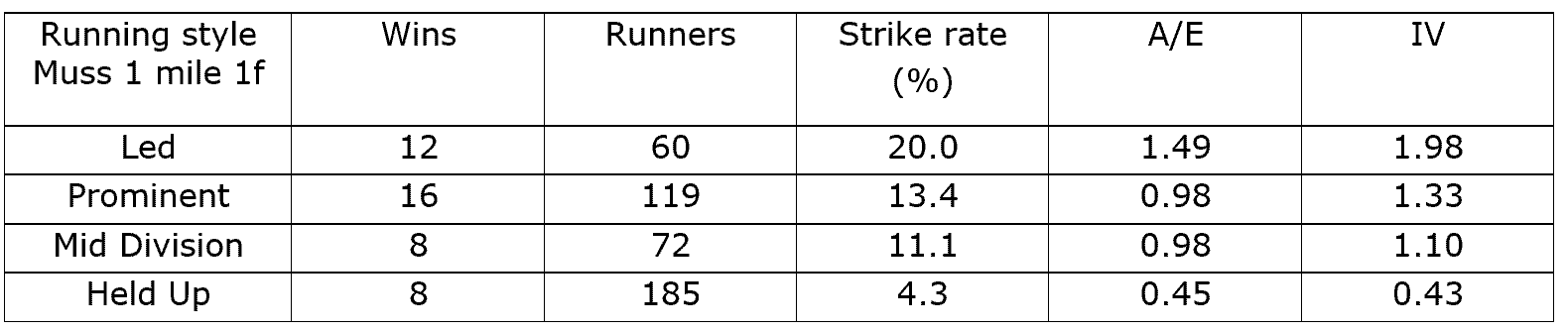
Firstly, check out the four coloured 'blobs' at the top. These show the performance of different run styles over this course and distance, and in this field size/on this going. If selected, the data are filtered for handicap runs only (as in this case).

In this example, it is clear that horses coming from the back of the field have an almost impossible task (held up runners are 1 from 107 !), and those racing midfield don't fare much better. Prominent racers and especially front-runners have virtually monopolised 5f handicaps at Kempton since the all-weather was laid.

Below the blobs and the going/field size/race selection variables, we have a pace prediction - 'possible contested speed'. There are also two more variables for users to select: number of previous runs to include, and display type. Here I've chosen last three runs and 'heat map'.

Because I've selected 'Heat Map' view, the display underlays colour to identify which parts of the track are favoured from a draw/pace perspective. Again, this is a pretty open and shut case with horses that lead or race prominently being favoured regardless of draw.

Being able to visualise how a race is likely to be run, and having the historical context, is hugely powerful in isolating those runners whose chance is improved or reduced by their run style.

Quite simply, I wouldn't bet without checking this first. And nor should you!

Pro Tip: Look for horses matching the historically favoured run style - especially when they might be 'uncontested leaders'.

#6 Full Form

Arguably the most under-rated aspect of the entire Geegeez Gold offering is Full Form, a place where it is possible to drill down on a horse's (or trainer's or sire's or jockey's) form to any number of form elements relevant to today's race.

Full Form is comprised of a series of content blocks, each one collapsible so you can keep your view neat and tidy if you're not interested in some components. In the example below, I've collapsed the Runner Details, Race Record and Race Entries blocks, leaving only what I'm interested in: the Filters and Race Form blocks.

In this, granted extreme, example Halling's Comet has a phenomenal record at Worcester (I've filtered by 'course') where he almost always leads.


I have also selected the 'Proximity Form' filter. When selected, a traffic light appears to the left of each form line, based on how far, per furlong, the horse was beaten. On the 14th August 2019, for instance, Halling's Comet was beaten 12 1/4 lengths over two and a half miles (20 furlongs). That averaged to 0.61 lengths per furlong and an amber traffic light.

This is very useful for understanding when horses may have run better (or worse) than their finishing position implies.

One final point to note on Full Form is that it is not just for horse form; by selecting Trainer or Jockey or Sire from the buttons top right, it is easy to drill down and establish how those actors performed against various form filters appropriate to today's contest.

Pro Tip: Experiment with the Filters. Discovering that a horse has won three times from four runs within 10 days, or for today's jockey, etc., can be very rewarding!


Sign up today and get your first month for just £1 >>>

#7 Sectional Data

One of the new frontiers of horseracing information in Britain in the last couple of years is the publication of sectional timing data. After a few false dawns down the years, this staple of international racing has begun to make its way into the form book here. The problem, like many things in racing, is that divisions in ownership and media have meant that the information is not available for all race tracks. At least not yet.

Geegeez publishes data from a company called Total Performance Data (TPD), and we've tried to make it as versatile as users could wish for. There is much more information on sectional timing data here, but I wanted to pick out a couple of aspects with which you may not be familiar.

To the untrained eye, there is a lot going on with a presentation of sectional timing. Those who like to get knee deep will find satisfaction in the Geegeez sectional content but, for most, a toehold into this new realm will be enough, so let's try to address that here.

The most generally-discussed metric is 'finishing speed percentage' and it tells us a lot about not just the finish but the race overall. We break the race into either five or three sections - the display below showing five - and each section is colour-coded red to blue.

The top colour row is the 'race speed', based on the leader throughout the race. In this case, the race leader was the same horse throughout, National Anthem. He went hard - very hard (see the orange/red) - early and finished commensurately slowly.

Compare his colour bars with second-placed Mabre, who ran almost an opposite race. Very slow at the start (15 lengths back after two furlongs!), he closed to within four lengths of the winner by the line.

National Anthem had a finishing speed of 88% which means he went very fast early; Mabre had a finishing speed of 96.6%, which means he ran a more measured race overall in spite of his slow start.

Below the colour bars for each runner is a sequence of numbers that we call 'running lines'. These five numbers, and their associated superscript, outline the race position and the distance behind the leader at different 'call points' during the race.

In the example race above, National Anthem was 1st, seven lengths clear, at the second call. We can see that the second race section, the end of which is the second 'call', was 5-4 (i.e. from the five furlong to the four furlong pole). So National Anthem was seven lengths clear at the four furlongs from home point.

Conversely, Mabre was 15 lengths sixth (of six) at the same point.

This is invaluable information for understanding how much ground a horse has made up during a race. Those who like their visuals might also have a look at the chart representation of this (from the 'Chart' button at the top).

In this chart image, I've highlighted the second horse, Mabre, by hovering over the 5-4 point on this 'behind leader' view. The winner led all the way and, therefore, is the red line at the bottom of the chart: he was 0 lengths behind the leader (because he was the leader!) throughout.

Sectional data is more in-depth than a lot of bettors wish to get, and if that's you, don't worry - there's plenty else to go at!

Pro Tip: Do not get too bogged down in sectional data if it's all new. But know that, if a race looks likely to be steadily/falsely run (our pace prediction will help here), a horse with fast finishing speed percentage figures will be of interest, all other things being equal.

#8 QT Angles

If you're one of those people who likes to ask, and find answers to, your own questions then our Query Tool is for you. Query Tool, or QT for short, allows users to build angles or systems from our extensive racing database. Crucially, it allows them to save those angles and have qualifying horses highlighted right within the racecard.

This information is unique to a user and means the card is your own, and as powerful/insightful as you want to make it.

The legwork is done elsewhere, within Query Tool; but once done users reap the benefit over and over again. There is much more information on Query Tool here.

Pro Tip: Some of our savviest subscribers use QT to identify positive factors, which are not necessarily profitable by themselves but contribute to the case to be made for a horse. Having a range of these Angles saved in QT - and displaying right in the racecard - is dynamite!

#9 Sire Data

If a horse has had thirty runs, the primary consideration is always its own form. But, when there is less racecourse evidence from which to base a judgement, the form of a trainer or a sire can be instructive. We've discussed trainer form already and now it is the turn of the sire.

Geegeez racecards have a sire icon behind which is a raft of facts and figures.

As well as the basic breeding line, Geegeez Gold racecards also publish latest sales information, and notable relatives. But the real insight comes from the two-year Sire Snippets (highlighted in the box). The top line is always the overall two year form of the sire's progeny, while subsequent rows relate to the specific context of the race in question.

In this example, where Little Jo was running in a mile handiap at Newcastle (all-weather), we can see the sire's (Major Cadeaux) form in all-weather races and in middle distance races flagged this one as a live contender. With form in the bank, too, he was hardly a shock winner at an eventual SP of 9/1.

This can be very helpful, especially for horses either running in maiden and novice races, or trying something different for the first (or second) time.

Pro Tip: Compare contextual snippets with a sire's overall two-year form (the top row) to see if his progeny fare better or worse in today's circumstances.

#10 Form Indicators

There is a huge amount of information available via the racecards, and some of us don't have either the time or the inclination to sift through all of it. That, of course, is absolutely fine - nobody uses everything - and the Gold cards have lots of shortcuts and indicators.

With our trainer and jockey indicators you can see at a glance who is hot and who is not. They reveal recent (14 and 30 day) form, and longer-term (course one year and five year) form. Green is good, red is not good.

Also notice the numbered arrows next to Vaziani and Steel Native. These relate that, respectively, Vaziani is dropping one class and Steel Native is up one class bracket.

Most other indicators (C = course winner, CD = course and distance winner, etc) are fairly standard, but notice how Gold racecards deploy a 5+ notation for horses wearing a piece of apparatus, or running after wind surgery, for a fifth or greater time. By the same token, a W3 notation, for instance, would imply a horse was running for the third time after wind surgery; and h2 would be a second start wearing a hood, and so on.

Horses making their first start in a handicap are flagged by 'HC1' next to their name (and they also have trainer snippets to help users understand the trainer's record with such runners).

And horses running for the first time since a change of stable have 'TC' (trainer change) against their name on the card:

Trainer_Change_Indicator

In each case, these indicators provide valuable time-saving shortcuts to help you understand more information quicker; and there is always more detail a click away for those who are curious or wish to drill down.

Pro Tip: Although the indicators offer a snapshot flavour of noteworthy elements, it is always advisable to make the extra click required to see the related data. Knowing a horse is making its handicap debut is interesting; knowing that the trainer has a 30% strike rate with such horses is very, very interesting!

**

And those are ten things which perhaps you didn't know about Geegeez Gold racecards.

But wait, there's more. Ten items just isn't enough to share all of the hidden gems lurking in our cards, and I simply cannot fail to mention these two more...


Sign up today and get your first month for just £1 >>>

#11 Bet Tracker

How is your betting going? Well? Okay? Not so good? Chances are you have a hunch as to the general direction of your wagering travel but the specifics are a little harder to come by. Many Geegeez users have not only grabbed their P&L by the scruff of the neck, but are also now starting to understand where they do well and where they do less well thanks to our Bet Tracker tool.

It works very simply: click the BT icon on the card and enter your bet details.

When the results are confirmed your bets will be settled within the Bet Tracker tool. After you've accrued a history in Bet Tracker you will be able to perform detailed analysis to see where you're doing best... and worst!

For those who take just a minute or two a day to add their bet details, it is turning their entire game around. It can do the same for you, too.

Pro Tip: Add all of your single bets to Bet Tracker. When you've got 100+ bets recorded, start to review for pointers. When you've got 500+ bets recorded, you'll be able to make some highly targeted changes to your betting approach: cut out what's not working, do more of what is.

#12 Price / Rate A Race

If you really want to test your value edge, try pricing a few races up yourself. Our 'My Ratings' feature allows users to add notes about a race during the pre-race form study period (we also have a separate horse / race / meeting notes and rating facility within the results).

Most people don't price up races in this way, but for those who do, their judgement of value is sure to be improved. And everyone should do this at least once or twice a month.

Pro Tip: From your My Geegeez profile page, you can opt to turn off bookmaker odds. Pricing a race 'blind' is a Jedi Master trick for testing your feel for the market. Don't be discouraged if early attempts miss the mark somewhat; after all, you wouldn't expect to learn Slovak in an afternoon!

****

So that's ten - sorry, twelve - things you perhaps didn't know you didn't know about Geegeez Racecards.

If you're not yet a Gold subscriber, you can put all of these - as well as our Query Tool, Draw and Pace Analysers, Stat of the Day picks, and so much more besides - to work for you. Sign up today and get your first month for just £1 >>>

Monday Musings: We’re On!

So finally, after 76 days, 330 lost meetings and something of a cliff-hanger, the wait is officially over, writes Tony Stafford. Oliver Dowden, Minister for Digital, Culture, Media and Sport, was in the saddle to announce the go-ahead at Saturday’s coronavirus briefing in Downing Street. Thus, unlike his government’s much-maligned advisor Dominic Cummings, Newmarket trainers and horses will legally have carte blanche to take the long road north to Newcastle.

With ten races both on Monday and Tuesday at Gosforth Park, all limited to maximum fields of 12, it might have been expected that there would be an imbalance of runners from HQ. In the event, while there are Newmarket-trained representatives in most (eight) races on Monday and all ten on Tuesday, the total is a fairly modest 22 on the opening day and only 15 on the second, which must have been a relief for many trainers and owners in the north.

Kempton on Tuesday predictably has a southern bias, but it will not be until today Monday’s 72-hour declarations for the first of four days at Newmarket that the skilful hand of the BHA will be properly shown. The first four of seven races are all restricted to two-year-olds and, with the same limitation of 12 runners per race as elsewhere, three of the four can be divided. That means we will have seven races for juveniles, helping to make a start to redressing a few of the forfeited opportunities in the void of April and May.

Smaller fields and racing behind closed doors will enable the continued practising of social distancing rules. With the last week also (thanks principally to a big drop on the Tuesday after the latest Bank Holiday) contributing another approximate 20 per cent fall in the number of UK deaths (on my figures a 21.4% decline and 1696 deaths), the government felt able to counter some northern politicians who wanted a further delay. Even more compelling is the continued reduction in the weekly numbers in hospital suffering from the disease, down 15% on the week.

Dowden clearly believes that horse racing will be an important potential agent for renewed public confidence after the shock and denial of entertainment of the past 11 weeks. Even better news for the man in the street, not that he’s been anywhere in sight of late, is the prospect of re-opened betting shops on Royal Ascot eve, Monday June 15. Just as it was deemed possible to regulate customer-flow in supermarkets at the height of public hysteria and fear about Covid-19 - which would have been fine apart from many customers’ refusal to comply with the two-metre apart arrows - then it should be easy enough to allow the smaller volume of people wishing to enter betting shops to do so in an orderly and safe fashion.

With top professional football also resuming that week, couch potatoes will be in their element. However it’s the four days of Newmarket that excite me with last year’s Derby winner, Anthony Van Dyck, heading a possible team of three from Ballydoyle in the Hurworth Bloodstock Coronation Cup, transferred from Epsom. Broome and Sir Dragonet can bolster the Aidan O’Brien team and the Irish maestro is reportedly taking a short lease on a property in the town to accommodate his staff in what will be something of a satellite operation with 14-day isolation rules in place while the horses can fly back and forth as needed.

Two other highly-interesting names are included in the 11-horse entry, with Stradivarius, champion stayer for the past two years, dropping back to a mile and a half, and Godolphin’s Ghaiyyath, who would have been one of the obvious favourites had the Dubai World Cup meeting gone ahead as planned, representing Charlie Appleby. Ghaiyyath has the advantage of a run this year, winning a Meydan Group 3 by eight lengths in late February.

At five, so a year younger than Stradivarius, he is lightly-raced with six wins in nine starts, but critics will point to his flop when only tenth of 12 in last autumn’s Arc behind Waldgeist and Enable. So far he has yet to click on the biggest days but his official mark of 126 clearly indicates what a classy performer he is.

Later today, the acceptors will be known for the 2000 Guineas but also today the French maintain their edge of getting going first of the three major European racing powers with both Guineas mile Classics, transferred to Deauville from Longchamp. That latter track was summarily, but probably only temporarily, closed after an initial flurry three weeks ago.

Many of the big trainers are based near or in Chantilly, which was previously also in the same proscribed Red Zone as Paris proper, but they will have been relieved that Chantilly has now been given the all-clear so meetings there and at nearby Compiegne can resume from this week. One obvious exception is Jean-Claude Rouget who trains in the west, so within easy reach of Deauville. Rouget and Andre Fabre both have fancied runners in each race, but I expect Ecrivain, second while not getting a clear run in the trial (Fontainebleau) three weeks again, to beat both in the “2000” for the Carlos Laffon-Parias stable.

As with the Coronation Cup, Appleby and O’Brien will be going head to head on Saturday in the 2000 Guineas, but five-day confirmations will not be known until after these words are published on Monday morning. Pinatubo has been favourite, and a short-priced one throughout the winter and the subsequent period of no racing, and remains odds-on to confirm his superiority over Coolmore’s Arizona, whom he beat by two lengths in the Dewhurst Stakes last October.

While confidence abounds in the favourite, word from Ireland suggests that O’Brien, already winner of the Newmarket colts’ Classic ten times, could not be happier with Arizona’s progress, so an each-way bet at the prevailing 6-1 could be a value bet-to-nothing, possibly with a small saver to be second to the favourite as insurance.

Ryan Moore has had his moments of misfortune as well as success in the 2000 Guineas in the past decade, winning on Churchill and Gleneagles, but having to watch from Churchill Downs two years ago while Donnacha O’Brien collected on Saxon Warrior before his own unfortunate ride on Mendelssohn in the Kentucky Derby. Last May he looked across from the middle of track on the non-staying favourite Ten Sovereigns as stable-mate Magna Grecia, again with the younger O’Brien son riding, swept to victory up the stands rail.

Ryan’s international pursuit of big prizes has often extended across to Japan and as recently as last November he teamed up with the two-year-old Contrail to win a Group 3 race in Tokyo. The colt won two more important races without Ryan, the Group 1 Hopeful last backend and the Japanese 2000 Guineas (Satsuki Sho) this spring. Both races were over ten furlongs and Yuichi Fukanaga had the mount each time. Contrail won the Guineas by half a length when the runner-up was Salios.

I’m sure that without those quarantine rules, Ryan would have been seeking out connections to try to get back on Contrail in yesterday’s Japanese Derby (Tokyo Yushun) for which he was the 2-5 favourite in a field of 16 over the mile and a half trip. Salios again proved to be his main challenger but this time the victory margin was three lengths as the winner, a son of star stallion Deep Impact, took home the first prize of more than £1.5 million.

No doubt Moore will be fully aware of the missed jockey’s share, but will hope he can pick up some compensation nearer home. Already O’Brien has intimated that the jockey will not be going across to The Curragh for the following weekend’s Guineas double. As to Contrail he seems to be following hard on the example of the brilliant filly Almond Eye as another potential Japanese star set to take on the world’s best in the coming months.

- TS

Stat of the Day, 1st June 2020

Tuesday March 24th's pick was...

5.00 Clonmel : Frontal Assault @ 11/4 BOG 5th at 9/4 (Tracked leaders, pushed along briefly 7f out, improved to dispute lead 3f out, ridden entering straight, headed 2f out, dropped to moderate 5th 1f out, no impression) Thankfully, I don't need to rely on Irish racing any longer : definitely a failed experiment.

Monday's pick runs in the...

4.30 Newcastle :

Before I post the daily selection, just a quick reminder of how I operate the service. Currently, I'll identify and share the selection between 8.00am and 8.30am and I then add a more detailed write-up later within an hour or so of going "live".

Those happy to take the early price on trust can do so, whilst some might prefer to wait for my reasoning. As I fit the early service in around my family life, I can't give an exact timing on the posts, so I suggest you follow us on Twitter and/or Facebook for instant notifications of a published pick.

Who?

Be Proud @ 4/1 BOG

...in a 12-runner, Class 5 A/W handicap for 4yo+ over 5f on Standard to Slow Tapeta worth £3,493 to the winner...

Why?...

Here we have a 4 yr old gelding whose modest career record to date of just 2 wins and 7 places from 24 starts might not make him an obvious candidate, but I'm happy to discard his failure to win any of his 13 attempts on turf to focus on an All-Weather record at 2 wins and 3 places from 11 starts that is further inmproved to 2 wins, 3 further places from 8 here at Newcastle.

A 62.5% overall place strike rate including a 25% win record on one track is certainly of more appeal and all 8 runs were in handicaps for trainer Jim Goldie and they also include of relevance today...

  • 2 wins and 2 further places from 6 over course and distance
  • 2 wins and another place from 5 when sent off as favourite, as seems likely today
  • 2 wins from 3 starts in 12-runner contests
  • and one win from two when ridden by today's jockey, Daniel Tudhope...

...who himself had a brilliant time of it here last year winning 19 of 78 (24.4% SR) races, generating level stakes profits of 23.9pts at Betfair SP, the equivalent of a 30.7% return on stakes invested, from which he was...

  • 13 from 56 (23.2%) for 20.2pts (+36%) in handicaps
  • 3 from 10 (30%) for 2.22pts (+22.2%) over this 5f course and distance
  • and 3 from 6 (50%) for 23.3pts (+388.6%) for trainer Jim Goldie.

That performance for today's trainer was no short term flash in the pan either as today the Goldie/Tudhope combo has 7 winners from 16 her at Newcastle since the start of 2017 with the resultant 43.75% strike rate generating 28.5pts profit at an ROI of 177.9% and this includes..

  • 6/15 (40%) for 16.1pts (+107.1%) in handicaps
  • and 3/6 (50%) for 4.2pts (+70%) over this 5f course and distance (all in handicaps)...

...all of which points to...a 1pt win bet on Be Proud @ 4/1 BOG as was quite widely available at 8.00am Monday, but as always please check your BOG status. To see what your preferred bookie is quoting...

...click here for the betting on the 4.30 Newcastle

Don't forget, we offer a full interactive racecard service every day!

REMINDER: THERE IS NO STAT OF THE DAY ON SUNDAYS

Here is today's racecard

P.S. all P/L returns quoted in the stats above are to Betfair SP, as I NEVER bet to ISP and neither should you. I always use BOG bookies for SotD, wherever possible, but I use BFSP for the stats as it is the nearest approximation I can give, so I actually expect to beat the returns I use to support my picks. If that's unclear, please ask!

Racing is Back! 1st June Video Preview

Racing is back! My, how we've missed it. And, to celebrate its return, as well as the return of plenty of subscribers old and new, I've recorded a video preview of the opening contest.

Regardless of how long you've been a Gold subscriber - perhaps you're still not - I hope you'll find some value in the video, which is designed to highlight a process rather than a tip... though as you'll discover I found a few reasons to like a 20/1 shot!

In the video I refer to a post talking about our metrics, which you can find here.

And here's a quick link to the Newcastle Punting Pointers article.

And, finally, if you're not a Gold subscriber, here's the link to sign up. Get your first month for just £1.


5 Things to Consider Ahead of the New Season

The flat turf season finally gets underway at, er, Newcastle on the tapeta on Monday.

Take two: the flat turf season finally gets underway at Yarmouth next Wednesday and, whether you're a lawn purist or take your sans obstacles action on whichever surface it comes, the good times are once more about to roll.

But how should we play the early days of a season where all yards have been mothballed for ten weeks and more? The short answer is, tentatively (or not at all). Expounding upon that, I offer five thoughts ahead of the new season.

#1 Fast starters are fast starters

We don't really know the implications of the deferred start for those stables who typically stumble into a season half asleep. Will they have done more work at home to bring horses closer to day one readiness? Maybe, maybe not; after all, plenty of those handlers like their charges to gain race fitness in actual races.

But what we can be sure of is that those trainers who habitually hit the ground running, especially those with a good record when running horses off a layoff (some logical overlap between the two), will call on that 'muscle memory' once more. Some obvious names to look out for are Hughie Morrison, Mick Easterby, Richard Fahey, John Quinn, Mick Appleby, and much of Newmarket (Messrs. Gosden, Appleby (C), Stoute, Haggas, and on).

That list is based on those with the best flat turf strike rates in April and May with horses running off a layoff of between two and six months. It is not exhaustive, it will not be profitable to follow blind, but it does point towards some who will be expected to have winners in the first days.

Geegeez Gold cards publish the two-year record of all trainers running horses off a 60+ day layoff - which is to say, currently, all of them. That should be a very helpful snippet.

#2 Day 1 losers can be day 2 winners

It is a fundamental human failing: looking for patterns on the basis of scant, sometimes almost no, evidence. And yet, in horseracing betting terms, we are often obliged to take such flyers where new and short-term situations emerge.

In these circumstances, extreme caution is necessary: a trainer who has two winners from four runners at Newcastle on Monday can be suspected to be 'in form'; but a trainer with no winners and just one place from four runners on the same day should not be written off as 'out of form'. There will be many who arrive at such a premature conclusion.

If a trainer's long term 'off a layoff' record is good, be forgiving of early failure. Conversely, where the historical form of a yard has suggested slow starters, proceed with caution and a nod to point 1 above: everyone has had an extra ten weeks to tighten bolts in 2020 so some of those traditionally tardy types may be more forward now, even if they fail to demonstrate that on opening day.

Management summary: expect everyone to be ready, or more ready than normal!

#3 Negative market movers may be most instructive

In the land of the blind, the one-eyed market is king; or something like that. Where we as punters are obliged to surmise so much about form and well-being, the market can offer valuable clues. However, this is a completely new frontier for a few reasons.

Firstly, we have 72-hour declarations, bookmakers clamouring for business, and no intervening races - or indeed sport generally - to divert attention away from the feverish excitement of Monday's ten tussles on the tapeta. Prices will be up early, probably by 2pm today (Friday 29th May). There will be chunky overrounds and accepted liabilities will be small, tacit acknowledgement that the opening shows are wonky and rick-ridden. As usual, small players will pick off the best of the prices, essentially being paid by trading rooms to more accurately reflect the runners' chances.

The weekend will be interesting: I'd expect this fallow period in terms of sporting and wagering diversion to be a fruitful spell for punters, who will rarely - perhaps never - have had such an opportunity to focus on a single card before. The markets should firm up more quickly than normal, then.

And then there is the elephant in the room. There will be no on-course bookmakers because there are no on-course punters. As such, there will be an industry SP, returned by some process which as far as I can tell has not yet been explained publicly. That said, this has been published by SPRC.

Nobody reading this bets at SP unless they took a Best Odds Guaranteed price and the returned price was greater.

Overrounds will be subject to close scrutiny, and so they should be with a new process in situ. The regulation of that process is somewhere between opaque and borderline non-existent, and it is a genuine concern (albeit one which, for some, conveniently finds itself a good way down the hierarchy of racing's genuine concerns just now).

Back to my point: a lot of market hares can be expected to be set running. After all, punters and stables no know more than you or me about relative forwardness at this juncture. Following the market, then, will be instructive if crying wolf relatively often. What may be more instructive is where horses are notably weak, especially when representing yards who usually start well.

I'll be looking to avoid the pink horses rather than back the blue ones, generally speaking.

#4 The 2yo minefield

Royal Ascot is scheduled to start 16 days into the British flat calendar this season, and just 15 days after the first juvenile contest has concluded. As such, there has been a clamour to get a run into the good horses in order that they may qualify for Royal Ascot's two-year-old Pattern events. Juvenile races may divide and divide again, meaning as many as three divisions of up to twelve horses each will be able to demonstrate their precocity.

And if you've got a good one with a realistic chance at the Royal meeting, do you want to give it two weeks' rest after a debut spin, or a week? The answer is obvious, so expect some ferociously hot heats in the coming days.

Moreover, in order to facilitate all yards having a relatively equal opportunity to get a runner to the Ascot starting gate, trainers have been asked to nominate their most likely candidates, the pick of which are given a 'ballot bye': they will be prioritised to get a run in those events which now amount to Royal Ascot qualifiers.

The full list of those runners is below (click to view full screen), and they can be expected to be above average, in relation to their barn cohort at least:

The priority list for elimination ballots in pre-Royal Ascot 2yo races. These horses will be given priority to qualify for Royal Ascot.

The priority list for elimination ballots in pre-Royal Ascot 2yo races. These horses will be given priority to qualify for Royal Ascot.

Frankly, it is a braver man than me who bets a two-year-old race prior to Royal Ascot this year. These seem to represent the caveat emptor of all caveats emptor in this quasi-normal wagering world of the early weeks of the 2020 season.

#5 Nobody knows, so be your own judge

Speaking of 'buyer beware', and of the land of the blind, this post is very much a case of the blind leading the blind; it contains few facts and much conjecture. It is my best guess as to how things will play out, and it is the basis upon which my (light) betting forays will be constructed. My cornerstones will be that fast starters are fast starters, that those weakest in the market should be considered to need the run, and that two-year-old races are mere amuse-bouches for the beckoning Berkshire banquet a fortnight or so hence.

But I could very well be wrong. It's happened before, you know. So by all means ponder the above, but ultimately make your own mind up. Perhaps you'll ignore it all as fluff, noise hampering the signal, and wager as normal; maybe you'll decide to watch and learn while others win and lose; possibly you have a different take entirely on playing the early dust ups.

Before the battle, all strategies are degrees of credible and plausible. To the victor the spoils. Even in defeat, if the collateral damage is not too bloody, it will be great to be at it once more. C'est la guerre!

- Matt

‘Money Without Work’ 2: Wisdom of Crowds

Part 1 of this series can be found here.

I have deliberately kept mathematical 'proof' and academic rigour of the theories of Wisdom Of Crowds and the related Efficient Market Hypothesis out of this article, writes Russell Clarke. Those who are interested can easily research further their efficacy online. For what it's worth, I believe both theories have limited real world applications, though their usefulness in sporting prediction markets is undeniable.

A brief definition of the Wisdom of the Crowd is that large groups of people are collectively smarter than individual experts at predicting outcomes. Explanations of the wisdom of the crowd are numerous but the Diversity Prediction Theorum attempts to mathematically quantify via the definition, “the squared error of the collective prediction equals the average squared error minus the prediction diversity”.

In layman’s terms, when group of predictors is large and diverse, the error is small. There are more complex layers to add to the wisdom of the crowd theories and explanations involving independence, bootstrapping and other exotically named theories, but for our purposes, we will omit the bells and whistles of academia. This is simply about, to misquote Jeremy Corbyn, “why the many are smarter than the few”. It is especially true when the crowd is diverse and independent, which is very much the situation in betting markets.

It has been demonstrated in numerous studies that the crowd is particularly accurate in the fields of quantity estimate, general world knowledge and spatial reasoning. If we look at quantity estimate, I saw a programme on this subject where office workers were asked to guess the number of sweets in a large jar. The estimates had a huge range and yet the average was just 4 sweets from being correct! More famously, at a 1906 Plymouth Fair, 800 people were asked to guess the weight of an ox and the average was within 1% of the actual weight. I know, I need to get out more…

Related to Wisdom Of Crowds is the Efficient Market Hypothesis. The EMH in its simplest form suggests that asset prices reflect all available information (and thus, by association, it is impossible to beat the market). The latter conclusion is a stretch of the theory, particularly in sports betting.

So, what are the implications of this theory when we look at, for example, horse racing? I have evidence that in recent times a real sea-change has occurred in the racing markets and this has been caused by the increasing wisdom of the crowd. It has gone largely unnoticed as it has been gradual and marginal. However, it has been incremental and, as a result, the marketplace today is very different from that of even a few years ago.

Let me rewind to a time when starting prices were produced by the on-course betting market. A few “good men and true” would form a huddle at the 'off' of each race and compare the prices they saw offered by the bookmakers. They came to an agreement or average and that was declared as the starting price. This SP was basically the result of supply and demand in the on-course marketplace (racecourse punters and the major bookmaking offices who sent cash to the course to reduce the prices of horses that they had large liabilities on). This method was later replaced by a similar method, but one which included more on-course bookmakers.

However, the methodology is not of major importance. The SP’s were still, in theory, a result of supply and demand mechanics within the racecourse crowd. The rise and rise of betting exchanges and, crucially, their use by virtually every racecourse bookmaker means that is no longer the case. Today, the SP’s are a reflection of the betting activity on the exchanges rather than the activity on a racecourse. Suddenly, the crowd is no longer a few hundred punters on a racecourse, it is tens of thousands on an exchange. The new crowd is better informed, more diverse and greater in number. The wisdom of the crowd has increased.

If we accept the aforementioned theories at face value, the best approximation of the chance of an outcome would, in horse racing, be the Betfair Starting Price (BSP) and, in football, the Asian Handicap closing lines. That is because those markets are the largest, deepest and smartest markets for those individual sports. The participants in those marketplaces are diverse, independent and largely devoid of any 'group think'.

In both of these markets there is virtually no margin to account for and so the final prices (once every participant has eventually 'voted') can be readily converted into a percentage chance of that outcome actually happening. A BSP of 2.0 represents a 50% chance, 3.0 represents a 33% chance, 5.0 represents a 20% chance etc. Similarly, Asian Handicap Lines can be converted into % chances for football betting. Numerous empirical studies have shown both to be almost wholly accurate.

I realise I have ‘banged on’ a bit here, but, the importance of this knowledge cannot be overstated. It demonstrates the futility of trying to beat the market when it is at its most accurate. In plain English, it is arrogant in the extreme to believe you know more than the market at the closing and you will eventually find out that it pays to be humble! If you bet at BSP (Betfair Starting Price), the commission is likely to ensure you are a long-term loser (although it is a more favourable strategy than betting with bookmakers at SP with their much higher margins than the exchange commission). If you accept that logic, then it is clear that you should be betting early, when the market has less participants and is therefore less accurate.

Another use for the EMH is if you want to accurately assess systems, strategies or the records of tipsters/experts. It is a quicker and faster way to assess than simply looking at a profit/loss account, which can be wildly erroneous. So, traditionally, even those that do their research, will look at a series of results and concentrate on factors such as profit/loss, strike-rate, longest losing run, taken from a set of past results. On the surface this seems logical and sensible. However, the downside is that you will almost certainly be dealing with an inadequate sample size (again, if you need the maths, then an online check) and even if you have thousands of results, a simple Monte Carlo simulation will demonstrate the huge variance in results you could experience moving forward (more of which anon).

Using our appreciation of the accuracy of the markets, we can gain a quicker and more accurate guide to how a strategy will perform in the future and in the longer-term. We can ignore profit/loss figures and instead concentrate on how the selections (winners and losers) perform against the market. There are a few criteria you could apply but a very simple method is demonstrated below:

Two figures you require are the price at which the selection is advised (or a morning price) and the eventual BSP. Then it becomes a simple comparison. If a horse is advised at 10/1 (11.0 digital odds) and the bsp is 7.0, then that would be assessed as +4 (11-7). Similarly, a horse advised at 8/1 (9.0) and the bsp is 9.0 would be assessed as 0 (9-9) and a horse advised at 12/1 (13.0) that has an eventual bsp of 18.0 would be -5 (13-18).

After as few as fifty bets you would get a good reading of the number of selections that are positive as opposed to negative, and, the running total would give an indication of the magnitude of the long-term profits/losses that are likely. The actual results and profits/loss are largely irrelevant as they may just reflect either a favourable or unfavourable run of winners/losers. You can be sure, however, that if you continue to beat the "closing line” you have unearthed a source of long-term profit.

- RC

Next week: Part 3: Bookmakers - Sharps and Softs

Monday Musings: On the Resumption

After a first week of a successful and seemingly uneventful return to racing on the Flat, over jumps and, no doubt, while unseen on our screens, the equally popular trotting, the French government surprisingly invoked their colour co-ordinated map to ban racing in the Northern and Paris regions, but allowed it to continue elsewhere, writes Tony Stafford.

Fortunately for Sky Sports Racing, it was still able to continue with its daily offerings. Once I heard though on Monday the first strains of South African tones, with its accompaniment of some odd pronunciations, identity-delaying tactics like “in second placing, in third placing, and then came” <a switch of tenses another irritation> “in fourth placing…” one sole non-Ian Bartlett commentary was more than enough.

Mr Bartlett it seemed had done his bit for now, his rather posh and supremely accurate English “chalk” superseded by southern hemisphere cheese for the latest week. Smaller fields were the norm for this period compared with the generally bigger and therefore more demanding line-ups in the Paris region before Longchamp and the rest closed their doors once again. Maybe from today another commentator might be on duty for the third and final week before France becomes more of a side-show as, everything crossed, domestic sport gets going at last next Monday.

The French government’s unexpected pull back away from the country’s red zone prompted scepticism that the June 1st date might not be adhered to over here. One friend, in particular, who with two family members was laid low (though happily not hospitalised) with the virus in its early days, predicted that the hoped-for Monday week restart in the UK, would not go ahead. He pointed out that the schedule had never (and still hasn’t) been formally confirmed by government.

Now though we have a much more detailed programme of fixtures from the BHA, with races and prizemoney fully documented. Initially after the French decision on red zones, Betfair’s market on the June 1st resumption had swung to odds against. Early today it was around 4-1 on to resume on that date or earlier. Indeed the delay until the first day of June, after an earlier hoped-for date two weeks prior by trainers, owners and the BHA, has been fortuitous.

Last week’s article outlined evidence which showed that the infection had been steadily reducing week on week for the previous month or so. One week further on, the trend has continued apace so that for each of the past five weeks, the number of fatalities and people remaining in hospital with the virus has continued its steady decline.

Most encouragingly, for the fifth week in a row, the percentage decline in deaths has been in double figures. Week one, Sunday April 19th-26th fell from 6207 to 5573, representing a fall of 11%; week 2, 5573-4791, 14.6%; week 3, 4791 to 3409, 28.3%; week 4, 3409 to 2781, 18.4% and the latest period until yesterday it was 2781 to 2157, and 22.4%.

A similar level of decline into the middle of next month – by the time of the behind closed doors’ five days of Royal Ascot – could coincide with the number of deaths falling some way short  of 1000 per week. Most striking has been the very small numbers for London, fewer than 20 mortalities a day over the past week, astonishing for a city of around 10 million inhabitants.

I’ve looked back again at the March 15th bulletin, when the first briefing from Downing Street was called. It was announced that there had been 15 UK deaths over the previous 24 hours. That day, one official predicted that as many as 80% of the population, thus potentially approaching 50 million people, could become infected. Of the three million plus people that have now been tested, around one in 20 (fewer than 270,000) have been found to have had the virus.

A couple of weeks ago I was pretty rude to Weatherbys, suggesting that while owners will have to be prepared to accept smaller prizes when racing resumes, Weatherbys’ administrative costs never seem to go down. In retrospect I have to agree with one of the firm’s top officials who pointed out how unfair a side-swipe it was. I had been referring to a small increase in the Levy yield for the past year, without factoring in that there would be no spectator or corporate catering income for the foreseeable future. No wonder prizes need to be reduced.

Over the past week the timetable for the early part of the revived season has firmed up. Most exciting and best received by all quarters has been the five days of Royal Ascot which will now include six extra races, seven rather than six each day from Tuesday June 16th to Friday the 19th and then eight instead of six on the Saturday. Racing will also begin earlier than usual each day.

There will be a maximum field size of 24, and three of the meeting’s existing races are now being divided with the Royal Hunt Cup and Wokingham both having consolation races. The Buckingham Palace Handicap has also been revived, the race having been lost upon the founding of the Group 1 Commonwealth Cup sprint for three-year-olds a few years ago.

My wife usually comes racing once during Royal Ascot every year although in 2019 she could not attend. She suggested to me that it would be fun if on the one day she normally goes, we could put on our finery and wear it while we watch the sport from home – she’ll stretch to one race at least! She did tell me the name of a site where such things are habitually shared with others, but I cannot remember what it’s called and I daren’t wake her at 5 a.m. I know my top hat still fits and the lockdown slimdown means the morning suit and waistcoat will also have a little welcome room. Join us if you will!

Ireland’s revived start of June 8th begins at Naas, while the following weekend features the opening fixtures at The Curragh with the Irish 2,000 and 1,000 Guineas staged on June 12th and 13th respectively.

Four tracks have not been included in the initial provisional UK fixture list which stretches to the end of August. Brighton and Worcester have had damage caused respectively by gales and flooding and, combined with the lockdown, it has proved impossible for ARC (the Arena Racing Company) to undertake the necessary repairs in time. Jockey Club Racecourses also have had to forego any fixtures during the resumption period at Carlisle and Nottingham, two of my favourite smaller tracks.

Many of the other highlights later on from the initial flurry are scheduled pretty much on their customary timings. If the recovery from the worst excesses of the virus continues at its present rate, it could even be that by Goodwood or York’s Ebor meeting some elements of a crowd could be possible.

We’ve missed coming up for ten weeks of racing, with Aintree, Chester’s and York’s May meetings as well as the Guineas lost, though thankfully those two Classics will be held over the first weekend at Newmarket. I reckon I would normally have been racing at least 30 times in that period which is always the most enjoyable and informative time of the year for me.

Thank goodness we have the two specialist channels able to televise the sport. Roll on next Monday and Newcastle. The entries will be out by noon tomorrow for the eight races (1.00 to 4.30) and I expect them all to be vastly over-subscribed. Good luck to everyone for the resumption.

Two-year-old A/W Debutants, Part 2

In my initial look at trainers to follow with juvenile debutants on the All-Weather, I suggested that anyone thinking of blindly backing such runners should be focusing this season on two yards, those of Hugo Palmer and Archie Watson, writes Chris Worrall.

As with my delve into flat trainers, I went on to mention in that piece that we may be able to eliminate some bad bets by focusing more on each trainer's runners based on a series of factors: track location, actual track, race class/distance/surface, jockeys used, time of year and sex of horse.

So, with that in mind, let's look at each of our two trainers individually to see if we can find an angle for future use, starting with...

Hugo Palmer

As a recap of Palmer's overall figures, we can see that his results with 2yo all-weather debutants from 2015-19 were as follows:

When I looked at each of those 81 runs in more detail, I discovered that they included...

  • 14/67 (20.9%) for 73.89pts (+110.3%) away from Lingfield (where he is 0 from 15)
  • 11/58 (19%) for 45pts (+77.6%) at Class 5
  • 11/56 (19.6%) for 73.99pts (+132.1%) over trips of 7 or 8 furlongs
  • 10/41 (24.4%) for 76.68pts (+187%) from male runners
  • 8/33 (24.2%) for 45.13pts (+136.8%) at Chelmsford, Newcastle & Wolverhampton
  • 8/29 (27.6%) for 42.69pts (+147.2%) during September & October
  • 6/18 (33.3%) for 37.31pts (+207.3%) on Tapeta

I would propose to initially combine the first three filters to give us just the Class 5 runners in races of 7 or 8 furlongs away from Lingfield for a combined record of...

...from which, males were 6 from 13 (46.2%) for 61.79pts (+475.3%) and those running on Tapeta won 3 of 7 (42.9%) for 37.4pts (+534.3%).

Suggestion: back all Hugo Palmer 2yo A/W debutants over 7 or 8 furlongs in Class 5 races away from Lingfield, paying closer attention to male runners and also not being afraid of backing one "at a price" on the Tapeta.

Archie Watson

And now onto Archie Watson, whose first AW runner was saddled on 1st October 2016, his 2016-19 stats were...

From which (in order of winners)...

  • 18/61 (29.5%) for 26.7pts (+43.8%) over trips no further than a mile
  • 18/48 (37.5%) for 39.7pts (+82.7%) were sent off at SPs of 10/1 and shorter
  • 17/53 (32.1%) for 30.98pts (+58.5%) no further north than Wolverhampton (1/10 @ Newcastle)
  • 13/42 (31%) for 25.46pts (+60.6%) on Polytrack (Chelmsford, Kempton, Lingfield)
  • 13/38 (34.2%) for 14.29pts (+37.6%) at Class 5
  • 8/19 (42.1%) for 15.56pts (+81.9%) with Hollie Doyle in the saddle

and if we took the first five of those filters, that is Class 5 on Polytrack over trips up to a mile and just considered those sent off shorter than a 7/1 ISP (as the market seems to have a good handle of these runners), we'd end up with the following...

...from which, both Oisin Murphy (3 from 5) and Hollie Doyle (3 from 6) seem to be the jockeys to have most success on these runners with a combined record of...

Suggestion: back all Archie Watson 2yo A/W debutants sent off shorter than 7/1 at up to a mile in Class 5 races on polytrack, paying closer attention to those ridden by either Oisin Murphy or Hollie Doyle.

*

Rather than the blanket approach, if we just followed the runners highlighted in the above two suggestions, we'd be looking at 17 winners from 44 runners (38.64% SR) generating 83.85pts profit at Betfair SP, the equivalent of making almost £1.91 profit for every pound invested and that's before adopting the final considerations for each trainer.

Obviously we're dealing with small datasets here, so some caution is advised, but the approaches make good sense in the context of the respective trainers' modi operandi so there is cause for optimism.

Hopefully, we'll soon be able to "live trial" these angles. Fingers crossed and all that, but for now, thanks for reading and I'll be back with more soon.

 - CW


Gold Updates: Cosmetics and PRB

As well as providing bundles of top class thought-provoking editorial during this interminable lockdown, we've also been beavering away on generating some new bells and whistles on our racecards. Actually, we've been mostly cosmetically enhancing our existing features. Let's start with those...

Blue is the new grey

First up, you'll see a lot more blue about the place and a lot less grey.

The card tab now looks like this:


Full Form, with its collapsible blocks, now looks like this:

In the above example, for a geegeez.co.uk syndicate horse, I've collapsed the Race Form and Race Entries blocks.


Perhaps the biggest change is to Instant Expert where we've inverted the colour blocks. So, where previously the outlines and numbers were in the colour (green, amber, red), now the block is that colour with the number font in white. It looks like this:


Similar cosmetic amendments have been made to the result, pace, odds and draw tabs, which leads me nicely on to...


New Draw Metric

We've introduced a new metric on the Draw Analyser and in the draw tab, called Percentage of Rivals Beaten, or PRB. I've explained more about it in this post, which I very much recommend you read if you haven't already.

The value of PRB over, say, win or place percent is that every runner in every race receives a performance value, with only the last placed horse getting 0. So, for example, in a six horse race, there would be a winner, one additional placed horse (as well as the winner), and four unplaced horses.

In the win percentages, that race would produce a breakdown of 100/0/0/0/0/0 (100% win for the winner, 0% win for the rest of the field).

Place percentages would have 100/100/0/0/0/0 (two placed horses, four unplaced '0' horses).

But the third horse has performed better than the fourth, fifth and sixth horses; and the winner has performed better than all of its rivals. PRB aims to more accurately place a value against finishing position. So the percentage of rivals the winner beats will always be 100%, and the PRB of the last placed horse will always be 0%, but in between there will be a sliding scale. In this six-horse race example, the second horse has beaten 80% of its rivals (four out of five rivals), and the fourth placed horse has beaten two home, which is 40% of rivals.

In a fair draw each stall, or group of stalls, would see a PRB score of 50%, or 0.5. And many stalls are within one or two percentage points of that. If a draw location has a PRB of 55%+ (0.55+) it is probably favoured; the converse is also true: if a stall has a PRB of 45% or less it may be somewhat unfavoured. Here's how it looks on the draw tab:

The table columns to the right hand side list PRB and PRB2. In this case we can see that high is favoured to a small degree and low commensurately unfavoured.

PRB2 is simply the PRB score multiplied by itself. What this does is accentuate the percentages: in practical terms it rewards those finishing closer to the winner than those finishing further down the field, recognising that horses may not be ridden out for the best possible placing if that placing is going to be eighth of 20, whereas they virtually always will if that placing is third of 20. There is more on how that works in the horse racing metrics post.

When looking at individual draws, I've introduced a metric called PRB3. Similar to IV3, it takes a rolling three-stall average PRB of the stall in question and its immediate neighbours. So, for example, the PRB3 of stall six would be the average PRB of stalls five, six and seven. It is, in exactly the same way as IV3, a means of smoothing the curve and making sense of draw data distribution. Here it is in action:


PRB has lots of potential applications in horseracing datasets, and we've started our adoption in the draw space. It will be especially useful when, as in the examples above, there is not a lot to go on in terms of runs, wins and places. There is still not a great deal in the PRB dataset but, by scoring every horse in each race in the sample, there is more data depth in which to fish.

That's all for this update. Very soon we'll be able to get stuck back into one of our favourite pastimes: messing around with racing data! And Geegeez Gold will have it well covered.

Matt

‘Money Without Work’ – Back to Betting Basics

Success in betting is typically approached with the primary, and sometimes exclusive, goal of selecting winners, writes Russell Clarke. Whilst undoubtedly important, such an approach rather puts the cart before the horse (pardon the pun). Understanding the betting marketplace, and some of the basic maths, is the cornerstone of any viable strategy. This can then be built upon to identify areas that should be  utilised and exploited by the knowledgeable punter.

In this weekly series, I will cover:

The Efficiency of the Marketplace: Why it is crucially important to recognise and accept The Wisdom of the Crowd, and how you can utilise it to assess the validity and accuracy of angles/edges/systems from limited data samples.

“Sharp” and “Soft” Bookmakers: Who is who? Why there is a difference and how to utilise that difference. Which are the greatest potential source of profit, and how.

Bookmaker Concessions: The Great, the Good and the Ugly. Evaluating and measuring new account opening offers along with "reload" offers and ongoing offers. Examining 'price boosts', where to find them and how to measure them. The importance of Best Odds Guaranteed and how much difference this concession makes to a successful strategy. Last, but definitely not least, a look at the vexing question of each-way betting. When is it optimal over win only betting, and are enhanced place terms better than the standard offers?

Variance and Positive Expected Value (EV+): Understanding the crucial role of variance even for “The Best System in the World” (well….possibly). How to calculate EV+.

Betting Psychology: Examining cognitive behaviours and their potential effect on betting.

The Logistics of Betting: Creating an optimal betting strategy that mathematically gives you the greatest chance of profit.


The purpose of this series of articles is to increase the efficiency of readers’ betting and thus impact directly upon your ‘bottom line’. There will be no reference to selection methods; instead I will concentrate on understanding the marketplace, and utilising that knowledge to create an optimal strategy. The articles should be useful for both the experienced and less experienced amongst you.

But, before all of that, who am I, and what qualifies me to write about such things?


About the Author: Russell Clarke

Russell Clarke, formerly of Odds On magazine; now writing on geegeez.co.uk

Russell Clarke, formerly of Odds On magazine; now writing on geegeez.co.uk

Those of more mature years may remember me from decades long since past! For those who don’t, in the 1990’s and 2000’s I ran what was, I hope, an ethical and successful racing service, wrote articles for the much missed Odds On magazine, and, was generally known for my statistical approach to betting: a poor man’s Nick Mordin if you will! Whatever happened to him?

I moved to Dubai in 2007 and, along with a betting partner, became one of the first to pay the Betfair Premium Tax for our football betting exploits. I remain as an advisor to a Scandanavian-based football betting syndicate.

However, the story starts some time before that, as a youngster (maybe 9 or 10 years old) compiling speed figures for my uncle. He took his racing and betting seriously and subscribed to both the form book and the daily Sporting Life. I was fascinated by the theory that you could calculate the likely winner of any given race through the use of numbers or ratings, an objective approach that appealed greatly to my nascent scientific leanings.

I was also drawn to Dick Whitford’s ratings that appeared on page 2 of The Sporting Life each day. Whitford was the doyen of private handicappers in those days and, as a curiosity, his top rated horses were awarded the lowest figures. Another part of the Sporting Life that attracted my interest in those early days was The Sporting Life Naps Table. I was young and naïve, and therefore surprised that such a small number of experts (typically around 20%) managed to show a profit on their 'naps' over the season. I also noticed that each season it was a different group of tipsters that headed the table. Clearly their subjective methods were not a route to profit! Almost half a century has since passed and yet the racing correspondents still seem to rely on the same opinions and hunches that have never worked on any long-term basis. Anyway, I digress...

These early experiences encouraged me to concentrate on an objective approach to betting. In my early teens I was rating horses' performances based upon time. I also dabbled in private handicapping via collateral form and started to explore the murky world of systems and systematic betting. In those days systems were sold in the media by unscrupulous rascals (I’m looking at you Mr Dawson) and most were useless. One of the more honest purveyors of the systematic approach was a gentleman who operated under the pen name of Alan Gregory. He wrote books on systematic betting and produced a weekly newsletter in the 50’s, 60’s and early 70’s. Much of the stuff, in hindsight, was misguided, but it certainly introduced me to an alternative way to make betting profitable.

The advent of computers and their processing power was the revolution that changed the way many successful punters approached their betting. One product in particular, Racing Systems Builder (now unfortunately no longer with us), allowed you to test various factors in minutes rather than devoting weeks or months to ploughing through old newspapers. Many long-held racing truisms and beliefs were challenged and overturned using this product. Users were able to measure accurately the effect that hundreds of variables had on racehorse performance. They no longer had to guess how important, or otherwise, it was for a horse to be a distance winner, a winner on the prevailing ground, stepping up in class etc.; it could now be measured and quantified. I was like a dog with two tails!

With the information revolution underway, profitable betting came within reach of the ordinary punter. During this period, the racecourse market thrived (as it was a way of avoiding betting tax and  obtaining better prices than starting price). I went racing three or four times a week and there were a number of professionals operating on any given circuit. Off-course bookmakers began offering more generous early morning prices and this was truly a golden age for punters. Although accounts were closed, they were relatively easily re-opened and the bookmakers were far less sophisticated than they are today. Some bookmakers headed abroad to places such as Gibraltar, Alderney and Malta, to provide tax-free betting facilities. Things got better still when betting exchanges took their first steps. Flutter and Betfair led the way until the latter bought the former and became the dominant force.

During all of this change I had become more and more aware of the influence of value on profitable betting. It is now accepted that value is an intrinsic part of profitable betting, but from the 70’s to the mid 80’s, the majority were simply interested in finding a winner at any price. It was Mark Coton’s  Pricewise column that really brought the concept of value to the masses. By this time I had begun reading American racing books and their knowledge was clearly far in advance of their British counterparts.

Interestingly, despite the fact they had to bet into pools and, therefore, value becomes difficult to calculate, many of the American authors wrote extensively about measuring value and optimising staking. One overseas author that had a great influence on myself was an Australian professional punter called Don Scott. I think Don retired as a losing punter overall, but his book The Winning Way introduced me to the calculation of an odds line. An odds line, also known here as a tissue, allocates a percentage chance of winning to each horse and that is then converted into a price. The simple theory is that, to obtain value, you must bet at odds greater than the odds line indicates. This brings in the concept of backing horses that are perhaps not your first choice in a race - indeed they could be your 5th, 6th or worse, choice. That takes a change of thought process!

At this stage, I was a regular winner at early morning prices and the number of accounts closed approached a hundred. I was operating a full-time tipping service and more and more of my personal betting was via the exchanges. I had also begun to explore other sources of potential betting profit. My theory was simply that what worked in the very complex world of horse racing should also work in other sports. Football was the obvious target because it had such liquidity.

I found a talented football/computer addict as a partner and together we set about betting for profit on Premier League football. Our approach was systematic and, using a fantastic piece of software that my partner had developed, we bet into every available market on all the televised games. The software worked out a price on every market and we simply offered to lay at, or below, that price or back at a margin above that price. The software was able to operate in-play as long as it knew the current score and number of minutes until the end of the game (other relevant information such as injuries, sending-offs, etc. was factored into the price calculations).

Our profits exceeded seven figures and it was only when Betfair effectively doubled their ill-conceived Premium Charge (profits tax) to an effective 50%, did we call a halt to our betting partnership.

Personally, a good deal of my time is now spent on investments within a Hedge Fund that utilises similar statistical techniques to those utilised by myself in the sports betting arena. I was attracted to this approach to financial investments because of the huge liquidity alongside the availability of large amounts of data and advanced statistical tests/techniques that make much of what we utilise in horse racing look, quite frankly, a little amateurish by comparison.

That's more than enough about me. Matt has invited me to pass on my experience in a series of articles that I have entitled “Money Without Work”. Those of you who go racing will know this is the catchphrase of a well known Midlands bookmaker. I have used it here because the articles will hopefully provide easy to utilise advice that will improve your returns with no effort on your part in terms of changing your selection process. I hope you'll enjoy them.

- RC

p.s. The next article is around the wisdom of the crowds and the efficiency of the marketplace. You can read the full series from this link >>

Your first 30 days for just £1