Read all sorts of commentaries and tips across a range of racing disciplines on the most popular horse racing blog in Britain, from staff and guest writers.

Monday Musings: Christmas Racing Roundup

Yes, it was brilliant stuff for the first two days of Christmas at Kempton, Wetherby and Leopardstown, not to mention the other venues that none of us could go to, writes Tony Stafford. Shock results abounded in the big races and over two days at Kempton, Dan and Harry Skelton had the type of magical 48 hours that professional racing people can normally only dream about.

Five big wins from only nine runners including the convincing Nube Negra, who started out life as a non-achieving Spanish-bred (nought from seven) at Madrid’s La Zarzuela racecourse and now easily humbled an admittedly sluggish Altior in the Desert Orchid Chase.

What with Nicky Henderson also left to try to explain to himself and presumably owner JP McManus (and for that matter me!) how Epatante could be beaten so emphatically in the Christmas Hurdle, not this time by a Skelton runner but Evan Williams’ Silver Streak, a hard-working seven-year-old, it was a rum old do for Team Seven Barrows.

Epatante, in winning this race a year ago, had Silver Streak five lengths behind and that margin had swelled to a dozen lengths in the Champion Hurdle in which Silver Streak was only sixth.

Williams’ runner met another classy Henderson mare in Verdana Blue on his reappearance over Saturday’s track back in October and was not troubled to overturn that odds-on chance. Then his third meeting with Epatante, in the Fighting Fifth Hurdle at Newcastle, ended abruptly when Not So Sleepy jinked himself out of the race at the first flight and carried out Silver Streak at the next.

Evan quickly salved his frustration at a wasted 655-mile round trip from his stables in the Vale Of Glamorgan by taking him to Cheltenham a fortnight later when he was only a neck behind another improver, Song For Someone.

Then it was Kempton and another big step forward although whether he can win a Champion Hurdle will depend on further progress from the son of Dark Angel.

Obviously the biggest excitement was Bryony Frost doing over Kempton’s fences what Hollie Doyle has been achieving on racecourses everywhere throughout 2020 by becoming the first female rider to win the King George Chase on her inseparable partner, Frodon.

She already has a Cheltenham Festival win – a fair exchange for Hollie’s Royal Ascot success in the summer - and now on yet another rag, not just a 20-1 shot but Paul Nicholls’ third string, she humbled his dual previous winner Clan Des Obeaux into third, while much-vaunted Cyrname (my fancy) was out of petrol by halfway and pulled up a long way out.

It was left to Waiting Patiently to finish second but Bryony controlled the pace from the start on Frodon and the tried and trusted partnership never looked remotely in trouble.

Who’s to say that Frodon, always a great jumper, could not stretch out to the full distance of the Gold Cup? Many of its winners have gone there with the question of stamina unresolved. It usually comes down to the quality of the jumping and Frodon has few peers in that regard. The only difference from the Thursday two years ago is that if he goes there, it will not be a repeat same-day dream double with Paisley Park.

Looking further afield, I would not be surprised if another Skelton horse, Shan Blue, who saw off The Big Breakaway in the Kauto Star Novices Chase, didn’t one day win a Gold Cup. He had been very impressive in his first two chases, both at Wetherby, in the second of them outclassing the very tough and talented staying mare Snow Leopardess by 16 easy lengths.

Again on Saturday he was always in control against main market rival The Big Breakaway whose jumping of fences was far less secure. The pair had met before when in fourth and sixth respectively behind the still-unbeaten Envoi Allen in the Ballymore Novice Hurdle at Cheltenham in March when Shan Blue was the loser of their private battle.

It’s great to see the Skeltons doing what Dan, and for that matter Harry and their extraordinary father Nick, had always planned. The dozens of summer jumping winners have been sacrificed for the development of horses that can challenge for the top prizes from a showpiece training facility. It’s just a pity we couldn’t all be there to enjoy their move into the very top echelon of the profession.

As ever, Christmas racing in Ireland provided some brilliant sport and high-class winners, again with the top names to the fore. Willie Mullins is far more accustomed to multiple wins at major fixtures and he matched Skelton’s feat with his own quintet over the first two days of the Leopardstown meeting, but from many more runners – he needed 21 to reach the landmark.

If everything had been as intended, the score would have been six as the Irish Racing TV producers emphasised before the finale. “Imagine what the other trainers must be thinking. Willie’s had three winners already today and he says his one on the bumper is the banker”. And so it looked when son Patrick sent 4/11 shot Reality Cheque clear in the short straight.

But there are no certainties in racing and Patrick, Willie and the horse’s connections were left to mourn the loss of their exciting prospect who broke down a furlong from home.

Before I go on to my final offering, and as you can guess, yes there is a Raymond Tooth element to it, I must return to the Desert Orchid Chase and Nube Negra. The race was delayed for several minutes when Sceau Royal, the majority choice beforehand to challenge the favourite, needed to have some remedial work by the farrier and then made a summarily early exit from the race itself, falling at the fifth.

If you get a chance, try to watch the video of the race. If you scan back a long way behind the surviving runners as they enter the last half-mile of the race, you will pick out the riderless Sceau Royal miles behind.

Astonishingly, by the line he was bombing up the outside, powering past Altior and almost catching the winner – and Alan King’s superstar will have gone back to Barbary Castle thinking how unlucky he was to get up.  As he goes onto the gallop in the morning he’ll be telling his equine companions: “I was at least a furlong behind and would have got them in another stride. I’ll be a certainty wherever the boss takes me next time!” He probably will.

And, finally, to the opening race on yesterday’s Leopardstown card, an 18-runner juvenile hurdle. There were contenders from some of the best stables and, of those that finished in places from second to eighth inclusive, all bar two were at no longer odds than 6/1. As they say, all the right ones were there.

Coltor, 6-1 and rated 86 on the Flat and trained by Dermot Weld, who only ever bothers with nice horses over jumps, was second. Third was the Jessica Harrington-trained 9-2 shot Ilmig, a Galileo gelding who won his maiden second time out at Navan in late October for Aidan O’Brien. This was his third jumps run after a good debut second but an odds-on flop next time.

Henry De Bromhead introduced a well-regarded Golden Horn gelding they’d picked up from the summer sales for £34k, a little more than 10% of the 300 grand the Highclere Stud product fetched in Tattersalls Book 1 sale in October 2018. He was sufficiently well-fancied to go off at 5/1.

Joseph O’Brien usually has serious contenders in juvenile hurdles and he supplied the fifth, Flying Scotsman, the McManus-owned dual Galway winner from this summer. Rated 87, he’s another Galileo and was an 11/2 shot after a couple of okay tries over jumps.

Charlie Bassett, Noel Meade’s Lawman gelding, finished sixth. He is a non-winner in ten Flat races, but with four seconds and three thirds good enough to acquire a rating of 80. He was a 16-1 shot on his third jumps start having been fourth at Fairyhouse two weeks earlier. Seventh came the only true interloper, Denise Foster’s 125-1 chance Ahaziah who made the most of the experience gained from two previous runs.

He was ahead of the Willie Mullins-trained and 77-rated Dark Voyager, another 5/1 shot. The highest-rated of them all was a second Aidan O’Brien graduate, Iberia. This horse was still rated in the low 100’s by the time he left to join Coolmore’s main vet John Halley’s small but shrewd team. He ran in the Irish Derby this year and competed in high-class juvenile races in 2019. Naturally he is another son of Galileo.

Are you bored yet? Well I think if you make time for another look at the videos from yesterday, take note of another newcomer, French Aseel, a son of Raymond’s smart Group 1 winner, French Fifteen. Sold after his Group 1 success to Qatari interests but remaining in Nicolas Clement’s stable, he finished a close second to Camelot in the 2012 2000 Guineas.

French Aseel won once in nine starts in France for a minor stable, never racing beyond a mile and even concluding his career in a six and a half furlong race after which Paul Holden bought him for €62,000 at Arqana’s July horses in training sale in Deauville.

A 22-1 chance in yesterday’s Racing Post betting, word clearly got around and the Ellemarie Holden-trained gelding was down to 7-2 favourite by the off.

French Aseel set off behind a 150-1 outsider, racing easily in second until moving smoothly ahead coming to the end of the back straight. Denis O’Regan kept him to his narrow advantage all around the long bend and approaching the straight he started to edge further clear.

O’Regan gradually allowed his mount to stretch the margin as they approached the normal final hurdle which, owing to the low sun, would not be jumped on either circuit.

As they passed it, O’Regan still had a firm grip on the son of French Fifteen – there I said it again! – and soon after they went past the flight, still needing  only minimal encouragement, he had a look behind and could hardly have believed the gap. This had stretched to 22 lengths by the finish! Honestly you have to look to see it. I have a few times and still can’t believe it.

I wonder how long it will take before black and white hoops become green and yellow? For information purposes only, the extended distances were 22 lengths, 6, 3.5 and 5.5 (to Mr McManus’s Flying Scotsman).  If JP hasn’t bought French Aseel yet - he should!

- TS

The Pick of the Posts 2020

Well, what a year this has been. It was borderline impossible to imagine the gathering gloom as we turned the page from 2019 to a new decade and what we surely all believed would be a fresh chapter full of hope and opportunity. For those of us lucky enough to have never had to live through a world war, or a civil war, or an iron curtain, or indeed anything much in the way of reduced choice/liberty, it has been degrees of difficult coming to terms with the restrictions imposed by Covid.

Those restrictions, which are again tightening their grip here in the southeast and, presumably, across the home nations (and across the globe) as we stumble into 2021, led to the cessation of British racing for around ten weeks between mid-March and the end of May.

If that was the cloud, we tried to bring you a semblance of silver lining.

In lieu of the track action, the brilliant gang of thinkers and scribblers here at geegeez.co.uk doubled down to offer plenty upon which to mull in those long barren hours, days and weeks, meaning this year's pick of the posts is a bumper edition!

I've broken things down into approximate subject matter sections, so you can choose what to look at. In my opinion, these are some of the finest articles written anywhere in the world on the subject of horseracing and betting this year. Without blowing my own horn, I was nominated for the industry 'Specialist Writer of the Year' award recently and I might be only the third best technical writer in this list of blog posts!

Our love of racing will continue to at least partially shield us from whatever the realities of the outside world hurl our way. And geegeez.co.uk (which incidentally was voted Best Betting Website by the lovely people at Smart Betting Club for the FOURTH year in a row, and Best Horse Racing Product for the SECOND year in a row by the fine judges at Lay Back and Get Rich) will be by your side throughout. You're in the right place! 😉

Below is the good stuff. Enjoy.

And season's greetings from all of us to you. Stay healthy, be lucky, and enjoy the small things.

Matt, and everyone at geegeez.co.uk x

[That's Chris, Sam, Dave, Tony, Andy, Jon, Russ, Nige, Dave, Tarun and Ketki]

General Betting Advice

Some Thoughts on Betting Better
Some Thoughts on Race Reading
The Brass Tacks of Betting Angle Research Principles

The Three Week/Part Challenge

Introduction
Part 1: Race Selection
Part 2: Shortlisting
Part 3: Bet Selection

Specific Betting Advice

The Complete Guide to Betting in 3yo Handicaps
Form Profiling for Fun and Profit
A Sectional Timing Refresher

Multi-Race (Placepot, Jackpot etc) Masterclass

Exotic Betting Part 1
Exotic Betting Part 2

Understanding Markets and Odds (by Russell Clarke)

'Money Without Work' Part 1: Back to Betting Basics
'Money Without Work' Part 2: Wisdom of Crowds
'Money Without Work' Part 3: Sharp and Soft Bookmakers
'Money Without Work' Part 4: The Value of Bookmaker Concessions
'Money Without Work' Part 5: The (Good and Bad) Value of Each Way Betting
'Money Without Work' Part 6: Bond, Bloom, Benham and Buffett: Variance and EV+
'Money Without Work' Part 7: Betting Psychology
'Money Without Work' Part 8: Logistics

Pace

Synopsis of Five-Furlong All Weather Draw and Pace
Synopsis of Six- and Seven-Furlong All Weather Draw and Pace

Hurdle Races

Novice Hurdles: What's the Form Worth? Part 1
Novice Hurdles: What's the Form Worth? Part 2
Punting in Juvenile Hurdles

Random Analysis

NH Trainer Rankings, Geegeez Stylee
Jeremy Scott Trainer Profile
How NOT to buy a horse at the sales: weird data experiment

Geegeez Gold

10 Things You (Maybe) Didn't Know About Geegeez Gold
Researching with the new PROFILER tool
Hot Form, or How To Back More Winners

Data / Metrics

What do the geegeez numbers mean?
Introduction to PRB (Percentage of Rivals Beaten)

The Winter Webinars

Winter Webbie 1: Setting Up To Succeed
Winter Webbies 2 & 3: The Racecards, and The Reports
Winter Webbie 4: The Tools

Monday Musings: of Hollie, Paisley and Sleepy

So Hollie Doyle finished third in the new-look BBC Sports Personality of the Year 2020 showing that technology can mix with the old-style modesty and courtesy which Ms Doyle, Jordan Henderson and Stuart Broad showed by bothering to turn up on a Sunday night in Manchester, writes Tony Stafford.

Henderson, the genuinely-likeable captain of Liverpool FC, team of the year and whose manager Jurgen Klopp was coach of the year, finished second and favourite Lewis Hamilton won for the second time having been successful six years ago. Standing next to a Christmas tree – “I didn’t decorate it!” he said, Hamilton was presumably at home in Monte Carlo rather than Stevenage. Ronnie O’Sullivan and Tyson Fury didn’t show up either.

Seven world driving championships in overwhelmingly the best car proved too high a hill to climb even for Liverpool’s first winning captain in the life of the Premier League and an unassuming 24-year-old who rode her first Group winners in her eighth year as a jockey only this summer.

It had been quantity rather than quality until her recruitment by Tony Nerses to ride for his boss Imad Al Sagar and it was her win on Sagar’s Extra Elusive in the Group 3 Winter Hill Stakes, the fourth of a record five winners on a single day for her as recently as August 29 at Windsor that propelled her into the public perception.

It was a nice, albeit forlorn, idea to think she could supplant the well-established front-runners for the SPOTY award. At least the belated campaign put a few quid in the bookmakers’ coffers and a nice boost for British Telecom, although I’m sure the BBC will take a chunk of the phone receipts to help pay their quartet of highly remunerated presenters.

What Hollie will need now to be competitive in this rarefied arena is a step up, a job like stable jockey to John Gosden – move over Frankie, your time is up, maybe? Then she can ride steering jobs in Group races around the big tracks and leave the travelling to the gaffs to stack up the numbers to her fiancé, Mr Marquand! Alternatively, in true “promising debut, should win next time” racing tradition, she could even win it, as long as she gets her first championship in the meantime.

While all the talk around racing circles concerned the possible win against the odds of Hollie and the implications of Tier 4 for those of us in the now most contagious part of the country, Ascot provided two wonderful examples of talented hurdlers coming back from adversity.

The new normal won’t make much difference to me, for although I did make it to Newmarket on Thursday morning and actually saw a couple of horses, since March I’ve pretty much stayed at home. Others around where we live are not so compliant.

Later on Thursday evening, police cars swarmed past our block as they sought out the actual venue where hundreds of people, reckoned to be mainly in the 20-30 age bracket, were having an illicit drinking party. Helicopters were right overhead for at least an hour. Wasn’t us, guv’nor!

The Paisley Park story and its connection to his owner Andrew Gemmill was one of the strongest themes of the 2018-9 jumps season. The Emma Lavelle-trained hurdler went unbeaten through a five-race campaign triumphing emphatically in the Stayers’ Hurdle at Cheltenham, all the time accompanied by pictures of his enthusiastic owner who, as is well documented, has been blind from birth.

As a result, when at the track he relies on race commentaries and insights from his friends as to how his horses are going. It must have been a dreadful shock at Cheltenham this March when, with a second consecutive championship and another unblemished season in the offing, he first realised something unusual was happening. Where normally he would hear, “Paisley Park is starting to improve”, instead his star made no impression between the last two flights and finished a very tired seventh.

Initially all the stable representative could tell the stewards, understandably like the owner and many thousands of his supporters around the country wanting an explanation of what did go wrong, was he had lost two shoes during the run; but, soon after, a heart issue was discovered.

While such a finding might be alarming, it would at least be enough to explain what happened and probably why. Emma Lavelle went back to the beginning with Paisley Park after the shock had been accepted and, to her and her staff’s credit, she had him ready for the Grade 2 Ladbrokes Long Distance Hurdle at Newbury, the race in which he began his previous campaign.

Whereas 2019 brought a five-length win over Thistlecrack, new contenders lined up, understandably sensing a chink in the previously impenetrable armour, making it double the field size of the previous renewal. As well as Lisnagar Oscar, the horse that now it seems may have “borrowed” rather than taken his crown, there were a number of regulars on the staying circuit but, more tellingly, two of the new generation at the top level in McFabulous, who started favourite and Thyme Hill.

McFabulous proved unable to beat Paisley Park, but the latter in turn was unable to match the speed between the last two jumps by Philip Hobbs’ Thyme Hill. One of the best novices of his generation he was unluckily beaten out of the frame in the Albert Bartlett Novice Hurdle a year after his close third to Envoi Allen (still unbeaten and frankly untroubled) in the Festival Bumper of 2019.

Thyme Hill was getting 3lb from the old champion at Newbury and made the most of it, winning by a length and a half but Paisley Park was staying on very well at the finish. When they renewed rivalry on Saturday in the Long Walk Hurdle, a race Paisley Park won two years ago, this Grade 1 was a level-weight affair. Understandably, Thyme Hill, better off, and very much the progressive animal, was favourite to maintain his edge.

If Andrew had been nervous at any stage in the 2020 Stayers’ Hurdle, I’d hate to have been the one to tell him, apart from commentator Simon Holt, what his chances were. Until they were well into the straight Holt didn’t have the best of news to report.

After suffering some interference on the bend, he was in an unpromising sixth place coming to two out as Aidan Coleman guided him to the wide outside. By now Thyme Hill was going up to challenge Younevercall and Roksana. Holt said: Paisley Park is under pressure, who is responding, in sixth. At the last he said, “Only three lengths back is Paisley Park, still staying”, and then after the last, “Paisley Park is storming home and he’s got him. He’s pulled it out of the fire!” Thirty or more seconds of agony turned to ecstasy for the owner.

And that’s exactly what it was, a champion showing all his best abilities when everything seemed to be against him, not least his first experience of truly heavy going. After this the regaining of his Cheltenham Festival title must be a strong possibility.

The second back from – if not the dead, then certainly from adversity – was provided by Not So Sleepy, who also made a return win on the track; but, whereas Paisley Park’s first Long Walk was two years ago, Not So Sleepy had been the wide-margin winner of the concluding Betfair Exchange Trophy only last December.

Previously, Not So Sleepy had finished a creditable fourth in the Cesarewitch behind the Willie Mullins-trained Stratum and then won off what at the time looked a gift jumping mark of 122 at the November meeting on the Royal course. A 5lb rise never appeared enough to stop him on his return for the Betfair Handicap Hurdle and he duly romped home by nine lengths as the 9-2 favourite.

Trainer Hughie Morrison, who has managed the one-time Dee Stakes (more than once a precursor to Derby success) winner through seven full campaigns and 49 races, aimed higher after that. The Betfair Hurdle itself at Newbury in February was the plan despite a further, this-time restrictive, hike of 17lb.

Several false starts meant a farcical melee on the outside where Tom O’Brien lined him up in that handicap and, thereafter, he was never in contention. Morrison then took him to the Champion Hurdle and again false starts and interference at the gate precluded against his showing his merits.

So to post-lockdown and a Flat return at Pontefract in late September where he was a ridiculously-easy winner of a two-mile handicap off 94. The 4lb rise which followed in this year’s Cesarewitch could not prevent a repeat fourth place, this time to another Mullins ‘job’, Great White Shark, a six-year-old mare lined up for the purpose and a ridiculously-easy winner under Jason Watson.

Graham Lee set off at the front of the 34-strong line-up and Not So Sleepy did nothing to suggest his powers had declined. Less positive were my feelings after his abortive challenge for the Fighting Fifth at Newcastle last month when he jinked and jettisoned Paddy Brennan at the first flight of the race won so impressively by Epatante.

Lastly to Ascot at the weekend, off 2lb lower than in the “real” Betfair in February and, inexplicably with hindsight, Not So Sleepy was allowed to start at 20-1. I, like many others, was fooled by the trio of hurdles mishaps and temporarily forgetful of his Ascot hurdles and solid Flat form. Fortunately, some less short-sighted members and a few pals reading the From The Stables newsletter I edit every day, kept the faith and profited accordingly.

‘Twas ever thus, don’t do as I do, do as I say, or vice versa!

- TS

So Good For Honeyball and Dingle At Haydock On Saturday

The 2.40 at Haydock on Saturday, a handicap to be run over an extended 3m1f and shown on ITV4, looks a very interesting contest and hopefully one we can find an edge in using a selection of the brilliant data on offer through Geegeez Gold.

Pace

As with any race, pace and any potential pace bias is of great interest in figuring out this puzzle.

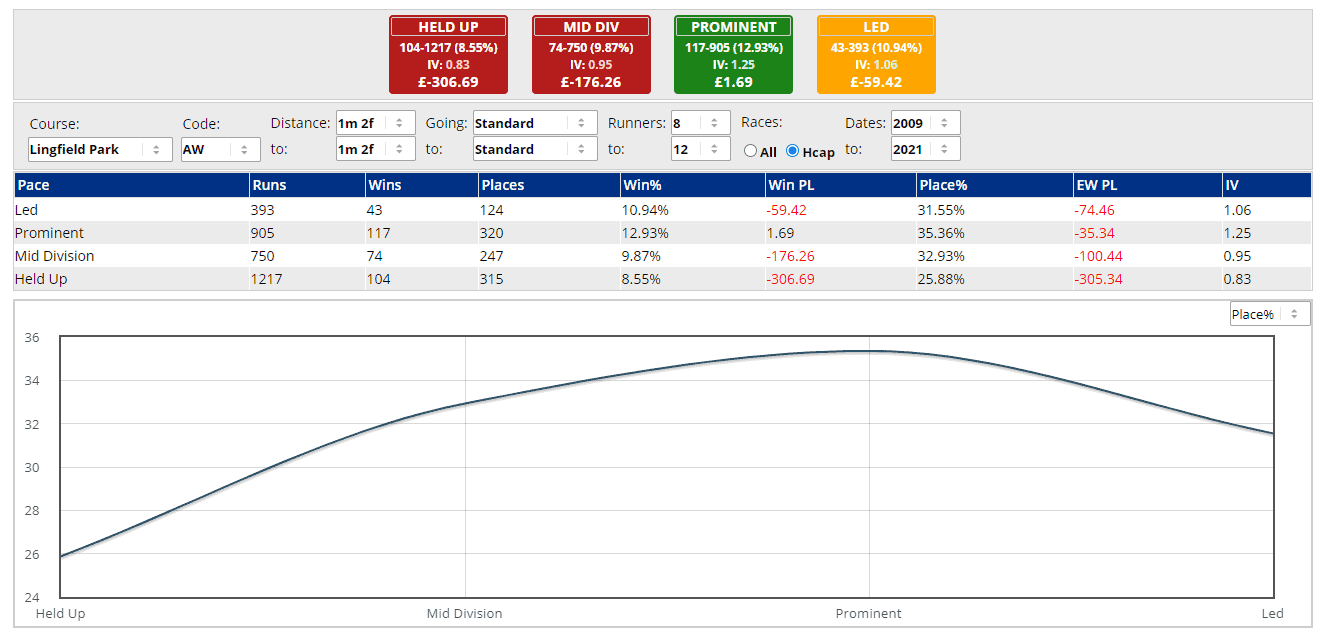
Using the Pace Analyser we can get a nice enough sample size on soft or heavy ground by using a slightly wider distance range (3m to 3m4f) and by including handicaps containing between 8 and 12 runners.

As is often the case, those nearer the pace tend to have an advantage over those that are ridden more patiently. This advantage is not necessarily considered by the bookmakers with several betting related metrics such as WIN PL and EW PL both showing that front runners and prominent racers produce far better returns than those that race in mid division or are held up.

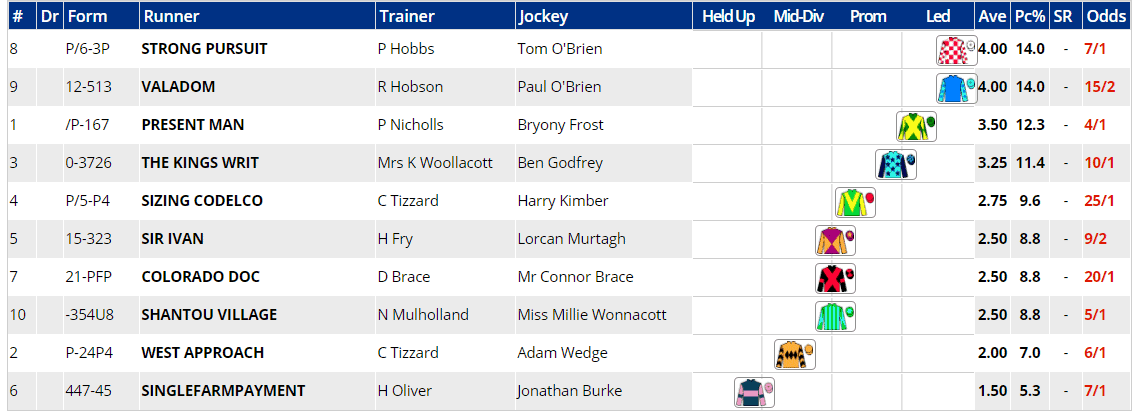
Let’s have a look at the pace map for this race to see which runners might be advantaged by this bias.

We could be set for a contested pace here with Roll Again and Hill Sixteen often keen to get on with things. The four runners who are likely to be ridden most patiently in this race are all amongst the least well fancied in the market and if the two front runners to take each other on and compromise each other’s chances then from a pace perspective the most interesting runners in this contest are likely to be Lord Napier, Enqarde, Sojourne and Crixus’s Escape.

Instant Expert

Instant Expert is always worth a look in every race, especially races that are set to be run on heavy ground as this one is.

There is a decent level of placed heavy ground form in handicaps here, Sojourn perhaps best on show with two places from two efforts in heavy. Roll Again is not only likely to be taken on for the lead but also failed to place on his only run on heavy ground. That run was two starts ago when beaten 97 lengths which is a massive worry but it was his first run for 248 days.

Hill Sixteen and Highest Sun seem reliable propositions in this race class. Lord Napier has failed to make the frame in three runs in this class and Crixus’s Escape is 0 from 2 in class 2 races.

Course handicap form is thin on the ground but Pop Rockstar does at least have a 50% place record at Haydock. Sam’s Adventure, Crixus’s Escape and Lord Napier all failed to place in their one handicap run here.

We have a distance range set in Instant Expert which is showing us data from runs between 3m and 3m2f. Sojourn now looks consistent both in the ground and at this trip with a 100% place record over these trips in handicaps from three runs. Lord Napier and Enqarde also have a 100% place record from fewer runs. Roll Again is once again a negative, as are Crixus’s Escape and Salty Boy.

Sojourn and Enqarde have both run well from limited opportunities in this sort of field size. Highest Sun, Pop Rockstar and Roll Again all get a ‘tick’ having provided more data. The negatives would be Crixus’s Escape and Lord Napier.

Highest Sun is well handicapped on older form as he’s now 8lbs lower than his last handicap win. The rest of the runners are either higher than their last winning marks or have never won a handicap before.

Now let’s take a look at the win data in Instant Expert:

Sojourn once again scores very well for both going and distance which proves conditions will be absolutely fine for him. We don’t know about the class or course for this runner but he’s potentially progressive in these conditions.

Sam’s Adventure and Hill Sixteen look largely good here whilst that comment could also apply to Pop Rockstar who generally scores well but has only won once from five attempts on heavy ground.

Lord Napier has a lot of warning signs across the board whilst it’s difficult to weight up Enqarde here with so few qualifying runs.

Other Angles

Roll Again has some interesting trainer snippets in his favour. For the distance range and last time out winners in handicaps his trainer has an IV of 1.64 and 1.51 respectively.

Three runners  whose trainers win more than their fair share of handicaps in general are Sojourn (IV 2.0), Crixus’s Escape (IV 1.78)  and Salty Boy (IV 1.67).

Sojourn is also highlighted for winning a race that was hot form. His win on seasonal debut in heavy ground has thrown up four subsequent winners and two next time out runners ups which shows that race in great light. He won that race by 15 lengths and although now up 11lsb, that could be lenient for winning a race of that depth in that kind of style.

The trainer and jockey combination for Crixus’s Escape is worthy of closer inspection. The Boanas/Quinlan double act have a 25% win strike rate over the past year and have produced an IV of 2.50. Sean Quinlan is also certainly a jockey in good current form, over the past 30 days he has generated a WIN PL of 30.25 if backed blind.

Lord Napier represents a trainer and a jockey who score well as individuals both over the long term (5 years) and the short term (30 days). You can see their stats below.

Verdict

Sojourn does look extremely solid from all angles here, representing Anthony Honeyball and Geegeez sponsored jockey Rex Dingle. It’s difficult to pick many holes in him and although he’s the early favourite, he still looks a fair price and should be perfectly positioned here. Picking a main danger is tough with many in with a decent chance but Crixus’s Escape does look interesting based on several angles.

Updates Roundup

It's a fairly quiet time before the Christmas break, but we've been busy working on a number of upgrades and enhancements, as always. In this post, I'll share what's arrived and what's next, and will also invite you to vote for the next 'bigger' item we work on.

Added recently or Coming Soon

PRB on Trainer, Jockey and Sire

We recently added percentage of rivals beaten (PRB) figures for trainers, jockeys and sires as a further insight into their respective performance. PRB helps us see beyond bare win and place numbers to understand the totality of performance. They won't be for everyone, but I personally find them very useful from a context perspective.

You'll find this detail in the right hand column on trainer, jockey and sire inline data on the cards:

Full Form Upgrades

We're adding a selection of small upgrades to Full Form, as follows:

- Winnings and Total Prize Money
- PRB by race code
- Extra date filter option for 'seasons'
- Dam data


Winnings, total prize money (i.e. win and place), and PRB by race code will be published in the Race Record on Full Form:


Users will also soon be able to filter Full Form by particular seasons:


Dam Useful!

And, perhaps most interesting of all, we're adding a 'Dam' tab to Full Form, and you'll also be able to click through from the breeding inline data to both sire and dam:

Clicking on Concentric in this example brings up Full Form for the progeny of this dam


What about the next big thing?

Those are small feature upgrades, all of which are pretty awesome in their own rights, and should add value - and ease of use, and knowledge - to your daily studies.

But what about the next big thing? It'll be 2021 in a minute and it's time to build something new and cool!

I've got a few big items on the wishlist, all of which I believe are possible; and I'd like you, dear subscriber, to decide which we should work on first/next! They are:

1 Bet Finder (filter the day's runners based on your criteria, e.g. trainer in form, course winner, etc)

2 'Fast finishers' sectional timing report (note horses that may have run better than their finishing position suggests)

3 Add Betfair historical data (win and place Betfair SP's) to P/L calculations

4 Add previous race parameters to Query Tool (e.g. Position last time out, class move, etc)

So, please use the form below to say which one is a 'yes please' and which is a 'no thanks'...

Thanks!

Matt


Monday Musings: The Mogul Blueprint

Getting up early is more of a bind in these dark winter mornings but there was a point to it yesterday with the multi-million-pound offerings on Hong Kong’s day of the year, writes Tony Stafford. The Vase (mile and a half) and the Cup (ten furlongs) were, as usual, the highlights and, while Magical couldn’t quite get there in the Cup – instead finishing a close and as ever valiant – third, Ryan Moore and Mogul did the business for Aidan O’Brien and Coolmore when turning the Vase into a rout.

The son of Galileo (who else) and the equally-sought-after broodmare Shastaye had three lengths to spare over smart local and odds-on shot, Exultant, a 13-time winner, 11 since leaving Ireland’s shores as a Mick Halford-trained three-year-old.

It is almost uncanny how much Mogul’s career is echoing that of his stable predecessor Highland Reel and there can be little doubt that health and fitness permitting, the former will be the most obvious successor to the latter’s role as a world-wide Group 1-collecting money-machine.

Highland Reel stayed in training for four seasons, winning twice at two and three times at three, culminating in, guess what, a nice win from the previous year’s Andre Fabre-trained winner Flintshire in the 2015 Hong Kong Vase. Two years later he won it again, with a close second in the intervening season. Four campaigns brought him seven wins and easily the highest-ever earnings for a son of Galileo, more than £7.5 million.

Mogul, like Highland Reel, won twice at two, but whereas Highland Reel had already tucked away his three runs – a second and two wins: a maiden and then the Group 2 Vintage Stakes at Glorious Goodwood by the end of July – Mogul didn’t start his career until mid-August; but the pattern was similar. He was second on debut, won a maiden, and then third time out was odds-on and a fluent winner of a Group 2 on the Irish Champion Stakes undercard.

The one divergence from the matching juvenile programmes was that Mogul was lined up for one extra race, the Group 1 Vertem Futurity at Doncaster. In all likelihood that race’s postponement for almost a week because Doncaster had become waterlogged was not in Mogul’s favour. It was switched to the all-weather Tapeta track at Newcastle and Mogul, ridden by Donnacha O’Brien with Moore engaged at the Breeders’ Cup, finished fourth to Kameko. He had been as close as disputing second coming home but got the worst of a three-horse Coolmore photo for that place, behind Innisfree and Year Of The Tiger, two clearly inferior animals.

Neither horse managed to win a Classic. Highland Reel had three goes - a close sixth in the French 2,000 Guineas, second to New Bay in the Prix Du Jockey Club, and fifth to Jack Hobbs in the Irish Derby. So it was a full year without a win when he made his second trip to Glorious Goodwood and collected the Gordon Stakes, another Group 2 en route to a more exhausting test of his temperament for long-haul travelling when landing the Grade 1 Secretariat Stakes on the turf at Arlington Park, Chicago. Two more non-wins followed before that first Hong Kong Vase at the end of the year.

Mogul’s Classic aspirations were also just as frustrating. O’Brien admitted not having him anywhere near ready after an early training setback and amidst all the Covid-19 upheavals, when he turned up at Royal Ascot for the King Edward VII Stakes which preceded the delayed-until-July Derby rather than the usual way around. He still seemed a little under-cooked when, as Ryan Moore’s ride at Epsom, he was one of the fast finishers that failed to get anywhere near stablemate Serpentine and the other always-prominent outsiders in that mystifying Classic. After that, in precisely the same way as Highland Reel, much better was to follow.

Mogul, too, went to Goodwood and won a very strong Gordon Stakes and then, after finishing third in the Great Voltigeur at York, as at Ascot behind Pyledriver, he also went overseas (but not as far as Highland Reel) to pick up his first Group 1 in the Grand Prix de Paris. That day he impressively overturned Derby form with Serpentine.

Then followed a modest fifth, three places and two lengths behind Magical when very fast ground and the tight Keeneland track were not ideal, especially after a slow start, in the Breeders’ Cup Turf. Yesterday’s exhilarating performance though means he’s probably a few pounds higher in class terms than Highland Reel was at the same stage.

As a full-brother to Japan it was never a shock that Mogul should cost a fortune as a yearling, although 3.4million guineas might have been rather more than the boys expected to pay. When the pair’s full-sister showed up at this year’s Tattersall’s October Book 1 sale, again there would be few possible buyers. Once again M V Magnier put in the closing bid for Coolmore and amazingly for a filly, it matched the price of her illustrious older brother.

As I said at the top, Mogul, with five wins, is a good way along the road to becoming a latter-day clone of Highland Reel, but probably with pretensions to being higher-class. That said, Highland Reel won a Coronation Cup, a King George and a Prince Of Wales’s Stakes, three races of the highest international prestige, along with those overseas victories, so he won’t be easily out-performed. I get the feeling, though, that Mogul is that little bit classier and possibly a more obvious higher-end stallion prospect for the future, so whether he’ll be allowed to go on racing for quite as long might be another question.

It was interesting to hear that Aidan O’Brien would be delighted if the amazing Magical was to be kept in training for yet another year in 2021. She may never have beaten Enable in their multiple tilts on the track over the past three years but she did get a verdict over the 2020 Horse of the Year Ghaiyyath in the Irish Champion Stakes back in September, the only horse to beat the Charlie Appleby star in the calendar year. She is still poised close to £5m in earnings, needing another £125,000 to reach that mark after 12 wins (six at Group 1) and ten second or third places in a 28-race career.

**

There was some high-grade jumping at Cheltenham over the two previous days but it was a source of great irritation that Saturday’s big race, the Unibet International Hurdle, was reduced by three hurdles to only five. This Grade 2 event was widely seen as the first real test of Goshen’s chance of wresting the Champion Hurdle from the mare Epatante since his unfortunate last-flight fall with the Triumph Hurdle at his mercy back in March.

It’s not a secret that in mid-December as if by a fluke the sun happens to make an appearance, that it will be low in the sky by 3 p.m., the time of this race. Bizarrely, there was one more hurdle race run after the Unibet and with the sun by now setting, this had a full complement of hurdles.

In the big race though they had to plot a serpentine route through and between the hurdles and fences, twice down and then twice up a hill. Last time round, a group of nine without only Goshen, who was never travelling or jumping, set off with only a few lengths between them. By now Jamie Moore had already eased off Goshen allowing him to coast past the post.

The winner was yet another for Tom Symonds. The Hereford-based handler’s ex-French gelding Song For Someone maintained his progress to win for the sixth time in 12 starts, with another five placed efforts to boot. There will be worse-value 20-1 shots, his price in Champion Hurdle ante-post lists, than this Flat-bred five-year-old son of Medicean.

Symonds had gone through a lean spell after an initial bright start to his training career. He had 22 winners in the third of his ten seasons, but had got nowhere near that number in the following six campaigns, having previously been joint assistant trainer – with Ben Pauling – to Nicky Henderson.

They were in those roles at the time of the Punjabi/ Binocular rivalry within Seven Barrows: when the two lined up in the 2009 Champion, Tom was on the Punjabi side in opposition to Ben and Corky Brown, the revered head lad, both of whom favoured Binocular. Both sides were to enjoy their Champion Hurdle winner and, overall, even Punjabi’s biggest fans (like who?) will have to admit that Binocular probably shaded it. It’s great that, with 20 wins already and a renaissance since former trainer David Dennis moved across to join forces (and provide additional equine ammunition) with Tom at the start of the season, he’s definitely going places.

There was a feasible explanation after the race for Goshen’s disappointing effort as he was found to have finished with an irregular heartbeat. He won’t be the first horse – Sprinter Sacre for example – to have that medical issue to overcome. While that great chaser was to rise again pretty much back to his absolute best, Gary Moore and Goshen’s owners will always have the thought that any physical weakness in a horse is an extra worry especially with championship races in mind.

- TS

Geegeez Writer Shortlisted for Derby Award

Geegeez chief writer - and founder/creator - Matt Bisogno has been named on the four man shortlist for Specialist Writer of the Year at the presitigious Horseracing Writers & Photographers Association's Derby Awards.

Matt, who was also nominated last year - the first time this award was presented - is the only writer to have been nominated in both shortlists. He is joined in the Specialist Writer category by elite scribblers and multiple Derby Award winners, Chris McGrath and Bill Barber, as well as newcomer Franck Mourier.

Matt's submissions were:

This year's Derby Awards, normally held in a West London hotel after a copious lunch, will be presented virtually and broadcast on Attheraces from 3pm this afternoon.

Other categories include Racing Writer, Racing Reporter, Emerging Talent, Photographer, Broadcaster, and Photograph of the Year. The full list of categories and nominees is below.

Good luck to Matt this afternoon!

Racing Writer of the Year
David Carr
David Jennings
Peter Thomas
Jonathan Harding

Racing Reporter of the Year
Bill Barber
Chris Cook
Lewis Porteous
Lee Mottershead

Broadcaster of the Year
Ed Chamberlin
Niall Hannity
Nick Luck
Jamie Lynch

Specialist Writer
Bill Barber
Matt Bisogno
Chris McGrath
Franck Mourier

Emerging Talent
Adam Houghton
Callum Jamieson
Nick Seddon
Josh Stacey

Photographer of the Year
Mark Cranham
John Hoy
Tracy Roberts
Hugh Routledge

Picture of the Year
Francesca Altoft
John Hoy
Tony Knapton
Tracy Roberts

Flat Jockey of the Year
Hollie Doyle
Tom Marquand
William Buick
Jim Crowley

Flat Trainer of the Year
John Gosden
William Haggas
Aidan O’Brien
Marcus Tregoning

 Jump Jockey of the Year
Rachel Blackmore
Brian Hughes
Barry Geraghty
Paul Townend

Jump Trainer of the Year
Nicky Henderson
Willie Mullins
Paul Nicholls
Fergal O’Brien

Owner of the Year
Hamdan Al Maktoum
JP McManus
Marie & Joe Donnelly
La Pyle Partnership

International Trainer of the Year
James Fanshawe
William Haggas
John Gosden
Kevin Ryan


Monday Musings: Trying Times

Suddenly it’s all back – for some of us anyway, writes Tony Stafford. Ice rinks – yes, I have to be aware of those! – football stadia and racecourses can now have participants and visitors, within strict limits of course. My mate Scott was able – after some manoeuvring – to take up his annual quest to Sandown Park for the Tingle Creek meeting.

He chose to get from deepest Essex (well Shenfield) to Esher by public transport and the hourly service from Waterloo was a bind as inevitably train times were synchronised not to gel with races. It was a proper full day’s excursion and not without its difficulties as well as cost.

It was £30 for his grandstand ticket and as someone who with his pals, especially at Cheltenham, his version of some people’s pilgrimage to Mecca or Lourdes, will normally sprinkle his race viewing with imbibing. The rules for alcohol consumption on racecourses just as in hostelries in tier 2 are equally as strict. “I fancied a pint,” relates Scott, “So I went to the food outlet where drinks can only be bought to accompany a meal. There was no lager on draught so for a pint it had to be two half-pint bottles at £5.20 each alongside pasty, chips, mushy peas and gravy for £8.50. Almost £20 a shot and if I’d wanted another pint it would have been same again, as I couldn’t have got them without a second meal.

“One friend, who went there on Friday, had three pints, so three lots of pasty, chips, mushy peas and gravy. I’m not sure if he made it back again on Saturday!” said Scott.

Winner-finding was difficult from the outset and, like many punters on the day, the pleasure of getting back racing had its less enjoyable moments. Scott can at least rest assured that his day would not have been anywhere near as frustrating as Nicky Henderson’s. The multi-champion trainer must have had misgivings when deciding to withdraw Altior from the big race the night before because of the testing ground, but he still went to the track with three short-priced favourites at Sandown as well as his Gold Cup hope Santini returning to action in a Grade 2 chase at Aintree.

Sandown’s litany of shocks started early. Pars in the Middleham Park colours was 7/4 on to defy the penalty earned by his debut win in a €15k Dieppe juvenile hurdle back in March, but was a well-beaten fourth behind three more French-breds, led home by Fergal O’Brien’s Elham Valley, who won readily.

Surely there were to be no mistakes in the next, a National Hunt novice hurdle in which Grand Mogul, twice a winner, faced three rivals, two of them newcomers, and started 2/11. Nico De Boinville had him in the first two from the start and he had seemed to have got the better of Pride of Pemberthy, the only one of the other trio to have raced previously, when the Gary Moore-trained Golden Boy Grey, another French-bred, suddenly arrived at the last galloping all over him. Golden Boy Grey went on to win by nine lengths in the style of a fair performer, whatever reasons could be found for the favourite’s tame acceptance of his fate from the last flight.

With no runner in the Tingle Creek, Nicky would have been able to switch his attentions to Aintree for Santini’s first appearance since going under by only a neck to repeat Gold Cup winner Al Boum Photo back in March.

He did have a former God Cup winner in Native River to beat and in having a couple of lengths in hand of him was creditable enough first time back. Less easy to swallow must have been his failure to beat 16-1 shot Lake View Lad, ridden by champion Brian Hughes and trained in Scotland by Nick Alexander. Lake View Lad was receiving 6lb on Saturday and was 12lb wrong at the weights with the 172-rated favourite. The winner, a ten-year-old who carries the Trevor Hemmings colours, must inevitably come into focus for a Grand National challenge after this.

The National fences were in use twice on Saturday and seemed to be back to a much more formidable status in both the William Hill-sponsored Becher and Grand Sefton Handicap Chases. Henderson’s Might Bite, who was second in Native River’s 2017 Gold Cup, has only occasionally shown anything like that level since and he appeared to have a clear dislike of the obstacles which led to an early pulling up by Jeremiah McGrath. So it was left to Sandown’s finale, a valuable handicap hurdle, if Henderson was going to salvage a spot of consolation from a dreadful day.

The punters, including Scott by all accounts, went in with both feet on 6-4 shot Mister Coffee, an alarmingly-easy winner of his last race over course and distance a month earlier and raised 10lb for this tough handicap hurdle. His late run never looked like matching that of in-form Benson, who completed a hat-trick for himself and an across-the-card double for Dr Richard Newland. The doctor’s love affair with the Aintree fences had continued a few minutes earlier with the 20-1 success of Beau Bay under Charlie Hammond in the Grand Sefton.

The Sandown race had been shaped by the predictably-fast pace set in the early stages by Totterdown, twice a course and distance winner, but reckoned by the Fergal O’Brien stable to be at the limit of his handicap potential. His mark will need to come down, and two earlier tries this year over fences have not revealed a similar level of talent in that discipline.

That reverse did nothing to take the gloss off a memorable day for this stable. Just a year since he moved from his original premises rented from his former boss Nigel Twiston-Davies, O’Brien’s progress is such that he is needing to take temporary use of a 30-box barn at Graeme McPherson’s stables while development of his own base continues – “it’s like a muddy building site at the moment”, says Fergal’s assistant and partner, Sally Randell.

Earlier they were celebrating Elham Valley’s win, yet another example of how they improve horses from elsewhere. Beautifully-schooled for this debut, the 70-odd rated Flat performer came smoothly through under Paddy Brennan to bring the stable tally to 63 for the season. “That equals our best score set last year,” says Sally. With five months of the season to go, a first century must be in the offing, not wishing to jinx it, of course.

There can only have been one highlight of the day, though, the unchallenged victory of the David Pipe-trained Vieux Lion Rouge in the Becher Chase over three and a quarter miles and 21 fences of the Grand National course. Now an 11-year-old, Vieux Lion Rouge won on his first try in the race four years ago, by which time he’d already run in the previous April’s Grand National won by Rule The World.

Opportunities for tackling Aintree’s National fences don’t come very often. It’s feasible, but very rare for a horse to run twice at a Grand National meeting, needing a run either in the Topham or Foxhunters as well as the big race. Back in 1977 Churchtown Boy won the Topham on the Thursday and then finished runner-up as Red Rum completed his third and final Grand National victory, to which he could add two second places in between the second and third wins.

Vieux Lion Rouge, owned by Professor Caroline Tisdall and John Gent, has run nine times around the Grand National course – it would have been ten without a break, no doubt, had the 2020 Grand National been run. Twice the big race has needed to have one of its 30 fences omitted for safety reasons, so Vieux Lion Rouge has navigated safely over an almost-unimaginable total of 223 fences without mishap. The one blemish on his safe jumping career was an unseat of Tom Scudamore three fences out one day at Chepstow when he was still in with a chance of winning. Two pulled ups also slightly mar his otherwise excellent completion record in all races.

Considering he must now be regarded as an Aintree specialist, the fact that he has won 11 of his 27 other races, between bumpers, hurdles and chases, as well as the two around the big fences, speaks volumes for his versatility, talent and the trainer’s skill. Tom Scudamore must have been livid to have been on the Pipe’s stable’s apparently better-fancied Ramses De Teillee on Saturday, a 13-2 shot against the 12-1 SP of the winner. That made it still only eight times in the gelding’s long career that Scudamore had not partnered him. That also included his first Grand National challenge back in 2016 when James Reveley was in the saddle. Tom has been on the gelding on all his other Aintree excursions.

For a few years I’d been thinking that Aintree had become relatively soft, something that the old timers regularly trot out. That wasn’t the case on Saturday, possibly with the testing ground contributing to the potential for errors and fatigue. That this old boy could canter round behind but in touch with a very strong field, go to the front easily by the second-last fence and draw 24 lengths clear up the run-in was a marvellous display and brilliant advertisement for the talents of David Pipe and of course a certain older member of the family who still keeps careful watch on events equine down in Somerset.

- TS

Walk In The Mill Has Right Credentials For Hat Trick Bid

The Becher Chase is one of my favourite jumps races of the season and we look set for a cracker at Aintree on Saturday.

This article will run through some trends for this race, relevant form for each runner and of course many of the angles that are highlighted with a Geegeez Gold subscription.

Pace

Pace is an important factor in any race so let’s take a look at any potential pace bias in this race which could help narrow down the field:

Despite the long distance there is a clear indication that being near the pace is an advantage here at Aintree. It’s worth noting that not all of these races took place on the National course but many of them did and we see some very strong data.

The Win %, Win PL, Place % and IV all drop the further back in the field you are. The Place PL also follows a similar trend except 'Prominent' is slightly more profitable than 'Led' for that metric.

Now it’s worth noting that almost half the winners above have been either held up or have raced in mid division so we can’t simply put a line through those that are likely to be more patiently ridden but they’ve provided far more runners in the above data set and are clearly disadvantaged. Therefore we need to mark up those likely to be closer to the pace and mark down those who are likely to be held up.

The fact that almost half of front runners reach the frame suggests it’s not a bad strategy to simply back whichever front runner appears to have the best chance in this race.

Further credence is given to that strategy when you look at the data for this distance exclusively on soft ground.

The metrics for front runners fly up and the IV is huge 6.54. Front runners have a 37.5% win ratio and 62.5% place ratio. The sample is even smaller here so perhaps this data shouldn’t be taken completely at face value but soft ground certainly seems to benefit front runners even more than good ground does.

So which horses are likely to benefit from the pace bias, and which aren’t?

It looks likely that the pace will come from Yala Enki with Coo Star Sivola most likely to lead if Yala Enki doesn’t.

The immediate take away from this pace map, other than the fact that it’s likely to be front runner favouring lone speed, is that two of the leading contenders according to the market, Walk In The Mill and Le Breuil could be near the rear of the field.

Previous Experience Of The Fences

When it comes to the Grand National, some prefer the solid choice of previous experience over these fences and others prefer something that is unexposed over the famous obstacles.

When it comes to the Becher Chase it has certainly paid to follow Grand National fence form. A massive nine of the last ten winners had previously run on the Grand National course and twenty-three of the last thirty horses to finish in the first three had the same experience.

Now it’s worth remembering that in an ordinary year some of these that haven’t yet run here would have done so in April had we not lost the 2020 Grand National meeting to Covid so if there is a year this trend will be bucked it will probably be this year but this remains a noteworthy stat.

The runners in this year’s Becher Chase who have Grand National course experience are:

Kimberlite Candy
Le Breuil
Walk In The Mill
Ramses De Teilee
Minellacelebration
Vieux Lion Rouge
Joe Farrell

The runners without a run over these fences are:

Yala Enki
Calett Mad
Coo Star Sivola
Give Me A Copper
Smooth Stepper
Aso
Jett
Calipso Collonges

Race Fitness

Only four of these come here without a previous run this season. Is that a big deal?

Well three of the last ten winners have come here fresh and defied an absence which is a strong record given the majority of the field have usually had a prep. A lack of previous run this season certainly shouldn’t be seen as a big negative.

Once again Covid could have a slight effect here. Those who won here fresh had previously run in April but the fresh runners this year have not run since January at least which could have an impact.

Instant Expert

Instant Expert is an excellent tool for getting a quick insight into horse, trainer, jockey or sire performance across a number of relevant metrics. This is how the runners shape up from a place perspective here:

Calipso Collonges is particularly consistent on this ground but surprisingly Le Breuil, and a few other fancied runners, have a patchy record on soft ground.

The importance of course form has already been discussed and Walk In The Mill, Kimberlite Candy and Minellacelebration all do well here but it’s worth noting that Minellacelebration’s good runs at Aintree were on the Mildmay course and he ran poorly over this course in this race last season.

Le Breuil’s poor performance here across the board really stands out. He was beaten 20 lengths in this last season and is only 4lbs lower this time around. It’s difficult to make a case for him and he looks remarkably short with so many question marks.

Vieux Lion Rouge ticked a box having previously run at this course but also seems to have plenty of negatives against him, including a poor run in this last year.

From the place perspective Kimberlite Candy (from limited data), Walk In The Mill, Minellacelebration are all solid.

Narrowing it down with the win data:

It’s a lot harder to find positives when looking solely at win data but Walk In The Mill and Minellacelebration are once again relatively strong and it’s also worth noting that Give Me Copper is amongst the better scorers, albeit with limited data.

Further Analysis

We have to start with last year’s 1st and 2nd, Walk In The Mill and Kimberlite Candy.

Walk In The Mill, despite often being ridden patiently, has won this from mid division and from a prominent position in the past two years. He’s now 12lbs higher than when taking this two years ago and 8lbs higher than twelve months ago. He was also 4th in the 2019 Grand National so is clearly well at home here.

He was beaten 22 lengths and pulled up on his two prep runs for this race in the past so his recent run has once again followed suit and he’ll undoubtedly be primed for this. He wears cheekpieces for just the second time in his career, the first was in this last year when racing more prominently than he often does. The cheekpieces once again should give him a bit more extra early spark.

He beat Kimberlite Candy by 2.5 lengths last year giving Kimberlite Candy 4lbs. Kimberlite Candy has since won at Warwick by 10 lengths meaning he’ll now be 8lbs worse off with Walk In The Mill this time around.

Kimberlite Candy is the more lightly raced of the pair and should still have further improvement but with both at similar prices it’s difficult not to side with Walk In The Mill. Kimberlite Candy’s record first time out in the past four years is 1512 so his absence shouldn’t be much of a concern and he’s only raced twice in cheekpieces, finishing first and second in big races.

Ramses De Teillee has won three of his past five races and has finished runner up in a couple of big field chases. He should be well placed in this race and is proven in conditions and over staying trips. He was pulled up on his only try over these fences but he went okay for a long time and was eventually pulled up because the jockey’s reins had snapped. He certainly can't be ruled out.

He’s closely matched with Yala Enke, who he beat a short head last time out. Yala Enke is a pound better off and is another who should be well placed in this. He has no form over the National fences which is a slight put off and he appears to be a very dour stayer who could be one more for the Grand National itself if proving himself over the fences here.

Coo Star Sivola is yet another who should be suited by the run of the race but he also has never run over these fences before. He hasn’t run particularly well on his last three runs either so looks short enough.

Calett Mad stays very well and goes on any ground but has to defy an almost two year absence here. This may well be a sighter for the big one in April.

Give Me Copper was noted as performing well in Instant Expert and he comes here off the back of a wind op. He’s not the most consistent but he’s another who won’t be too far off the pace and he’s not completely handicapped out of this. If you fancy this one he may be more of a win only bet than each way despite the price.

Minellacelebration was the other very interesting runner from the view of Instant Expert. He won a handicap on the Mildmay course by 14 lengths back in October and has been raised 12lbs off the back of that. He seems to have improved from a wind op twelve months ago, possibly needing his next run but following that up with a second place and two wins. He did run poorly in this last year but that was just before his wind op and he’s otherwise won three from four at this venue and finished runner up in his other race. He did at least complete last year over these fences so if you can put that performance down to his wind he'd have a very good chance, for all he has to prove himself off this kind of mark.

The other runner worth a mention is Vieux Lion Rouge. He did score poorly in Instant Expert and ran poorly in this last year but he was second to Walk In The Mill two years ago and is now 18lbs better off. He hasn’t been at his best on his recent runs and was well beaten by Minellacelebration last time out so it’s entirely possible age is catching up with him now.

Verdict

Very unoriginal but the two most interesting runners here are two of the favourites, Walk In The Mill and Kimberlite Candy. The swing in the weights leaves two time winner Walk In The Mill the better handicapped of the pair.

Le Breuil seems much easier to take on and the best of the each way brigade seems to be the interesting Minellacelebration who does still have to prove himself over these fences and off this mark but he seems most likely to gatecrash the party if anything does.

New Metric on Geegeez Gold: PRB

We're constantly striving to improve Geegeez Gold, our flagship racecards and form tool service. After a few quieter months - lots going on in the background - we're about to inject a new metric into Gold.

We've deliberately kept it away from the more commonly used numbers, simply because if you don't want to engage with this, we don't want it in your way. At the same time, I very much believe you should take heed of the new number and that's why I've put this post together.

So, what is the new number? Well, it's not exactly brand new as we already display Percentage of Rivals Beaten (PRB) within our draw content. But we're now extending it calculation and display to trainer, jockey and sire data. Here is some more information on Percentage of Rivals Beaten...

What is PRB?

Percentage of Rivals Beaten (PRB) is a calculation based on a horse's finishing position in relation to field size. It makes key distinctions between a horse finishing, say, third in a five-horse race (PRB 50%, two rivals beaten, beaten by two rivals) and finishing third in an eleven-horse race (PRB 80%, eight rivals beaten, beaten by two rivals).

For a collection of results - for example, a trainer's record over the last year - we take an average of all the individual PRB scores.

On geegeez.co.uk, we express PRB as a number between 0 and 1. So, in the examples above, 50% is 0.5 and 80% is 0.8.

What is convenient about PRB is that a par score is always 50% of rivals beaten, or 0.5. This means that a trainer with a one-year PRB of 0.55, 55% of rivals beaten, is doing very well; conversely, a trainer with 0.45 as his PRB is under-performing in finishing position terms.

It is always important to remember that finishing position is not the only number in town and, as with all numbers, it should be used sensibly and in concert with other metrics.

Why is PRB useful?

PRB is useful because it helps to make small datasets bigger. In racing we are almost always hamstrung by small datasets, relative to what general statistics would consider so at any rate. And when we then try to discern knowledge from the data by looking only at wins we ignore seven-eighths of the information we have (assuming an average field size of eight, one winner, seven losers).

If we had 1,000,000 wins to consider, that wouldn't be much of an issue. But we don't. We have much smaller groups of wins and runs with which to work.

Historically I've used place percentages to enlarge the positive to negative comparison: using our eight-runner average, we now have three 'wins' (placed horses) for five losses (unplaced horses). That's much better but still lacking in nuance.

PRB awards 'score' to every runner except tail end Charlie in every race (ignoring non-completions which are dealt with separately - an explanation of how we've accounted for them will appear in the user guide as it will add little value here). This has some challenges of its own; for instance, a horse that went hard from the front and is still battling for third place will be ridden right to the line, whereas that same horse may be eased off if/when four others have already passed it: it has given its running already and there is little be gained from finishing fifth or ninth.

Such issues are accommodated up to a point by squaring the PRB figure, and you can see how that manages the curve in the post linked to at the bottom of this one if you're that way inclined.

The crux is this: PRB is useful because it helps us understand the totality of performance of a dataset rather than just a fraction (win or place, for instance).

How should I use PRB?

PRB has utility in isolation because every score can be compared to 0.5 to understand whether the thing being measured - trainer, jockey or sire performance in our case - is better or worse than what might be expected.

But, of course, we should expect that, for example, Paul Nicholls will have a far higher one-year National Hunt handicap PRB figure than Jimmy Moffatt. He does, 0.62 vs 0.5 at time of writing. But knowing that is unlikely to add to our bottom line; at least not in or of itself.

As it happens, both have been profitable to follow blindly in handicaps in the past twelve months: Nicholls has an A/E of 1.05 (and an SP win profit of +16.70) while Moffatt has 1.26 / +21.50.

If anything, Nicholls' figures are more impressive, for all that Moffatt's may be more sustainable.

What PRB tells us is the amount of merit in unplaced runs. It should be used to support understanding of an entity, rather than as an end in itself. And it is especially helpful in rendering the inference of small samples sizes slightly less of an act of folly.

Where does PRB live?

Regular Gold users will know that PRB - and its close relatives, PRB^2 and PRB3 - have been happily adding value to our draw content for some time.

And now (next week), PRB appears within trainer, jockey and sire data on the racecards and in reports. It is on the far right, out of trouble for those not (yet) interested in its utility.

On reports, it can be found in the same rightmost column location:

Use it or don't use it, but I'd suggest you make yourself aware, as a minimum, of what Percentage of Rivals Beaten is; and when it might pay to keep it in mind.

You can read more about all of our key metrics - A/E, IV and PRB - in this post.

Matt

p.s. more new features coming soon!

Monday Musings: Jump Racing’s Newmarket Interlopers

There was plenty going on around the country on Friday and Saturday and there was no disguising the authority with which Epatante won the Fighting Fifth Hurdle at Newcastle on her reappearance, indeed her first sighting on a track since winning the Champion Hurdle back in March, writes Tony Stafford. If there’s anything more exciting on a jumps racecourse than a horse sprinting home after being waited with in the way she was under Aidan Coleman, I’ve yet to see it.

So she sets a very high standard and with that single lapse at the previous Cheltenham Festival in the mares’ novice hurdle last year as the sole blemish on her record for Nicky Henderson, she looks on target to dominate the two-mile division for some time to come.

The stayers also came into sharp focus with Friday’s Ladbrokes Long Distance Hurdle at Newbury where Thyme Hill stepped up on the level of his novice achievements to show too much speed for former champion stayer Paisley Park, the pair drawing well clear of the favourite McFabulous.

There seemed no fluke about the result, Thyme Hill under Richard Johnson looking a more complete hurdler than he had last season. He had been unlucky when only fourth in the Albert Bartlett Novice Hurdle but after Friday’s display I’ll be surprised if he doesn’t reverse the form with the trio that finished ahead of him in March if and when they meet again: Philip Hobbs clearly has a contender for this season’s Stayers’ Hurdle.

That’s not to under-estimate Paisley Park who had been unstoppable for two seasons before his failure to complete the double in the big race at Cheltenham, a lapse explained afterwards by the discovery of a heart murmur. Emma Lavelle has brought him back steadily and no doubt owner Andrew Gemmill will have been delighted at how well he ran on this comeback. The prospect of a re-match with Friday’s winner, no doubt spiced with various Irish pretenders will make it one of the best races next spring.

My favourite performance on Saturday, though, was that of Pink Sheets in the mares’ Listed novice hurdle which opened the Newbury card and, while this daughter of Gold Well is most unlikely ever to be anywhere near the class of her two-month older contemporary Epatante, she’s clearly improving very fast.

When she was acquired by Micky Quinn on behalf of his principal owner, Kenny Bruce, boss of the Purple Bricks estate agency, she had just won a Huntingdon bumper by 16 lengths for the Mick Channon stable. Channon not only preceded Quinn as a former top footballer to take up training horses, but he also spent time as Quinn’s mentor, employing him as his assistant while teaching him the rudiments of the business.

The pair were both barn-storming strikers and until he got immersed in racing, Channon had a time as a football pundit, best known for the way he pronounced in his Hampshire burr “The Boy Line-acre!” on Match of the Day and such-like.

Quinny, while never an international, had considerable on-field achievements. He scored in each of the first four games he played in the Premier League and had the effrontery (sorry distinction) to score a hat-trick for Coventry against Arsenal. For many years he has combined training from his compact yard just off Newmarket’s Hamilton Road with regular spots on Talk Sport radio when his easy-going Scouser style made him popular with listeners, as it does with interviewers whenever his horses win on the track.

From the time of his first licence in 1998-9 – can you believe it Micky, 22 years as a trainer? – he has put together a tally of 183 wins and that with only ever a small string. Over those two decades he has had jumps runners only sporadically, a total of just 68 spread over the time until the start of this season with a couple of big gaps.

But then there was Pink Sheets. The Quinn jumping blank was still intact and it wasn’t a case of instant success with the mare either despite the ease of the Huntingdon win. It took two runs in bumpers from Quinn’s yard, one behind the smart Urban Artist and then three exploratory outings over hurdles before she was anywhere near the finished article. Then suddenly at Warwick eight weeks ago she finally clicked, beating Commander Miller comfortably off a mark of 103 and giving the trainer his first ever jumping winner. That opened the floodgates, the mare following up on the same track off 110 ten days later before completing the hat-trick at Kempton beating two higher-rated rivals from the Alan King and Olly Murphy stables despite carrying a double penalty.

So, coming to Newbury on Saturday her mark had already gone up by a stone and a half to 124, time then for Micky to give her a shot at Listed class. Despite the wins and this time running without a penalty she was allowed to start at 10-1. Jack Quinlan, who had been on her for all her previous outings sent her off in front and she went exuberantly over her hurdles, jumping fast and never getting challenged. The final margin was three and a half lengths over the well-backed Ahorsewithnoname (Henderson) and the favourite Mrs Hyde who had won four of her five previous starts for Brian Ellison.

The Racing TV coverage admired the performance but reserved final judgment for a comparison on the time she took compared with the later Intermediate Listed handicap hurdle for second-season jumpers. Henderson’s Floressa, rated 141, won that well-contested affair and got round in only 0.70 seconds faster than Pink Sheets.

I’m so pleased for Micky who proves it’s never too late for talent to shine through and that should be Quinlan’s motto too. It’s nine seasons since, as the conditional taking most of the rides for embryonic Rules trainer John Ferguson, Noel Quinlan’s son compiled his best season when still in his teens, with 27 wins.

I know it came as quite a shock towards the climax of that season with Cheltenham on the horizon when Sheikh Mohammed’s former right-hand man started putting Denis O’Regan on some of the better horses. The one-time assistant to Sir Michael Stoute, clearly enjoying the celebrity of his new role, presumably felt Quinlan was too raw for the bigger stage.

The stable, based at Cowlinge outside Newmarket, was home to many useful staying horses surplus to requirements in the Sheikh’s main-line Godolphin team, being sent with the idea to exploit them over jumps rather than sell them on at the horses in training sales as had been the practice in the past. It proved an instant success. Cotton Mill was probably the best of them, so after Quinlan had won a Grade 2 novice hurdle on the gelding at Warwick, he could hardly wait for the Festival.

But it was O’Regan rather than Jack in the saddle when Cotton Mill took on Simonsig for the Neptune Novices’ Hurdle and the young man had to watch on as Cotton Mill moved comfortably up to Simonsig going to two hurdles out. Then disaster happened for Ferguson, Cotton Mill running out to the inside of the obstacle and depositing O’Regan on the deck.  Afterwards, John Francome, working on Channel Four television was asked by a fellow commentator what he would do with Cotton Mill. Without hesitation he replied: “I’d put Jack Quinlan back on him.”

Sadly Ferguson never really had a change of heart and for most of the ensuing time, Jack had to settle into the most singular niche role in jump jockeyship. For almost a decade he has been just about the only senior jump jockey in Newmarket. He schools for most of the stables that train jumpers in the town and rides a good proportion of all the town’s runners.

A combination of the two has been enough to keep him busy and since those 27 wins brought so much optimism as a 3lb claimer in 2012, his subsequent seasons of successively 10, 19, 16, 18, 23, 23 again, 21 and just 10 in the latest truncated campaign have made many consider he has been out on a limb. Just as many people reckoned Jack should have extended his horizons beyond his home base of Newmarket, but the lasting association with Amy Murphy and especially with her best jumper Kalashnikov, on whom he has won seven times including in the Betfair Trophy, have kept him within touching distance of the big time.

But now, with still five months of the 2020-21 season to go Pink Sheets has helped put him on to 20, so only seven shy of his best. I’ve also detected a much better appreciation of his ability. For years his name never got a mention in the press or on television after a win, the horse and trainer always getting the credit. Now, though, some of the younger course commentators and television pundits like Mick Fitzgerald are quick to register a good ride and he was given plenty of credit for Saturday’s enterprising win.

As to being a Newmarket jockey pure and simple, the facts are pretty compelling. All of the 20 wins this season have come from Newmarket-trained horses, and more than 100 of his 132 rides have come from representatives of 15 different Newmarket stables. Jack Quinlan is truly Mr Newmarket where jumping is concerned and, at last, he’s a man whose talent is getting fair recognition after all these years. Maybe even sometimes outside the Newmarket town limits!

Running Well Against a Pace Bias, Part 2

In the first half of this two-parter, I started to look at something I term as ‘negative pace bias’, writes Dave Renham. The basic idea is to find races where there seems to have been a strong pace bias with a view to highlighting horses that have run well against it. I mentioned last time that one can never be 100 per cent certain whether there has actually been a pace bias in a race or not but, generally speaking, one is going to be right many more times than one is wrong.

To recap, there are two ways a pace bias could play out. Firstly, races where horses close to the pace from the start dominate: here we are looking for any hold up horse that has run well. And secondly, one where hold up horses end up fighting out the finish, in which case we look for prominent racers or race leaders that have run well.

As before, I have looked at bigger field – races of 15 or more runners – from UK turf flat and all-weather racing in 2020. In the first piece I looked in detail at five races and the subsequent form of highlighted runners; in this one I will look at another quintet of big field negative pace bias races.

Continuing in chronological order, and starting on 4th July, with the Derby.


RACE 6 - 4th July – 4:55 Epsom

One of the most iconic races of the year, the Investec Derby showed a strong pace bias this year as the result and race comments below imply:


This was an extraordinary race where the early leader, Serpentine, just gradually increased his lead in the final mile until he was over ten lengths clear with three furlongs to go. He basically slipped the field, and it was a triumph of pace setting by jockey Emmet McNamara.

What was equally remarkable was that the first three horses home stayed in those positions for most of the race. Not only that, all three were huge prices which, for me, strengthens my belief that there was a bias that day for those who raced close to or up with the pace.

Also don’t be fooled by the words ‘held up’ in Kameko’s in running comments, because as it says he was ‘held up behind leaders’ and for virtually the whole race he was positioned in 4th or 5th.

English King and Mogul did best of those who ran midfield for the first part of the race and they are the horses that seemed to have run best in terms of performing against the bias.

In English King’s next run on 30th July at Goodwood he finished 4th, but can you guess who won that race? Yes, it was Mogul, who scored at a decent enough price of 9/2. English King has run once more since, finishing 6th at Longchamp, while Mogul finished 3rd at York before scoring another victory at Longchamp in September (price 6/1). All in all, another good outcome for the approach.


RACE 7 - 5th July – 3:15 Haydock

For the next race we travel north to Haydock a day after the Derby. The Old Newton Cup is a decent Class 2 handicap, which this year strongly favoured horses coming from off the pace as you can see from the following race comments.


Seven of the first eight raced midfield or in rear early and only The Trader, who finished third, was close to the pace. Therefore, The Trader is the horse to take out of the race on the negative pace bias angle. He has run twice since, finishing 3rd at Ripon and then 4th at Newcastle. No future win yet but the Ripon race result with the comments are definitely worth sharing:


As we can see, the jockey on The Trader dropped his rein a furlong out. Not only that, he also got his whip tangled up. I think we could legitimately argue that he should have won that race, but for those two unfortunate incidents. Even with that happening he was only beaten by a neck and a neck.


RACE 8 - 8th July – 8:40 Newbury

Newbury next and a long distance handicap.


In this race, six of the first seven home came from off the pace with only Tralee Hills in 4th racing prominently. Clearly, Tralee Hills was the horse to take out of this one. He has run four times since with his results shown below:


As we can see he has not made the frame subsequently in four starts and in truth all runs have been relatively poor. Initially I thought it was interesting that Tralee Hills had been ‘held up’ in all starts since when trying to look for potential reasons or excuses. However, looking at his career record, he has actually raced close to the pace in just three of his 25 starts. The remaining 22 saw him positioned midfield or in rear early. If I had the opportunity to speak to his trainer, I might point out that racing prominently is a running style that may in fact suit his horse!

Over both articles, this is the first race of the eight I have looked at where, to date, the follow up results have shown no positivity. This highlights, of course, that no method or angle is fool proof, as I have indicated many times in the past.


RACE 9 - 17th July – 12:35 Beverley

A class 6 5f sprint handicap is next on the agenda with the first two, and the fourth home returning big odds.


As the comments indicate, six of first eight home raced rear (four) or mid-pack (two). Pivotal Art, who raced close up and finished 3rd, has only raced once since when well beaten into 10th on the all-weather. The sixth horse home, Newgate Angel, who had led until the final furlong returned to the same course and distance on 12th August. In a slightly weaker contest, he proved that the previous run had indeed been a good one, by winning relatively cosily at odds of 7/1 (result below).


It is interesting to note that Newgate Angel was drawn in stall one on both occasions, a favourable box for a front-runner at Beverley – when getting the run of the race.


RACE 10 - 17th July – 3:40 Beverley

The final race in review is a race later on the card that same day at Beverley. This time it was a 1m2f handicap.


This was another race where the pace setters struggled with five of first seven home held up out the back early on. The two horses to buck the trend were Ideal Candy in 3rd and Motahassen who finished 5th. After watching a video of the race I had a slight preference for the latter even though he finished two places behind Ideal Candy. My reasoning was that Motahassen raced a little wide early but despite this soon took up a position in 3rd. By halfway he was still close up in 5th and then in the straight he did not take a particularly direct line, veering and changing direction a couple of times.

Since this race, Ideal Candy has run poorly on five occasions with a best finishing position of 6th. Motahassen has fared better finishing 3rd next time before winning at the fourth time of asking at Redcar in October.

Whether one would have stuck with him for four runs is another question. However, if you did, you would have been rewarded with excellent winning odds of 12/1.


The five races in this sample have not been as ‘successful’ as the first five but, having said that, I believe over the ten races the angle has produced an impressive set of future results.

**

Putting ‘Negative Pace Bias’ to work for you

If you want to check out other races for yourself, you can do this through Query Tool on Geegeez, using the following step by step method:

  1. Select 2020, UK, flat turf, flat AW, 15+ runners
  2. Go to Qualifiers tab and sort by position (this is in order to get the race winners)
  3. Click on the winner to go the race result
  4. Select 'Comments' to view the in-running comments
  5. Note any positive efforts against a bias
  6. Go to back to number 3 and repeat the process.


Step 1 is something that can be tinkered with – those were just the parameters I chose. I have yet to check Irish races, but the same principle should apply so you could add that if you wish. Likewise, this method can be applied to National Hunt racing, too. Furthermore, you may want to limit races to handicaps only, as I would guess they work better in general, and of course you could look at slightly smaller field sizes to include races with, say, 12 to 14 runners. I would be wary of going below ten runners, personally.

When choosing races that fit your ‘negative pace profile’, this becomes more down to the individual. I tend to look at the first six to eight finishers and look at the split between pace horses (leaders/prominent racers) versus non-pace horses (horses who raced midfield or rear). Even then, I have no hard and fast rules, but clearly there has to be an imbalance between the two.

To conclude, I continually ‘bang on’ about pace bias and how useful it can be for punters. I hope these two articles may have swayed any ‘remainers’ to switch their allegiance!

Secret Investor and Potterman Most Interesting In Ladbrokes Trophy Chase

The most interesting race of the day (and most difficult) is potentially the Ladbrokes Trophy Chase at Newbury on Saturday, which will be run at 3pm.

With the weather forecast set fair this looks likely to be run on good ground which could potentially catch a few of these out.

The Shape Of The Race

Looking at the pace analyser over staying trips at Newbury on good or good to soft ground we can see that those that aren’t too far from the pace are likely to be advantaged.

We have a fairly small data set here so this information should be taken with a slight pinch of salt. However most of the data points to a pace advantage. It’s not necessarily easy to make all here but front runners do have an IV slightly above 1 and a decent enough place strike rate of 21.05%.

Prominent racers have performed clear best in this sample. They have an outstanding IV of 2.19 and have been profitable to follow blindly producing a WIN PL of 7.25 and an EW PL of 19.56.

Those that race in mid division have performed well and also produced a profitable EW PL of 17.50 when followed blindly. However they have been very unprofitable to follow for win purposes.

What really stands out here is no held up winners from 66 runners. This run style has the largest number of runners and the least amount of success. Even the place strike rate is less than half as strong as that of prominent racers and only slightly better than half as good compared to mid division. It’s very likely that an extreme hold up ride will be a massive negative in this contest.

Looking at the pace map for this race, there looks to be no shortage of pace which will likely compromise the chances of anything that wants to lead exclusively.

It looks highly likely that Two For Gold is going to be the one that leads this field. He’s going to have to go off pretty fast to do so and he’ll be racing over two furlongs further than he’s ever gone before. He’s also jumped and hung right in the past so there are enough question marks here against him. There are a number of runners that look set to try to race prominently here and they include several of the market fancies.

Those nearer the head of the betting who could be more inconvenienced by their race position include the likes of Kildisart, The Conditional and Cloth Cap.

The Angles

Instant Expert

Instant Expert is a great way to gain a huge amount of insight into the field in a short space of time.

We can see from the above place data that several of the market leaders are yet to run here at Newbury. There are also some distance and field size question marks over a few of these, particularly for Two For Gold and Secret Investor who are yet to race over this distance and have never encountered this big a field before.

Black Op is yet place in two outings in 16+ runner fields whilst Copper Head has only manged to place in one run from four in class 1 races which is a worry. Mister Malarkey’s poor record in big fields is another stat that stands out here.

With most of the market leaders generally scoring well enough with their place data we might gain a bit more insight by looking just at the win data.

We’re seeing a few more question marks here now for win purposes. Vinndication remains a solid choice whilst Kildisart and Aye Right look vulnerable in this class. Black Op looked relatively reliable from the place data but now looks a poor choice considering the win data.

Copperhead doesn’t have the best place record in class 1 races but he has previously won a class 1 race and he has a pretty solid record in most of the criteria here.

One at a bigger price who is beginning to look interesting is La Bague Au Roi. She has the joint second best win ratio on this kind of ground, the clear second best win record in this class (only behind the early favourite) and she has won all three starts here at Newbury.

Related Form

One race that could hold the key here is the Ultima Handicap Chase from this year’s Cheltenham Festival. The winner (The Conditional), the third (Vinndication) and the fourth (Kildisart) all reoppose here and are all near the head of the market.

The Conditional stayed on really well up the hill, especially considering he made a mistake two from home. He’s generally been seen to best effect on softer ground although he was runner up in this last year, albeit off a 9lb lower mark. He has previously been withdrawn because of good ground and is conceding race fitness to many of these so could be vulnerable in this.

Vinndication was just over 2.5 lengths behind Kildisart at Cheltenham and is now 3lbs better off. Kildisart had a lovely pipe opener last month over hurdles and will enjoy this ground. He also had the cheekpieces back on that he wore at Cheltenham.

He is arguably a more solid choice than Vinndication who sports first time cheekpieces here. Vinndication’s sire, Vinnie Roe, has a 11.93% strike rate in national hunt races with his offspring and that only drops to 11.76% when running in this combination of cheekpieces and a tongue tie so there is a very good chance he is no worse for it at least.

Vinndication should be better placed in this race though which makes deciding between the pair difficult.

Hot Form

Secret Investor’s winning seasonal debut is working out well.

The third has won since and the runner up (Potterman, who reopposes here) was only a short head away from victory on his next start. Secret Investor won that race comfortably and is only up 6lbs here (due to go up another 3lbs) which underestimates the strength of that form. Potterman runs off the same mark again and is due to go up 5lbs following this race.

Black Op was a 4.75 lengths 4th to Imperial Aura last time out and that runner has since won a Grade 2. He was also less than 2 lengths behind Champ here last season. Aye Right was runner up on his first start of the season in a Kelso handicap and the winner of that race, Nuts Well, has won again since.

Other Angles

Amongst the most in form trainers here are Kim Bailey (Vinndication and Two For Gold) who has a 25.42% win strike rate and 50.85% place strike rate in the past 30 days from 52 runners, Paul Nicholls (Secret Investor and Danny Whizzbang) who has a 28% win strike rate and 52% place strike rate in the same period from 125 runners and Anthony Honeyball (Regal Encore) who has a 27.78% win strike rate and 41.67% place strike rate in the past 30 days from 36 runners.

Regal Encore also has some other trainer stats in his favour. Anthony Honeyball has a 2.07 IV here at Newbury over the past 5 years and an IV of 1.98 in handicaps.

There is concerning trainer form from Warren Greatrex (La Bague Au Roi) who has had no wins and just three places from 32 runners in the past 30 days.

Aye Right is interesting from a sire snippet perspective. His sire has a strong record in marathon races (21.35% win strike rate, 15.18 WIN PL). The same goes for Copperhead and Potterman whose sire has a 27.59% win strike rate and 15.0 WIN PL over this distance range.

The Conditional’s trainer, David Bridgewater, does well in both handicaps in general and handicaps in this distance range with an IV of 1.68 for both. Danny Whizzbang goes here for Paul Nicholls and Sean Bowen who have a 27.27% win strike rate here as a combination over the past 5 years.

The Verdict

The hot form and related form of Secret Investor (10/1) and Potterman (18/1) make the pair extremely interesting. Secret Investor does have to prove himself in very big fields but he has finished 1st and 2nd in 13 and 14 runner fields in the past so it really shouldn’t be an issue. His trainer is in excellent form and he’s likely to be very well placed, just off the lead. He did jump right last time though which is a slight concern but he’ll love the ground.

Potterman might not be so well placed, although if not prominent he shouldn’t be too far off the pace. He’s extremely consistent and seems well suited by marathon races on good ground, in line with his sire stats. He’s a bigger price than Secret Investor and is a bit more proven from a stamina perspective so is preferred and fancied to reverse form with Secret Investor this time around.

Vinndication and Kildisart should run well and La Bague Au Roi may have been interesting but her trainer’s form is a concern.

Three Week Challenge, Part 3: Bet Selection

You made it! This is the third and final part of the Three Week Challenge.

In this concluding part, we're going to look at bet selection.

We've already chosen the right races on which to focus in part one; and then in the middle section we've shortlisted our race runners into value contenders and overbets/also rans.


Catch Up

If you've skipped any sections, DON'T!

First, read this short introductory article.

Part 1 is about Race Selection: choosing your battles. Check that out here >

Part 2 is Shortlisting. Check that out here >


Part 3: Bet Selection

And now it's time to press home our opinions by making optimal wagers. That's the subject of the video below, and the report/link referenced in it and reproduced below the video.

This process in three parts WILL improve your betting if you work with it. Be patient, and forgiving of yourself; and review the races after the fact. Did things pan out as you'd expected? Did you over-/under-estimate any horses? If so, what are the lessons to learn? Focusing on one race a day, or whenever you have some time, like this will do wonders for your understanding of the game... and your enjoyment of it... and your bottom line!

Let's get to it!

Matt


Here is Russell's outstanding 'Money Without Work' report >>

And here is the multi-race value betting strategy >

Trainer Profiles: Jeremy Scott

Hello again, it’s been a while! It goes without saying that I’m delighted to be back “on-grid” and I very much hope that this article is the first of a steady flow over the next few months, writes Jon Shenton.

Expect the usual data-driven analysis in what follows. However, this time I’m going to move ever-so-slightly away from the approach of purely seeking angles and/or system bets. Whilst these are naturally going to be a result of the research, I don’t intend for that to be the be all and end all. In this series, I’m going to delve into the profiles of specific National Hunt trainers. The primary goal is to develop a deeper understanding of the circumstances in which stables excel and/or alternatively where they generally come unstuck.

To kick things off, I’m going to run the rule over the Somerset yard of Grade 1-winning trainer Jeremy Scott. It’s a safe start as this outfit seems to be omnipresent in terms of “good data” and I already have a couple of reasonably robust, well-performing data-driven “ins” which, of course, I’ll share in due course.

Firstly, some light optional reading on the Scott operation. If you have the time it is well worth kicking back with a cuppa and having a mooch around their website. There is an abundance of good info and a blog which is updated with greater regularity than most.

Of course, in addition, the yard also has an indirect affiliation to this very site through its relationship with Geegeez-sponsored conditional jockey Rex Dingle, who rides with regularity for Team Scott. [Rex's day job is centred at the yard of Anthony Honeyball, which you’ll already know is sponsored by Geegeez too].

I’ll be using a mix of Query Tool and Horseracebase for all the data in this article and all analysis relates to 1st Jan 2011 through to 7th November 2020 inclusive.

Jeremy Scott Runners: Performance vs. the Market

Firstly, when developing a feel for a yard, I often begin by examining performance in the context of the market. This gives a solid guide to the relative importance of the weight of money behind a runner from the stable in question. It can often be the case that a line can be struck through horses once they get to more exotic price levels. As a starter for ten the below table shows Scott performance by SP range.


These data have a reasonably clear division between the shorter side of pricing and the more fanciful range of SP’s. Notably, backing all horses indiscriminately where the price is on the skinnier side (equal to or less than 8/1) would result in a reasonable profit. It’s a 9% ROI across 927 runners over the near decade of performance from 2011. That’s an impressive stat and smashes home the mantra that keenly priced runners from this yard are at the very least worth shortlisting. The colour formatting on the ROI column demonstrates this in a clear enough way.

To further evaluate the outfit's overall performance the below graph gives an interesting perspective by comparing the Actual vs Expected market data for Scott runners against all the market averages by SP.


Basically, Scott comfortably outperforms the market across virtually all price bands, reinforcing that this is a trainer to keep firmly in the metaphoric crosshairs. As expected, the results at the prices up to 8/1 generally are north of 1.00, indicating market-beating propensity at these ranges.

The blue “average” line on the graph also demonstrates that if you habitually play at fancy prices then it’s exceedingly difficult, maybe close to impossible, to consistently beat the bookies. With an A/E of below 0.40 for all runners at 50/1 or greater it indicates what an uphill battle it is to prevail against starting price. [The exchanges reflect a more realistic representation of a horses chance of victory in these deep waters].

Circling back to Scott, here is the annualised breakdown of those runners at 8/1 or shorter, underlining that, historically speaking this stable is repeatedly a serious outfit at these prices.


A staggeringly simple and staggeringly consistent punting perspective, notwithstanding the smallest of small blips in a couple of earlier years.

Consequently, given that Scott’s runners are just 34-from-1042 (a little over 3% strike rate) when their SP is greater than 8/1 I’m going to ignore and exclude these runners from all subsequent analysis for the remainder of this article. It doesn’t mean that there isn’t value at some of these larger prices but, for the sake of brevity, starting with the more solid data set of keenly priced horses is a pragmatic option. There is always the chance of throwing the baby out with the bathwater in some cases, however, it’s a risk I’m happy to take.


Jeremy Scott Runners by Race type

When evaluating trainer records in National Hunt racing it is often a hugely worthwhile exercise to perform a check on the numbers by the different disciplines within the sport. It’s surprising quite how many yards display significant variance between the obstacle types. Through separation, value can regularly be attained.


In the case of Scott, there is variance between the chase and hurdle form with the smaller obstacle data being clearly superior. Bumper results are worth a distinct footnote due to their relative strength, albeit that's not an area of focus here.

By zooming in on hurdle form, further differentiation can be established by checking the handicap and non-handicap status of the race:


Again, performance is meritorious across both formats. However, the non-handicap form appears to be particularly noteworthy, with just about a third of runners prevailing and more than half making the frame, comfortably beating market expectations, too.

Evaluating at a slightly deeper level into specific non-handicap race type:


“None of these” relates to Graded/Listed races and all bar one of those runs relate to the stable star, Melodic Rendezvous, who won the G1 Tolworth Hurdle in 2013. That aside, performance in maiden and novice hurdles is exemplary. In fact, we’re into angle territory with this one: I’ll be setting an alert for any Scott runner with an SP of 8/1 or shorter in maiden and novice hurdle events over the coming months and hopefully beyond.


Jeremy Scott Runners by Jockey

Evaluating who are the go-to pilots for Scott is the topic for exploration in this section. It transpires that there are three jockeys who have secured by far the lion's share of rides for Scott during the ten years covered here.


Clearly, based on this table, Rex Dingle has an outstanding record when getting legged up for Scott. Incidentally, I did check and there is not a single winner at a price of greater than 8/1 in his Scott portfolio of rides.

However, there are a couple of considerations worth discussion in the Dingle data. Firstly, he is still is riding as a conditional jockey (now at 3lb claim) and it is not beyond the realms of possibility that his claim has historically been utilised to maximum effect by this trainer. As the claim expires over time, it may be that Dingle is called upon less frequently by the Scott operation. Or perhaps the dynamics of the horses ridden may change resulting in degradation of performance. However, that said, a Scott/Dingle combo at a short to middling price is a clear indication of general intent.

As a bit of a diversion I decided to inspect in detail how these three jockeys performed based on their pace position in the race. It’s in Query Tool so seemed it rude not to!

It may be of marginal benefit to know though, I maintain, interesting, nonetheless, that there is a clear variance in performance and style between the stable jocks.

In particular, the contrast between Scholfield and Griffiths is fascinating.


From the table above it can be seen that Griffiths leads from the front on over 28% of occasions. His performance on these front-running rides is strong, too, with an A/E of 1.44. Scholfield, by contrast, only leads in 13% of races where he’s piloting a Scott horse. (Note, there are some “null” pace scores, when a horse's run style cannot be determined from the in-running comments, which explains why the percentages for each rider do not total 100%).

I wonder if this is purely down to jockey discretion or whether the yard matches horses preferred run styles to the rider. Either way, it may be something to note in the future. A proven front-running or prominent animal with Griffiths jocked up may be upgraded in any shortlist. Scholfield less so obviously.

Dingle, as intimated, excels in most scenarios, although it should be noted that he has only led on five horses in the sample above. Interesting that such an ascendant talent is seemingly content to take a tow into a race with greater regularity than may be anticipated.


Jeremy Scott Runners by Race Class

One of my treasured angles over the past few years is remarkably simple in nature and has been consistently reliable in terms of returns. It relates to following Scott horses in the lower classes of UK National Hunt racing. See if you can spot it in the table below!


Whilst the numbers are solid enough across the board, it’s abundantly clear that Scott is a shrewd operator when placing his charges amongst the lesser lights. In 2020 thus far, for instance, he has a strike rate of four-from-nine; so there is no obvious sign of this letting up just yet. I’m usually inclined to produce deeper analysis and comment but on this occasion it is best to just let the speak for themselves.

For assurance purposes, here is the annualised performance. Of course, there are no guarantees in this game but everything being equal it’s well worth tracking Scott animals lining up in these lower echelons with maximum interest.


Jeremy Scott Runners: Seasonal Performance / Ground conditions

Broadly speaking, trainers are creatures of habit and one factor which is always is worth due care and attention is how a yard's form typically fluctuates across the course of a season or calendar year.  However, it can pay to cross reference this seasonal view with how that stable's horses perform in specific ground conditions, particularly where National Hunt racing is concerned.

The logic for doing so is thus: given that ground conditions tend to be softer over the winter months, it could be easily argued that the primary reason a yard peaks in winter is because their horses are geared toward running in the mud, and not because their horses are highly tuned at that specific time of year.

It probably doesn’t overly matter, as horses that are mudlarks will be trained to peak with winter conditions in mind. However, I do think it’s pragmatic to check as, by focusing on winter (for example) rather than soft ground, it’s possible that other seasons' creditable soft ground performance is missed. Scott is a good case in point.

The two graphs below illustrate the performance by month. The left hand graph demonstrates the rate of return through backing all horses from the Scott yard. On the right is A/E performance relating to the same data. As you’d expect there is a strong correlation between the two.


This is a yard that appears to make hay when the sun starts to shine in the spring. Performance, whilst still of a respectable nature, is a notch or two lower as things progress through to late summer, autumn and into the dark winter months.

Naturally, it might then be expected that this yard would deliver stronger numbers on the slightly quicker ground which is usually more prevalent in the spring and summer months.


Bang in line with expectancy: Good to Soft, Good, and Good to Firm all sit proudly in profitability comparison against their slower ground counterparts. However, note the overall consistency of strike rate, both win and place.

To attempt to understand which of the ground or seasonal aspects is the primary driving force in performance it’s sensible to test the data by dividing it by month and by going. Perhaps it’s easier to explain with a graph. Below, the data show A/E of the yard's runners on good to firm, good and good to soft ground (the blue line). Soft and Heavy are represented by the broken orange bar (May through to September excluded due to small sample sizes).

The data do indicate a bias towards ground conditions being the primary factor rather than time of year. Performance of Scott horses appears to be stronger on the quicker ground across all months. It is also worth noting that the A/E’s of 1.00 or greater in deep ground conditions in March, April, September and November still exceed market expectation: likely profit still, but certainly a reduced edge.


Jeremy Scott Runners by Race Distance

Another element of differentiation of performance within the Scott dataset is race distance. Like many of the other topics, results are strong across the board. However, there is an advantage to consider when evaluating the yard's runners over the shorter or intermediate National Hunt trips, the table below demonstrating this:


A 20% strike rate for races of around three miles and beyond is not to be sniffed at. Nevertheless, it appears as though Squadra Scott has a stronger winning formula at distances towards the lower end of the spectrum. One to be filed under good to know.


Jeremy Scott Runners by Course

Finally, it would be remiss to omit track performance insight when considering any trainer. It’s often one of the first things to evaluate. In terms of Scott, he is an operator who seems to like keeping things close to his Somerset base.  Most of the yard's runners are concentrated across the South West and West Midlands. The data below show track results (at 8/1 or shorter) sorted in A/E order for all courses where Scott saddled 30 or more runners. His local patch of Taunton is clearly a fertile hunting ground, displaying the strongest strike rates and P&L performance, as well as A/E value.


Essentially, it’s a picture of almost metronomic consistency. Perhaps the Taunton data may merit further individual study. However, the excellent all-round performance signifies that course data is of less relevance for Scott than it is for most of his contemporaries. Whist it is always prudent to check performance by track, this insight gives reasonable assurance that achievement is predominantly course agnostic.


Jeremy Scott Trainer Profile: The Summary

There is a lot to consider when weighing up runners from the Jeremy Scott yard and none of the data are mutually exclusive. Based on the analysis above, the identikit Scott runner might be:

  • Keenly Priced (8/1 or shorter)
  • Maiden or novice Hurdle
  • Good to soft or quicker ground
  • Rex Dingle as jockey (or perhaps a Matt Griffiths front runner)
  • Less than 2 mile 7 furlongs in distance
  • Class 5 or 6 Race
  • And perhaps at Taunton!

Incidentally, and probably not surprisingly, this perfect cocktail has never happened yet. But when the stars align, I’ll be ready! I’m a patient man.

Until next time.

- JS

Your first 30 days for just £1